Get straight answers on cloud security services Melbourne businesses need. We cut the jargon to show you how to protect your data and meet Aussie privacy laws.
The cloud is just someone else's computer.
That is the plain truth. No magic. No mystery. It is just a server sitting in a secure data centre somewhere across Australia instead of a dusty, overheating box in your office cupboard. Personally, I reckon the tech industry loves mystery because it lets them charge more for things you do not understand. When you are hunting for cloud security services Melbourne professionals who talk sense, the jargon has to go.
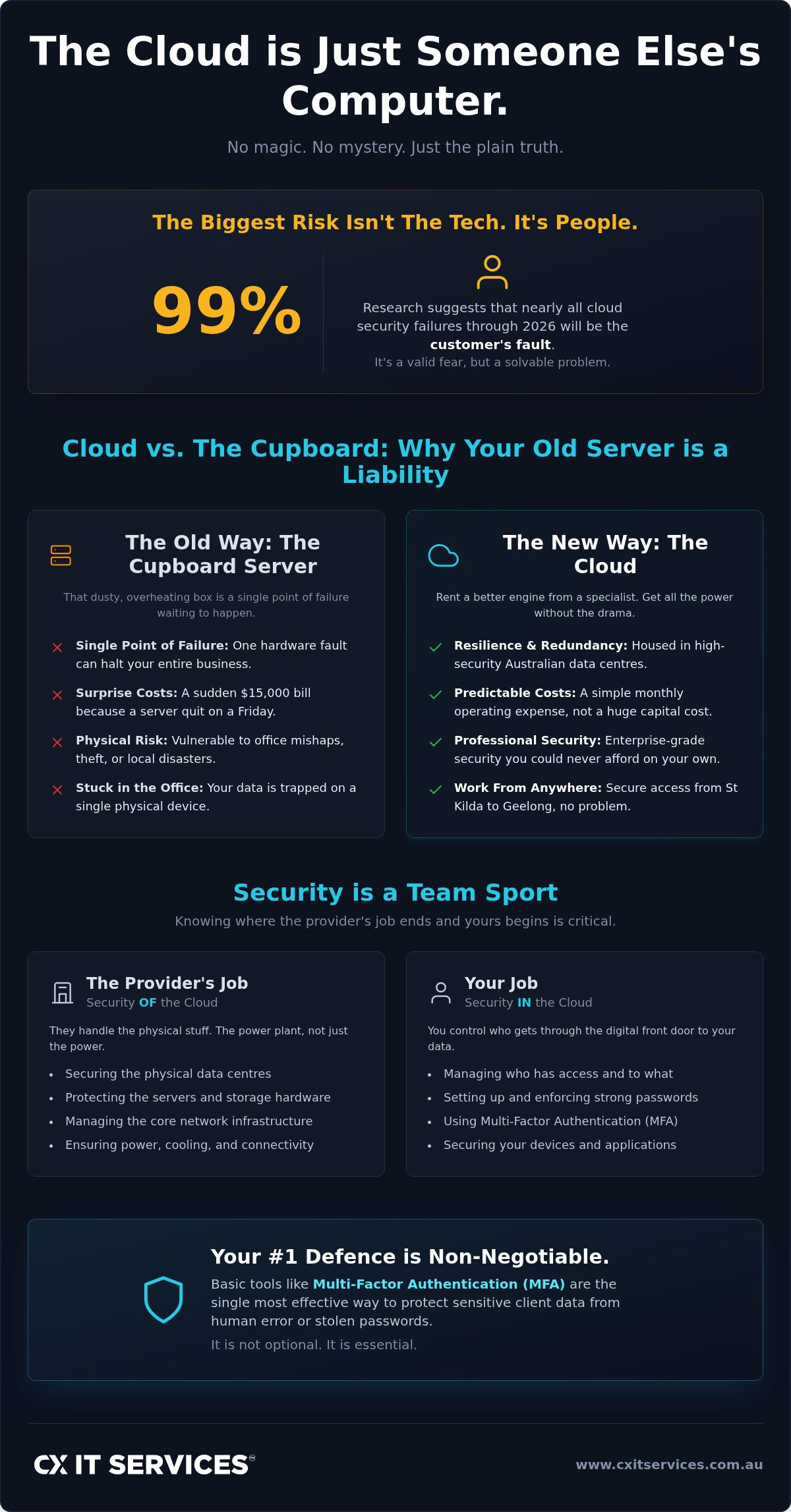
You are likely fed up with the alphabet soup of SaaS and IaaS while worrying if a single human error will leave your client data open to hackers. It is a valid fear. Research suggests 99% of cloud security failures through 2026 will be the customer's fault. You want to ditch expensive on-site hardware but need to stay on the right side of Australian privacy laws.
CX IT Services will strip away the technical fluff to show you exactly how the cloud works and how to keep your Aussie business data locked down tight. We will cover the shared responsibility model, the 2026 government cloud policies, and how to build a setup that is both resilient and compliant. You will finish this with a clear path to modernising your firm without the headache.
Key Takeaways
- The cloud is not a mystery. It is just a more efficient way to rent high-end technology instead of trying to build and maintain it yourself.
- Security is a team sport. You will learn why picking the right cloud security services melbourne provides means knowing exactly where the provider's job ends and yours begins.
- Local servers are a liability. We look at how cloud redundancy protects your business from the single point of failure risk of that dusty box in the cupboard.
- Human error is the biggest threat. Discover why basic tools like Multi-Factor Authentication are non-negotiable for protecting sensitive client data.
- Moving data requires a plan. Learn how to use pilot programs to migrate your business in stages so you do not disrupt your billable hours.
Stripping back the jargon. What is the cloud really?
Personally, I reckon the tech industry loves a bit of mystery. It makes the simple stuff sound like magic, which usually means they can charge you more for it. The cloud is not some fluffy, intangible place in the sky. It is a network of high-security servers sitting in a data centre.
Think of it like a high-performance engine. You could try to build one in your backyard shed. You would have to source the parts, handle the cooling, and pray it does not blow up when you hit the accelerator. Or, you could just rent a better engine from a specialist. You get all the power without having to worry about the grease under your fingernails. That is the cloud in a nutshell.
You access your files and software over the internet instead of a local hard drive. It means your data is no longer trapped on a single physical device in your office. If you are hunting for What is the cloud really? you will find a lot of academic definitions. For an Aussie business owner, it just means being able to work from anywhere without the drama.
When you look for cloud security services melbourne providers, you want someone who speaks plain English. You need to know that your data is locked down tight, even if you are accessing it from a laptop at a cafe in St Kilda or a home office in Geelong. It is about mobility without the risk.
The simple metaphor that actually makes sense
Think about the electricity grid. You do not own a coal mine or a massive solar farm. You do not keep a giant, noisy generator in the office basement just to keep the lights on. You simply plug into the wall and pay for the kilowatts you actually use. The cloud works the exact same way.
There is no need to own the power plant. You just plug in and get to work. This shifts your IT from a massive, terrifying upfront cost into a predictable monthly bill. It turns a capital expense into an operating cost. No more surprise $15,000 invoices because a server decided to quit on a Friday afternoon.
Why your business is likely already in the cloud
Most Aussie teams are already using the cloud every single day without even knowing it. If you check your business bank balance on your phone, that is the cloud. If you use social media to promote your firm, that is the cloud too. It is already part of your workflow.
If your office uses Microsoft 365, you are already a cloud user. Your emails and documents live on massive, secure server farms instead of a box in your office cupboard. You are already halfway through the transition. The real trick is ensuring your cloud security services melbourne strategy is robust enough to handle the modern threats that come with that connection.
The three flavours of cloud. SaaS, PaaS, and IaaS explained
Tech people love an acronym. It is like they are trying to gatekeep the good stuff behind a wall of SaaS, PaaS, and IaaS. Personally I reckon it is just a way to make simple concepts sound expensive. If you want to stop overpaying for kit you do not need, you have to understand these three flavours.
Most of the business benefits of cloud computing come from choosing the right model for your specific stage of growth. For most firms in Melbourne, that means getting the balance right between convenience and control. Choosing between these models isn't just about cost. It is about how you deploy cloud security services melbourne professionals recommend to keep the hackers out of your specific environment.
SaaS. The software you use every day
Software as a Service (SaaS) is the most common one. You already know it. It is Xero. It is Outlook. You log in via a browser, pay your monthly sub, and it just works. No more installing software from discs. No more manual updates that crash your PC on a Tuesday morning. The provider handles the lot.
The beauty of SaaS is that it is ready to go. You don't need to be a tech wizard to get started. If you want the nitty-gritty on how to run this properly for your team, check out our guide on Microsoft 365 management. It is the gold standard for Aussie teams who want to stay productive without the technical debt.
IaaS and PaaS. The heavy lifting
Then you have Infrastructure as a Service (IaaS). This is like renting the digital foundations of your business. Instead of a noisy server room that smells like ozone and costs a fortune to cool, you rent virtual space. You get the power of a data centre without the hardware headache. It replaces the physical server in your cupboard with a virtual one that never gets dusty.
Platform as a Service (PaaS) is mainly for the developers and tech heads. It is a sandbox where they can build custom apps without worrying about the underlying plumbing. Unless you are building the next big Aussie tech startup, you probably won't touch this much.
For a business with 10 or more staff, I reckon you only need to worry about SaaS and IaaS. Getting these two right is where the real security wins happen. When we provide cloud security services melbourne businesses actually trust, we focus on locking down these environments so your team can work without looking over their shoulders. If you are worried your current setup is a bit of a dog's breakfast, you might want to chat about your setup with someone who has seen it all before.
Cloud vs On-premise. Why the server in the cupboard is a liability
There is a false sense of security that comes with being able to see your server. You can walk past the cupboard, hear the fans humming, and see the little green lights blinking. It feels solid. It feels like you have control. Personally, I reckon that is the most dangerous trap an Aussie business owner can fall into.
Physical servers are a single point of failure. If that box dies, your business stops. I have seen it happen more times than I care to count. One firm I know lost nearly a week of billable hours because a burst pipe in the office ceiling turned their server rack into an expensive aquarium. No amount of local backups could fix a fried motherboard in time to save their deadline. When you rely on cloud security services melbourne experts provide, that physical risk simply vanishes.
The cloud offers redundancy that a local server cannot touch. Your data is mirrored across multiple high-security locations. If one data centre has a hiccup, another one takes the load. Your team keeps working. Your clients stay happy. You get peace of mind knowing that a plumbing disaster or a power surge will not wipe out your entire digital history.
The real cost of keeping it local
Most professionals only look at the sticker price of a server. They forget the hidden costs that bleed a business dry over time. You have to pay for the electricity to run the kit and the extra air conditioning to keep it from melting during a Melbourne heatwave. Then there is the maintenance. Physical hardware requires constant attention, patching, and physical security to keep it safe from theft or tampering.
Hardware procurement is also a nightmare right now. I have seen basic parts sitting on backorder for months. If your local server fails today, you could be waiting weeks for a replacement. Managed services give you predictable costs and immediate availability. You are no longer gambling on supply chains. Not alone. Together.
Scaling without the growing pains
Adding a new staff member in the cloud takes minutes. You just provision a new seat and they are ready to go. If you are still running on-site hardware, scaling often means buying more RAM or even a whole new server. It turns a simple hiring decision into a major technical project.
Cloud resources can grow or shrink based on your seasonal demand. You only pay for what you actually use. You can read our take on managed IT services to see how this works at scale. It is about building a business that is agile enough to handle growth without the technical debt holding you back. Choosing the right cloud security services melbourne provider ensures that as you grow, your protection grows with you.
Cloud security services. Keeping the hackers out of your data
Personally, I reckon the biggest lie in tech is that the cloud is secure by default. It is secure, but only if you actually use the tools provided. Think of it as a shared job. The provider, like Microsoft or Amazon, secures the house. They build the walls and put on a roof. But if you leave the front door wide open with a "Welcome" mat, that is on you.
When we talk about cloud security services melbourne businesses need, we are talking about locking those doors. Research shows that 80% of organisations experienced a cloud security breach in the past year. Even more staggering is the prediction that 99% of cloud security failures through 2026 will be the customer's fault. Usually, it is just simple human error. A weak password here. A missed patch there.
Multi-Factor Authentication (MFA) is the absolute bare minimum. No excuses. If you are not using it, you are basically asking for a headache. Regular cyber security audits are non-negotiable in 2026. You need to know where the holes are before a hacker finds them for you. It is about being proactive, not reactive.
The essentials of cloud protection
Encryption is your best friend. It turns your sensitive client data into gibberish for anyone without the key. If a thief manages to intercept your data, they cannot read a single word of it. It is the ultimate invisible vault.
Strong password policies are boring. I know. But they work. Stop using the same password for everything and get a password manager for the whole team. It is a small change that makes a massive difference to your risk profile.
Role-based access is another vital layer. Your receptionist does not need access to the company's financial records. Your junior clerk does not need your payroll data. Lock it down to the essentials. If they do not need it to do their job, they should not be able to see it.
Backups. Even the cloud needs a safety net
Cloud storage is not the same as a cloud backup. This is a trap many Aussie professionals fall into. Just because a file is in OneDrive or Dropbox does not mean it is safely backed up. If a staff member accidentally deletes it or a hacker encrypts it, that live version is gone or useless.
You need an immutable backup. This is a copy of your data that cannot be changed, modified, or deleted by anyone. Not even a hacker who manages to steal your admin credentials. It is your final line of defence when everything else fails. Without it, you are just gambling with your business.
We provide comprehensive disaster recovery services to keep your shop running when things go pear-shaped. If you are worried your current setup is a bit of a lucky dip, you should book a security review with our team to see exactly where you stand.
Employee training is your best defence. Most breaches start with a dodgy email or a phishing link. If your team knows how to spot a fake, you have already won half the battle. A bit of knowledge goes a lot further than an expensive piece of software. Keep them sharp. Keep them informed.
Making the move. How to organise a secure cloud migration
Moving your entire business to the cloud can feel like trying to move house in the middle of a cyclone. It is stressful. It is messy. If you do it wrong, you end up losing the good china. Personally, I reckon the fear of the move is what keeps most Aussie firms stuck with old, failing hardware long after they should have binned it.
Do not try to move everything at once. You will just break things. I have seen too many businesses try a "big bang" migration over a single weekend, only to spend the next month trying to find where their files went. It is a recipe for disaster. Slow and steady wins this race.
Start with a pilot program. Move one department or one specific app first. This lets you test the waters without risking your entire operation. A strategic IT strategy is the map for your journey. It ensures every move you make is calculated and secure. When you are vetting cloud security services melbourne teams, look for someone who treats your migration as a business project, not just a tech task.
Get an expert to handle the heavy lifting while you run your business. You have better things to do than troubleshoot server permissions at 11 PM on a Sunday. Focus on your billable hours. Let the pros handle the data. Not alone. Together.
Choosing the right partner
Look for an Australian owned provider who actually understands local regulations. You need someone who knows the difference between a data centre in Port Melbourne and one in a country with dodgy privacy laws. It matters for your compliance and your peace of mind. If your data leaves our shores, you might be breaking the law without even knowing it.
You want a team that answers the phone 24/7. Not a chatbot. Not a ticketing system that ignores you for three days. You need a real human who can fix the problem when it actually happens. Avoid providers who hide behind jargon and complex contracts. If they cannot explain it simply, they probably do not understand it well enough themselves.
Your first 30 days in the cloud
Focus on staff adoption and training. People hate change if they do not understand it. If your team feels like the new system is making their lives harder, they will find ways to bypass it. That is where the security holes start to appear. Show them how it makes their work easier. Give them the tools to succeed.
Monitor your costs early to ensure you are not over-provisioning. The cloud is great because you pay for what you use, but it is easy to leave the digital lights on. Keep an eye on the meter in that first month to make sure your cloud security services melbourne plan is actually saving you money. Personally I reckon you will wonder why you did not do this years ago. Once you taste the freedom of a secure, mobile office, you will never look back at that dusty cupboard again.
Stop gambling with your business data
Personally, I reckon the biggest risk to your firm isn't the technology itself. It is the hesitation to move away from outdated systems that are one power surge away from retirement. You now understand that the cloud is simply a more efficient way to run your shop. It offers redundancy that a server in a cupboard can never match. By focusing on SaaS and IaaS, you can strip away the complexity and focus on your billable hours.
Setting up cloud security services melbourne professionals recommend is about more than just software. It is about having a partner who knows the local landscape. At CX IT Services, we have 26 years of experience keeping Aussie businesses online and secure. We offer 24/7 support from real technicians, not chatbots, and we stick to fixed monthly fees so you never get a nasty surprise in your inbox.
It is time to stop worrying about what might go wrong and start building a platform that works as hard as you do. Apply for a secure cloud strategy with CX IT Services today. Let's get your data locked down tight so you can get back to business.
Frequently Asked Questions
Is my data actually safe in the cloud compared to my office?
Your data is typically much safer in a professional data centre than in your office. These facilities have biometric security, backup power, and industrial fire suppression that you simply cannot replicate in a small office cupboard. Personally I reckon the biggest risk to your data is the physical vulnerability of on-site hardware. A professional setup removes the risk of theft, fire, or flood at your local premises.
What happens to my business if the internet goes down?
If the internet drops, you lose access to live cloud files until you are back online. Most teams just switch to a mobile hotspot or work on offline copies in the meantime. Your data remains perfectly safe and waiting for you in the data centre. It is a temporary inconvenience rather than a permanent disaster. It is always worth having a backup 4G or 5G connection ready to go.
How much does it cost to move my business to the cloud?
Migration costs depend entirely on the volume of data and the number of users involved. You are trading a massive upfront hardware bill for a predictable monthly fee. This shift makes your cash flow much easier to manage over the long term. When looking for cloud security services melbourne firms offer, focus on the value of never having to buy a physical server again.
Can I use the cloud if I have slow business internet?
You can use the cloud with slow internet, but I would not recommend it. The cloud relies on a stable connection to feel like a local drive. If your internet is crawling, you will spend more time watching loading bars than doing actual work. It is usually best to upgrade your business internet before you make the leap to a full cloud environment to ensure your team stays productive.
Do I still need an IT person if I am using cloud services?
Yes, because the cloud does not manage itself. You still need someone to handle user permissions, security patches, and your long-term IT strategy. Think of it like a high-end car. Even if it is a top of the line electric model, you still need a specialist to keep it running safely. We provide the oversight that keeps your environment secure and efficient while you focus on clients.
What is the difference between Google Drive and professional cloud computing?
Google Drive is essentially just a storage bucket for your files. Professional cloud computing is the entire digital foundation of your business. It includes your virtual servers, your network, and your advanced security protocols. Drive is a single tool that anyone can use. The cloud is a comprehensive workshop built specifically for your firm's professional requirements and long-term growth.
Will the cloud make my business compliant with Australian privacy laws?
The cloud provides the framework for compliance, but it is not a magic fix. You still have to configure your settings to meet the Australian Privacy Principles. This includes ensuring your data stays in Australian-based data centres. A proper strategy for cloud security services melbourne professionals design will include these specific regional safeguards to keep the regulators happy and your data protected.
How long does a typical cloud migration take for 10 staff?
For a team of 10 staff, I usually recommend a window of two to four weeks. This allows enough time for proper planning, testing, and training your team. The actual cutover usually happens over a single weekend to minimise disruption to your billable hours. Rushing this process is the fastest way to break your workflow. We make sure every detail is handled before we flip the switch.