Fed up with dodgy IT? This blunt guide breaks down the real costs of managed IT services for 20 employees. No fluff, just what your Aussie firm needs to know.
Personally, I've seen too many Aussie firms with 20-odd staff get stuck in the 'handyman' trap.
You know the one. You pay a bloke a few hundred bucks here and there to fix a printer or reset a password. It feels cheap until a server dies on a Tuesday morning and your entire team is sitting around drinking tea because nobody can access a single file. At this size, managed IT services for 20 employees shouldn't be a gamble. It should be the engine that keeps your billable hours moving.
I reckon you're probably fed up with "surprise" invoices and slow response times that leave your staff twiddling their thumbs. You want the tech to work so you can focus on your clients without worrying about a data breach trashing your reputation.
This guide is a blunt, honest breakdown of what a 20-person team actually needs from an IT provider, without the corporate fluff. I'll walk you through the real costs of stability, the cybersecurity essentials you can't ignore, and how to ensure your monthly IT spend stays predictable.
Key Takeaways
- Learn why 20 staff is the specific point where informal IT setups fail and start costing you more in downtime than they save in fees.
- Understand why managed IT services for 20 employees usually work best on a per-user basis rather than counting every single tablet or phone.
- Identify the essential cybersecurity and unlimited helpdesk features that must be standard in any professional agreement.
- Discover the blunt questions you need to ask to spot hidden costs and outsourced helpdesks before you sign a contract.
- See how a fixed-fee structure eliminates monthly bill shock and provides a predictable path for your firm's growth.
The 20-Employee Tipping Point: Why Your Old IT Setup is Failing
Personally I reckon 20 staff is where the wheels start to wobble. When you had five or ten employees, you could get away with the "IT guy" friend or a tech-savvy office manager who knew their way around a router. It was fine for a while. It felt like you were saving a quid.
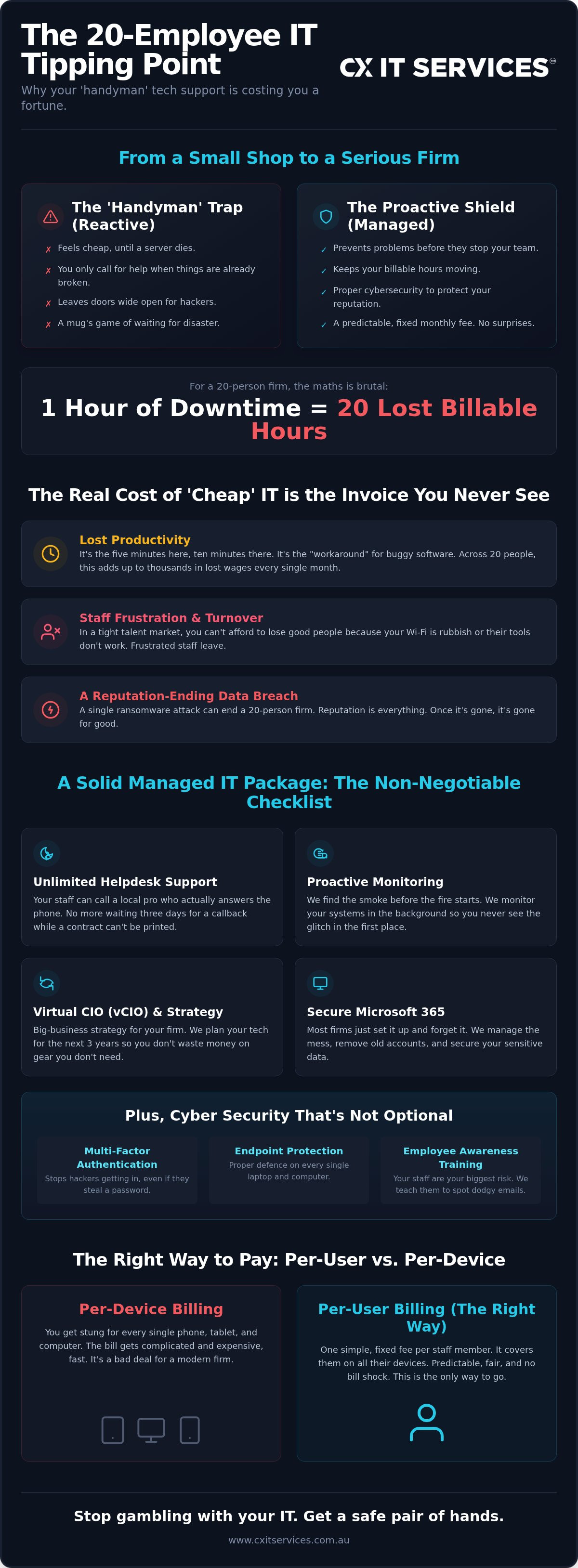
But at 20 people, you aren't a small shop anymore. You're a medium-sized firm with serious overheads and even more serious risks. If your system goes down for just one hour, you aren't just losing one person's time. You are losing 20 hours of billable wages in a single hit. That's a massive hole in the pocket for any Aussie business, especially in sectors like law or finance where time is literally the product you sell.
The "handyman" approach to tech leaves doors open that hackers love to walk through. Professional services have a higher bar to clear these days. Security isn't a hobby or something you "get around to" on a quiet Friday. It is a legal requirement. You need to understand what managed services are and why they matter for your specific scale. It's the difference between being a sitting duck and being a fortress.
From Reactive to Proactive
Waiting for things to break is a mug's game. If you only call for help when the screen goes black or the server is screaming, you've already lost. Managed IT services for 20 employees mean we find the smoke before the fire starts. We monitor the background so you never see the glitch in the first place.
Your team deserves an IT support helpdesk that actually answers the phone. No more waiting three days for a callback while your admin assistant can't print a contract. We focus on keeping the lights on so you can focus on the work that actually pays the bills.
The Hidden Cost of 'Cheap' IT
Lost productivity is the biggest invoice you never see. It's the five minutes here and the ten minutes there. It's the "workaround" your staff invented because the software is buggy. It adds up across 20 people every single day. Eventually, frustrated staff leave when their tools don't work. In a tight talent market, you can't afford to lose good people because your Wi-Fi is rubbish or your systems are ancient.
Then there's the big one. A single ransomware attack can end a 20-person firm. Reputation is everything in professional services. Once it's gone, it's gone. Investing in managed IT services for 20 employees isn't just about fixing PCs. It's about protecting the firm you spent years building.
What a Solid Managed IT Package for 20 Staff Actually Includes
Once you've accepted that the "cheap" option is actually costing you a fortune in lost time, you need to know what you're actually paying for. A proper package for managed IT services for 20 employees isn't just a reactive repair service. It is a comprehensive shield for your data and a growth engine for your operations.
First, you need unlimited helpdesk support. Your staff should be able to call a professional every time a printer plays up or a file goes missing. This keeps them productive and, more importantly, keeps them from bugging you with basic tech questions. You have better things to do than reset passwords or troubleshoot Wi-Fi connections.
You also need a Virtual CIO. This is where we sit down and plan your tech for the next three years. It's about making sure you don't waste money on hardware you don't need or software that doesn't talk to your other systems. We provide the big-business strategy that 20-person firms usually lack.
Then there is your Microsoft 365 environment. It needs to be secure and tidy. Most firms just set it up and forget it, leaving old accounts active and sensitive data sitting in unprotected folders. We manage that mess so you don't have to worry about internal leaks or messy file structures.
Cyber Security is Non-Negotiable
You can't just rely on a basic antivirus and hope for the best. We follow cybersecurity best practices to ensure your firm is locked down. This includes multi-factor authentication (MFA) and endpoint protection as the bare minimum. We manage the Cyber Security details so you can sleep at night without fearing a reputation-destroying breach. We also run employee awareness training. Personally, I reckon your staff are your biggest risk. Training them to spot a dodgy phishing email is the best defence you've got.
AI and Automation for the Modern Office
Most providers ignore this, but it is a genuine game changer for a team of 20. Stop paying humans to do robotic data entry. We use AI and Automation to streamline your front office and automate those mind-numbing repetitive tasks. It is about working smarter, not just having faster computers. If you want to see if your team is ready for this level of proactive support, you can check your eligibility here. It's about moving from just "surviving" with tech to actually using it to win more business.
Comparing Costs: Per-User vs Per-Device Models
Personally I've seen business owners get a massive headache trying to compare IT quotes. One looks cheap on paper because it only charges for the "server." Another looks expensive because it counts every mouse and keyboard. When you are looking for managed IT services for 20 employees, the pricing model you choose will determine if your monthly bill is a steady line or a jagged mountain range.
Most Aussie providers are moving away from per-device pricing. It's a relic from the days when everyone had one beige box on a desk. These days, your senior partner probably has a laptop, a tablet, and a desktop at home. Charging for three separate "devices" for one human is a bit of a rip-off. Per-user pricing is fairer because it covers the person. It doesn't matter how many gadgets they use to get the job done. You pay one flat rate for that employee to be productive and secure.
This shift reflects how modern work actually happens. The official cyber guidance from groups like CISA points out that securing the user's identity is now more important than just patching a single machine. When you pay per user, you are paying for that person’s digital safety across every platform they touch.
The Per-User Advantage
Predictable budgeting is the biggest win here. Your accountant or CFO will love you for it. If you hire your 21st or 22nd employee, you know exactly what the extra cost is to the cent. There are no "gotcha" fees for setting up a new tablet or a home office setup. It scales perfectly with your growth. You are paying for the human who does the work, not just the hardware they sit in front of.
Our Managed IT Support is built on this transparency. We want you to know what your bill will be before it even arrives.
Why 'Hourly' IT is a Conflict of Interest
If your IT provider gets paid every time something breaks, they have zero incentive to make sure it stays fixed. It's the "break-fix" trap. They make more money when you are suffering. It is a fundamental conflict of interest that keeps your business in a state of constant, low-level chaos.
Managed services flip that script. We align our goals with yours. Because we charge a fixed monthly fee, every minute of downtime costs us money in staff hours. We both want your systems to run perfectly all the time. We are motivated to be proactive, find the glitches early, and keep your 20-person team moving at full speed. It turns your IT provider from a reactive repairman into a strategic partner who actually cares about your uptime.
The 20-Employee IT Shopping List: Questions to Ask
Personally I reckon most IT sales pitches are designed to bury you in jargon so you stop asking questions. If you have 20 staff, you are too big to be ignored but too small to have your own internal department. You need to be the squeaky wheel during the vetting process. You need to ask the hard questions before you sign any contract.
Start by asking where the helpdesk actually sits. If the answer is anything other than "right here in Australia," you might want to keep looking. Offshore helpdesks often lead to lag, communication breakdowns, and a total lack of accountability when things go pear-shaped. You want a local who understands your business and your time zone.
Next, look at the security inclusions. Is cybersecurity baked into the price, or is it an 'extra' they'll tack on next month? At this scale, managed IT services for 20 employees must include security by default. It shouldn't be a luxury add-on. Ask them about the "2 AM Sunday" scenario. If your server dies or you get hit by a breach in the middle of the night, who picks up the phone? You don't want a recording. You want a person who can actually fix the problem.
Finally, ask about the future. Can they show you how they'll help you use AI to save time? A good provider should be looking for ways to make your team more efficient. They shouldn't just be keeping your old PCs running. They should be helping you evolve.
Checking Their Credentials
Don't just take their word for it. Ask for references from other firms in your specific industry. A law firm has very different needs to a medical clinic or an accounting practice. You also want an Australian owned managed IT provider. It means they understand our local privacy laws and the specific challenges of the Aussie market.
Whatever you do, don't settle for a one-man band. One person cannot support 20 staff and keep up with the latest security threats at the same time. It's a recipe for burnout. It's a recipe for failure. You need a team that has the depth to handle your workload every single day.
The Service Level Agreement (SLA)
A guarantee is only as good as the people behind it. Read the fine print on response times. You need to know exactly how long they'll take to fix a critical issue that stops your whole team from working. More importantly, make sure they speak plain English. If they start hiding behind technobabble when you ask a simple question, it's a massive red flag. You are paying for clarity and results. You aren't paying for a dictionary of acronyms.
If you want to see if your firm fits our model, you can apply for a strategy session here. We'll give you a straight answer on whether we can actually help you grow.
Why CX IT Services is the Safe Pair of Hands You Need
Personally I reckon 26 years in this game counts for a lot. We have been around since before most of the current "tech disruptors" were even born. We have seen every trend come and go, from the early days of dial-up to the current rush for AI. We know what works. More importantly, we know what is just expensive noise designed to pad out an invoice.
Our Managed IT Support is built specifically for teams of your size. Delivering managed IT services for 20 employees is our sweet spot. You are large enough to need professional oversight but small enough to still value a personal connection. We don't do corporate fluff. We don't do "circle back" or "synergy." We just provide results that keep your billable hours moving.
We handle the tech so you can get back to the work that actually puts food on the table. You shouldn't have to be an amateur IT manager on top of your day job. We take that weight off your shoulders and put it on ours. It's about giving you back your time and your sanity.
National Reach with a Local Feel
If you have an office in Sydney and a partner working from home in Perth, we have you covered. We have on-site technicians across Australia for those moments when you need a physical presence. Remote support is great, but sometimes you just need a person to show up and plug something in. We provide that boots-on-the-ground reliability nationally.
You also get 24/7 support that actually stays awake when you do. If you are burning the midnight oil on a big case or an end-of-month report, we are right there with you. Because we are Aussie owned and operated, we understand the local business landscape. We aren't reading from a script in a different hemisphere. We are your local partners who happen to be experts in high-end technology.
Ready to Stop Worrying About IT?
Transitioning to a new provider shouldn't feel like a root canal. We make the move seamless and stress-free. We start by auditing your current setup to find the "ghosts in the machine" and the messy workarounds that have been slowing your team down. We identify the gaps in your managed IT services for 20 employees and plug them before they become crises.
We turn your current tech mess into a streamlined, secure system. No more "handyman" fixes. No more surprise invoices. Let's have a blunt, honest chat about your 20-person team today. We'll tell you exactly what you need and what you don't. It's time to put your firm in a safe pair of hands.
Time to Move Beyond the Handyman
Personally, I reckon you already know if your current IT setup is holding you back. If you are tired of bill shock, slow response times, and the constant fear of a data breach, it is time to make a change. Choosing the right managed IT services for 20 employees is about more than just fixing broken laptops. It is about protecting your reputation and ensuring your team can actually get their work done without technical friction.
Remember that a fixed-fee model is your best friend for predictable budgeting. Look for a partner who understands the local landscape and has the depth to handle your growth. CX IT Services brings over 26 years of industry experience to the table. We are 100% Australian owned and operated, providing 24/7 national support that actually stays awake when you do. We are the safe pair of hands you need to turn your technology from an anchor into an engine.
Stop settling for "good enough" and start demanding stability. Get a fixed-fee quote for your 20-person team today. Let's get your systems sorted so you can focus on what you do best. You've built a great firm. Together, we'll keep it that way.
Frequently Asked Questions
What is the average cost of managed IT services for 20 employees in Australia?
Prices vary depending on the level of security and support your firm requires. Most Aussie providers have moved to a per-user model to keep things transparent. Personally I reckon you should look for a fixed monthly fee that covers your essentials. It stops the bill shock that usually follows a "cheap" hourly rate.
Does managed IT include the cost of software like Microsoft 365?
Software licensing is typically a separate cost paid directly to the vendor, but we handle the entire administration. We manage your user accounts, security settings, and tidy up the environment. You pay for the seats, and we make sure those seats are locked down and working perfectly for your team.
We have one IT person already. Can you work with them?
Yes, we do this often through our co-managed IT service. It is a smart move for a 20-person firm that has a "lone ranger" technician. We handle the heavy lifting like 24/7 monitoring and security patching. This frees up your internal person to focus on high-level projects that actually grow the business.
How long does it take to switch to a managed IT provider?
A professional handover usually takes between two and four weeks. We don't just flip a switch and hope for the best. We spend that time auditing your current setup and documenting your systems properly. This methodical approach ensures your team doesn't suffer any downtime during the transition.
Do you support both Mac and Windows environments for 20-person teams?
Absolutely. Most modern offices are a bit of a mix these days. We provide managed IT services for 20 employees regardless of whether they prefer a MacBook or a Windows laptop. Our monitoring tools work across both platforms to ensure your security standards stay consistent across the whole firm.
What happens if we grow to 30 or 40 employees?
Our system is designed to scale exactly when you do. Because we use a per-user structure, you simply add another seat to your plan as you hire new staff. You won't need to reinvent your entire IT strategy or buy massive new servers just because you've had a successful year.
Is cybersecurity included in your standard managed IT monthly fee?
Yes, we consider security to be a non-negotiable part of the service. We don't believe in "optional" protection because a single breach can end a firm of your size. Our standard fee includes essential defences like MFA management and endpoint protection to keep your reputation intact.
Do you provide on-site support or is it all remote?
We provide a hybrid of both. We solve the vast majority of issues remotely and fast, which keeps your staff moving. However, if a server dies or your office Wi-Fi drops out, we have technicians across Australia who can get on-site to fix the physical hardware.