Don't wait for a data breach. Our IT security audit Melbourne gives you a blunt, no-fluff roadmap to protect your Australian business. Real answers, no jargon.
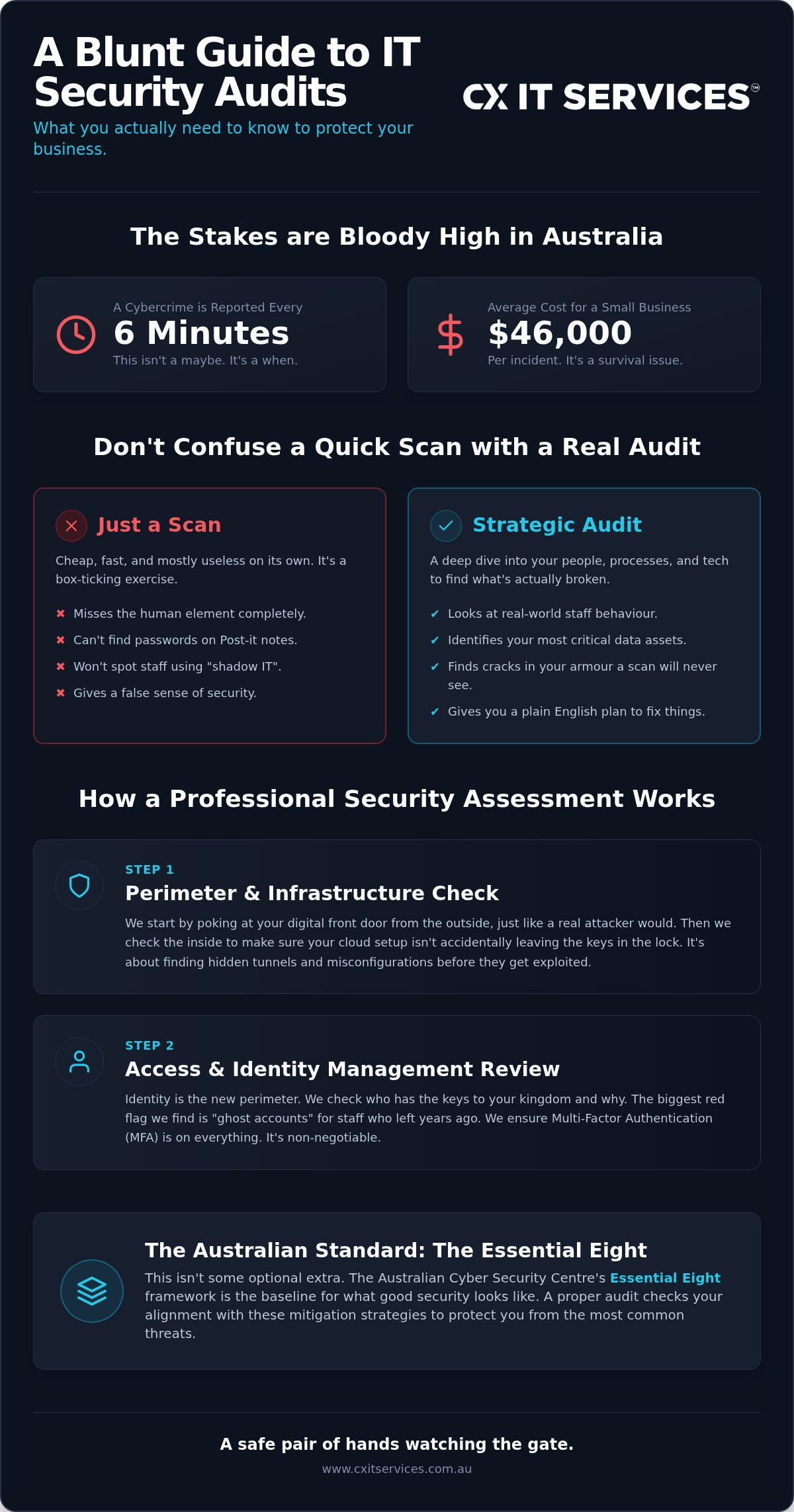
A cybercrime is reported every six minutes in Australia.
With the average cost of a single incident for small businesses now sitting at $46,000, this isn't just an IT issue, it's a survival issue.
Personally, I reckon if you're looking for an IT security audit Melbourne, you're probably sick of the jargon and the fear of a data breach ruining your reputation.
It's bloody frustrating to waste money on security tools that don't actually talk to each other.
You deserve a clear list of what's broken and a plan to fix it without the technical fluff.
This guide provides a blunt roadmap to identifying your digital vulnerabilities and securing your business assets using Australian standards.
We'll cover how to achieve compliance with the Essential Eight, even as the ASD begins its transition to the new Essentials series announced in June 2026.
By the end, you'll have a practical path to peace of mind and the certainty that a safe pair of hands is watching the gate.
Key Takeaways
- Stop treating security like a checkbox exercise. A proper audit finds the broken locks in your system before someone else does.
- Learn why a professional IT security audit Melbourne focuses on your actual risks instead of just trying to sell you more software.
- Understand how the Essential Eight framework sets the bar for Australian business security. It is the baseline for what good looks like.
- Discover why grading your own digital homework is a disaster. You need a safe pair of hands to give you the objective truth.
- Get a clear roadmap to move from DIY technical debt to a managed environment that actually protects your reputation.
Why an IT security audit is your first line of defence
Personally I reckon most businesses are sitting on a house of cards. You might have a firewall and some antivirus, but that is just the exterior paint on a building with no foundations. An IT security audit Melbourne isn't about being told to buy more software. It's about finding exactly where the locks are broken before a criminal finds them for you.
Hackers don't care if you are a nice person or a respected local professional. They care if you are an easy target. If your systems are wide open, they will take what they want. A proper assessment looks at your people, your processes, and your tech. It's the first step toward a managed IT support partnership that actually protects your assets.
The difference between a scan and a strategic audit
Automated scans are cheap and fast. They have their place, but they often miss the human element entirely. A scan won't tell you that your receptionist keeps their password on a Post-it note. To understand what is an information security audit, you have to look deeper than just code.
Strategic audits look at how your staff actually handle data in the real world. We look for the "shadow IT" your team is using behind your back. If they find your official tools too hard to use, they'll find a workaround. Those workarounds are usually where the breaches happen. They are the cracks in your armour that a simple scan will never see.
Identifying the high-water marks of your digital risk
Not all data is equal. Losing a marketing flyer doesn't matter. Losing 500 client tax files or medical records will sink your ship.
Understanding your risk profile helps you spend your budget where it counts. Client records and financial data are the main targets for industrialised cybercrime. Once you know what matters most, you can stop guessing. This is where our Virtual CIO service comes in. It provides the strategic brain behind the audit results. An IT security audit Melbourne moves you from hoping for the best to having a plan that works.
Breaking down the process of a professional security assessment
When we sit down to start an IT security audit Melbourne, we aren't there to pull the plug on your operations. A professional assessment should be thorough, but it shouldn't stop your team from getting their work done. We begin by reviewing your existing cyber security management services to see what foundations are already in place. It's a mix of deep technical probing and simple, honest conversations with your staff. We talk to your people because they know which systems are a pain to use and which ones they've bypassed just to meet a deadline. If the report we hand over at the end isn't in plain English, we haven't done our job.
Step 1: The external and internal perimeter check
We start by poking at your firewalls and cloud entry points from the outside. This is your digital front door. Then we look at what happens if someone actually gets past that perimeter. It's about testing your cloud infrastructure management for common misconfigurations. A single open setting in a cloud folder can be the difference between a normal Tuesday and a catastrophic data leak. We check how your data moves and where it sits, ensuring there are no hidden tunnels for attackers to exploit. This isn't just about finding bugs. It's about verifying that your defences actually do what they say on the tin.
Step 2: Reviewing access and identity management
Identity is the new perimeter. We look at who has the keys to the kingdom and whether they actually need them. One of the biggest red flags we find during an IT security audit Melbourne is ghost accounts. These are old logins for staff who left the business months or even years ago. If their access wasn't cut, that's a wide-open door for an attacker. We also check your alignment with the Essential Eight mitigation strategies. In 2026, things like Multi-factor authentication (MFA) are non-negotiable. If you don't have MFA active on every single entry point, you're essentially leaving your house keys in the lock for any passer-by to find. We ensure that permissions are tight and that only the necessary people have administrative rights.
Getting the technical side right is only half the battle. If your team isn't trained to spot a dodgy email, even the best firewall won't save you. If you're not sure where your biggest gaps are, it might be time to get a professional set of eyes on your setup.
Essential Eight and the Australian cybersecurity landscape
The Australian Signals Directorate (ASD) didn't just pull these rules out of thin air. They created the Essential Eight framework because it covers the most common ways businesses get hit. Personally I reckon it's the only baseline that actually matters for an Australian company. Even with the ASD's June 2026 announcement about transitioning to a broader "Essentials" series, these eight principles remain the bedrock of local defence. When we conduct an IT security audit Melbourne, we use these categories as our primary measuring stick.
Most Aussie businesses fail at least four of these categories when we first look under the hood. That's not a personal failure. It is just the reality of how fast the threat landscape moves. An audit benchmarks your business against specific maturity levels, moving you from Level 0 (basically wide open) towards Level 3 (fully resilient). Without this benchmark, you're just guessing where your vulnerabilities lie.
Why the Essential Eight is the gold standard for Aussie teams
It's practical because it focuses on the stuff that actually works. Application control and patch management are at the top of the list for a reason. If you can't control what software runs on your machines, you've already lost the battle. This framework gives you a clear, objective score to show your board or your insurers.
In 2026, many insurers are refusing cover or hiking premiums for businesses that can't prove they meet these standards. Our cyber security assessments make this data transparent. We don't just tell you that you're "secure." We show you the evidence that insurers and regulators are looking for in the event of a breach.
Moving beyond the basics to true resilience
The Essential Eight is a floor, not a ceiling. It is the minimum baseline you need to stay in the game. We look at how these rules fit into your specific daily workflow. Security should support your growth, not slow it down. We've seen too many businesses get bogged down by technical debt because their security was bolted on as an afterthought.
True resilience means having systems that can detect, respond to, and recover from an attack. We accept that a breach is a matter of 'when,' not 'if'. This is where our Virtual CIO & IT Strategy becomes vital. We ensure your security roadmap actually aligns with your business goals, making sure you're protected without being paralysed. It is about building a stable environment where you can focus on your clients while we watch the gate.
DIY checks versus hiring a safe pair of hands
Personally, I reckon you can do some basic sanity checks yourself today. You can check if your staff are using MFA. You can see if your backups actually ran last night. But there is a massive difference between a quick checklist and a deep dive. You cannot grade your own homework and expect a fair result. It is a fundamental conflict of interest.
Internal IT teams often have blind spots because they built the system. They are proud of their work. But that pride can lead to a "set and forget" mentality. Sometimes, they might even be worried that finding a massive gap makes them look bad to the board. A third-party IT security audit Melbourne provides the blunt truth without the office politics. We don't care about who set up the server. We only care if it's secure. Not alone. Together.
The limits of internal IT reviews
Your internal person is usually too close to the problems to see them. They see the same dashboard every morning. Eventually, they stop seeing the warnings. They might also be buried under a mountain of support tickets, meaning strategic security takes a backseat to fixing a broken printer. External auditors bring experience from hundreds of different environments. We see what works for a law firm in the CBD and what fails for a medical clinic in the suburbs. That cross-industry perspective is something an internal team simply cannot replicate. We aren't there to replace your IT person. We are there to give them a prioritised list of what needs fixing.
When to call in the professionals
If you have more than 10 staff, the risk is too high for DIY. At that size, the complexity of your data and the number of entry points grow exponentially. You also need to look at an IT security audit Melbourne when you are making big changes. This includes moving your files to the cloud or upgrading your business phone systems. New hardware and new software mean new vulnerabilities. You should also get an audit before you sign any major contract that requires security compliance. Many legal and financial firms now demand proof of security before they will partner with you. Having a professional report ready to go shows you are a safe pair of hands. If you want to know exactly where you stand, book an assessment with our team today.
Getting your security sorted with CX IT Services
Personally I reckon experience is the only thing that counts when things go south. We have been doing this for over 26 years. We have seen every version of "unbreakable" security get broken by a single bad click. Our approach to an IT security audit Melbourne is built on that history. We do not just hand you a scary report and walk away. That is the easy part. Any kid with a scanner can do that. The hard part is actually fixing the mess and making sure it stays fixed.
We focus on managed IT support that actually works for teams of 10 or more. If your security tools are fighting each other, they are not protecting you. They are just slowing you down. We streamline your tech stack so it is efficient and secure. We are a safe pair of hands. Dependable. Experienced. Calm under pressure. Not alone. Together.
Strategic guidance from a Virtual CIO
Our vCIO and IT strategy service is where the real work happens. We take the raw data from your IT security audit Melbourne and turn it into a three-year roadmap. We help you budget for security so there are no nasty surprises down the track. You get predictable costs and solid protection. No more guessing if you can afford the next upgrade or if your cyber insurance will be renewed. We treat your business like it is our own. We provide the strategic brain your business needs to stay ahead of the industrialised cybercrime we see today.
The next steps for your Melbourne business
It starts with a simple conversation about where you are at today. No judgment. No technical jargon meant to make you feel small. We identify the quick wins first. These are the things that improve your security overnight without costing a fortune. Think of it as locking the back door before we start building the high-tech fence.
Once the low-hanging fruit is sorted, we build the long-term walls. We keep the bad actors out while you focus on your clients. We specialise in moving businesses away from DIY technical debt into professional, managed environments. It is about stability. It is about growth. Let's get your gate watched properly by people who have seen it all before.
Take control of your digital perimeter
Personally, I reckon you now have the clarity to stop guessing about your security. An IT security audit Melbourne isn't just another report to file away. It's the foundation for a business that can survive the industrialised cybercrime we see every six minutes in Australia. Remember that the Essential Eight framework is your floor. It is the minimum standard to keep your reputation intact and your insurers happy.
We've been protecting Australian businesses for over 26 years. We specialise in teams of 10 to 100+ staff who need a safe pair of hands watching the gate. Our fixed-fee managed services mean you get predictable budgeting without the technical debt that usually hides in DIY setups. Don't wait for a data breach to find out exactly where your locks are broken. Not alone. Together.
Book a blunt, fluff-free IT security consultation with CX IT Services and let's get your roadmap sorted. You've built a great business. Now let's make sure it stays protected while you focus on your growth.
Frequently Asked Questions
What is included in a standard IT security audit for an Australian business?
A standard audit covers your digital perimeter, identity management, and data handling processes. Personally I reckon it's not just a technical scan. We look at:
- Firewalls and cloud infrastructure configurations.
- Staff access levels and identity management.
- Backup reliability and disaster recovery plans.
- Alignment with the Essential Eight framework.
It is a comprehensive hunt for the gaps in your armour that could lead to a data breach.
How long does a professional security assessment usually take to complete?
A professional assessment typically takes between one and three weeks from start to finish. The initial data gathering happens quickly, but the deep technical probing and analysis of your specific risks take time. We don't believe in rushing the process because missing a single misconfiguration can be a disaster. You'll get a clear timeline at the start so your team isn't left wondering what is happening with your systems.
Will an IT security audit disrupt my teams daily work or cause downtime?
No, a proper audit should not cause downtime or disrupt your daily operations. We perform the technical testing and vulnerability probing in the background. The most your staff will notice is a few brief, plain-English conversations about how they handle data and use their devices. We work around your schedule to ensure your business keeps moving while we watch the gate. Not alone. Together.
How much does a cybersecurity audit cost for a business with 20 staff?
Costs vary depending on the complexity of your network and the depth of the assessment required. For a business with 20 employees, the price reflects the time needed to review your cloud setup and user permissions properly. Personally I reckon it's an investment in resilience. We provide fixed-fee quotes so your budgeting remains predictable and you aren't hit with any surprise charges later on. It is about value, not just the bill.
Do I really need an audit if I already have an internal IT manager?
Personally I reckon even the best IT manager needs an external review. You cannot grade your own homework and expect a totally objective result. An external IT security audit Melbourne provides a fresh set of eyes and a blunt truth without the office politics. It actually supports your internal team by giving them a prioritised list of what needs fixing. This helps them justify the budget for the security projects that actually matter.
What is the Essential Eight and why does my business need to follow it?
The Essential Eight is a framework from the Australian Signals Directorate designed to stop the most common cyber threats. It is the baseline for what "good" looks like in this country. Even with the ASD's June 2026 announcement about new guidance, these principles remain the bedrock of local defence. Most insurers now demand proof of meeting these maturity levels before they'll even consider providing your business with cover.
What happens after the audit is finished and I have the report?
Once the report is finished, we sit down to discuss a clear roadmap. We don't just hand you a scary document and walk away. We identify the quick wins that improve your security overnight. Then we build a long-term plan to fix the bigger issues through managed IT support. It is about creating a stable environment where you can focus on your clients while we watch the gate.
Can an IT security audit help me lower my business insurance premiums?
An IT security audit Melbourne can certainly help when you're dealing with insurance. Many providers in 2026 are hiking premiums for businesses that can't prove they meet baseline standards. Showing a professional report and a plan to reach Essential Eight maturity levels makes your business a lower risk. It proves you are a safe pair of hands, which is exactly what insurers are looking for when they decide your rates.