Sick of cloud bill shock? Get a grip on your spending with proper cloud infrastructure management. A practical guide for Aussie businesses to cut costs and s...
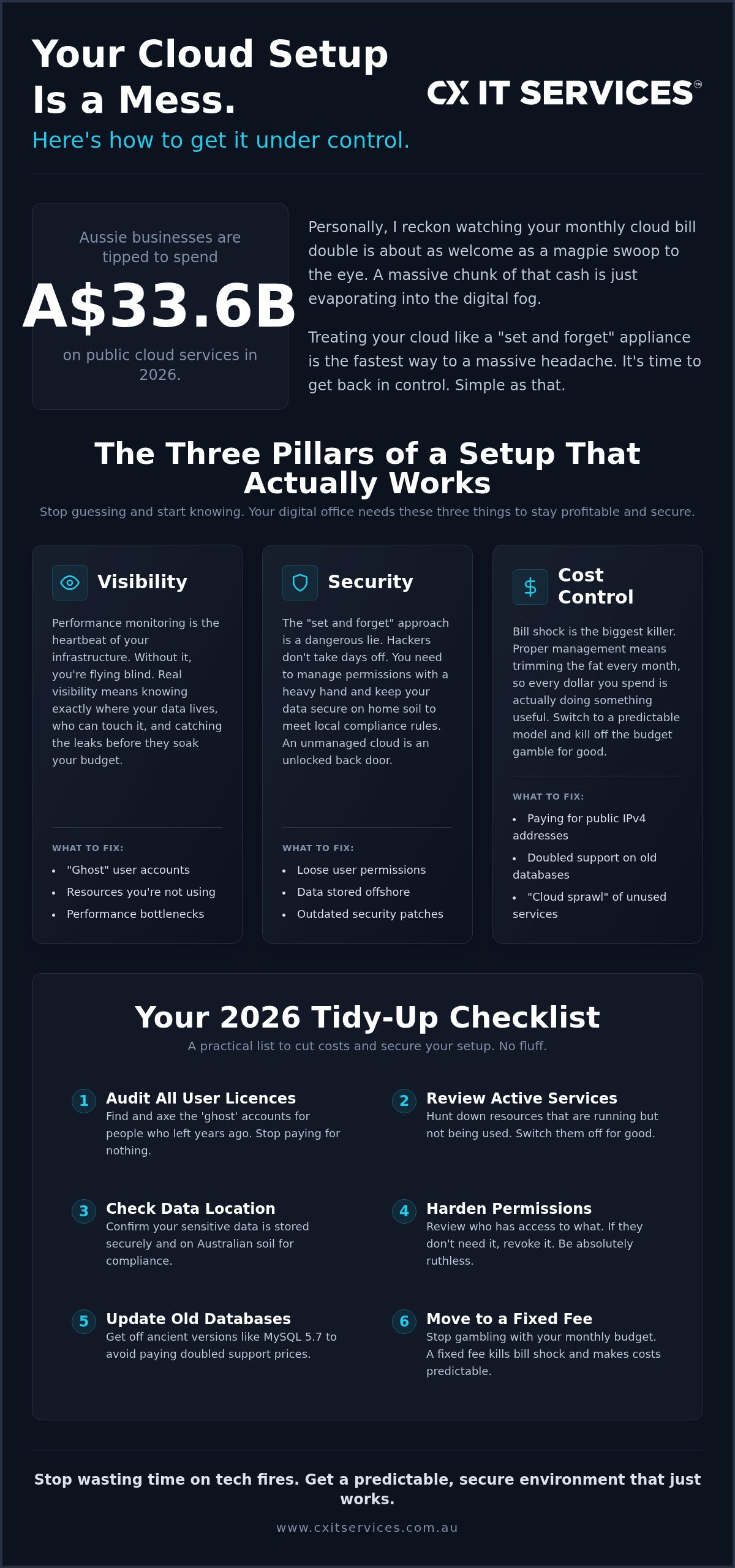
Personally, I reckon watching your monthly cloud bill double is about as welcome as a magpie swoop to the eye. With Aussie businesses tipped to spend over A$33.6 billion on public cloud services in 2026, a massive chunk of that cash is just evaporating into the digital fog. It's easy to feel like the cloud is a total black box that eats your budget and leaves you wondering if your data is actually safe. You aren't alone. Most people I talk to are bloody tired of the bill shock and the technical mystery.
Proper cloud infrastructure management shouldn't require a PhD or a direct line to NASA. I'm going to show you how to organise your setup so it finally makes sense. We will look at how to kill off those hidden costs and keep your data secure on home soil without the usual corporate jargon. No fluff. No nonsense.
We are going to turn that technical headache into a predictable, secure environment that just works. This means less time worrying about servers and more time actually growing the business. It is about getting back control. Simple as that.
Key Takeaways
- Stop treating the cloud like a set-and-forget tool. It requires active oversight to prevent it from becoming a confusing, expensive mess.
- Master the three pillars of a high-performing environment. You need total visibility, ironclad security, and strict cost control to stay profitable.
- Effective cloud infrastructure management stops your internal team from wasting time on tech fires. It lets them focus on growing the business instead.
- Switch to a fixed monthly fee model to kill off bill shock. Managing your digital assets shouldn't be a gamble with your monthly budget.
- Use a practical 2026 checklist to tidy up your setup. Focus on securing your data locally and cutting out the services you don't actually use.
What is cloud infrastructure management and why should you care?
I reckon most people think the cloud just takes care of itself. It does not. In my experience, treating your cloud setup like a "set and forget" appliance is the fastest way to end up with a massive headache and a bigger bill. It is like buying a high-performance ute and never changing the oil. Eventually, things are going to seize up.
At its core, cloud infrastructure management is the process of organising and overseeing your digital assets. It is about making sure your servers, storage, and apps are fast, secure, and cheap. Without a clear strategy for cloud management, you end up with "cloud sprawl." This is when you pay for resources you never use and services that should have been switched off months ago. Proper cloud infrastructure management ensures every dollar you spend is actually doing something for your business.
The components of your digital office
Think of your cloud setup as the digital version of a physical office. You have the computing power, which acts as the engines running your business software. If these aren't managed, they run at full tilt when everyone is asleep, wasting your cash. Then you have storage. This is where your files live and how they are backed up. If this isn't organised, you are just paying for digital clutter. Finally, there is networking. This is how your team connects to the data without a hitch. If the pipes are clogged or poorly routed, your team spends half their day staring at loading icons. You can see how we handle these moving parts on our Cloud Services page.
The cost of doing nothing
The "she'll be right" attitude doesn't work with modern IT. Bill shock is the biggest killer. As of 2026, costs have climbed. AWS charges for every public IPv4 address, and if you are still on older database versions like MySQL 5.7, those support prices have doubled. Add the 10% GST on top for all AWS services in Australia, and doing nothing becomes a very expensive hobby.
Then there are the security holes. Leaving your cloud unmanaged is like leaving the back door of your office unlocked. If your data is stored offshore or your permissions are loose, you are an easy target. Downtime is the final blow. If a service goes bust for an afternoon because of a configuration error, your staff are sitting idle. That is the real cost of a "black box" you don't understand. It is not just a tech issue. It is a business risk.
The three pillars of a cloud setup that actually works
Personally, I have seen too many Aussie businesses throw money at the cloud and hope for the best. It is a strategy for disaster. You wouldn't run a physical office without knowing who has the keys or what the rent costs each month. Your digital office is no different. A solid setup relies on three specific things. Visibility. Security. Cost control.
Effective cloud infrastructure management means you stop guessing and start knowing. Visibility is about more than just a dashboard. It is about knowing exactly where your sensitive data lives and which staff members can touch it. Security is not a one-time job. It is a constant watch over your perimeter to ensure nobody is poking around where they shouldn't be. Finally, cost control is about trimming the fat every single month. If you aren't actively managing these three pillars, you are just waiting for something to break.
Visibility and performance monitoring
Performance monitoring is the heartbeat of your digital infrastructure. Without it, you can't tell if your cloud is actually running slow or just being temperamental because of a local internet glitch. I often see firms paying for "ghost" users. These are Microsoft 365 licenses for people who left the company three years ago. It is money down the drain. Real visibility means catching these leaks before they soak your budget.
Security and Australian compliance
The "set and forget" approach is a dangerous lie in cyber security. Hackers don't take days off, and neither should your monitoring. You need to manage permissions with a heavy hand. If a disgruntled ex-employee still has access to your server, they can delete the lot in a few clicks. Keeping your data secure and compliant with local regulations is a full-time gig. You can read more about why this matters in our guide to cyber security management services.
Getting these pillars right takes the weight off your shoulders. If you want to see how your current setup stacks up, you can book a strategy call with us to get some clarity.
Managing it yourself vs bringing in the pros
Personally, I reckon the "do it yourself" approach to IT is a bit like trying to wire your own house. You might get the lights to turn on. You might also burn the place down. Choosing who handles your cloud infrastructure management is one of the biggest calls you will make for your business. You have three real options. Do it yourself. Outsource the lot. Or find a middle ground.
Most small to mid-sized Aussie firms start with DIY because it feels cheaper. It isn't. When your internal person is "fighting fires" all day, they aren't doing the work you actually hired them for. That is a massive waste of talent and money. Managed services give you a whole team of experts for a fixed monthly fee. It turns a technical mystery into a predictable business expense.
The DIY trap
The real danger here is the hidden cost of "learning on the go." If your cloud crashes on a Tuesday morning, you don't want your IT person watching YouTube tutorials to find a fix. That downtime costs you thousands in lost billables. It is a trap that many smart professionals fall into because they underestimate the complexity of modern systems.
Cloud security has become incredibly complex in 2026. Your internal IT manager might be a legend at fixing printers, but are they across Zero Trust security models and data sovereignty laws? Probably not. If your internal person is drowning, co-managed IT support is a better way to keep your head above water. It gives your staff a safety net without you having to hire more full-time heads.
The Managed Service advantage
Bringing in the pros changes the game. You get predictable costs. No more surprise invoices when a server needs a tickle. No more "oops, we need another ten grand for an emergency fix." It makes your IT spend as stable as your office rent.
We watch the shop while you are asleep. With 24/7 monitoring, we catch the glitch at 2:00 AM so your team can log in at 8:00 AM without a hitch. This isn't just about fixing bugs. It is about strategy. We use a Virtual CIO to look at where your business is going in the next three years. We don't just react to problems. We build a cloud environment that actually helps you grow. It is about getting your time back so you can focus on the work that actually pays the bills.
Your 2026 checklist for a lean and secure cloud environment
Personally, I reckon if your cloud setup feels like a bit of a shambles, you need to stop and take stock. Most Aussie businesses I see are paying for stuff they haven't used since 2022. It's a waste of money and a massive security risk. You don't need to fix everything at once. Just pick the low-hanging fruit and get the basics right.
Effective cloud infrastructure management starts with being proactive. You can't just wait for a server to go bang or a hacker to find a way in. You need a routine. A checklist that keeps things lean and secure so you can sleep at night without worrying about your data vanishing into thin air.
Step 1: Audit and clean up
Start by killing off any old cloud storage accounts you no longer use. I've seen firms paying for multiple storage providers because nobody bothered to consolidate. It's digital clutter that adds up. With SaaS spending in Australia expected to reach A$16.4 billion in 2026, there's usually a lot of fat to trim. Every unused account is a bill you shouldn't be paying and a door you've left unlocked.
Next, have a hard look at your Microsoft 365 tiers. Are you paying for premium features that your team never touches? Probably. You can find more detail on this in our Microsoft 365 management guide. Also, check for those public IPv4 addresses. AWS charges for these whether they're in use or not. It might only be a few bucks a month per address, but with the 10% GST added on, it's money better spent elsewhere.
Step 2: Fortify the perimeter
Security isn't a suggestion. It's a requirement. Turn on Multi-Factor Authentication (MFA) for every single person in your office. No exceptions for the senior partners or the busy managers. It's the simplest way to stop the vast majority of bulk attacks. If someone whinges about the extra few seconds it takes to log in, tell them it's better than losing the whole database.
You also need to verify your backups. Most people have a plan, but when was the last time you actually tested a restore? A backup that doesn't work is just a collection of useless bits and bytes. If you're not sure where to start, our disaster recovery services can help you build a plan that actually holds up under pressure.
Keeping your business out of the digital fog requires a bit of discipline. If you want us to run a professional eye over your setup and find where you're bleeding cash, you should apply for a cloud audit with us today. We'll tell you exactly what's working and what's just taking up space.
How CX IT Services handles the heavy lifting
Personally, I reckon you have enough on your plate without playing detective with your IT bills every month. We have been in this game for over 26 years. CX IT Services is Australian owned and operated. We don't just "set and forget" your tech and hope for the best. Our cloud infrastructure management is designed to be invisible to you and your staff. If we are doing our job right, your IT should be boring. It should just work in the background while you focus on the work that actually pays the bills.
Everything we do comes under a fixed monthly fee structure. No hidden nasties. No surprise invoices because a server needed a tickle at 3:00 AM. Our fixed-fee model means our interests are perfectly aligned with yours. If your systems go down, it costs us time and money to fix them. If they stay up and run perfectly, everyone wins. It is a simple, honest way to do business.
Local support you can actually talk to
We don't do overseas call centres. When you ring us, you get a real Aussie technician who knows exactly what they are talking about. Most cloud issues can be handled remotely. However, sometimes the problem is physical and requires a pair of hands on the ground. If a piece of hardware has actually given up the ghost, we have on-site IT support available to get you back online. You aren't just a ticket number in a global queue. You are a local partner.
Strategic growth with a Virtual CIO
Technology shouldn't just be an expense that eats your profit. It should be an investment that helps you scale without the growing pains. We use our Virtual CIO service to make sure your cloud setup is actually fit for purpose. Whether you are in law, accounting, or the medical sector, we help you choose the right storage alternatives that keep you compliant with Aussie data laws. We run regular reviews to ensure you aren't paying for those "ghost" services we talked about earlier. It is about long-term planning rather than just reactive patches. We keep you out of the digital fog for good.
Take back control of your digital office
Personally, I reckon the cloud shouldn't be a source of stress. It is just a tool. If you have the right visibility and security in place, it becomes the engine that drives your business forward instead of a black hole for your budget. We have looked at how to kill off "ghost" licenses and why a fixed-fee model stops the monthly bill shock. You now have a 2026 checklist to start tidying up the mess and securing your perimeter.
Getting your cloud infrastructure management right is about peace of mind. It is about knowing your data is secure on home soil and your spending is predictable every single month. Stability. Control. Growth. You deserve an IT environment that just works without the corporate jargon or the technical mystery.
We are a 100% Australian owned and operated team with over 26 years of industry experience. Our 24/7 national support team is ready to handle the heavy lifting so you can get back to running your business. Get a fixed-fee quote for your cloud management today and let's get your business out of the digital fog once and for all. You've got this.
Frequently Asked Questions
Is cloud infrastructure management the same as cloud hosting?
No, cloud hosting is just renting the digital space while management is the active oversight of that space. Think of hosting as the empty warehouse and cloud infrastructure management as the logistics team that keeps the place running. One gives you a roof. The other ensures your business actually functions inside it.
How much does it cost to have my cloud managed by pros?
We provide our services through a fixed monthly fee structure rather than charging by the hour. This approach stops the bill shock that usually comes with complex IT projects. You pay for the outcome of a stable environment. It makes your IT spend as predictable as your office rent.
Do I really need 24/7 monitoring for a small business?
Yes, because technical failures and cyber attacks don't wait for business hours. If a server goes down at 2:00 AM on a Sunday, you want it fixed before your team logs in on Monday morning. 24/7 monitoring means we catch those glitches while you are asleep. Your workday starts without a hitch.
Can you manage our existing Microsoft 365 setup?
Absolutely. We specialise in Microsoft 365 management for Aussie teams of 10 or more. This includes everything from securing your mailboxes to managing your SharePoint permissions. We also ensure you aren't paying for licenses you no longer need. It is a core part of a modern cloud strategy.
What happens to our data if we switch managed service providers?
You own your data, full stop. If you ever decide to move on, we facilitate a professional handover to your new provider. We believe in building long-term partnerships based on performance. We don't believe in holding your digital assets hostage.
Is my data stored in Australia or overseas?
We prioritise storing your data in Australian data centres to ensure compliance and better speed. While some global apps might use offshore servers, a proper cloud infrastructure management strategy focuses on data sovereignty. Keeping your files on home soil is better for security and local regulations.
How does cloud management help with cyber security?
It closes the gaps that hackers usually exploit. We manage your patches, enforce Multi-Factor Authentication, and monitor for unusual activity around the clock. It is about building a proactive defence. We don't just hope your firewall is enough to keep the bad guys out.
Will managing the cloud help reduce my monthly IT bills?
Yes, it usually does by eliminating "cloud sprawl." We find the services you are paying for but not using and rightsize your resources to match your actual needs. It is about making your IT spend more efficient. You stop bleeding cash into the digital fog.