
An ISO 27001 readiness assessment shows what your ISMS covers, where the gaps are and what to fix before Stage 1, so certification brings fewer surprises.
Personally, I reckon the useful question isn’t just how long certification takes. It’s what your business already has in place, and what still needs doing. An ISO 27001 readiness assessment helps map that work before certification, while the overall timeline depends on your ISMS scope, existing processes and available evidence.
I’ve seen how easy it is for security processes to look tidy on paper but work differently day to day. A readiness review checks that gap, including requirements in clauses 4-10, relevant controls, risk processes and the Statement of Applicability.
It’s also separate from a Stage 1 audit. A readiness review is preparatory, not a formal certification audit. Here, I’ll explain what it covers, what affects the timeline and how it differs from Stage 1, so you can plan the work with fewer surprises.
Key Takeaways
- I use a readiness review to turn gaps in my ISMS into a prioritised plan, with clear owners and evidence to gather.
- I map relevant Annex A controls to my risks and operations, then confirm how each control works in practice.
- I keep readiness work distinct from a Stage 1 audit: one prepares my organisation, the other is part of external certification.
- I make sure my risk decisions and Statement of Applicability reflect my actual assets, threats and control choices.
- I bring in IT and cybersecurity support where I need help putting controls into practice or keeping them on track.
Meaning and purpose of an ISO 27001 readiness assessment
Personally, I look for the gap between what an organisation says it does and what its records show. An ISO 27001 readiness assessment makes that gap visible before certification work advances. It reviews governance, documentation and controls against ISO/IEC 27001:2022, then identifies where evidence or action is still needed.
I start by considering whether the ISMS scope reflects the real business. Clauses 4-10 cover context, leadership, planning, support, operation, evaluation and improvement. The review can test whether responsibilities are clear and whether documented processes match daily practice. A policy may be approved, for instance, but staff need to follow the process it sets out.
Records show whether a control operates, not merely whether it is documented. I look for evidence such as approved procedures, training records, risk decisions and management records. If a process is described but there’s no record of it being followed, that’s a gap to understand before an external auditor reviews the ISMS.
When choosing an ISO 27001 readiness assessment provider in Australia, I’d look for one that works to ISO/IEC 27001:2022, sets out the review scope and delivers prioritised findings with evidence and practical actions. The report should distinguish a material gap from an improvement opportunity, not blur everything into one long to-do list.
I turn each finding into an action with an owner, risk context and due date, then retain evidence of the fix. If staff don’t follow a documented process, updating the document alone won’t resolve the problem. The process may need to change, staff need to understand the change, and records should show the revised process is being followed.
For the cost of an ISO 27001 readiness assessment in Australia, I’d expect it to depend on scope, system complexity, locations and the state of existing documentation, with a price provided after a quote request. Reviewing one well-documented environment differs from examining several business areas with fragmented records.
The practical value lies in the plan that follows the review. Clear findings let leadership decide what to address first, who owns each action and what evidence will show progress. That’s a stronger basis for planning certification work than relying on assumptions or treating a completed document as proof that a process works.
Annex A control selection and implementation
I map the controls already operating, then test what the records and responsible people can demonstrate. I map, interview, inspect evidence, assess control strength and prioritise gaps.
Current State and Control Mapping
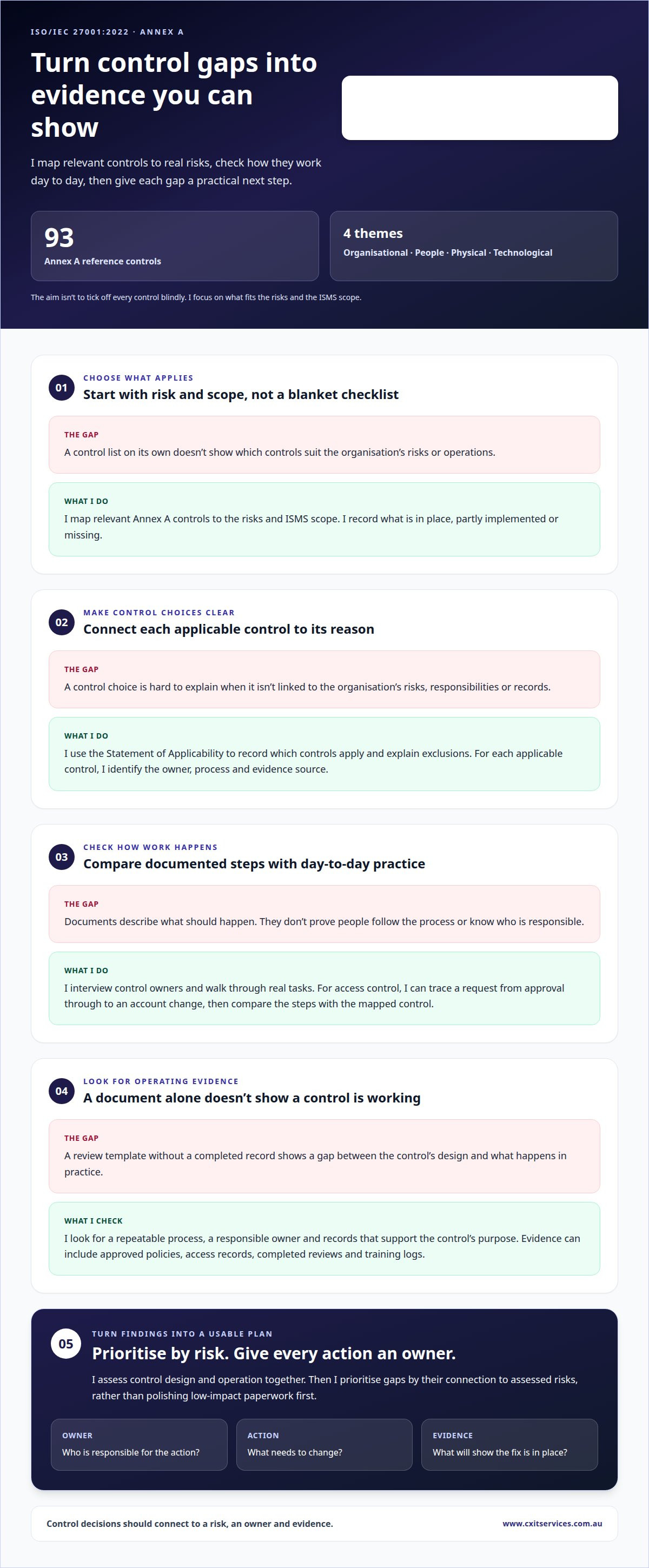
I compare the organisation’s current security measures with ISO/IEC 27001:2022 Annex A, which contains 93 reference controls across organisational, people, physical and technological themes. The aim isn’t to tick off every control blindly. I map relevant controls to risks and the ISMS scope, recording what’s in place, partly implemented or missing.
I also look for a clear reason behind each control choice. The Statement of Applicability records which controls apply and explains exclusions. In a useful map, each applicable control connects to its owner, process and evidence source. Where third-party technologies and suppliers are involved, services like those from SpaceCenter Systems show how structured IT vendor management can streamline oversight and maintain compliance evidence. That lets the organisation show how its decisions relate to its actual operations.
Control Owner Interviews and Walkthroughs
Documents describe what should happen; interviews and walkthroughs show what people actually do. For example, I ask an access-control owner to demonstrate a request from approval through to an account change. That practical trail can reveal where a written procedure and the internal process don’t line up.
I use interviews to clarify who performs each task and where records are kept. For a cloud platform, I ask the owner to show how access is granted and changes are recorded. I compare the process with the mapped control, note evidence gaps and identify unclear responsibilities.
Control Implementation and Evidence
I assess implementation by checking for a repeatable process, a responsible owner and records that support the control’s purpose. Evidence might include an approved policy, access records, completed reviews or training logs. A document alone doesn’t show whether a control is operating.
For instance, a review template without a completed record shows a gap between design and practice. I describe what’s missing and what evidence would demonstrate improvement. This gives control owners a practical basis for remediation and follow-up.
I assess control strength by considering design and operation together. A useful maturity view shows whether a control is defined, assigned, followed and supported by evidence. I prioritise actions according to their connection to assessed risks, rather than polishing low-impact paperwork first. The resulting plan should name an owner, action and evidence of completion.
Personally, I reckon the clearest findings link each control decision to a risk, an owner and evidence. If I’m ready to turn control gaps into an implementation plan, I can start a conversation about my next steps.
Is a Readiness Assessment the Same as a Stage 1 Audit?
No. I treat a readiness assessment as an internal preparatory review, not a formal certification audit. A Stage 1 audit is an external review of whether your ISMS documentation and scope are ready for certification.
External Certification Audit Preparation
I prepare by making the ISMS scope, risk information, policies and Statement of Applicability easy to follow. Stage 1 focuses on documented arrangements and whether the organisation is prepared to proceed. Stage 2 then tests whether controls work in practice, using interviews, evidence and sampling. In a readiness review, I can identify weak records before either stage, but I can’t replace the certification body’s audit.
I see internal audits as serving a different purpose. I use them to check whether the ISMS is operating as intended and identify issues before certification. I test the ISMS against agreed criteria, using documents, operating evidence, interviews and sampled controls. I record what I examine and support each finding with evidence.
I also treat management review as part of ISMS oversight. Clause 9.3 covers periodic management review, where leaders consider how the system is performing and what needs attention. I recommend completing the review and internal audit before certification, so findings can inform decisions and corrective actions. I advise internal audits at least annually, giving the organisation a recurring way to assess whether processes remain effective.
I see certification maintenance continuing after approval. Certification is valid for three years, with annual surveillance audits. I prepare for surveillance by keeping records current, tracking corrective actions and reviewing whether changes have affected the ISMS scope or risk assessment. I use the same evidence discipline before certification to help show that controls continue to operate between external audits.
Deliverables and Remediation Boundaries
I may include documented scope, evidence reviewed and findings such as supported nonconformities, observations or improvement opportunities in audit deliverables. I classify findings according to the approach agreed for that audit. I make each finding clear about the requirement, the evidence and the issue, so the organisation can decide what action is appropriate.
I use an assessment report to identify gaps, not to automatically implement corrective actions. I keep hands-on remediation, corrective-action implementation and follow-up testing outside an audit unless we separately agree on them. I keep that boundary clear: the organisation remains responsible for addressing findings, while I use a preparatory review to help clarify priorities before the next external audit.
I use a simple practical test: can I trace each finding to evidence, an owner and a next step? That keeps the readiness review, internal audit and certification audit distinct, while allowing each to contribute to a more reliable ISMS.
Risk assessment, treatment and Statement of Applicability
I use risk assessment to connect information security decisions to the assets, threats and vulnerabilities that matter to an organisation. I look for common gaps, including incomplete asset records, unclear risk acceptance and treatment actions without owners.
Information Security Risk Identification
I start by identifying information assets within the ISMS scope, such as client files, staff records, cloud platforms and business systems. Then I consider relevant threats and vulnerabilities for each asset. For example, a shared account may create unauthorised-access risk if individual activity cannot be traced. I record potential impact and likelihood using the organisation’s defined assessment method.
ISO 27001 clause 6.1.2 requires an information security risk assessment process and risk acceptance criteria. I check whether the method is applied consistently, risks are recorded, and leadership can understand the reasons behind each rating. If key systems or information owners are missing, I know the resulting risk picture may be incomplete.
Risk Treatment and Mitigation Planning
Once I’ve assessed risks, I decide how to treat each one. An organisation may reduce risk through controls, accept it against its criteria, avoid the activity or share the risk through an arrangement. I record the chosen action, the reason for the decision, its owner and how I’ll evidence progress. I use a treatment plan to turn risk ratings into assigned work.
For example, if I identify inappropriate access to client files as a risk, actions could include tightening permissions and reviewing access records. I connect those actions to the relevant risk and control. This gives auditors a clear trail from assessment to treatment, rather than a list of controls with no visible risk basis.
Asset Management in Risk Assessment
I use asset records to show what information needs protection, where it sits and who is responsible for it. I include relevant systems, information repositories, devices and services within the ISMS scope. A cloud platform holding client documents may have different exposure and dependencies from a local file server. I use asset ownership to identify who can explain its use and risks.
I keep the asset view aligned with the risk assessment and system changes. If a new service stores sensitive information, I assess its threats and vulnerabilities rather than assuming existing controls cover it. I trace each important asset to relevant risks, treatment decisions and applicable controls. That connection helps me decide control priorities.
Policies, Roles and Risk Assessment
I look at whether organisational policies set direction and assigned roles make risk actions accountable. I assess whether policy requirements reflect identified risks and whether owners have authority to carry out treatments. For instance, a policy requiring access approval needs a named decision-maker and records showing approvals occurred.
I use the Statement of Applicability (SoA) to record selected Annex A controls, whether they apply and the reasons for inclusion or exclusion. I keep it consistent with risk treatment decisions and actual implementation. An unexplained exclusion or a control marked implemented without supporting evidence can leave a gap for auditors to question. I expect leadership to review significant risks, accept them against defined criteria and track outstanding actions.
ISO/IEC 27001 and information security management systems
I use ISO/IEC 27001:2022 to set requirements for an information security management system, or ISMS. Its clauses 4-10 connect leadership, planning, daily operations and improvement.
Leadership and Information Security Policy
I see leadership setting the direction for information security management. Leaders approve the policy, support the ISMS and assign responsibilities. The policy should explain the organisation’s security aims and give staff a clear basis for decisions. For example, it can set expectations for handling client information and reporting a suspected incident.
I reckon leaders need enough awareness to oversee the system, not just sign a document. They should understand key risks, outstanding actions and whether security objectives remain relevant. A management review can make these discussions part of governance, with decisions and follow-up recorded. Documented oversight connects security priorities with business decisions.
Security Responsibilities and Roles
I find clear roles prevent important tasks from falling between teams. The ISMS should identify who owns policies, risk decisions, access approvals, incident handling and evidence records. A responsibility might sit with a manager, system owner or staff member who performs a defined process. The key is knowing who acts and who oversees the result.
I make sure responsibilities match actual working arrangements. If a cloud platform stores business information, its owner should know who manages access and where relevant records sit. An information asset inventory can identify systems, information types, owners and locations. Keeping it aligned with the ISMS scope helps leaders understand what the management system covers and where risks may arise.
I also reckon staff awareness matters. Employees and relevant contractors should receive security awareness training at least annually. Training should relate to their work, such as recognising suspicious messages or reporting an incident. Records show that the program runs, while feedback or incident trends can indicate where further guidance is needed.
I use a readiness review to reveal where documented responsibilities don’t match practice. For instance, a policy may assign incident reporting to a role that has changed. Update the policy, communicate the current process and retain evidence of the update. This keeps responsibilities usable, rather than leaving staff to guess during a security event.
If I can help your leadership team get a clearer view of its ISMS responsibilities, discuss your next steps.
CX IT Services
I’ve seen security assessments identify technical gaps, unclear ownership or controls that need ongoing support. The right next step depends on what the findings say and how your organisation manages its systems.
A report might flag access management, cloud configuration, backups or security processes. In my experience, Managed IT Services & Support can help with day-to-day IT needs, while Cyber Security addresses security priorities. These services can support work behind an ISMS, but they don’t replace leadership decisions, risk acceptance or a certification audit.
If you already have an internal IT team, Co-Managed IT may be a practical way to share operational responsibilities. Your team keeps its role, with extra support for agreed tasks. I’d define the work against the assessment findings, especially where it needs coordination across systems, users and existing processes. That keeps support focused on your actual gaps.
Cloud Services may be relevant if systems or information within the ISMS scope sit in cloud environments. Assessment findings can show which tasks need attention and who should own them. I’d tie decisions to the risk treatment plan, not treat a service change as proof that a control works. Evidence of how the control operates still matters.
AI & Automation may suit businesses exploring automation as part of their wider technology approach. Any change should fit the organisation’s security requirements and documented responsibilities. If an automated process affects access to business information, for example, the relevant owners need to understand the process and its risks. I’d keep the assessment findings central and avoid adding technology just because it’s available.
Before starting work, I’d make the findings, owners and priorities clear. That gives everyone a useful focus: which technical tasks need attention, which teams are involved and how the work fits existing IT operations. I’d discuss how Managed IT Services & Support, Cyber Security, Co-Managed IT, Cloud Services or AI & Automation might fit those needs. Let the assessment guide what matters.
Contact CX IT Services to discuss your IT and security needs.
Make the next security improvement part of the plan
I find an ISO 27001 readiness assessment most useful when its findings lead to steady changes in how an organisation manages information security. I connect the improvement plan with ordinary business decisions: who owns each action, how progress is tracked and how new systems or processes affect security responsibilities.
I know that work continues after certification. A new cloud platform, staff change or revised process can shift the risks an ISMS needs to manage. I recommend reviewing those changes and updating relevant records, rather than treating security documentation as a one-off project.
Where technical gaps need attention, I offer Managed IT Services & Support and Cyber Security through CX IT Services. I also see AI & Automation helping with suitable business processes while keeping security requirements in view. The right support depends on the work the findings identify.
Contact CX IT Services to discuss your next steps. I reckon a clear plan gives your team somewhere practical to start, and a way to keep moving.
Frequently Asked Questions
How long does it take to become ready?
I find certification commonly takes 6 to 12 months, but your timeline depends on the work still outstanding. A business with documented processes may have fewer gaps than one building its ISMS from scratch. I look at scope, risk treatment and staff responsibilities, as all affect the pathway. Readiness comes from completing actions and building evidence, not simply reaching a date on the calendar.
What is a readiness assessment for ISO 27001?
I use an ISO 27001 readiness assessment to review how prepared your organisation is for certification work. It can help leadership decide whether the ISMS scope is workable before committing further resources. I treat the findings as a planning tool, not a certificate or an external auditor’s decision. For example, I use the findings to assign owners and sequence work that depends on decisions or system changes.
What areas are reviewed during the assessment?
I can review ISMS requirements, relevant controls, risk processes and supporting records. I set the scope to reflect the teams, locations, systems and information involved. For example, I might trace how client information moves between staff devices, cloud services and business processes at a professional services firm. A clear scope helps me identify where responsibilities cross between teams and where evidence may sit.
How can an organisation measure readiness and find gaps?
I measure gaps in an ISO 27001 readiness assessment by connecting requirements and controls to evidence and accountable owners. I record whether each arrangement is documented, operating and supported by records. A useful finding explains what is missing and why it matters. I prioritise actions according to their connection to assessed risks, dependencies and the evidence needed to show that changes are working.
How long does the review itself take?
I find the review’s duration depends on the ISMS scope, the systems and business areas involved, and how accessible the records are. Interviews and walkthroughs take longer if ownership is unclear or teams follow different processes. I may need to follow up when evidence is incomplete. A current document set and access to people who own key processes help me keep the assessment focused and reduce avoidable delays.
Which records should be gathered for the review?
I find useful records include the ISMS scope, policies, risk assessment, treatment records and Statement of Applicability. Internal audit and management review records can also show me how the system is governed. Operational examples might include access approvals, incident records and completed reviews. I organise documents by process or control so I can understand what each record demonstrates, rather than relying on file names alone.
How does a readiness review differ from an internal or certification audit?
I use a readiness review to help identify issues before certification. It is not a formal audit. An internal audit tests the ISMS against agreed criteria and gives me an independent view of its operation. The certification body conducts the external audit. At Stage 1, I review documented arrangements. At Stage 2, I examine whether controls operate in practice through evidence, interviews and sampling.
Which standard version and Australian requirements apply?
I advise organisations seeking certification to use ISO/IEC 27001:2022. The standard is international, while relevant Australian obligations depend on the organisation’s operations, customers and contracts. I identify applicable obligations within the ISMS context and scope, then connect them to policies, risk decisions and controls. For example, I check whether a contract’s information-handling expectations are reflected in documented procedures and assigned responsibilities. Similarly, for organisations that must align information security with specific regulatory requirements, dedicated platforms like Trancher help manage and evidence ongoing AML/CTF compliance programs.





 Microsoft Partner