
Employee cybersecurity awareness training helps staff spot scams, handle suspicious requests and build safer habits with exercises and regular refreshers.
Personally, I reckon the gap between a blocked threat and a safe decision often comes down to what someone does next. A firewall can block a threat, but it can’t teach someone to pause before opening a dodgy attachment. Employee cybersecurity awareness training focuses on those everyday decisions, while broader cyber security training can also cover technical skills such as configuring systems or responding to security incidents.
Staff don’t need to become security experts to make safer choices, but a one-off slideshow won’t prepare them for every new scam. Effective employee cybersecurity awareness training gives people practical ways to recognise common risks and respond, then reinforces those habits with realistic examples and regular refreshers.
This article explains what learners can expect, how awareness training differs from technical cybersecurity training, and how to make a program useful across roles. It also covers onboarding, ongoing refreshers, interactive exercises and ways to assess whether lessons are sticking, without unnecessary jargon.
Key Takeaways
- I’ve found phishing and social engineering exercises help staff practise spotting suspicious messages and requests.
- In my experience, awareness sessions differ from technical training. Strong, unique passwords and multi-factor authentication matter in both.
- I’ve seen insider risks come from deliberate actions and everyday mistakes. Training can help reduce them.
- I’ve found completion records show who has completed training, and training supports a more resilient approach to privacy and business continuity.
- I reckon training works best when it fits different roles, includes new starters and uses regular, practical refreshers rather than a one-off session.
Is this course nationally recognised or accredited training?
I’ve seen people assume a workplace awareness course is nationally recognised or accredited just because employees complete it or receive a certificate. That status depends on whether the specific course is delivered as nationally recognised training through Australia’s vocational education and training system. I treat a completion record as evidence of participation, not as a nationally recognised qualification.
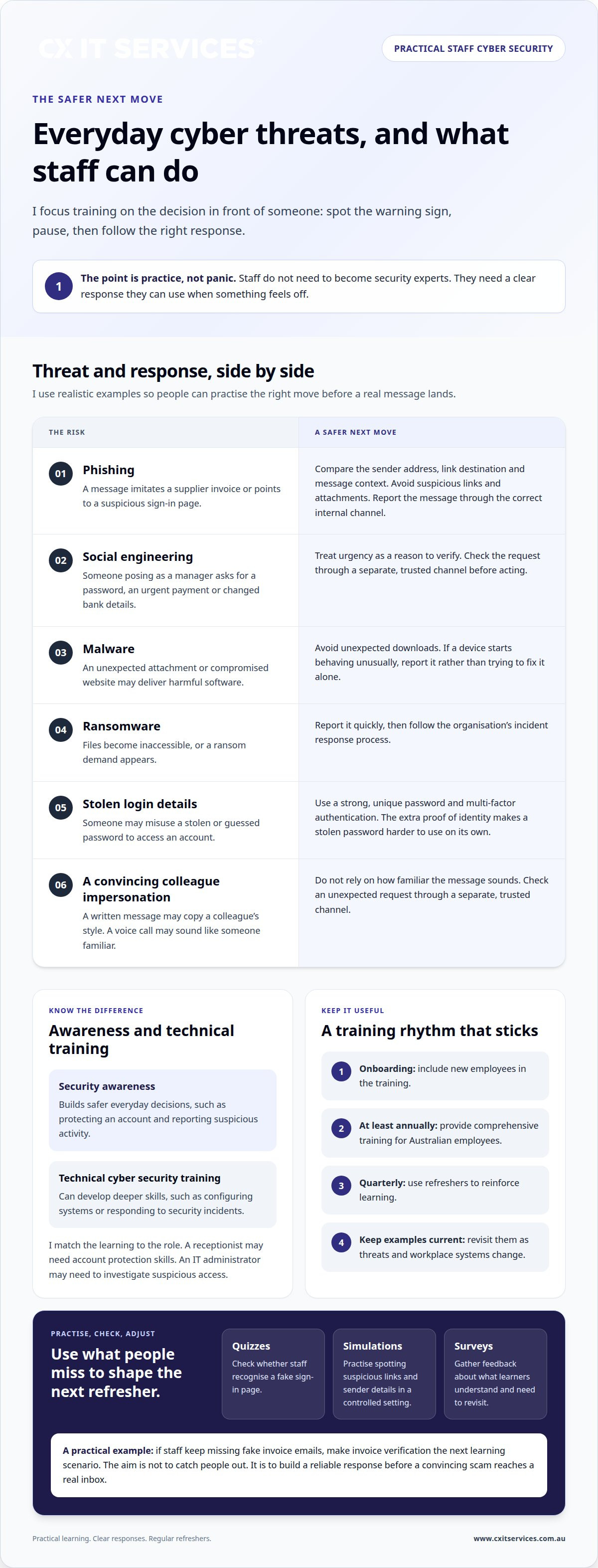
In my experience, the first priority is learning people can use during real attacks. A phishing message might imitate a supplier’s invoice. Social engineering could involve someone posing as a manager and requesting a password or urgent payment. Staff should learn to spot warning signs, avoid suspicious links and report messages through the correct internal channel. A prompt report gives an organisation more time to contain a threat.
I also make sure training covers more than suspicious emails. Malware can arrive in an attachment or through a compromised website. Ransomware can lock access to files, while identity-based attacks misuse stolen login details. A distributed denial-of-service, or DDoS, attack overwhelms an online service with traffic. Each threat calls for a different response, from avoiding an unexpected file to promptly reporting unusual account activity.
I’ve seen AI-driven scams add another challenge. A message may convincingly mimic a colleague’s writing, and a voice call may sound like someone the employee knows. Use realistic examples to practise checking unexpected requests through a separate, trusted channel. Phishing simulations let employees practise spotting suspicious links and sender details in a controlled setting. Afterwards, discuss what people missed without exposing business systems.
For Australian employees, I recommend comprehensive training at least annually, with quarterly refreshers to reinforce learning. Include new employees during onboarding, then revisit examples as threats and workplace systems change.
- Phishing: Compare the sender address, link destination and message context before opening an attachment or entering a password.
- Social engineering: Treat an urgent request to change bank details as a cue to verify it through a separate channel.
- Malware: Avoid unexpected downloads and report unusual device behaviour rather than trying to fix it alone.
- Ransomware: Report inaccessible files or ransom demands quickly, then follow the organisation’s incident response process.
- Account security: Use a strong, unique password and multi-factor authentication to make stolen login details harder to use.
I use simulation results to shape the next refresher. If staff repeatedly miss fake invoice emails, make invoice verification the next learning scenario. The aim is not to catch people out, but to build a reliable response before a convincing scam reaches a real inbox.
What is the difference between cyber security awareness training and cyber security training?
I see the distinction as what the learner needs to do. Security awareness training helps people make safer everyday decisions. Cybersecurity training can also develop technical skills, such as configuring systems or responding to incidents. I’d expect a receptionist to learn how to protect an account, while an IT administrator needs deeper instruction to investigate suspicious access. I’d match each course to the learner’s responsibilities.
In Australia, I find the cost of employee cybersecurity awareness training depends on factors such as delivery format, learner numbers, course customisation and practical exercises. The price depends on the case and is provided after a quote request. I’d weigh those factors against the organisation’s needs, rather than treating every course as the same package.
I see password security as a practical bridge between the two types of learning. I’d encourage staff to use strong, unique passwords and multi-factor authentication on critical systems. Multi-factor authentication asks for another proof of identity, such as an authentication code, alongside the password. I consider it a useful way to protect an account if someone steals or guesses the password. Awareness learning explains the behaviour; technical training can cover how an organisation configures and manages its controls. For small and medium-sized businesses that lack in-house technical resources, outsourced support from JOB Technologies can help manage systems and security infrastructure effectively.
I use frameworks to help organise learning, not to make every course identical. The NIST Cybersecurity Framework, NIST Special Publication 800-53 and CIS Critical Security Controls include security awareness training as a component. To assess learning, I’d use quizzes, simulations and surveys. A quiz can test whether staff recognise a fake sign-in page, while a simulation can show whether they report it.
I’d make healthcare training fit the work. I’d include secure telehealth and online conferencing, where staff need to protect confidential health information during consultations. The Australian Digital Health Agency offers a short eLearning module on securely using those technologies. I see its focus on confidentiality during consultations as a practical topic for healthcare teams to include in role-based learning.
For broader threat information, I’d point Australian internet users to the Australian Cyber Security Centre’s free service covering recent online threats and how to manage them. I’d treat it as a resource, not a business training program or a substitute for healthcare-specific learning. The Office of the Australian Information Commissioner notes that mistakes such as misdirected emails and weak passwords account for a significant number of reported breaches. I’d turn those risks into clear workplace habits.
If I can help your organisation connect staff learning with its systems and risks, discuss a security approach for your organisation.
Insider threats
I see insider threats come from deliberate misuse and ordinary mistakes by people with access. That includes employees, contractors and former staff whose access remains active. Human error caused 37% of reported data breaches in the OAIC reporting period from January to June 2025. That figure tells me cyber security isn’t only about stopping outsiders. A misdirected email, careless file sharing or an overlooked access change can expose sensitive information.
I’ve seen deliberate misuse look like someone with legitimate access taking client records or trade secrets to sell, or using information during a dispute. Other risks are less dramatic: an employee approves a fake invoice, shares login details, or sends confidential files to the wrong recipient. Verizon’s 2021 Data Breach Investigations Report found a human element in 85% of the 5,258 breaches it analysed. CrowdStrike reported that about 80% of network breaches fraudulently use legitimate identification. In my experience, stolen credentials can make suspicious activity look like routine work.
For businesses in Melbourne, Brisbane and Sydney, I reckon the practical challenge is giving staff useful access without leaving it open unnecessarily. I’ve seen phishing attacks imitate a supplier or request a change to bank details. A compromised account could then be used to access shared files or target colleagues. I’d teach staff to verify unusual requests through a separate channel, report unexpected account activity and avoid forwarding sensitive information to personal email. Managers also need a clear process for changing access when roles change or someone leaves, reducing avoidable exposure.
I’ve seen healthcare teams face extra reasons to take insider risks seriously. The Australian Digital Health Agency monitors threats to national health infrastructure, healthcare entities and the broader Australian health sector. Ransomware and phishing attacks are assessed as high-risk threats for that sector. A staff member who opens a malicious attachment can disrupt access to information needed for care. I’d make sure training covers secure handling of health information, prompt reporting, and how staff continue or resume normal operations after an attack.
I’ve also seen insider risks shift as work systems and scams evolve. A new remote-work process, shared cloud folder or AI-generated impersonation can create fresh ways to misuse access. I use workplace scenarios: a contractor requests a client file, a manager asks for an urgent transfer, or an employee spots unfamiliar sign-ins. Ask learners what they would do, whom they would tell and what information they should preserve. Short refreshers can address mistakes or uncertainties those exercises reveal.
From what I’ve seen, a useful measure isn’t whether staff can recite a policy. It’s whether they report concerns quickly and follow the right response. A straightforward reporting route, role-based access and regular reviews of active accounts give that learning somewhere to land. Training won’t replace technical controls, but it can help people recognise when normal work has gone wrong.
Do learners receive a certificate or record of completion?
I find that depends on the course. Workplace awareness programs may provide a completion certificate or record, but I reckon the useful evidence is the detail behind it. I’d keep each learner’s name, completion date, course topics, assessment result and any follow-up training together. A record showing staff practised identifying suspicious requests, for example, says more than a certificate with no learning detail.
For Australian organisations covered by the Privacy Act, I see training as one way to help employees handle personal information responsibly. The Notifiable Data Breaches scheme concerns how eligible data breaches are assessed and handled. Training supports those practices, but I wouldn’t treat a completion record alone as proof that an organisation has met its privacy responsibilities or handled a breach correctly.
I find effective records make compliance work visible. I’d map training topics to your procedures, then document who completed each module and which gaps need attention. A medical practice might record training on handling patient records and reporting a privacy incident. A Western Australian accounting firm might document how staff protect client tax files and escalate a misdirected email. For practices handling sensitive financial data that need structured security policies to support their training, apextech4taxpros.com outlines dedicated cybersecurity solutions and information security plans. I’d make sure examples match the information each workforce handles.
I also see cyber insurance as a reason to keep records organised. An insurer may ask about staff training, security practices or incident response when assessing an application or claim. A dated attendance log, course outline and assessment results can help explain what the organisation did. They don’t prove every risk was controlled or guarantee an insurance outcome. I’d keep evidence accurate, current and consistent with actual workplace practices.
I see training as support for resilience and business continuity too. If ransomware blocks access to shared files, staff need to know how to report the disruption and follow the organisation’s response plan. Exercise records can show which teams practised those decisions, while a review captures lessons and actions. I’m not after paperwork for its own sake. I want to see what people learned and what still needs work.
I’ve seen ineffective training leave staff with knowledge gaps, weak habits and no clear response when something goes wrong. That can increase the chance of data breaches, delay reporting, disrupt business operations and leave an organisation with little evidence of its workforce’s preparation.
I find completion records are most useful when they lead to action. After a quiz or simulation, I’d record common errors, assign relevant follow-up learning and note when it’s completed. If staff repeatedly mishandle sensitive attachments, for example, I’d focus the next session on secure file sharing and reporting steps. That gives me a practical trail from learning to improved practices, rather than a certificate that gathers digital dust.
Planning and implementing employee cybersecurity awareness training
I’ve found a useful program starts with the risks people actually face, not a generic slide deck. Map who handles sensitive information, which systems they use and what could disrupt their work. A receptionist might handle unexpected delivery requests, while an accounts team processes supplier bank details. Those roles need different practice, even when both teams use the same email system.
I’d start with a baseline assessment. A short quiz, staff survey or controlled simulation can show where knowledge gaps are. If staff struggle to spot a fake login page, prioritise account security. If they aren’t sure how to report a suspected incident, teach the reporting path before adding more theory. The first assessment gives the program a clear purpose.
In my experience, learning works better when it uses varied formats. Have staff read a short guide, watch an explainer, discuss a scenario and practise a response. An accounts team could work through a mock request to change supplier bank details. A manager could practise reporting a lost device containing sensitive work files. Each exercise should explain what to do, whom to notify and what information to preserve.
I wouldn’t treat training as a one-off event. Provide learning during onboarding, deliver comprehensive training at least annually, and use quarterly refreshers to reinforce key habits. Adjust examples as workplace systems and threats change. A new remote-work process, for example, may call for guidance on handling sensitive files outside the office.
I use information from the Australian Cyber Security Centre, which offers Australian internet users a free service with details on recent online threats and how to manage them. It can inform current examples, but it isn’t a business training program. A practical Australian workplace schedule is onboarding, annual comprehensive learning and quarterly refreshers, with role-specific updates when procedures or risks shift.
I’ve seen questions and near misses provide useful signals, so make them part of workplace culture. If an employee reports a suspicious message, explain the right response without publicly dressing them down. Staff are more likely to speak up when reporting is clear and managers respond consistently. A quick report can help the organisation act before a small incident spreads.
I’d measure behaviour, not just attendance. Compare quiz answers, simulation outcomes and staff feedback over time. If people click a simulated link but report it afterwards, focus the next session on pausing before opening links. Record what changed, then revisit the same skill in a later exercise. That gives you a practical feedback loop instead of a box-ticking routine.
To shape a program around your workplace’s risks and staff roles, start a conversation about your security needs.
CX IT Services: Cyber Security
I help businesses connect staff awareness with the wider security measures protecting their systems and information. My Cyber Security offering is for when training needs to sit alongside practical controls and a clear incident response approach.
If you have internal IT staff, Co-Managed IT can support your existing team. Managed IT Services & Support can suit businesses that need broader oversight of their technology environment. The right fit depends on your current setup, the information your workforce handles and where your security gaps lie.
Training works best as part of a wider plan, not as a box ticked once and forgotten. Contact me to discuss your organisation’s cyber security needs.
Make safer habits part of the way your team works
Make learning useful after the course ends. Bring employee cybersecurity awareness training into everyday conversations about handling information, using systems and raising concerns. Managers can reinforce good habits by making reporting straightforward and treating questions as part of the work, not an interruption.
A training program is useful when people know what to do under pressure. That takes steady attention from the organisation, not just a completed module. CX IT Services offers Cyber Security, Managed IT Services & Support, and AI & Automation to help businesses address related technology and security needs.
Personally, I reckon the useful starting point is a clear plan and learning that fits the risks staff face. I’d keep the conversation grounded in what your organisation needs, whether that’s with CX IT Services or your existing provider. A practical first step makes the next one easier to manage.
Frequently Asked Questions
Does the course include phishing simulation?
I can include it. In my experience, phishing simulations give staff a safe way to practise assessing a message, rather than just hearing about warning signs. For example, I might use a mock email asking an employee to sign in through an unfamiliar link. The useful part comes afterwards: I explain the clues, show staff how to report the message and use the results to shape follow-up learning. I keep exercises controlled and avoid collecting real passwords.
How can cyber security awareness and education help cyber resilience?
I’ve found that people respond in a more organised way to disruption when they know what to do. A team that knows where to report a suspected incident can alert the right people sooner. For example, a receptionist who notices an unusual sign-in can notify the designated contact instead of ignoring it. I pair that knowledge with clear continuity procedures, so staff know which essential tasks to prioritise during an outage.
How can organisations build a cyber-aware, compliant workforce?
I recommend making secure practices part of normal work, then connecting them to the organisation’s policies and responsibilities. I give each role clear examples, such as how a payroll officer handles a request to amend bank details or how a clinician protects a shared workstation. In my experience, managers need to reinforce the same expectations, provide a clear reporting route and maintain training records. That helps staff understand both the practical behaviour and the reason behind it.
How does culture support cybersecurity?
I’ve seen culture shape whether staff speak up, follow procedures and ask questions before taking a risky shortcut. If an employee promptly reports a mistaken email, I recommend responding constructively and focusing on containing the issue. That encourages early reporting rather than silence. Leaders also set the tone. When executives bypass safeguards or share accounts, staff may treat the rules as optional. I find that consistent behaviour from managers makes security expectations credible.
Is this course suitable for managers, executives and board members?
Yes. I find it works best when the learning reflects their decisions and access. Managers can practise escalating suspected incidents and safely approving unusual requests. Executives and board members may need to understand how to oversee risk, ask useful questions and support response planning. For a board-level scenario, I might use a service outage affecting client work. I’d focus on governance and decision-making, not technical configuration that belongs to IT specialists.
What should employee cybersecurity awareness training cover?
I recommend covering situations staff encounter in their actual roles. These can include handling confidential records, using approved systems, checking unexpected requests, protecting accounts and reporting incidents. I also add examples for remote work, contractors and shared devices where relevant. For a legal practice, I might use a scenario involving a confidential document sent to the wrong recipient. Staff should know whom to notify and which internal process applies, without attempting their own investigation.
Are Australian businesses legally required to provide cybersecurity training to employees?
I wouldn’t assume there’s one prescribed course or schedule for every Australian employee. Privacy obligations and relevant sector requirements depend on the organisation and the information it handles. I’ve found training can help staff follow privacy procedures and handle personal information carefully, but it does not replace those responsibilities. I recommend connecting learning to your own policies, including how staff escalate a suspected eligible data breach.
How can businesses measure cybersecurity awareness training effectiveness?
I recommend using more than completion rates. Compare quiz answers, simulation behaviour and reporting patterns, then look for specific changes. If staff can identify a suspicious request but don’t know where to report it, I’d treat that as a gap in the process, not recognition. I record recurring mistakes, update the next learning activity and assess the same skill again. I keep results focused on improving workplace practices, not naming and shaming individuals.





 Microsoft Partner