
Tired of IT jargon? Get a blunt 2026 guide to cyber security for small business Australia. Protect your firm from A$56k breaches without the usual headache.
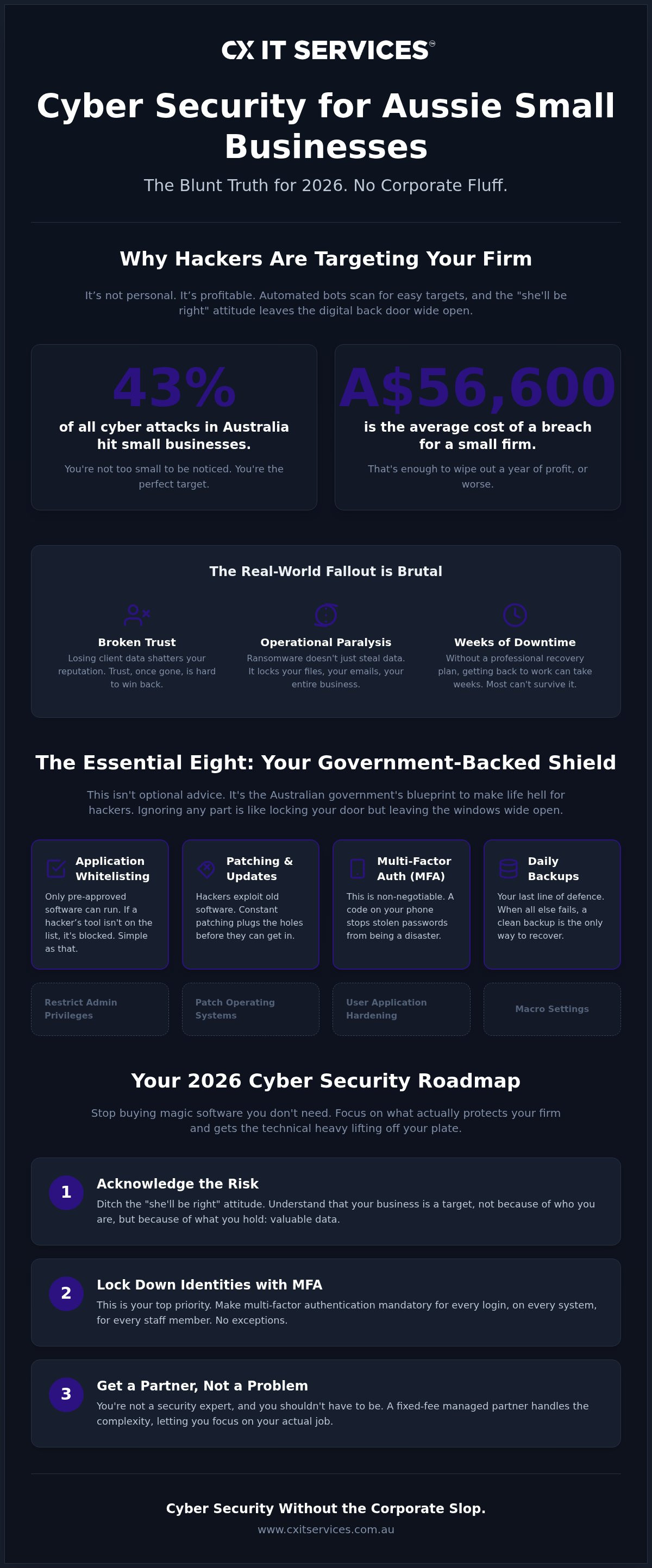
Did you know that 43% of all cybercrime in Australia targets small businesses just like yours? It's a grim reality. When you look at cyber security for small business Australia, the numbers are confronting. Last financial year, the average self-reported cost of a breach for a small firm hit A$56,600. That's not a rounding error. It's often enough to wipe out a year of profit or force a local practice to close its doors for good.
I know you're likely fed up with IT providers who talk in circles or try to scare you into buying magic software you don't understand. It's exhausting trying to keep up with conflicting technical advice while you're busy running a firm. You want peace of mind, not a lecture in binary. You deserve to know your data is safe without having to become a part-time security expert yourself.
This guide gives you the blunt truth for 2026. I'm stripping away the corporate fluff to show you exactly what matters right now. We'll look at the transition from the Essential Eight to the new Essentials series and how to protect your operations without the usual headache. It's time to get the technical heavy lifting off your plate so you can focus on your actual job.
Key Takeaways
- Understand why the "she will be right" attitude is the biggest risk to your firm and how hackers exploit that mindset.
- Learn how the Essential Eight framework provides a practical, government-backed shield to keep your sensitive data out of the wrong hands.
- Discover why proactive cyber security for small business Australia is a financial necessity when the average breach costs local firms over A$56,600.
- Get a clear 2026 roadmap that prioritises locking down user identities and MFA over buying expensive software you do not need.
- See how a fixed-fee managed partner takes the technical heavy lifting off your plate so you can focus on running your business.
Why Aussie Small Businesses Are the New Favourite Target for Hackers
Personally I reckon the biggest risk to Aussie firms isn't some hooded genius in a dark room. It's the "she will be right" attitude we carry around like a badge of honour. We think we're too small to be noticed. We're wrong.
Hackers love small businesses because their digital back doors are often left wide open. They know you don't have a dedicated room full of IT staff. They know you're busy with clients and paperwork. To a criminal, your customer data is pure gold on the dark web. It's names, addresses, and tax file numbers that can be sold or used for identity theft.
The landscape has changed. Automated bots don't care if you have five staff or five hundred. They just scan the internet for vulnerabilities. If your front door is unlocked, they walk in.
The Myth of Being Too Small to Target
These automated attacks make every IP address a potential victim. Hackers aren't always picking you out by name. They're just fishing. They want those Australian business bank accounts and tax records because they're high value. Understanding What is Cybercrime? helps you realise it's a massive global industry now. It's not just a hobby for bored kids.
There is also the "supply chain" angle. You might be a small accounting firm, but you work for a big construction company. Hackers use you as a stepping stone to get to the bigger fish. You're the weak link in their chain. By ignoring cyber security for small business Australia, you're not just risking your own firm. You're risking every partner you work with. To see how international regulatory standards are shifting in this area, read more about strategic perspectives on supply chain due diligence.
Real World Consequences for Local Firms
The fallout is brutal. Imagine having to call every one of your clients to tell them their private financial details are gone. That reputational hit is hard to recover from. Clients trust you with their lives. Once that trust is broken, they'll find someone else who takes their privacy seriously.
Then there is the operational paralysis of a ransomware attack. It doesn't just steal data; it locks your entire system. No emails. No files. No work.
I've seen it happen. Without a professional backup and a solid plan for cyber security for small business Australia, recovery takes weeks. Most firms can't survive that kind of downtime. It's not just about the money. It's about the sheer stress of losing control over the business you built from the ground up.
The Essential Eight and What Actually Protects Your Data
If you want a blueprint that actually works, look no further than The Essential Eight. It is the gold standard for cyber security for small business Australia. The Australian Signals Directorate (ASD) designed these strategies specifically to make life hard for hackers. As of 2026, the ASD is beginning to transition to a new "Essentials series," but the Eight remains the foundation you cannot ignore. Personally I reckon the biggest mistake firms make is picking and choosing which parts to follow. Most firms only do two or three of these and wonder why they still get hit with ransomware. It is like locking your front door but leaving the windows wide open and the garage door up. You don't have to do all eight by tomorrow morning. But you do need a clear plan to get there.
The Core Pillars of Aussie Cyber Defence
Application whitelisting sounds like technical jargon. In plain English, it just means your computers are told to only run approved software. If a hacker tries to run a dodgy script or a piece of malware, the system simply refuses to open it. Next is patching applications and operating systems. Hackers love old software with known holes because it is easy to exploit. Patching is just the process of plugging those holes before a criminal finds them. Finally, there is multi-factor authentication (MFA). This is non-negotiable in 2026. If you aren't using a code on your phone to verify your login, you are practically inviting someone to steal your business identity.
Moving Beyond the Basics in 2026
Backups are your absolute last line of defence. When everything else fails and a virus gets through, you need a clean copy of your data to start over. But a backup alone isn't a strategy. You need disaster recovery to act as the bridge back to normal operations. It is the difference between being back at work in four hours or being offline for four weeks. Then you have your people. Your staff are either your weakest link or your best sensors. One wrong click on a fake invoice can bypass the best security software in the world. Regular, blunt training turns them into a human firewall that spots trouble before it starts. Getting your cyber security for small business Australia right doesn't have to be a nightmare if you take it one step at a time. If you're worried your current setup is full of holes, you can have a chat with our team to see where you actually stand.
The True Cost of Cybercrime in Australia: Self-Managed vs Managed Security
Personally I reckon trying to manage your own security is like trying to fix your own plumbing with a YouTube video. It looks easy enough on the screen until your office is literally underwater. For an Aussie firm, that "water" is a data breach that costs, on average, A$56,600 according to the latest figures. That is not a theoretical number. It is a massive hit to your cash flow that can sink a small practice overnight. Proper cyber security for small business Australia is not an optional extra anymore. It is an insurance policy for your survival.
Managed security is about moving from a "break-fix" mindset to a proactive one. Fixed monthly fees mean you know exactly what you are paying to keep the lights on and the hackers out. You aren't waiting for a disaster to happen before you call for help. You are paying for a safe pair of hands to ensure the disaster never happens in the first place.
The Hidden Costs of the DIY Approach
The true price of the DIY approach is often hidden in the gaps between your tools. You might buy three or four "cheap" security apps, but if they do not talk to each other, you have blind spots. Then there is the cost of staff downtime. Every hour your team spends trying to figure out a technical glitch or a suspicious email is an hour they aren't billing clients. For those in the legal or financial sectors, the risk of non-compliance with legal practice IT security standards can lead to professional indemnity nightmares. The Australian Government's cyber security guide makes it clear that the responsibility for data protection rests squarely on the business owner.
Predictable Spending with Managed IT
A managed IT support model is the only way to remove "bill shock" from your life. You shouldn't have to choose between patching a critical security hole and making payroll because of an unexpected IT invoice. By bringing in a virtual CIO, you can plan your technology budget years in advance. This strategic oversight ensures you are investing in the right tools at the right time. Proactive monitoring is cheaper than reactive repairs every single time. It is the difference between a routine service and a total engine failure on a major highway during peak hour. Investing in cyber security for small business Australia through a managed partner keeps your operations smooth, predictable, and, most importantly, secure.
Your 2026 Cyber Security Roadmap: Practical Steps to Lock Your Digital Doors
Personally I reckon the best way to start is by figuring out what you actually have. Most Aussie firms are flying blind. They have staff using personal Dropbox accounts or unapproved AI tools that leak data like a sieve. This is called shadow IT. It is a massive risk for cyber security for small business Australia because you cannot protect what you cannot see. You need a proper audit before you spend a single cent on new software.
Once you have a list, you need to lock down identities. If you are not using MFA on everything, you are asking for trouble. It is that simple. You also need to get your Microsoft 365 house in order. Many firms leave the default settings on. That is like leaving the keys in the ignition of a brand new ute and hoping for the best. We tighten those settings so only the right people get in.
Step 1: Audit and Identity Management
Implementing a zero-trust approach is the next logical step. This means your network never assumes a login is safe just because it has the right password. It verifies every single request. We also look closely at domain and DNS management to stop email spoofing. If your DNS is not configured correctly, hackers can send emails that look exactly like they came from your CEO. It is the easiest way to trick a staff member into paying a fake invoice.
Step 2: Technical Hardening and Monitoring
You need an enterprise-grade firewall. A home router from a big-box retailer is fine for Netflix, but it is not enough to protect a law firm or a medical clinic. You need hardware that can inspect traffic in real-time. This works alongside 24/7 security monitoring, where commercial technology specialists like Terapixels Systems deploy remote monitoring management to identify and mitigate cyber threats before they escalate. Hackers do not work nine-to-five. They often strike at 2:00 AM on a Sunday when they think nobody is watching. Proactive monitoring ensures someone is always on the tools.
For firms with remote teams, cloud infrastructure management is the final piece of the puzzle. It keeps your data secure whether your staff are in the office or working remotely from home. It ensures that the same strict security rules apply everywhere. If you are ready to stop guessing and start securing your firm, you can book a security audit with our team to find your biggest gaps.
Cyber Security Without the Corporate Slop: How We Protect Your Firm
We do not do fluff. We do secure, reliable IT that lets you get back to work. Personally I reckon you have heard enough marketing buzzwords to last a lifetime. You need results, not a sales pitch wrapped in technical density. Our team is Australian owned and operated. We know the local landscape because we live and work in it every day. We have spent 26 years helping Aussie firms grow and stay safe.
We specialise in businesses with ten or more staff who need real results. These are the firms that have outgrown basic support but do not want the distant, cold feel of a global corporation. Our approach to cyber security for small business Australia is built on being a safe pair of hands. We provide a fixed monthly fee model. This model is the cure for unpredictable IT costs. There are no long-term contracts that trap you. We prefer to earn your business every single month through quiet competence and transparency.
The CX IT Services Difference
Experience matters when things go sideways. We have seen every possible challenge and have a refined process for handling them. Sometimes remote help is not enough to solve a complex issue. Our onsite support technicians get things sorted when you need a physical presence. With a national reach, we can support your business even if you have multiple offices across the country. Our fixed-fee model is built for your growth, not our profit margin. We do not profit from your downtime. We are incentivised to keep your systems stable and your data locked down tight.
Ready to Secure Your Future?
The first step is not a complex onboarding process. It is a simple conversation about where you are at right now. We will give you a straight answer on what you need and, more importantly, what you do not. We do not believe in selling you expensive tools that do not solve your actual problems. Cyber security for small business Australia should be practical and effective. It is about getting the basics right and having a partner who actually gives a toss about your firm. You can apply for a strategic security review today to find out exactly where your gaps are and how to close them for good.
Take Control of Your Firm's Digital Safety
Securing your firm in 2026 isn't about buying every piece of software on the market. It's about getting the fundamentals right. You need to lock down your identities with MFA and follow the clear roadmap provided by the Essential Eight framework. Personally I reckon the peace of mind that comes from knowing your client data is safe is worth far more than the cost of any recovery effort.
You don't have to navigate these technical hurdles alone. We've been Australian owned and operated for over 26 years. Our model focuses on fixed monthly fees with no hidden surprises and 24/7 national support for total peace of mind. Getting your cyber security for small business Australia sorted once and for all means you can finally stop worrying about hackers and get back to your actual work.
If you're ready for a partner who handles the technical heavy lifting without the corporate slop, let's have a straight conversation about your needs. Apply for a strategic security review with our Aussie team. Your business is too important to leave to chance. Let's get it locked down.
Frequently Asked Questions
Is cyber security really necessary for a small business in Australia?
Yes, it is absolutely vital for your survival. With 43% of Australian cybercrime targeting small firms, thinking you are too small to be a target is a dangerous myth. The average self-reported cost of a breach is now A$56,600. With over 26 years of experience, I have seen that this is often enough to wipe out a year of profit or force a local practice to close permanently.
What is the Essential Eight and why does my business need it?
The Essential Eight is a set of baseline mitigation strategies designed by the Australian Signals Directorate to protect against common cyber threats. It focuses on practical steps like multi-factor authentication and patching applications. While the government is beginning a transition to the new "Essentials series" in 2026, the Eight remains the foundation for cyber security for small business Australia. Implementing these strategies makes it significantly harder for hackers to find a way in.
How much does professional cyber security management cost?
Professional management is typically structured as a recurring monthly subscription fee based on your staff numbers. This fixed-fee model provides the predictable costs that growing firms need to avoid bill shock. While I cannot give you a generic quote here, it is always cheaper than the alternative. When you compare a monthly fee to the A$56,600 average cost of a breach, the investment in cyber security for small business Australia pays for itself.
Can I just use basic antivirus software to protect my business?
No, basic antivirus is no longer enough to protect a professional firm in 2026. Modern hackers use sophisticated identity theft and "living off the land" techniques that bypass traditional scanners. You need a multi-layered approach that includes application whitelisting, 24/7 monitoring, and strict identity management. Antivirus is just one small part of a modern security stack. Relying on it alone is like putting a deadbolt on the front door but leaving the back door open.
What should I do if I think my business has been hacked?
Disconnect the affected device from the internet immediately but do not turn it off. Turning it off can destroy the digital evidence needed to find out what happened. Call your IT provider straight away. You will need to change passwords on uncompromised devices and check if you are required to notify the OAIC under the Notifiable Data Breaches scheme. Reporting the incident to the Australian Cyber Security Centre is also a critical step.
How often should my business perform a cyber security audit?
You should perform a comprehensive security audit at least once a year. However, you should also trigger a review whenever you make significant changes, such as moving to new cloud services or hiring a large group of staff. While our managed services include 24/7 proactive monitoring, a formal audit is a deeper dive. It identifies shadow IT and hidden vulnerabilities that might have crept into your network as your business has grown.
Does my business insurance cover cyber attacks and ransomware?
Standard business insurance policies usually do not cover cyber incidents or ransomware payments. You generally need a specific cyber insurance policy for that. Be aware that insurers in 2026 are much stricter than they used to be. Most now require proof that you have implemented multi-factor authentication and other Essential Eight strategies before they will offer you a policy. If your security isn't up to scratch, you might find yourself completely uninsurable.
How do I train my staff to be more cyber aware?
Regular, short training sessions beat a long annual lecture every time. Your staff are your first line of defence, so they need to know what a modern dodgy email actually looks like. Use phishing simulations to test their reactions in a safe environment. Encourage a culture where reporting a suspicious link is rewarded rather than punished. When your team knows the blunt truth about the risks, they become your most effective security sensors.





 Microsoft Partner