
Need website design and SEO services Melbourne businesses can rely on? Ditch empty ranking promises and build a site that attracts real, paying enquiries.
What if the problem isn’t your website’s age, but the fact that its design and SEO were handled as separate jobs? Personally, I reckon website design and SEO services Melbourne businesses can put to work need to start with the same goal: helping the right customers find you, understand what you do and take the next step.
A dated site or a trickle of unhelpful enquiries is frustrating enough. It’s harder when you can’t tell whether the website structure is helping search visibility, or whether anyone is measuring progress beyond rankings. You don’t need a promise of a number-one spot. You need a clear plan and useful signs that the work is moving in the right direction.
This guide explains how website structure, content and practical SEO support each other, what to look for when assessing progress, and how to make the project manageable for your business. CX IT Services is Australian-owned, based in Melbourne and brings over 26 years of industry experience. The focus here is straightforward: build a website around customers first, with SEO foundations considered from the start.
Key Takeaways
- Good website design builds trust and makes it easier for customers to act. SEO helps the right people find the pages they need.
- With website design and SEO services Melbourne businesses can plan together, site structure and useful page content can support both visitors and search visibility.
- Track whether relevant pages are being found, then compare that with practical outcomes such as enquiries. A ranking promise alone won’t tell you if the site is working.
- A clear project moves from business goals and page planning through content, build, review and monitoring, with local details included where they help customers.
- CX IT Services brings website design and SEO together with practical technology experience, helping businesses consider their website within the wider systems they rely on.
What should website design and SEO services in Melbourne deliver?
I’d define integrated website design and SEO as planning a business website so its structure, content and visitor experience support both search discovery and useful action. For website design and SEO services Melbourne businesses rely on, I’d expect design to make the business easier to understand and the site easier to use, while SEO helps relevant customers find the pages they need.
I don’t see these as separate jobs. A polished page that makes key information hard to find can frustrate visitors. A page written around search terms without a clear purpose won’t give a potential customer much reason to stay. I’d want both sides considered together, without pretending either guarantees rankings, enquiries or revenue.
What does website design cover for a business site?
I’d look at how the site organises its information and guides visitors. That includes page structure, navigation, layout, mobile usability and clear calls to action. Someone arriving on a service page should be able to understand what the business does, find relevant details and see a sensible next step without having to hunt around.
For example, I’d expect a visitor to get enough context on a service page to decide whether it fits, then find a clear way to enquire or take another useful action. That doesn’t mean squeezing every detail onto one page. I’d organise the information so it’s easy to follow and related pages are easy to reach.
I see website design and SEO as a way to bring those decisions together, so the layout helps people use the information rather than just admire it.
What does SEO contribute to a Melbourne website?
I’d expect SEO to help search engines understand what a website and its pages cover, so they can be considered for relevant searches. Clear page structure, descriptive headings and useful content all help explain what each page offers. For a broader overview of the discipline, I’d point readers to Search Engine Optimization (SEO).
For local relevance, I’d make sure the business describes its services accurately and makes its location information easy to understand. If it serves particular parts of Melbourne, I’d include those details where they help customers decide whether the business is relevant. I wouldn’t scatter suburb names across a page just for the sake of it.
My measure of useful website design and SEO services Melbourne is whether the site becomes easier to find and easier to use. I’d treat search visibility as one signal and qualified enquiries as a business outcome. Neither a new design nor SEO alone guarantees rankings, enquiries or revenue. I’d set practical goals, then review visibility and enquiries over time instead of treating a launch or ranking promise as proof of success.
How website design and SEO work together from the outset
The useful work starts before anyone chooses colours or adjusts a layout. First, get clear on what the business needs the website to do and what a customer needs to understand before taking action. That gives the site a job to do, rather than leaving design and SEO to pull in different directions.
For website design and SEO services Melbourne businesses can use effectively, planning should connect customer questions to clear pages. A professional services firm, for example, might need separate pages for distinct services, with enough detail on each for a potential client to understand the offer. A page for every keyword is rarely the answer. If two pages repeat the same information, visitors may struggle to tell them apart too.
Plan pages around real customer questions
Start with the services customers need to understand, the questions they’re likely to ask, and the next step they may take. Group related information logically. A visitor looking for one service shouldn’t have to sift through unrelated material to work out whether it’s relevant. Add Melbourne or service-area references where they clarify who the business serves, not as a string of suburb names bolted onto the page.
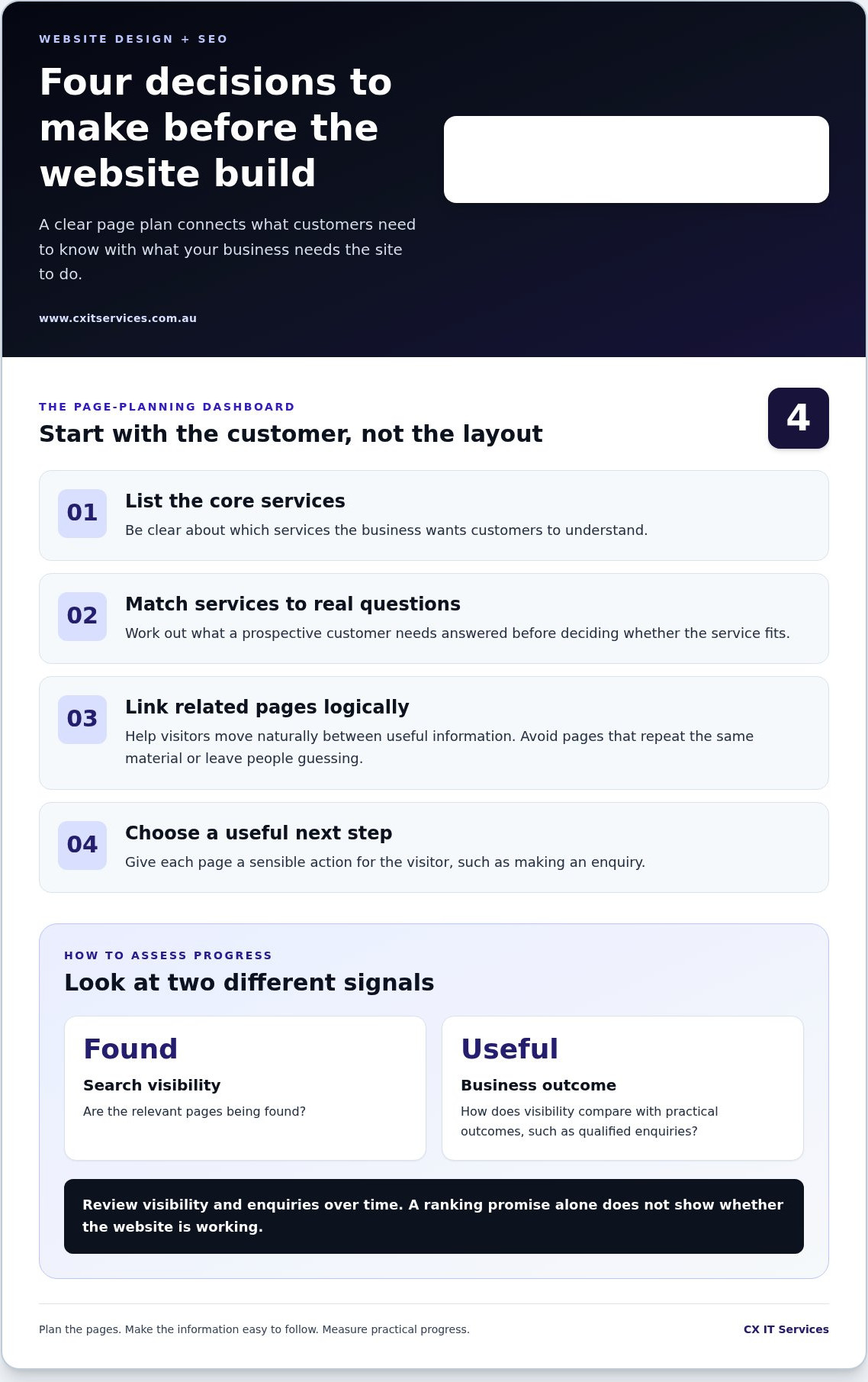
A simple page plan can make decisions easier:
- List the core services the business wants customers to understand.
- Match each service with the questions a prospective customer needs answered.
- Decide which pages need to link together so visitors can move naturally between related information.
- Choose a useful next step for each page, such as making an enquiry.
This structure gives content and design a shared starting point. It also helps avoid late changes that can happen when important pages are discovered only after the layout is underway.
Build useful SEO foundations into the design
Clear structure helps people navigate a site and helps search engines interpret what each page covers. Page hierarchy gives important information a logical place. Descriptive titles and headings tell readers what they’re looking at, while relevant copy explains the service in plain language. Navigation should make the main pages easy to reach, and mobile usability matters because people may visit from a phone while comparing options or trying to get in touch.
Technical foundations matter too, but they don’t need to become a mystery tour of jargon. The site should be organised so its pages can be accessed and understood, with a layout that remains usable across screen sizes. For a broader set of design considerations, Web Design Best Practices covers practical topics such as navigation and mobile usability.
Useful website design and SEO services bring these decisions together early, so a page isn’t designed first and made search-friendly as an afterthought. If you’re working out what your own site needs to support, you can share a few details about your project as a starting point.
How to assess website design and SEO results without buying into hype
A sharp-looking website launch is a start, not proof that the site will appear in search or bring in useful enquiries. I’d judge the work against the business’s goals and a clear starting point, not a bold promise or someone else’s growth story. SEO outcomes depend on competition, the site’s condition, the usefulness of its content and the work that continues after launch.
Which measures help explain whether the work is progressing?
Look at different signals separately. Relevant organic visibility shows whether important pages are appearing for searches that matter. Engagement can help show whether visitors use those pages. Enquiries show whether the site is prompting action, while their quality tells you whether the people getting in touch are a good fit.
Tools such as Google Search Console and Google Analytics 4 can help monitor search visibility and site activity. They’re examples, not a result in themselves. Agree what matters before work begins, record the starting point, then review the same measures over time. For example:
- Visibility: Are the pages tied to priority services appearing for relevant searches?
- Engagement: Do visitors reach useful information or take a next step?
- Enquiries: Are people getting in touch about services the business actually wants to provide?
A rise in visits is not automatically good news if those visits don’t come from relevant customers. The connection between SEO and web design matters here: useful pages and a workable visitor experience need to support the same business objective. Choose measures that help you make a decision, not just numbers that look impressive in a report.
What can a website redesign and SEO project not promise?
No provider can responsibly guarantee a particular search ranking or revenue result. Search results depend on factors outside a designer’s control, and a design change alone can’t promise that visitors will enquire. Be wary of treating big growth claims as expected outcomes for your business. A result reported elsewhere doesn’t tell you what your own site will achieve.
Changes to pages or site structure may also need monitoring as search engines recrawl and reassess them. That’s a reason to keep an eye on important pages after launch, not a reason to panic over every short-term movement. Compare like with like, note what changed, and look for patterns across visibility and enquiries rather than judging the project on one day’s figures.
For businesses considering website design and SEO services Melbourne, sensible reporting should explain what was measured, what changed and what the next step is. CX IT Services provides website design and SEO for businesses looking to connect their website work with practical business goals. If you’re ready to outline what your site needs to do, you can share your project details.
A practical Melbourne website design and SEO project, step by step
I’d start a website project with the business decisions, not the design choices. First, I’d clarify what the site needs to achieve, then work through the pages, content, build and review. I wouldn’t assume every project follows the same schedule. Scope and timing depend on the business requirements, the current site and the work involved. A small update and a full rebuild are different jobs.
Prepare the business information and website structure
Before deciding what to change, I’d get clear on the priority services, the customers the business wants to reach, its locations and the action visitors should be able to take. I’d also review the current pages and useful content. Some material may still be accurate and worth keeping. Other pages might need updating, combining or removing.
I find that review helps avoid rebuilding useful information from scratch or carrying confusing pages into a new site. If domain settings or DNS are part of the project, I’d consider them alongside the website changes. Domain and DNS management may be relevant when the website address and related settings are part of the wider setup.
Next, I’d map pages around the services customers need to understand. I’d include Melbourne location or service-area details only where they help someone judge whether the business is relevant. Keep those details accurate. A location reference should clarify the offer, not just decorate a page.
Build, review and improve in stages
Once the page plan and content are clear, I’d build the site around them. Before launch, I’d review key pages and check that the navigation works, the content is clear and enquiry forms allow visitors to take the intended action. I’d rather catch a confusing route or missing detail before customers rely on the new site.
I see launch readiness and ongoing SEO improvement as related, but different. A site can be ready to use while still leaving room to improve its visibility and performance.
| Launch readiness | Ongoing SEO improvement |
|---|---|
| I’d check that priority pages and business information are in place. | I’d review how relevant pages perform over time. |
| I’d check navigation and enquiry actions before launch. | I’d use observed results to decide what content or pages may need attention. |
| I’d confirm the site is ready for customers to use. | I’d keep refining it as business needs and customer behaviour become clearer. |
After launch, I’d use monitoring to spot issues and inform sensible next steps, not to change pages just for the sake of activity. For website design and SEO services Melbourne businesses need, I’d want the project plan to explain what’s included, what depends on the current site and how progress will be reviewed. If you’re planning a project, send through your website project details to start the conversation.
Website design and SEO services in Melbourne with CX IT Services
I see website design and SEO as work that should start with the business’s needs, not a one-size-fits-all plan. CX IT Services provides both, and I’d keep the project focused on what the website needs to help customers understand or do. That might mean making a service clearer, improving the path to an enquiry, or reviewing how the website fits with the technology the business already uses.
Personally, I reckon a local perspective is most useful when it keeps the project grounded in day-to-day business needs. A professional firm may need its website to explain its services clearly and help prospective clients decide whether to make an enquiry. I wouldn’t start with assumptions about what the site needs. I’d first understand what isn’t working, what customers need to know and what a practical outcome would look like.
A Melbourne technology partner for website and SEO work
I’d keep the discussion centred on the website project while taking the wider technology environment into account where it’s relevant. That context can help frame practical questions about how the website fits the business, without turning the conversation into a pitch for unrelated technology work.
I wouldn’t expect you to arrive with a technical specification. I’d find it more useful to hear what’s not working, which customers you want to reach and what you want them to do on the site. From there, we can discuss scope and realistic expectations. I wouldn’t promise a fixed search position or revenue result.
If you’re weighing up website design and SEO, I’d use your current site and business priorities to make the first discussion specific.
What to bring to an initial project conversation
I’d suggest bringing a few practical details. No polished brief needed. A rough picture of the project is enough to start:
- Your current website: I’d ask which pages feel dated, unclear or difficult to use.
- Priority services: I’d want to know what the site needs to explain clearly.
- Target customers: I’d ask who you want to reach and what they need to know.
- Business goals: I’d discuss what a useful outcome would look like for your business.
- Location details: I’d clarify where you operate and which service areas matter to customers.
With those details, I can have a more useful conversation about scope and priorities without guessing at costs or timelines. Apply to discuss your website design and SEO project.
Make your next website decision a practical one
A website project doesn’t need to begin with a grand redesign. Start with the part that’s getting in the way. Maybe customers can’t tell which service fits, or the site gets visits but few useful enquiries. A clear priority gives the work somewhere to start and makes it easier to judge whether the proposed scope makes sense.
That’s the useful question to take into a discussion about website design and SEO services Melbourne businesses need: what should the site help your customers understand or do? Keep the answer grounded in your business, not in promises of guaranteed rankings or overnight growth. From there, you can discuss what needs attention first and what progress should look like.
If you’re ready to talk through your priorities, apply to discuss your website design and SEO project. Bring the questions you have, even if the plan isn’t fully formed yet. A sensible next step is enough to get moving.
Frequently Asked Questions
Is SEO included in website design services?
It can be, depending on the project scope. A design project may consider search foundations alongside the site’s layout, including how priority services are organised and explained. Before work starts, decide what the website needs to support, such as helping customers find a particular service or make an enquiry. Then assess whether the agreed work is addressing those aims. A new design alone won’t guarantee search rankings.
How much do website design and SEO services cost in Melbourne?
There’s no single fee that fits every website design and SEO project. Costs depend on the size and condition of the current site, how many pages need attention and the SEO work involved. For website design and SEO services Melbourne businesses should start by outlining their goals and priority pages. CX IT Services can use that context through its application page to discuss the project scope, without guessing at a figure before the requirements are clear.
How long does a website design and SEO project take?
The timeframe depends on the agreed scope. A site with a small number of changes is different from a project involving extensive content, many pages or more involved technical work. The review process can also affect the schedule, particularly if several people need to approve content. SEO work doesn’t simply stop at launch, either. Ongoing monitoring can show where further attention is useful once the site is live.
Can SEO help a Melbourne business attract local customers?
Yes, local SEO can help make a business’s services and operating area clearer to people searching nearby. Keep business details accurate and explain where the business actually works. CX IT Services serves businesses in Melbourne, Brisbane and Sydney, so location information should reflect the relevant city and service area rather than being copied indiscriminately across pages. Repeating suburb names without helping customers understand the offer won’t guarantee visibility or enquiries.
Does a new website guarantee a first-page Google ranking?
No. A redesign can make a business’s services easier to understand, but it can’t promise a first-page position. Search visibility can be affected by competition, the condition of the site, the relevance of its content and the work done over time. Be cautious about claims that promise a particular ranking or timeframe. A more useful approach is to set realistic search objectives and review how relevant pages perform after launch.
Should I redesign my website before starting SEO?
Not necessarily. First look at whether the existing site can support the business’s needs. If customers can use it easily and its key pages explain services clearly, targeted updates may make more sense than a full rebuild. If the site is difficult to navigate or important information is buried, design changes may be worth considering. CX IT Services can discuss the website and SEO requirements together, based on the current site.
What should I prepare before discussing website design and SEO?
Bring your website address, a short description of your priority services, the customers you want to reach and what you’d like visitors to do. It also helps to identify pages that cause confusion or don’t reflect the business as it is now. You don’t need technical specifications or a polished project brief. Plain business context is enough to start a practical conversation about scope and possible outcomes.





 Microsoft Partner