
A solid vulnerability assessment for business networks cuts through noise. Learn what to test, what to skip, and how to sort real security risks first.
Personally, I’ve seen a long list of vulnerabilities leave a business unsure what to fix first. A useful vulnerability assessment for business networks shows which weaknesses matter, where they sit and what action to take next.
It’s fair to ask what an assessment tests and whether scanning could disrupt systems your team relies on. The answer depends on the scope and approach. A good assessment makes clear what was checked, what was excluded and where automated results need context. A scan isn’t a simulated attack, and it can’t prove your network is completely secure.
This guide explains what an assessment can cover, how to compare approaches and how to turn findings into prioritised work with clear owners. You’ll also find practical questions to settle before testing begins. No panic over every technical alert. Just a clearer path from identifying risk to reducing it.
Key Takeaways
- A vulnerability assessment for business networks should connect technical weaknesses to the systems and business activities they could affect.
- Automated scans can flag possible issues. Analyst review helps validate findings and separate practical risks from noise.
- External, internal and broader assessments cover different parts of your environment. Choose the scope to match the question you need answered.
- Before testing, identify critical systems, business owners, access needs, exclusions and acceptable testing windows.
- A useful report gives you clear priorities and a way to assign remediation, not just a pile of technical alerts.
What a Vulnerability Assessment for Business Networks Should Actually Tell You
Personally, I reckon the useful question isn’t how many vulnerabilities an assessment finds. It’s whether you can tell which weaknesses matter to your systems and what to do next. A vulnerability assessment is a structured review of systems and networks to identify and evaluate security weaknesses.
A vulnerability assessment identifies and evaluates weaknesses. A penetration test attempts to exploit selected weaknesses to demonstrate their impact. They answer different questions. An assessment helps map and prioritise issues. A penetration test goes further by simulating an attack within an agreed scope. The term vulnerability in computer security refers to a weakness that could be used to compromise a system or its information.
What can a business network vulnerability assessment examine?
Depending on the agreed scope, a vulnerability assessment for business networks may examine routers, firewalls, servers, staff computers, other endpoints and services exposed to the internet. It may also include internal networks and cloud services. These areas matter for different reasons. A weakness on an internet-facing system presents a different kind of exposure from one on a staff device behind the office network.
Coverage depends on what’s included, what access is available and how the assessment is carried out. A review limited to internet-facing systems won’t tell you much about internal devices it never examines. Cloud services and third-party connections need deliberate consideration too. If your team uses an external provider to access or store business information, that connection may be relevant to the scope, even though the provider’s systems aren’t yours to test.
Before setting the scope, list the systems your staff rely on for essential work. Include services that hold sensitive information, support client work or connect your business to outside providers. If your teams work across Melbourne, Brisbane and Sydney, note which systems and locations are connected. That gives the assessment business context, not just a technical asset list.
What an assessment can and cannot prove
Assessment findings describe weaknesses identified during a defined review. They show what was found in the systems examined at that time, using the access and methods agreed for the work. Systems change, new weaknesses emerge and assets can sit outside the review. No assessment can prove that every vulnerability has been found or that a network is secure.
A technical finding, by itself, doesn’t tell you the full business risk. A weakness on a system that supports a critical business process may need faster attention than a similar issue on a low-impact device. The right response depends on the system’s role, the information it handles, who can reach it and what could happen if it were compromised.
I’d treat the findings as a decision aid, not a pass-or-fail verdict. A useful report explains what was identified, where the limits of the review sit and which issues deserve action first. From there, the findings can inform practical cyber security planning, with technical work tied back to the systems and operations your business needs to protect.
How Network Vulnerabilities Are Found, Validated and Prioritised
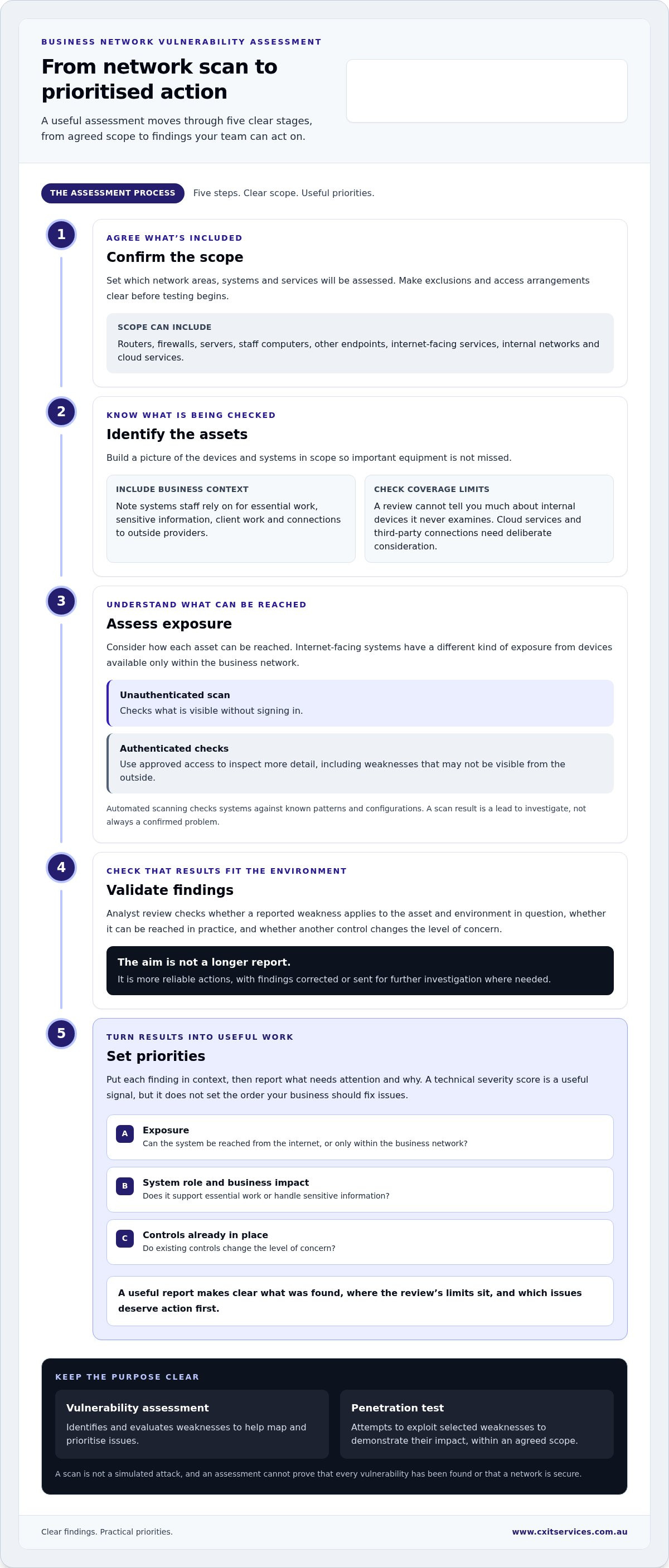
Personally, I reckon an assessment is judged by what a business can do with the findings, not by how long the list is. The process should move from agreed scope to identified assets, exposure checks, validation and clear priorities. Skip those steps and it’s easy to end up with technical alerts but no sensible next move.
- Confirm the scope. Agree which network areas, systems and services are included, along with exclusions and access arrangements.
- Identify the assets. Build a picture of the devices and systems being assessed so important equipment isn’t missed.
- Assess exposure. Consider how each asset can be reached, including whether it’s exposed to the internet or available only within the business network.
- Validate findings. Review reported weaknesses to check that they apply to the asset and environment in question.
- Set priorities. Put findings in context, then report what needs attention and why.
Scanning, authenticated checks and validation
Automated scanning checks systems against known patterns and configurations. It can cover ground quickly, but a result is a lead to investigate, not always a confirmed problem. An unauthenticated scan sees what’s visible without signing in. Authenticated checks use approved access to inspect more detail and can reveal weaknesses that aren’t visible from the outside. The access used affects what the assessment can see.
Analyst review adds context. It helps determine whether a result applies to the system, whether it can be reached in practice and whether another control changes the level of concern. Review can also identify findings that need correcting or further investigation. The aim isn’t to make the report longer. It’s to make the actions more reliable.
Turning technical severity into business priority
A severity score is a useful signal, but it doesn’t account for everything your business needs to weigh. A severity score describes a technical weakness, not the order your business should fix it. Prioritisation should also consider exposure, the system’s role, potential business impact and controls already in place. A weakness reachable from the internet may need prompt attention. So might one in a system that supports essential work.
For example, imagine one finding with a higher technical score on a device used for a limited internal task, and another with a lower score on a server that supports client appointments or financial records. The second issue may deserve earlier review if that server is widely accessible or disruption would affect daily operations. Existing safeguards matter too, but they don’t automatically make a weakness irrelevant.
For each finding, look for a plain-language explanation of the affected asset, how it’s exposed, why it matters and what action is recommended. A conversation about your cyber security priorities can help connect assessment findings with the practical work needed to address them.
Comparing Vulnerability Assessment Approaches for Business Networks
The right assessment scope depends on the question you need answered. Are internet-facing services exposed? Could a weakness inside the network put key systems at risk? Do you need a wider view across cloud services and connected environments? A scan-only report may list issues, but a useful comparison starts with what was checked, what was out of scope and what the results mean for your business.
External, internal and broader-scope assessments
An external assessment looks at systems and services reachable from outside your business. An internal assessment examines network exposure from within and can reveal weaknesses an outside view won’t show. A broader assessment can include more environments, but only where access and boundaries are clearly agreed. Cloud platforms and third-party connections need particular care. The scope should distinguish your environment from systems managed by someone else.
| Approach | Coverage | Access required | Useful when | Important limitation |
|---|---|---|---|---|
| External perimeter review | Internet-facing services and network entry points | Information about public-facing assets; internal access may not be needed | You want to understand what an outsider can see or reach | It can’t show weaknesses that are only visible inside the network |
| Internal network assessment | Systems and devices within the agreed internal scope | Suitable internal network access | You want to examine exposure between internal systems | It may not assess external services or environments outside the agreed scope |
| Broader scoped assessment | Selected external, internal, cloud or connected environments | Access and permissions for each included environment | You need a wider view across business-critical systems | More scope only helps if boundaries, access and exclusions are clear |
Use the business question to guide your choice. If you’re concerned about services exposed to the internet, an external view may be the right starting point. If you’re concerned about how weaknesses inside the network could affect essential systems, internal coverage matters. A vulnerability assessment for business networks can combine approaches, but broader isn’t automatically better. Unclear scope can leave important gaps hidden in plain sight.
Vulnerability assessment or penetration test?
A vulnerability assessment identifies and evaluates weaknesses. A penetration test attempts controlled exploitation within an agreed scope to show whether selected weaknesses could be used to gain access or affect systems. Neither approach is universally superior. The useful choice depends on your objective, the systems involved and the risk question you need answered.
For Australian businesses, the Australian Cyber Security Centre’s Essential Eight guidance can help inform broader security priorities. It’s a baseline for thinking about protective measures, not a rule that every business must use a particular assessment approach. Keep the distinction clear: guidance can help shape priorities, while an assessment examines the systems and scope agreed for the review.
How to Scope an Assessment and Make Its Findings Actionable
Personally, I reckon the useful work starts before anyone runs a scan. Set the business objective first, then agree what’s in scope, who needs to provide access and what the final report must help you decide. That stops the assessment becoming a technical exercise with no clear owner at the end.
- Set the objective. Name the question you need answered, such as whether key systems are exposed or a planned change has introduced weaknesses.
- Define the scope. List the systems, network areas and locations included. Identify critical systems, the business owners responsible for them and any operational dependencies.
- Agree access. Confirm what access is needed, who will arrange it and how it will be used. Include cloud services and third-party connections only with clear boundaries and permissions.
- Record exclusions. State which systems or activities are out of scope and why. This matters for sensitive systems, supplier-managed environments and services where testing could affect operations.
- Plan timing and reporting. Identify acceptable testing windows and periods to avoid. Agree what the report should show, including affected assets, evidence, business impact, priority and a practical next action.
Agreeing scope without disrupting business
Scope, timing and access all shape an assessment. A critical system may need a carefully planned window, while a supplier connection may need explicit approval before it’s included. Involve people who understand the day-to-day work, not just the IT contact. They can flag dependencies such as client appointments, financial processing or shared services that need extra care. Don’t treat an assessment as automatically risk-free.
Clear exclusions matter too. If a cloud environment or supplier system isn’t included, say so plainly in the scope and report. Otherwise, someone may assume it was checked when it wasn’t. A vulnerability assessment for business networks is useful only when everyone understands which parts of the environment the findings cover.
Remediation, ownership and retesting
A finding without an owner is just another item in a report. Assign each significant issue to someone who can coordinate the fix, agree a target date based on priority and record the next action. That might be a configuration change, an update or a decision to investigate further. The right response depends on the affected system and business impact.
Retesting can help confirm whether selected fixes addressed the findings. It doesn’t replace ongoing security work, but it closes the loop on specific actions. Managed IT support can help keep remediation connected to operational work, while broader cyber security planning can link assessment findings with wider security priorities.
If you’re mapping assessment findings to practical next steps, start a conversation about your IT and security needs.
Choosing a Business Network Assessment Partner and Planning What Comes Next
A useful assessment relationship doesn’t end when a report lands in your inbox. The work needs a clear scope, findings you can understand, priorities tied to business risk and a sensible way to follow through. Personally, I’d look for more than a long list of technical alerts. I’d want to know what each issue affects, why it matters and what decision or action comes next.
What to expect from a useful assessment relationship
Before work starts, expect clear communication about boundaries, access, timing and exclusions. The reporting should explain technical findings in business language. If a finding affects a system your staff need for client work, the report should make that connection clear, rather than leaving you to translate jargon afterwards.
Remediation needs an owner. A finding should lead to a practical next step, an accountable person or team and a way to track progress. Some fixes may sit with your internal IT team; others may involve a managed service or third-party provider. Managed IT support can help connect that operational work with the systems your business relies on.
From assessment findings to ongoing security management
Use the findings to inform broader planning, not just to close individual items. If several issues point to the same weakness in how systems are configured or maintained, that pattern may deserve attention alongside immediate fixes. Link the priority list to your IT plans, business owners and review process so security work doesn’t vanish once the report has been filed.
CX IT Services is Australian-owned and operated, with more than 26 years of industry experience and support for businesses across Australia. Its cyber security and managed IT services provide a practical basis for ongoing security work. The aim is to connect technical findings with the work of managing and protecting business systems, without treating one assessment as a promise of complete security.
For broader planning, cyber security services can help connect assessment priorities with wider security work. Bring the scope, key concerns and any findings you already have into the discussion.
Apply to discuss your business IT and security needs.
Make Security Work Part of the Plan
Personally, I reckon the real value of a vulnerability assessment shows up after the report, when the work becomes part of how your business manages change. New systems, staff access and supplier connections can all shift what needs attention. Security shouldn’t be a once-and-done job that gets dusted off only when something goes wrong.
Use your next planning conversation to decide who tracks security actions, how changes to important systems are reviewed and when priorities should be revisited. That gives your team a practical way to keep risk visible without turning every technical alert into an emergency.
A vulnerability assessment for business networks can be a useful starting point. The next step is to connect your questions about the systems you rely on with the IT and cyber security support your business needs.
Apply to discuss your business IT and cyber security needs and take the next step towards a clearer, more manageable security plan.
Frequently Asked Questions
Is a vulnerability assessment the same as a penetration test?
No. A vulnerability assessment identifies and evaluates weaknesses, while a penetration test attempts to exploit selected weaknesses within an agreed scope. Think of the assessment as a way to build a picture of potential issues, and the penetration test as a controlled check of whether specific issues could be used to gain access or affect systems. The right choice depends on the question your business needs answered.
Can a vulnerability assessment disrupt a business network?
It can, depending on the systems, assessment activity and timing. Some older or business-critical equipment may be more sensitive to network activity than other systems. Before work begins, identify services that can’t tolerate interruption, agree testing windows and decide how to handle unexpected effects. A clear plan helps manage disruption, but it’s sensible to treat operational impact as a risk to plan for, not something to dismiss.
How often should a business network have a vulnerability assessment?
There isn’t one interval that suits every business. Consider a review when major systems or network connections change, when you add a new internet-facing service or after significant remediation work. Your exposure and the importance of the systems involved also matter. A business with frequent technology changes may need to review its approach more often than one with a stable environment. Set a cadence that fits your risk and change patterns.
Does Australian law require every business to conduct vulnerability assessments?
No single rule requires every Australian business to conduct a vulnerability assessment. Requirements can depend on the organisation’s sector, contracts, customer commitments and other obligations that apply to its circumstances. A framework or insurer may also influence the security evidence a business is expected to maintain. If you need to determine what applies to your organisation, get advice specific to your legal and operating context rather than relying on a general rule.
How much does a vulnerability assessment for a business network cost?
There’s no single price that applies to every network, and this guide doesn’t provide a cost estimate. The scope, number and type of assets, access arrangements, assessment approach and reporting needs can all affect the work involved. Be clear whether the proposed work covers remediation or only identifies findings. A useful proposal explains what’s included and excluded, so you can compare the work being offered rather than just the headline figure.
Can a vulnerability assessment find every weakness in a business network?
No assessment can guarantee that it will find every weakness. Results depend on the assets included, the access available and the assessment approach. An unknown device, a system outside scope or a weakness that emerges later may not appear in the findings. Treat the results as a view of the environment assessed at that time, then revisit security when important systems or connections change.
What should a vulnerability assessment report include?
A useful report should let someone who wasn’t involved in the testing understand what was examined and what the findings mean. Look for the affected asset, supporting evidence, scope limits and enough detail for the technical team to investigate or reproduce the issue. It should also make clear which findings need attention first and what decision is required. An executive summary can help business leaders act without wading through technical detail.
Can small and medium-sized businesses benefit from network vulnerability assessments?
Yes. An assessment can help a smaller organisation direct limited IT time towards weaknesses that matter to its systems and operations. The scope can focus on the services and devices the business relies on, rather than attempting to examine everything at once. For a firm with staff in Melbourne, Brisbane or Sydney, agreeing which locations and connected systems are included helps make the results relevant to how the business actually works.





 Microsoft Partner