
Stop wasting cash on duplicate tools. Real technology alignment for business goals cuts software bloat and turns your IT setup into actual commercial profit.
Your IT setup should be driving profit, not just chewing through monthly cash. Personally, I reckon too many Australian firms don't have a tech problem, they have a commercial strategy problem. True technology alignment for business goals is a profit strategy, not a helpdesk ticket. You're probably sick of paying for duplicate software licences nobody touches, while your team battles clunky tools that grind daily work to a halt. It gets worse when your IT provider happily resets passwords all day but never once asks about your commercial objectives.
You can turn that dynamic around. In this guide, you'll discover how to audit your software stack, ditch costly bloat, and tie every single IT dollar directly to measurable commercial outcomes. We will walk through the exact steps to consolidate redundant systems, lower overheads, and build a predictable technology roadmap that protects your margins and scales cleanly with your business.
Key Takeaways
- True technology alignment for business goals turns reactive IT overhead into measurable operational leverage that supports actual revenue growth.
- A disciplined five-step stack audit exposes ghost SaaS subscriptions, eliminates tool sprawl, and cuts needless overheads.
- Strategic Virtual CIO guidance replaces the break-fix panic cycle, keeping long-term commercial targets at the centre of tech decisions.
- Treating cyber security as an active business protector guards your commercial balance sheet, regulatory standing, and client trust.
- Disciplined quarterly reviews and predictable monthly operational models end chaotic, unbudgeted IT spending once and for all.
What Technology Alignment for Business Goals Actually Means
Most business owners I speak with view IT as a necessary evil. A recurring monthly bill, an occasional headache, and a bloke you call when an email inbox stops working. That is break-fix thinking. It keeps you stuck treating computers like office plumbing instead of growth drivers.
In academic circles, experts refer to this integration as Business-IT alignment, but in practice, it is far simpler. True technology alignment for business goals means configuring your entire digital footprint to directly generate revenue, remove bottlenecks, and boost frontline staff efficiency. As I often tell executive teams, "Technology alignment turns overhead IT expenses into measurable operational leverage."
Growing professional service firms almost always end up with an accidental software collection. You hire ten new staff, bolt on three unvetted SaaS tools to solve immediate problems, and suddenly your operational backbone is held together with duct tape and hope. Real alignment replaces that clutter with deliberate, commercially driven infrastructure.
The High Cost of Tech Misalignment
When your tech and your business targets pull in opposite directions, your balance sheet bleeds out quietly. Misalignment rarely announces itself with a bang; it chips away at your firm every single day:
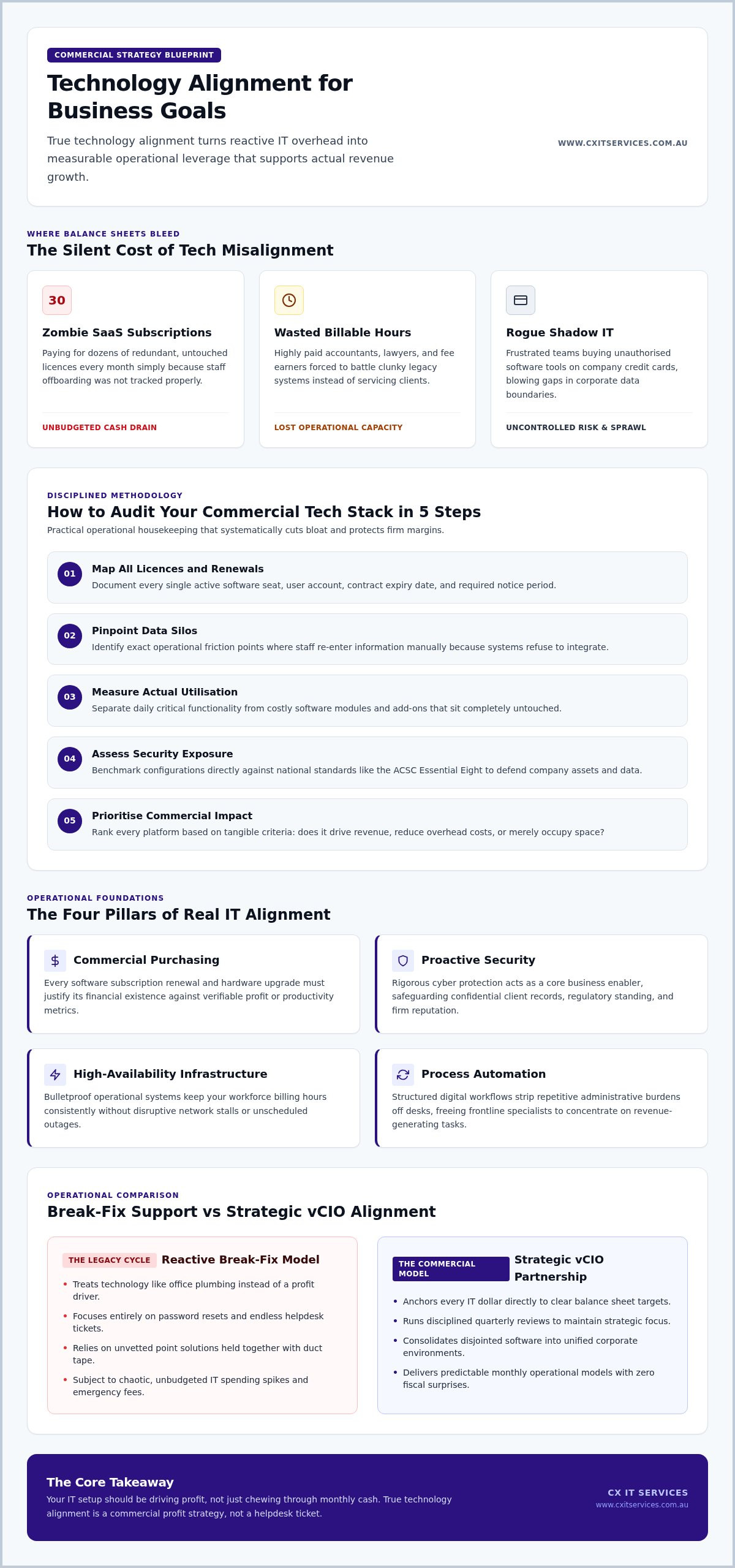
- Zombie SaaS subscriptions: Paying for 30 redundant licences every month because nobody tracked employee offboarding properly.
- Wasted billable hours: Highly paid accountants, lawyers, and consultants fighting clunky legacy tools instead of serving clients.
- Rogue shadow IT: Frustrated employees buying unauthorised cloud apps on company credit cards, blowing wide gaps in your corporate data perimeter.
The Four Pillars of Real Alignment
Transforming your setup requires a deliberate operational shift. A structured vCIO and IT strategy anchors every technical decision to four clear pillars:
- Commercial purchasing: Every software renewal and hardware upgrade must justify its existence against genuine profit or productivity metrics.
- Proactive security: Rigorous cyber protection shields confidential client records, protects company cashflow, and safeguards industry reputation.
- High-availability infrastructure: Bulletproof systems keep your team billing hours without disruptive outages or network stalls across national offices.
- Process automation: Systematic digital workflows strip repetitive manual administration off your team's desk so they can focus on profitable work.
How to Audit Your Current Technology Stack in 5 Steps
You cannot align what you cannot see. Achieving true technology alignment for business goals starts with pulling back the curtain on your digital environment. Big consultancies make this sound like a six-month theoretical exercise. It isn't. It is practical housekeeping that protects your margins.
Here is the five-step framework we use to audit a commercial tech stack:
- Step 1: Map all licences and renewals. Document every active software seat, user account, contract end date, and notice period.
- Step 2: Pinpoint data silos. Identify where staff re-enter information manually because systems refuse to talk to each other.
- Step 3: Measure actual utilisation. Check which features your team relies on daily, and which expensive modules sit untouched.
- Step 4: Assess security exposure. Benchmark your setup against Australian standards like the ACSC Essential Eight to ensure client data is protected.
- Step 5: Prioritise commercial impact. Rank every platform by whether it increases revenue, cuts costs, or just takes up space. For enterprise retailers, for example, commerce operations platforms like Ommni tie operational metrics like inventory turnover straight to margin protection and bottom-line growth.
Uncovering Redundant Applications and Shadow IT
Shadow IT is usually a symptom of broken internal tools. When your official systems are sluggish, smart staff find their own solutions. They pull out a corporate credit card and buy separate file-sharing tools, PDF converters, or team chat apps.
Pull your last three months of credit card statements. You will almost certainly spot recurring monthly charges for software nobody in management approved. Talk to your team directly. Ask them what workarounds they rely on to get their jobs done. Once you know what they actually need, consolidate those disjointed point solutions into integrated environments like Microsoft 365. You save money on subscriptions, clean up data sprawl, and close accidental security holes in one sweep.
Evaluating System Bottlenecks Against Revenue Targets
System downtime is not an IT inconvenience. It is lost revenue. When an accounting or legal team loses two hours to a frozen remote desktop, those billable units are gone forever.
Calculate what 15 minutes of daily disruption costs across 20 staff over a full financial year. The math gets ugly fast. Look closely at routine workflows to spot where manual data entry drags down delivery times. Modernising legacy setups with structured cloud services removes these productivity bottlenecks, ensuring your team spends their day billing clients instead of waiting on loading screens.
If you suspect your firm is carrying costly digital dead weight, apply for a commercial stack review to see where you can trim waste and boost output.
Strategic vCIO Guidance vs Reactive Break-Fix IT Support
Break-fix IT has a perverse incentive. When your systems crash, they get paid to pick up the pieces. If your computers run smoothly, they don't make a cent. That is the fundamental flaw of the old break-fix model. Reactive technicians patch problems only after downtime has already cost you billable hours. They live in a helpdesk queue, not your boardroom.
Achieving meaningful technology alignment for business goals requires an entirely different mindset. A Virtual Chief Information Officer (vCIO) does not wait for things to break. They look at where you want your practice to be over the next three years, then build the digital infrastructure to get you there. It replaces frantic emergency calls with calm, structured direction.
The Role of a Virtual CIO in Growing Firms
Mid-sized accounting, legal, and financial firms rarely need a full-time, in-house CIO executive package. What they need is senior commercial oversight without the bloated corporate salary.
Partnering with dedicated vCIO and IT strategy advisors delivers high-level governance focused on your commercial reality:
- Quarterly commercial reviews: Translating operational growth goals into exact hardware and software budgets, so your financial planning stays rock solid.
- Vendor accountability: Negotiating commercial contracts with line-of-business software vendors, eliminating double-billing and unwanted terms.
- Strategic tech governance: Linking every technology investment directly to staff productivity, client retention, and margin expansion.
Building an Agile 3-Year Technology Roadmap
Surprise IT bills ruin cashflow. An ageing server suddenly dies, a rushed cloud migration blows out, or a surprise software licence true-up lands on your desk. None of that should happen. A rolling three-year roadmap eliminates those capital expenditure shocks entirely.
Here is how a strategic roadmap protects your firm:
- Targeted capital spending: Prioritise investments based strictly on measurable commercial returns and staff capacity.
- Scheduled hardware refreshes: Upgrade critical infrastructure on a predictable lifecycle well before performance degrades or hardware fails.
- Pragmatic workflow automation: Roll out automated admin processes and smart tools in controlled phases, giving your team time to adapt without disrupting billable output.
Ready to audit your systems? Apply for strategic technology alignment and stop letting reactive IT dictate your commercial momentum.
Protecting Growth: Cyber Security as a Core Business Enabler
Too many leaders still treat cyber defence like a digital fire extinguisher. You buy it, stick it on the wall, and pray you never have to touch it. That attitude is dangerous. Cyber security is not an IT chore designed to block junk email; it is a shield for your balance sheet.
The numbers tell a brutal story. In Australia, the average data breach now costs AUD $4.26 million. For a mid-sized legal practice, accounting firm, or medical centre, that sort of hit is catastrophic. Cash disappears. Professional indemnity premiums skyrocket. Client trust vanishes overnight. True technology alignment for business goals treats security as an operational priority, not a panic response after an incident.
Enterprise clients and government departments actively vet your security before they sign a contract. Personally, I tell business owners all the time: "Modern security is a commercial differentiator that wins major tender contracts." If you cannot prove your systems are locked down, corporate clients will simply take their retainers elsewhere.
Essential Controls Every Australian Firm Must Enforce
You don't need exotic technology to keep criminals out. Aligning your business with the Australian Cyber Security Centre (ACSC) Essential Eight baseline neutralises the vast majority of opportunistic attacks:
- Mandatory multi-factor authentication: Turn on MFA across every single corporate platform, email account, and remote desktop tool without exception.
- Automated OS patching: Run automated routines that deploy operating system patches immediately, closing known vulnerabilities before hackers exploit them.
- Strict application control: Restrict workstations so only pre-approved corporate software can execute, preventing unverified attachments and shadow downloads from running.
Disaster Recovery and Immutable Backups
Backups mean nothing if they get encrypted right alongside your primary network. Modern ransomware specifically seeks out network-attached drives to erase recovery options before demanding payment.
Real resilience requires air-gapped, immutable backups that cannot be overwritten or deleted, even if administrative accounts are compromised. More importantly, test your restores. Schedule simulated recovery drills twice a year to prove how fast your operations can bounce back during a crisis. Investing in proven backup and disaster recovery keeps downtime minimal when disaster strikes.
Do not wait for a breach to expose your blind spots. Apply for a strategic cyber assessment to protect your client data, secure your supply chain, and build real operational resilience.
Executing Your Alignment Plan: How to Build Lasting IT Value
A strategy document sitting in a drawer changes nothing. Execution is where the rubber meets the road. If you want sustainable technology alignment for business goals, you need clear accountability, commercial KPIs, and a predictable operating cadence.
The first major shift is financial. Ad-hoc IT billing creates erratic cashflow swings that make long-term planning impossible. One month your bill is tiny, the next month you are hit with five thousand dollars in surprise billable hours because a critical switch blew up. Transitioning to an all-inclusive, fixed monthly per-user model eliminates those shocks. It aligns your IT partner's goals directly with your own: when your systems run smoothly and efficiently, everyone wins.
Setting Measurable Technology KPIs for Operations
Stop measuring your tech team by how many support tickets they close. That is a vanity metric. If a technician closes 200 tickets a month, it usually means your systems are falling apart.
Instead, hold your operational systems accountable to commercial performance benchmarks:
- Resolution speed on operational bottlenecks: Measure how fast critical, client-facing disruptions get resolved, not just standard ticket response times.
- Software adoption rates: Track whether your staff actually utilise new applications after rollout, or if they quietly revert to manual spreadsheets.
- Core system uptime: Benchmark network and line-of-business application availability against strict monthly service level targets.
Partnering with a Dedicated Australian Technology Guide
Managing technology across multiple offices or remote teams requires boots on the ground as well as strategic vision. You need seasoned partners who understand the local commercial regulatory environment, not an offshore call centre reading scripts from a binder.
With over 26 years of Australian industry experience, we have seen what happens when firms let their technology drift aimlessly. Our national technician network backs up proactive strategy with genuine, 24/7 helpdesk availability. By bundling comprehensive managed IT support services with high-level advisory under one predictable fee, we keep your technology working toward your commercial milestones every single month.
Take control of your technology today. Partner with CX IT Services and turn your IT spend into lasting commercial leverage.
Turn Your Technology into a Commercial Growth Driver
You don't have to keep tolerating software clutter, slow systems, and erratic invoices. Real technology alignment for business goals isn't an overnight corporate overhaul. It simply starts with auditing your active stack, clearing out unused subscriptions, and demanding that your IT investments tie directly to staff output and bottom-line profit.
At CX IT Services, we bring over 26 years of Australian technology experience to your corner. We protect your operations with a national network of qualified on-site technicians, reliable 24/7 helpdesk support, and true fixed-fee per-user monthly billing with no hidden surprises. When your infrastructure directly serves your commercial roadmap, scaling up becomes clean, predictable, and manageable. Apply for a strategic technology assessment today, and let's get your tech pulling in the right direction.
Frequently Asked Questions
What is the main difference between IT support and technology alignment?
IT support is reactive troubleshooting, while technology alignment for business goals is proactive commercial planning. Helpdesk support fixes frozen laptops, resets forgotten passwords, and patches broken servers after work stops. Strategic alignment designs your entire tech stack around your firm's revenue targets, workflow speed, and growth plans. Support keeps the lights on; alignment ensures your IT spend actively generates measurable operational leverage and profitability.
How often should our leadership team review our technology alignment strategy?
Your leadership team should conduct a formal technology review every quarter. Business priorities, client demands, and headcount shift quickly over twelve months, so an annual review leaves you playing catch-up. Quarterly reviews let you evaluate software licence usage, assess emerging operational bottlenecks, track active IT project milestones, and adjust your forward technology roadmap before costly inefficiencies creep into daily workflows.
Can our business align its technology without hiring a full-time Chief Information Officer?
Yes, absolutely. Most growing Australian firms with ten or more staff don't have the budget or the need for an executive CIO salary. Partnering with a Virtual CIO gives you access to seasoned, high-level technical direction on a fractional basis. You get strategic hardware roadmapping, vendor negotiations, and board-level advice without adding another massive corporate executive package to your permanent payroll.
What are the first signs that our current technology is holding our business back?
The clearest sign is staff relying on manual spreadsheets and offline workarounds because your primary systems feel sluggish or disconnected. Other warning flags include frequent client complaints about communication delays, recurring billable hours lost to system freezes, and surprise software renewals for tools nobody uses. If tech issues constantly pull leadership focus away from client work, your systems are actively holding you back.
How does technology alignment help protect our business from cyber threats?
Strategic technology alignment for business goals integrates security controls into everyday operational routines rather than treating defence as an afterthought. By aligning your systems with Australian standards like the Essential Eight, you ensure multi-factor authentication, patch automation, and application controls operate seamlessly. It keeps your balance sheet safe from devastating ransomware payouts and prevents severe compliance penalties without slowing staff down.
Will aligning our technology require completely replacing all of our current software?
Almost never. Real alignment is about optimisation and consolidation, not throwing everything out and starting from scratch. In most cases, firms already pay for capable platforms like Microsoft 365 but only use a fraction of their features. We usually focus on ditching duplicate third-party licences, connecting siloed databases, and training your team to squeeze genuine commercial value out of your core systems.
How does a fixed monthly IT support model assist with long-term strategic alignment?
Fixed monthly per-user billing removes financial friction between your firm and your IT provider. Under traditional hourly billing, providers profit when things break. Under a predictable fixed fee, your provider is commercially incentivised to keep your infrastructure reliable, secure, and fully aligned with your targets. It eliminates bill shock, stabilises cashflow, and turns your IT partner into an invested strategic ally.





 Microsoft Partner