


Wondering about the real smb1001 certification cost? Don't get caught out by basic entry fees. Here is the true price of readiness, audits, and ongoing upkeep.
The certificate fee is often the smallest part of the SMB1001 certification cost. The bigger job is getting security controls in place, gathering evidence and keeping the work going after certification.
It’s easy to see a low entry price or sponsored pathway and assume that’s the whole bill. Personally, I reckon that’s where businesses can get caught out. The fee, readiness work and any remediation are separate parts of the budget. The right certification level depends on what your business needs to demonstrate.
In this guide, I’ll explain what shapes the total cost and how the five SMB1001 levels differ. I’ll also cover the distinction between self-attested tiers and those requiring an independent audit, so you can compare pathways on more than the headline price.
You’ll get a practical way to plan for certification, compare what each pathway covers and identify costs and ongoing requirements before choosing a route. Certification isn’t a one-off purchase. The security work behind it needs to fit how your business actually operates.
Key Takeaways
- The smb1001 certification cost depends on your chosen pathway and the work needed to prepare. Don’t budget from an entry fee alone.
- Separate certification or assessment fees from preparation, remediation, staff time and ongoing security upkeep.
- Compare direct, supported and sponsored pathways by eligibility, inclusions and the effort your team needs to contribute.
- Set a target level, identify your security gaps and compare written scopes before committing to a route.
- Managed IT and cybersecurity support can help organise practical security work alongside certification planning.
What does SMB1001 certification cost an Australian SMB?
There’s no single total that applies to every Australian SMB. The smb1001 certification cost depends on the pathway you choose and how much preparation your business needs. A headline fee, sponsored place or low-cost entry offer won’t necessarily include the work required to meet the standard.
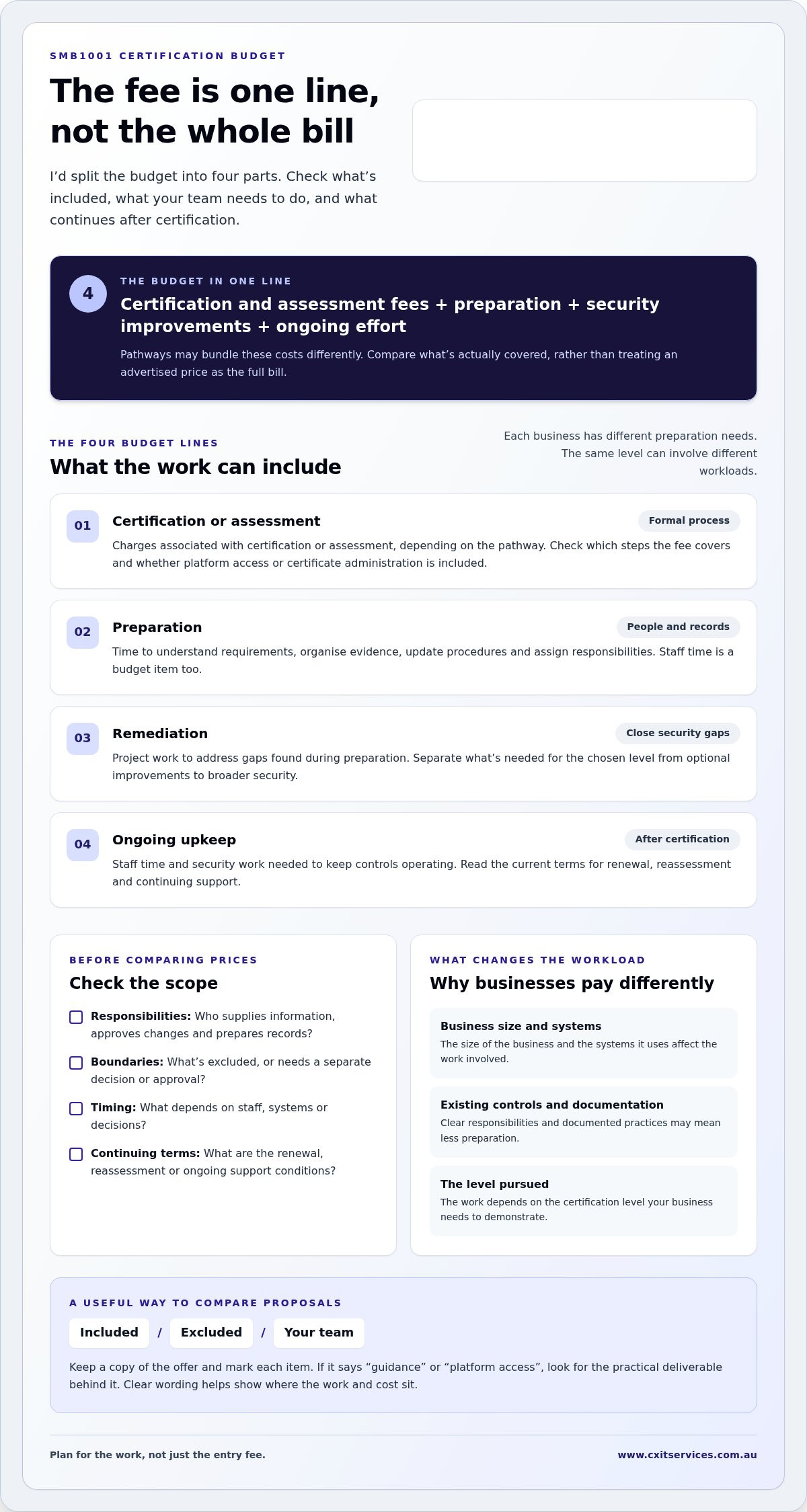
I’d split the budget into four parts: certification or assessment fees, preparation, security improvements and ongoing maintenance. Pathways may bundle these costs differently, so compare what’s included instead of treating one advertised price as the full bill.
Total certification cost is the certification and assessment fees, plus the preparation, security improvements and ongoing effort needed to meet and maintain the chosen level.
That ongoing effort matters. Certification is useful only if the security practices behind it keep working in the day-to-day business, not just on assessment day.
What the certification cost can include
The certification fee relates to the formal certification process. It’s separate from the time your staff spend collecting evidence, updating procedures or coordinating security tasks. External support, if used, is another budget line. A pathway might bundle some of these items, but a bundled price doesn’t mean every activity is covered.
- Certification or assessment: Charges associated with the certification process or assessment, depending on the pathway.
- Preparation: Time spent understanding the requirements, organising evidence and assigning responsibilities.
- Remediation: Project work to address security gaps identified during preparation.
- Ongoing upkeep: Staff time and security work needed to keep controls operating.
Renewal and reassessment arrangements can vary. Read the current terms for the pathway you’re considering, including what happens after the initial certification period. Don’t assume a sponsored credit or platform tool covers preparation, remediation or future upkeep.
Why costs differ between businesses
Business size, existing controls, systems and the level pursued all affect the work involved. An organisation with clear security responsibilities and well-documented practices may need less preparation than a business that first has to work out who manages access, updates or backups. There’s no universal formula. That’s why two businesses pursuing the same level can face different workloads.
Separate work needed to meet the chosen certification requirements from optional improvements that strengthen security more broadly. That makes it easier to see what’s essential for certification and what’s a wider business decision.
Before committing, be clear about the outcome you need. A customer requirement or procurement opportunity may make certification relevant. If there’s no clear business reason, compare its value with other ways to improve security readiness. I’d start by mapping the work, then use cybersecurity support to help organise practical security improvements alongside the certification plan.
Which costs make up an SMB1001 certification budget?
A quoted amount is useful only when you can see what work sits behind it. I’d read each pathway or support proposal as a scope of work, not just a price. You need to know what the route covers, what your team must handle and what sits outside the offer.
Certification and assessment fees
Read the current terms for the specific route. Check which steps the fee covers, whether platform access or certificate administration is included, and whether any part is charged separately. Don’t carry an old promotion or member offer into a current budget without confirming that it still applies and that your business is eligible.
For context on the broader Australian small-business security environment, Australian government resources for small business cybersecurity offer general guidance beyond the certification process.
Readiness work, staff time and ongoing effort
For external support, compare the actual deliverables. A useful scope names the work products, who is responsible for each task and what happens if the work identifies an issue. Check whether the support ends with advice or includes help carrying out agreed actions. That can make a real difference to the coordination your own team needs to provide.
- Responsibilities: Identify who supplies information, approves changes and prepares records on your side.
- Boundaries: Note what the scope excludes, including work that needs a separate decision or approval.
- Timing: Check the proposed sequence and dependencies on staff, systems or decisions.
- Continuing terms: Review stated renewal, reassessment or ongoing support conditions for the chosen route.
Keep a copy of the offer and mark each item as included, excluded or assigned to your team. If you see wording such as “guidance” or “platform access”, look for the practical deliverable behind it. Clear wording now makes it easier to compare proposals and avoid finding a costly gap halfway through the work.
If you want help organising operational security alongside your planning, get in touch with CX IT Services.
How do SMB1001 certification pathways compare on total cost?
There are three broad routes to compare: manage the certification process directly, use external support, or access a sponsored or membership pathway. The lowest upfront fee isn’t automatically the lowest total cost. If readiness work is still yours to organise, the apparent saving may come with more staff effort and project work.
Compare scope, eligibility and responsibilities side by side. The table below is a framework, not a claim that every route is available on the same terms in 2026.
| Pathway | Eligibility | What it may cover | Business effort | What to verify |
|---|---|---|---|---|
| Direct certification | Businesses using the relevant certification process directly, subject to its current terms. | The certification process and any stated platform or administration components. | Your team coordinates the process, prepares evidence and handles readiness work not included in the route. | Current fees, included steps, access requirements, assessment method and renewal terms. |
| Supported certification | Businesses engaging external guidance alongside the certification process. | Support defined by the written scope. It may cover planning or readiness tasks, depending on the agreement. | Work is shared, but your business still needs clear owners for decisions, access and internal tasks. | Deliverables, exclusions, staff responsibilities, treatment of gaps and any ongoing support. |
| Sponsored or member pathway | Only organisations meeting the current programme’s eligibility conditions. | A sponsored credit or access to specified certification elements, as set out in the offer. | Readiness work may remain with your business, even if a particular fee is covered. | Whether the offer is active in 2026, who qualifies, which levels and costs are included, and any conditions. |
Direct and supported certification routes
With a direct route, the business works through the certification process itself. That can suit a team with the time and capability to coordinate requirements, evidence and internal tasks. A supported route adds external guidance, but the label alone doesn’t tell you how much help is included. Compare written deliverables and responsibilities, not just the headline fee.
For example, a proposal might include a readiness review but leave implementation and evidence gathering to your staff. Another may define more hands-on support. The useful comparison is what each route takes off your team’s plate and what it leaves behind.
Sponsored or membership pathways in Australia
The Australian Computer Society announced a sponsored SMB1001 pathway for eligible members in 2025. That announcement is a past offer, not proof that the same pathway, levels or eligibility apply in 2026. Don’t build a budget around it until current programme terms show exactly what’s available and covered.
Also keep SMB1001 separate from the Essential Eight. The Essential Eight is an Australian Cyber Security Centre maturity model, not a certification pathway. Choose the route that fits your business objective and actual scope, not simply the smallest number on an offer. That’s the sounder way to judge the SMB1001 certification cost.
How can your business estimate SMB1001 certification cost before committing?
A useful estimate starts with your business, not a headline offer. Set the outcome you’re aiming for, map the work already done, then compare pathways against the same scope. That gives you a clearer view of cash costs and staff effort before anyone commits.
A useful SMB1001 estimate states its scope, assumptions and excluded work. Without those details, two prices can look comparable while covering very different things.
Build a business-specific cost checklist
Write down the target level and why you want it. A customer request, procurement expectation or need to demonstrate security practices can shape the objective. Then record your current position: controls already in place, evidence you can readily access, who owns each task and any known improvement work.
Use that information to compare routes. Ask for a written scope that makes responsibilities plain. I’d capture the answers in one place:
- Objective: The intended level and the business reason for pursuing it.
- Starting point: Existing controls, available evidence, systems in scope and known gaps.
- Included work: Assessment steps, preparation, guidance and any platform access or administration covered.
- Excluded work: Remediation, internal staff tasks and any work priced separately.
- Timing and ongoing commitments: Expected stages, renewal conditions and continuing support or security work.
Verify current fees, eligibility rules, inclusions and renewal terms for the specific pathway. Record when you checked them and any assumptions, especially where an offer depends on membership or sponsorship. If a detail is unclear, mark it as an open item rather than quietly treating it as included.
Separate the initial project from ongoing work
Build two budget views. The first covers one-off preparation and remediation, including staff time to organise evidence and complete assigned tasks. The second covers any recurring certification charges or reassessment required by the chosen route, alongside security work the business needs to maintain regardless of certification.
This split stops you treating the first assessment as the finish line. It also shows which costs are tied to the pathway and which reflect broader operational security needs. A cybersecurity programme can provide useful context for planning that wider work.
Decide whether certification fits the business case
Weigh the intended assurance or commercial benefit against the effort and improvements required. A customer’s stated requirement is a concrete reason to assess the pathway. But certification alone doesn’t guarantee lower insurance costs, regulatory compliance or new contracts. Keep those outcomes out of the budget unless they’re supported by specific terms or evidence.
Once you’ve documented the objective, gaps and scope, the SMB1001 certification cost is easier to assess without guesswork. If you want a practical partner to help organise security readiness alongside your planning, get in touch with CX IT Services.
How CX IT Services can support practical SMB1001 readiness
Certification planning is easier to manage when it connects to security work your business already needs to do. CX IT Services helps businesses organise practical security work, so preparation supports day-to-day operations instead of becoming a paperwork exercise that stops once a certificate is issued.
Connect certification planning with everyday security management
I find the useful starting point is understanding who owns each security task and how it gets done. Managed IT and cybersecurity support can help bring that work into focus, from clarifying responsibilities to addressing operational needs. CX IT Services is Australian-owned and brings more than 26 years of industry experience.
Our cybersecurity services can support practical security improvements alongside your planning. The aim is to make security work part of how the business operates, not a scramble tied to one milestone. Certification remains a separate process, and no support arrangement can guarantee certification or a particular commercial outcome.
That distinction matters for budgeting too. If operational work is already managed consistently, your team may have a clearer picture of current practices and responsibilities. If there are gaps, treat them as business work, not as something automatically covered because you’re planning for certification.
Plan a sensible next step with a local Australian IT partner
A useful first conversation starts with a few plain facts: how large your business is, what security practices are already in place and why you’re considering SMB1001. A customer requirement, an upcoming procurement process or a broader need to improve security readiness can each shape the discussion. Bring any known gaps and internal responsibilities too. No elaborate paperwork needed.
CX IT Services supports businesses in Melbourne, Brisbane and Sydney. We can discuss how managed IT and cybersecurity support fits around your practical security needs, while keeping certification decisions and issuer responsibilities separate.
Before you commit to a pathway, bring the intended level, your current security position and the work you expect to complete. That gives us a useful basis for discussing where operational support could help, without treating the smb1001 certification cost as a promise of a particular result.
Apply to discuss your business IT and cybersecurity needs.
Make your next security decision with confidence
Before you commit, decide what you need certification to do for your business. That gives you a clear test for the next step, whether it’s pursuing a particular level or addressing a security priority first.
Personally, I’d rather build a plan around a real business need than chase a certificate because an offer looks cheap. A clear view of the smb1001 certification cost helps you make that call with your eyes open.
If you want to discuss the practical IT and cybersecurity work involved, CX IT Services can help you consider how it fits your business. We’ll keep the conversation focused on your needs, not on promising a certification outcome.
Apply to discuss your business IT and cybersecurity needs. A considered next step is a good one.
Frequently Asked Questions
What is the total cost of SMB1001 certification?
There isn’t one total that applies to every business. I’d ask for a written estimate tied to your intended level and current situation, rather than relying on a general figure. Make sure it states its assumptions and shows which tasks your team owns. That gives you a practical way to compare proposals and revise the budget if your target level or starting position changes.
Does SMB1001 certification have different levels, and can the level affect cost?
Yes. CyberCert describes five levels, from Bronze to Diamond, and the level you pursue can affect the scope of the process. Start with the reason you need certification, then compare the requirements for the level that addresses that need. Don’t assume the highest level is automatically the right choice. Check the current assessment scope, fees and eligibility for your chosen route before deciding.
Can an Australian small business get SMB1001 certification for free?
I wouldn’t assume so. The ACS announced a sponsored pathway for eligible members in 2025, but that announcement doesn’t establish a universal free option or confirm what’s available now. Read the current programme terms for eligibility, levels, conditions and exactly what the sponsorship pays for. Even if a certification charge is covered, your team may still need to schedule time and handle work outside the sponsored offer.
What costs can sit outside an SMB1001 certification fee?
Look beyond the certificate charge for work that may be left to your business. Staff might need to coordinate access to information, document existing practices or make time for agreed changes. External guidance may also have limits set by its scope. Ask for a clear list of deliverables and exclusions, then identify who in your organisation will own each task before work starts.
Is SMB1001 certification worth the cost for a small business?
I’d judge it against a specific business need, not the certificate alone. If a customer has raised SMB1001, ask what level or evidence they expect and whether they need certification or another form of assurance. For an internal security improvement goal, identify what decisions the process will help you make. Certification doesn’t guarantee contracts, insurance outcomes or compliance, so keep those separate from the case for pursuing it.
How long does it take to complete SMB1001 certification?
There’s no standard duration I’d apply to every business. Timing depends on the selected route, your current security position and how quickly decisions, evidence and required changes can be handled. Ask for a current process outline with the assessment stages and dependencies. Then put internal tasks on your own project schedule. That makes delays easier to spot, especially if staff availability or approvals could hold up progress.





 Microsoft Partner