
Front door alarms won't stop 2am data theft. Discover how 24/7 security monitoring catches silent network threats before intruders lock your firm out for good.
You can set the deadbolts, arm the building alarm, and head home thinking your office is safe. But an intruder slipping into your server at 2am does not care about motion sensors. Personally, I reckon too many Australian businesses still treat physical locks like digital shields. Real security monitoring is not about catching someone jimmying the back window. It is about detecting silent network intruders before they hijack user credentials, encrypt your systems, and lock down your trade.
You want quiet confidence that your confidential client files stay guarded after hours, not an inbox flooded with useless software alerts you have no time to triage. You are probably wondering what comprehensive digital defence actually covers and whether your practice genuinely needs it. In this guide, you will discover how modern 24/7 digital security monitoring spots quiet threats before they halt your operations. We break down the stark difference between physical premises alarms and active threat monitoring, so you can keep your firm trading with zero downtime.
Key Takeaways
- Physical building alarms protect office hardware, but modern digital security monitoring is what stops silent network intrusions before data gets stolen.
- Active threat hunting cuts dwell time drastically by identifying hijacked staff credentials that passive antivirus software routinely ignores.
- Drowning in alert fatigue leaves critical warnings missed, which is why automated event correlation paired with human triage is essential.
- Growing firms need strict non-negotiables from external providers, starting with true round-the-clock coverage through weekends and public holidays.
- Consolidating management and cyber defense under a seasoned Australian team delivers complete operational continuity and genuine peace of mind.
What is Security Monitoring and Why Physical Alarms Fall Short
Most commercial leases in Australia come with a familiar ritual. You set the keypad code, test the PIR sensors, and lock the front door on Friday afternoon. That makes people feel safe. But if an extortionist wants your client ledger, they will not bother trying the front window.
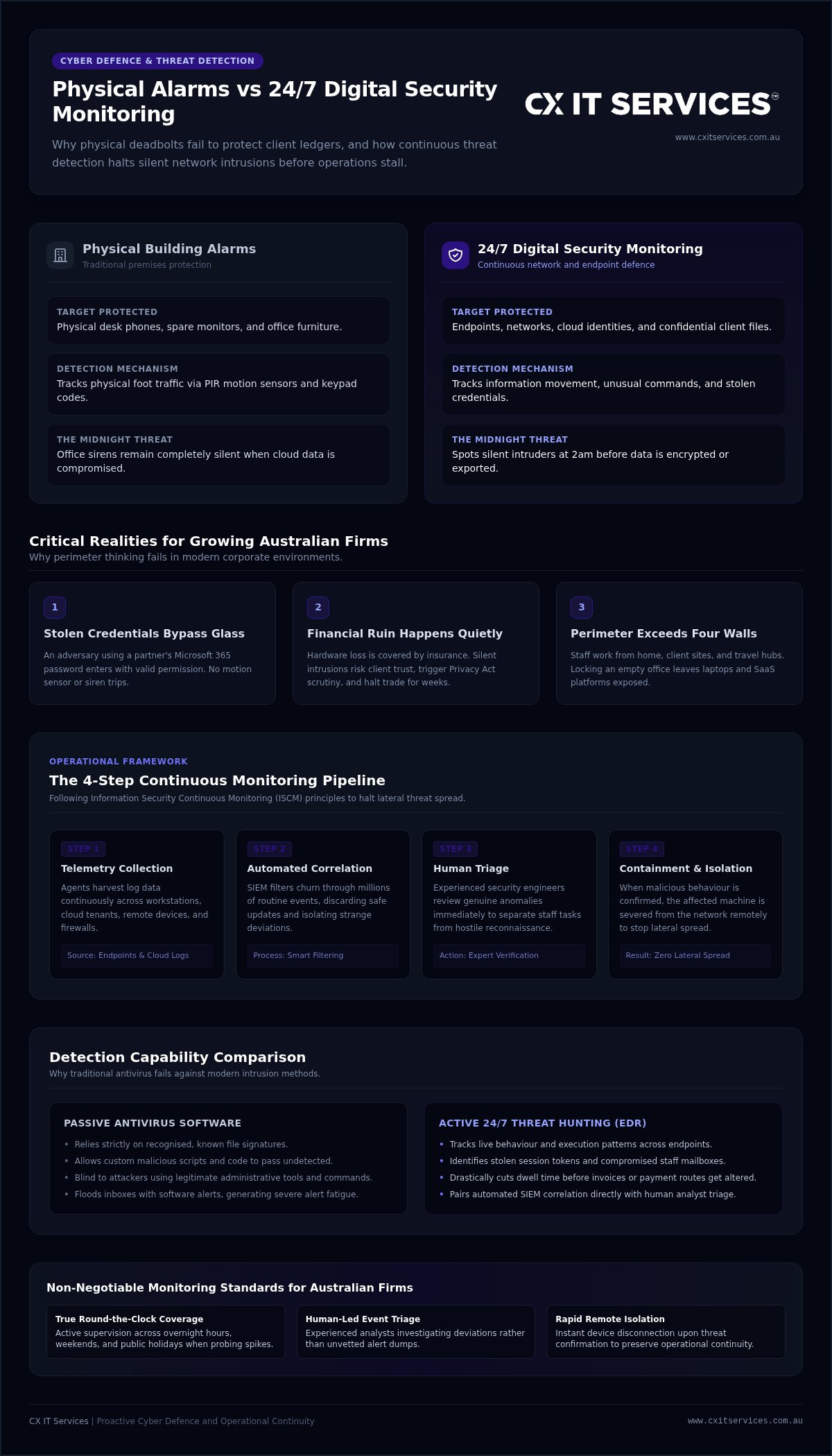
Here is the reality: digital security monitoring is the continuous oversight of endpoints, networks, and identities. It tracks the movement of information, not foot traffic. When an adversary targets an Australian accounting firm, medical practice, or legal office at midnight, the office siren stays silent while gigabytes of tax records or trust account details walk straight out the cloud.
The Dangerous Confusion Between Physical and Digital Security
Traditional building alarms solve a 1990s problem. They protect physical desk phones, spare monitors, and cheap furniture. Those things can be replaced on insurance by Tuesday, especially as modern offices move away from legacy hardware by adopting cloud telephony solutions like ManagePoint.
Digital compromise behaves differently:
- Stolen credentials bypass glass entirely: A crook who buys a partner's Microsoft 365 password logs in through the front gate with valid permission. No sensor trips.
- Financial ruin happens quietly: Hardware theft costs a few thousand dollars. A silent network intrusion costs client trust, generates hefty regulatory scrutiny under the Privacy Act, and can halt billable work for weeks.
- Your perimeter is no longer four walls: Your staff work from kitchen tables, client sites, and airport lounges. Locking up an empty central office leaves remote laptops and SaaS apps completely exposed.
The Threat Landscape for Growing Australian Firms in 2026
Organised syndicates know mid-sized Australian professional practices hold sensitive corporate files without enterprise defence budgets. They rely on quiet infiltration paths.
They use tailored spear-phishing to steal session tokens. They probe unpatched firewall firmware on public holidays. They sit inside compromised mailboxes for days, studying how invoices get approved before redirecting vendor payments.
Basic anti-virus cannot spot this activity. Automated software logs thousands of innocuous events every hour, burying real intrusions under a mountain of digital noise. Modern corporate defence relies on specialised tools like Security Information and Event Management (SIEM) to aggregate those trails. But software alone is blind. You need seasoned human analysts reviewing those logs continuously to separate routine staff behaviour from active, hostile reconnaissance.
Without round-the-clock digital oversight, you are assuming an empty office equals a safe business. Implementing dedicated cyber security oversight ensures your operational data stays defended no matter where your team logs in.
How Continuous 24/7 Digital Security Monitoring Operates
Most business owners picture security monitoring as a control room full of flickering CCTV footage. In the digital space, it looks completely different. It is a live data pipeline running around the clock, designed to catch invisible intrusions before they turn into full outages.
Here is how the workflow runs from start to finish:
- Step 1: Telemetry collection: Agents quietly harvest log data across workstations, cloud tenants, remote laptops, and network firewalls.
- Step 2: Automated correlation: Smart filters churn through millions of ordinary events, discarding routine software updates and isolating weird deviations.
- Step 3: Human triage: Experienced security engineers review genuine anomalies immediately, verifying if an odd PowerShell command or login is genuine staff work or an intruder.
- Step 4: Containment and isolation: The moment malicious behaviour is confirmed, the affected machine gets severed from the corporate network remotely, stopping lateral spread in its tracks.
This operational framework follows the principles of Information Security Continuous Monitoring (ISCM), shifting your business posture from blind faith to verified, real-time awareness.
Endpoint Detection and Response Across Every Workstation
Traditional antivirus waited for a file signature it recognised. If an attacker wrote custom code, old antivirus smiled and let them pass. Modern Endpoint Detection and Response (EDR) tracks behaviour instead.
Attackers now live off the land. They use built-in administrative tools like Windows Command Prompt or PowerShell to snoop through file shares. EDR recognises that an accounting clerk has no business executing administrative scripts at 3am. It halts the process right there. Having strict, managed cyber security oversight across every endpoint ensures your business devices do not betray the rest of your fleet.
Cloud and Identity Monitoring in Microsoft Environments
Identity is the new attack front. If an attacker hijacks a legitimate email account, firewalls are useless. They are already inside.
Continuous monitoring flags suspicious activity instantly. If a conveyancer signs into Microsoft 365 from Australia at 9:00am, then logs in from eastern Europe at 9:15am, that impossible travel triggers an immediate containment action. Monitoring also catches sneaky inbox rules designed to forward financial discussions or blind-copy sensitive negotiations outside the firm.
For firms looking to lock down their environments properly, reviewing a broader approach to cyber security management services helps unify this protection across every user. If you want to know where your blind spots sit right now, you can apply for a security review to see what your systems are broadcasting.
Passive Antivirus Software vs Active 24/7 Threat Hunting
Most Australian offices rely on basic antivirus bought during an end-of-financial-year software bundle. It sits quietly in the system tray, green tick glowing, giving management a warm sense of safety. But passive software is built for threats we knew about yesterday. Active threat hunting looks for what is breaking in right now.
The difference between leaving an automated tool to fend for itself and running continuous security monitoring comes down to active human intervention:
| Capability | Passive Antivirus Software | Active 24/7 Security Monitoring |
|---|---|---|
| Detection Method | Matches static file hashes against known databases. | Correlates live behavioural anomalies across endpoints, cloud accounts, and networks. |
| Response Speed | Fires an unmonitored email notification to your internal inbox. | Instantly isolates compromised workstations via a 24/7 Security Operations Centre. |
| Attacker Dwell Time | Often 200+ days before an intrusion is discovered accidentally. | Aggressively reduced by hunting intruders before they encrypt file stores. |
| Credential Abuse | Blind to legitimate logins used for malicious data access. | Flags abnormal user sessions, lateral movements, and permission escalations. |
Industry leaders define security monitoring as an automated process of collecting and analyzing indicators of potential cyber security incidents. But without real people driving that loop, you are left with software that barks after the thief has already driven off with the safe.
The Reality of Alert Fatigue in Unmanaged Systems
Practice managers already juggle payroll, billing disputes, and client deadlines. When an unmanaged endpoint tool generates eighty low-level security notifications every morning, human nature takes over. People ignore them.
That is alert fatigue. If everything is an emergency, nothing is. Attackers rely on this exact blind spot. They hide malicious commands inside noisy background activity, knowing the office manager will swipe the warning away as another false alarm. A dedicated operations crew absorbs that noise, filtering out mundane platform updates so genuine threats receive instant attention. For organisations looking to understand how modern European providers structure these combined operations, you can explore Services managés ICT et solutions de cybersécurité for an overview of integrated infrastructure and threat response.
Human Expertise at the Triage Stage
Software cannot read business context. It cannot know that your senior partner is on annual leave in Bali and shouldn't be bulk-downloading confidential financial ledgers at 11pm.
Automated rules spot the anomaly, but an experienced analyst verifies intent. If that activity indicates account takeover, the engineer severs the session instantly. That rapid containment stops a single phished inbox from ballooning into a catastrophic breach of client confidentiality. Pairing proactive threat hunting with dependable managed IT services gives Australian firms the operational stability to trade without looking over their shoulder.
What Growing Australian Businesses Must Demand From a Provider
Handing over your systems to an external provider requires blind trust unless you set clear boundaries. If an IT outfit promises round-the-clock protection, you need to know exactly what happens at 2am on Christmas Eve. You cannot afford to discover their support desk is an unmonitored ticket queue after an attacker starts scrambling your drives.
When you evaluate third-party security monitoring, keep these four criteria non-negotiable:
- True 24/7 human oversight: Not an automated email system that creates a ticket for Monday morning. You need active eyes on glass through weekends and public holidays.
- Sovereign Australian operations: Your operational telemetry, security logs, and sensitive client records must remain under Australian legal jurisdiction and local data governance.
- Documented containment SLAs: A fast response time means nothing if it only measures how quickly an automated acknowledgement fires. Insist on a contractual agreement covering active containment and host isolation speeds.
- Transparent reporting: You deserve direct access to executive summaries that translate complex event logs into plain commercial impact.
Local Accountability and Clear Escalation Paths
When a crisis strikes, speaking with an onshore technical specialist matters. The last thing a managing director needs during an active intrusion is an offshore call centre reading standard scripts.
You need seasoned engineers who understand how local accounting, medical, and legal practices function. Clear escalation protocols mean minor anomalies get handled cleanly without disturbing your weekend. If a critical breach does unfold, your leadership receives immediate, calm direction on what was isolated and what steps follow. No corporate panic. Just methodical remediation.
Alignment With National Cyber Security Standards
Australian compliance rules carry serious teeth. Under the Notifiable Data Breaches scheme, ignorance is no longer an acceptable legal defence for business owners who lose client records.
Comprehensive security monitoring captures the detailed audit trails required during mandatory privacy investigations. If an attacker gains entry, investigators need forensic logs to establish which specific files were viewed, copied, or altered. Without verifiable records, regulators and insurers assume the worst possible exposure across your entire database, multiplying your commercial liability. Meeting these standards requires proactive oversight across your complete digital footprint. If you want experienced engineers defending your infrastructure around the clock, book a security consultation to protect your firm today.
How CX IT Services Delivers Proactive Protection That Lets You Sleep
Personally, I reckon business owners have enough on their plate without acting as referee between their IT support and an outside cyber vendor. When an issue crops up, the IT company blames the security software, and the security vendor blames the network setup. Meanwhile, your billing clock stops. Staff sit around twiddling their thumbs. Nothing gets fixed.
We built CX IT Services to put an end to that runaround. With over 26 years in the industry, we deliver complete IT management and dedicated security monitoring under one roof. No passing the buck. Just clear accountability backed by a fixed monthly fee tailored specifically for Australian teams of ten or more staff. We manage the network, the patching, and the threat detection so you can run your practice in peace.
The Advantage of Single-Point Technology Management
Splitting your helpdesk from your security operations creates dangerous delays. When our engineers spot a suspicious credential anomaly, we do not need to lodge a ticket with an outside contractor and wait for clearance. We already look after your environment.
Our team can isolate a compromised workstation, revoke active session tokens, and deploy fixes in minutes. You get calm, seasoned oversight that keeps systems defended without getting in the way of daily client work. One partner. One standard. Total operational clarity.
Taking the Next Step Towards Total Digital Peace of Mind
Upgrading your defences does not mean tearing everything down over a weekend. Good security monitoring should slot neatly over your existing infrastructure without pulling the handbrake on day-to-day operations.
Our onboarding begins with a thorough look under the bonnet. We examine your cloud tenancy, audit user privileges, and inspect the integrity of connected devices. You receive a clear, plain-English roadmap detailing where your blind spots sit and how we close them. No corporate jargon. No high-pressure sales spin.
If you want real confidence that your operations and confidential records remain guarded 24/7, apply for a confidential IT security assessment today and let us handle your digital defence.
Take Command of Your Firm's Digital Defence
Physical locks protect your desks and monitors. They will never stop an adversary harvesting credentials from a remote laptop or siphoning client archives out of the cloud. Leaving that defence to basic antivirus software and unmonitored inboxes is an unnecessary gamble when your commercial reputation is on the line.
Real operational resilience comes from active threat hunting that spots network anomalies before they cause downtime. At CX IT Services, we are Australian owned and operated with over 26 years of technical experience protecting commercial practices nationally. We combine proactive management, rapid helpdesk support, and round-the-clock security monitoring into one predictable fixed monthly fee designed specifically for teams of 10 or more staff.
You do not have to wait for an extortion demand or an empty server to find out where your network gaps sit. Take the front foot, protect your billable hours, and sleep soundly knowing seasoned local engineers have your back. Apply for a confidential security assessment for your business today and let us safeguard your operational future.
Frequently Asked Questions
What is the main difference between physical security monitoring and cyber security monitoring?
Physical monitoring guards doors, windows, and premises against physical trespass, while cyber security monitoring defends data, identities, and software networks. A physical sensor alerts someone if a window breaks. Digital oversight continuously tracks telemetry to catch stolen user credentials, suspicious cloud logins, or silent malware running in the background. Both serve a purpose, but physical locks cannot protect corporate databases.
Does my business still need security monitoring if we already use antivirus software?
Yes, because traditional antivirus only catches known malicious files after they land on a workstation. Modern cyber criminals bypass antivirus entirely by using stolen staff logins and legitimate administrative tools. Continuous security monitoring tracks live behaviour across your network, spotting abnormal movements and credential abuse that standard antivirus software simply never flags.
Why is 24/7 monitoring necessary if our staff only work regular business hours?
Attackers deliberately launch intrusions when your office is empty and your desks are clear. Most ransomware strikes kick off late at night or during long holiday weekends to maximise damage before anyone notices. If a breach starts on Friday night, an unmonitored business loses valuable days. Continuous oversight ensures hostile activity gets snuffed out immediately, avoiding Monday morning chaos.
How does digital security monitoring handle false alarms without disrupting our staff?
Automated correlation engines quietly filter through millions of routine background events, discarding safe software updates and scheduled tasks. When an anomaly triggers an alert, dedicated security engineers investigate the issue behind the scenes. Your staff are never swamped with alerts. They only hear from us if a verified event requires business coordination, leaving your team focused on daily work.
What happens immediately when a suspicious cyber threat is detected on our network?
The targeted device or user session gets isolated immediately to prevent lateral spread into your core file shares. Analysts assess the malicious process, terminate active connections, and identify the initial entry point. Once neutralised, the machine is safely cleared and restored to production. Management receives a plain-English briefing outlining what happened and how it was contained.
Is professional security monitoring affordable for businesses with 10 to 50 employees?
Yes, because seasoned managed providers bundle oversight into a predictable per-user monthly fee. You do not need an enterprise budget or an internal cyber department to get business-grade protection. At CX IT Services, we tailor our fixed monthly structure specifically for Australian firms with 10 or more staff, uniting regular helpdesk support and active threat monitoring under one predictable cost.
Can our existing Microsoft 365 setup be integrated into active security monitoring?
Yes, and it is usually the first place we look. We connect Microsoft 365 activity straight into our monitoring feeds. That lets engineers spot impossible travel logins, unapproved mailbox forwarding rules, and unexpected mass file downloads in real time. We build upon your existing cloud environment, lifting security standards without forcing your staff onto unfamiliar software.





 Microsoft Partner