
Sick of ransomware threats? Get practical ransomware protection for business. This guide gives Aussie firms a clear plan to stay safe. No fluff, just what wo...
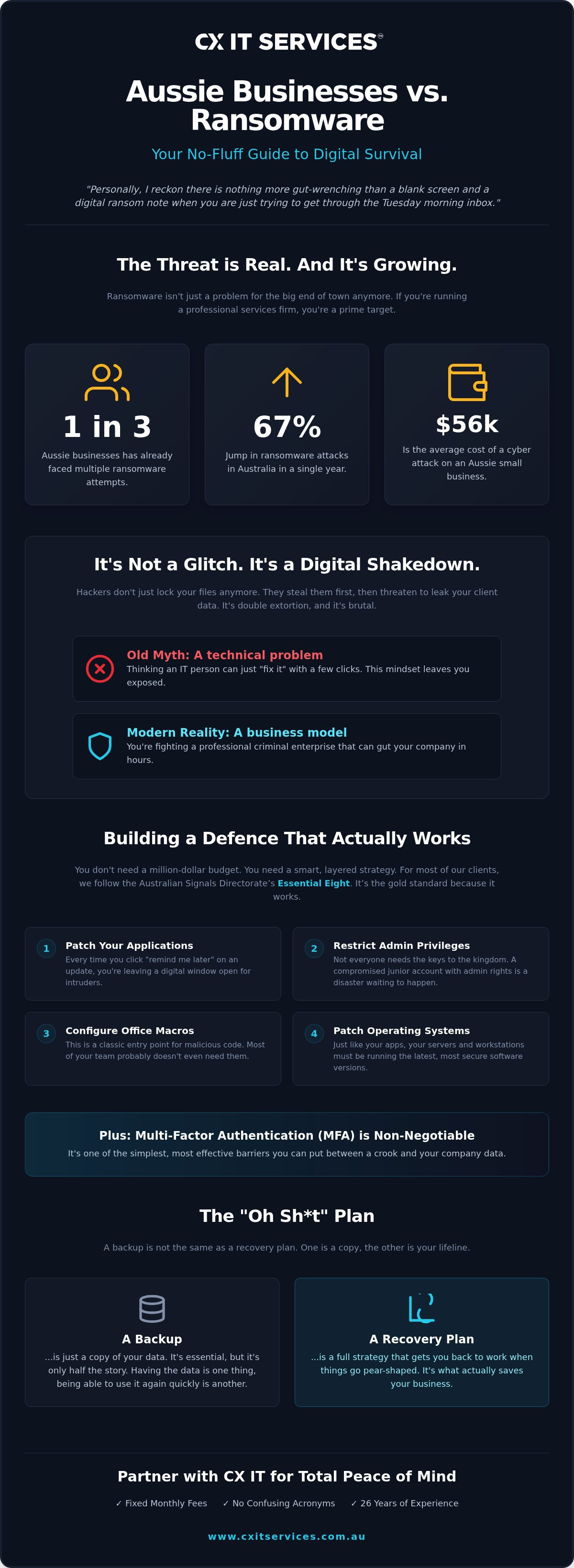
One in three Australian businesses has already experienced multiple ransomware attempts, which makes finding the right ransomware protection for business a matter of survival rather than just IT admin.
Personally, I reckon there is nothing more gut-wrenching than a blank screen and a digital ransom note when you are just trying to get through the Tuesday morning inbox.
With ransomware attacks in Australia jumping 67 per cent in 2025, it isn't just a big end of town problem anymore.
If you're running a legal or accounting firm, you're a prime target.
I get it.
You're likely sick of the conflicting advice and the stress of keeping up with threats that seem to change every week.
In this guide, I'll show you how to shield your operations from digital extortion.
No corporate fluff.
No confusing acronyms.
You'll find a clear path to total peace of mind and predictable monthly costs.
We'll build a recovery plan that actually works if things go pear-shaped.
We're going to cover layered defence and how to stay compliant with Australian standards while keeping the hackers out of your hair for good.
Key Takeaways
- Ransomware is a digital shakedown. Learn why it is the most efficient way to lose your business overnight.
- Discover how to use the Essential Eight to build solid ransomware protection for business without spending a fortune.
- Old-school antivirus cannot stop modern zero-day exploits. See what you actually need to keep hackers out of your systems.
- A backup is just a copy of your data. Learn how to build a recovery plan that gets you back to work when things go pear-shaped.
- Stop the stress of evolving threats with a local partner who offers fixed monthly fees and 26 years of experience.
Why Ransomware is the Single Biggest Threat to Your Business Bottom Line
Personally, I reckon most business owners think of ransomware as a nasty technical glitch that an IT person can just fix with a few clicks. It isn't. It is a digital shakedown. In my 26 years in the industry, I have seen it evolve from a nuisance into a cold, calculated business model that can gut a company in hours. If you haven't prioritised ransomware protection for business, you are essentially leaving your front door wide open in a neighbourhood where the crime rate just jumped 67 per cent in a single year.
To understand the scale of the mess, we should look at What is Ransomware? at its core. It is malicious software designed to block access to a computer system until a sum of money is paid. But that definition is far too clinical for the reality. In the real world, it is the most efficient way to lose your business overnight.
What Ransomware Actually Looks Like in 2026
It usually starts with something small. A dodgy link in an email that looks like a genuine invoice. A weak password on a remote desktop connection. Once they are in, your server becomes a brick. A polite note appears on every screen asking for millions in Bitcoin. Hackers don't just lock your files anymore. They steal them first. They threaten to leak your clients' private data onto the dark web if you don't pay up. It is double extortion. It is brutal. One in three Australian businesses has already dealt with multiple attempts. You are not just fighting a virus. You are fighting a professional criminal enterprise.
The Hidden Costs of a Digital Breach
The ransom demand is often the smallest part of the bill. Think about your team. If they cannot access their files, they are sitting on their hands. You are paying wages for zero output. Research from 2025 shows the average cost of a cyber attack on an Australian small business is now between $49,600 and $56,600. That does not account for the clients who walk away because they no longer trust you with their data. Then you have the regulators. Under the Cyber Security Act 2024, if your turnover is over $3 million and you pay a ransom, you have 72 hours to report it. If you miss that window, you could face a civil penalty of nearly $20,000. The legal fees and recovery costs alone are enough to sink a medium sized firm. It is a financial gut-punch that many never recover from.
Building a Defence That Actually Works for Aussie Businesses
You do not need a million dollar budget to keep hackers out of your systems. Personally, I reckon that is a myth sold by people who want to overcomplicate things. What you actually need is a smart, layered strategy that covers the basics properly. In the trade, we call this a "defence in depth" approach. It means that if a hacker manages to skip past one hurdle, they hit another three before they can do any real damage.
For most of our clients, we follow the Australian Signals Directorate’s Essential Eight. It is the gold standard for a reason. It works. The government even outlines the broader national context in Australia's Ransomware Action Plan, which highlights just how critical these baseline protections have become. When you implement these steps, you are making your firm a much harder target. Most crooks are lazy. They will move on to an easier victim if they see you have solid ransomware protection for business in place.
Step 1: Implementing the Essential Eight Without the Headache
The Essential Eight can sound intimidating, but it is really just common sense applied to your network. Start with patching your applications. Every time you see an update notification and click "remind me later," you are leaving a digital window open for an intruder. These updates often fix security holes that hackers are already exploiting.
- Restrict administrative privileges. Not everyone in your office needs the keys to the kingdom. If a junior staffer's account is compromised and they have admin rights, the hacker has those rights too.
- Configure Microsoft Office macros. These are a classic entry point for malicious code. Most of your team probably doesn't even need them to do their daily work.
- Patch operating systems. Just like your apps, your servers and workstations need to be running the latest, most secure versions of their software.
Step 2: Multi-Factor Authentication (MFA) is Non-Negotiable
If you are not using MFA across your entire organisation, you are basically leaving your front door unlocked. It is the single most effective way to stop a credential theft in its tracks. Even if a hacker manages to guess or steal a password, they still cannot get in without that second code from a physical device or app. It is a simple step that provides massive peace of mind. No excuses. Get it sorted today. If you are unsure where to start with your security layers, you can see if your business is a good fit for a managed security approach. We take the guesswork out of the Essential Eight so you can get back to running your firm without the constant worry of a breach.
Why Your Current Antivirus is Not Enough to Stop a Modern Attack
Personally, I reckon relying on basic antivirus in 2026 is like hiring a security guard who only stops people if their face is already on a "Most Wanted" poster. It is too little, too late. Old-school antivirus programs look for known signatures. They have a database of bad files and they check your computer against that list. The problem? Hackers don't use those files anymore. They generate new, unique code for every single attack. If the signature isn't in the database, your antivirus just waves the hacker through the front door.
Modern threats are built to bypass traditional software. We are seeing a massive rise in AI-powered malware. In fact, 32 per cent of malicious attacks in Australia now involve AI-generated elements. These threats use "zero-day" exploits. These are vulnerabilities that no one has seen before and no patch exists for yet. To get real ransomware protection for business, you have to move past reactive cleaning. You need a system that assumes an attack is coming and looks for trouble before it starts.
The Shift from Reactive to Proactive Security
Endpoint Detection and Response (EDR) is the new standard for Aussie firms. It does not just look for bad files. It watches for suspicious behaviour. If a user account suddenly starts encrypting thousands of documents at 2 PM, EDR notices the pattern. It doesn't care if it recognises the file name. It sees the action is wrong and shuts it down immediately. Think of it as a smart security guard who notices someone climbing through a window instead of just checking IDs at the gate. It is proactive, not reactive.
The Importance of 24/7 Security Monitoring
A tool is only as good as the person watching the dashboard. Hackers are not stupid. They love to strike at 3 AM on a Sunday or during the Christmas break. They know your internal team is at home having a beer. If no one is watching the alerts, the hackers have all night to wreck your systems and exfiltrate your data. This is where managed IT support makes the difference. At CX IT Services, we keep a constant eye on your infrastructure. We don't wait for you to call us on Monday morning to tell us your business is a brick. We see the smoke and put out the fire while you are still asleep. It is about having a safe pair of hands on the wheel at all times.
The "Oh Sh*t" Plan: Backup and Disaster Recovery
Personally, I reckon there is a massive difference between having a backup and having a recovery plan. A backup is just a copy of your data sitting on a drive. A recovery plan is the documented, tested process of getting your team back to work after everything has gone pear-shaped. If your only plan for ransomware protection for business is a USB drive plugged into the server, you are in for a world of hurt. Modern ransomware is smart. It doesn't just encrypt your live files. It hunts down your backups first. If your backup drive is connected to your network, the ransomware will kill it too. It will be the first thing to go.
In my 26 years of helping Aussie firms, I have seen too many owners realise their backups were useless only after the ransom note appeared. It is gut-wrenching. You might think paying the ransom is the easy way out, but the data says otherwise. In 2025, 36 per cent of Australian organisations that paid a ransom reported that attackers either didn't restore the data or demanded more money. You cannot trust a criminal. You need air-gapped or immutable backups to survive. Air-gapped means the data is physically disconnected from the internet. Immutable means the data is locked. Once it is written, it cannot be changed or deleted by anyone. Not by your staff. Not by a hacker. Not even by us. This is your ultimate insurance policy.
Why Immutable Backups are Your Last Line of Defence
Think of immutable backups as a digital vault that only opens one way. Even if a hacker gets administrative privileges on your network, they cannot touch these files. This is the core of any solid Disaster Recovery strategy. It ensures that no matter how much damage an intruder does to your live systems, you always have a clean version of your business to restore from. It is the difference between a minor hiccup and a total business collapse. It is your safety net when every other layer of security has failed.
Testing Your Recovery Plan Before You Need It
Do not wait for a genuine crisis to find out your backups are corrupt or incomplete. A backup you haven't tested is not a backup. It is just a wish. We run regular fire drills for our clients. We simulate a total system failure and see exactly how long it takes to get them back online. Minimising downtime is the goal here. If your team is sitting on their hands for a week, you are losing money every hour. We aim for a recovery that is measured in hours, not days. If you want to ensure your business can survive a digital shakedown, apply for a security assessment today. We will look at your current setup and tell you exactly where the holes are before a hacker finds them for you.
Partnering with CX IT Services for Total Peace of Mind
Personally, I reckon you have enough on your plate without worrying about whether a hacker is currently poking around in your database. You need a safe pair of hands to manage the technical chaos so you can focus on your clients. We have been Australian owned and operated for over 26 years. We have seen every version of digital extortion since the days of dial-up. We don't do corporate slop. We do results. When you work with us, you get a fixed monthly fee. No nasty surprises. No hidden costs when things go pear-shaped.
Effective ransomware protection for business isn't about buying a box of software and hoping for the best. It is about having a partner who understands the specific risks of your industry. If you are running a legal firm or a medical clinic, your data is your reputation. If that data is leaked, you aren't just losing files. You are losing the trust you have built over decades. We provide the oversight and the strategy to ensure that never happens.
Managed Security Without the Corporate Fluff
We pride ourselves on giving practical, blunt advice. We handle the technical bits behind the scenes so you don't have to learn the ins and outs of every new threat. Whether you are an accountant managing tax records or a medical professional protecting patient history, we tailor our Cyber Security Services to fit your actual workflow. We don't suggest tools you don't need. We just build a wall that keeps the bad guys out while keeping your team moving fast.
The CX IT Difference: Real People, Real Support
Choosing a partner is different from just hiring a provider. That is why we offer 24/7 support and have on-site technicians ready to go across Australia. If something goes wrong, you aren't calling a call centre in another time zone. You are talking to a local expert who knows your name and your network. It is about accountability. We take ownership of your security because we know how much is at stake. We don't hide behind tickets and automated replies. We pick up the phone. We show up on-site. For a deeper look at how we structure this, check out our guide on Cyber Security Management Services. We are here to be the safe pair of hands your business deserves.
Secure Your Business Future Today
Personally, I reckon the best time to fix your security was yesterday. The second best time is right now. We have covered why old-school antivirus doesn't cut it anymore and how immutable backups are your ultimate insurance policy. Implementing the Essential Eight isn't just a box-ticking exercise. It is about building a wall that actually keeps the hackers out of your systems for good.
Effective ransomware protection for business requires a proactive approach and a safe pair of hands. At CX IT Services, we bring 26 years of Aussie IT experience to the table. We don't do corporate slop or technical jargon. We just provide results. With our fixed monthly fee model, you get predictable costs and total peace of mind without the constant stress of evolving threats.
Don't wait for a ransom note to find out where your holes are. Let's get your defence sorted so you can focus on your clients. Get a safe pair of hands for your security today.
You have built a great business. Let's make sure it stays that way.
Frequently Asked Questions
What is the most common way ransomware enters a business?
Phishing remains the most common entry point. It usually starts with a staff member clicking a link in a fake invoice email. However, we are seeing a major shift toward compromised credentials. Hackers buy stolen passwords on the dark web and simply log in. This is why identity is the new security perimeter. If you don't have multi-factor authentication, you are making it far too easy for them to waltz into your network.
Should I ever pay the ransom if my business is attacked?
Personally, I reckon paying is a mug's game. There is no guarantee you will get your data back. As I mentioned earlier, many organisations that pay are left empty-handed or asked for more money. Plus, if your turnover is over $3 million, the Cyber Security Act 2024 requires you to report the payment within 72 hours. You could face a $20,000 fine just for keeping it quiet. Invest in recovery instead.
How much does ransomware protection for business actually cost?
We don't provide generic pricing because every network is different. However, we operate on a fixed monthly fee model. This ensures your security costs are predictable and transparent. You won't get a surprise bill after an incident. The real question is the cost of doing nothing. Investing in ransomware protection for business is a fraction of the cost of a recovery effort. It is about predictable budgets and total protection.
Is my business too small for hackers to care about?
Not at all. Hackers actually love small businesses because they often have weaker defences than the big end of town. You are part of a numbers game. Automated bots scan the internet for any open window. If you have a weak password or an unpatched server, they will find you regardless of your size. No one is too small to be hit by a bot looking for low-hanging fruit.
What is the Essential Eight and why does my business need it?
The Essential Eight is a set of baseline security controls developed by the Australian Signals Directorate. It is the gold standard for protecting your firm. It covers things like patching applications, restricting admin rights, and setting up multi-factor authentication. My team uses this framework because it works. It stops the majority of common cyber threats before they can take hold. It is the most practical way to secure an Aussie office.
How often should we be testing our disaster recovery plan?
You should be running a full recovery test at least once a quarter. A backup is just a copy of data, but a disaster recovery plan is your way back to work. We run regular fire drills for our clients to ensure everything works as expected. If you wait for a real attack to test your restores, you are gambling with your business survival. Regular testing ensures your team can be back online in hours.
Can my business survive a ransomware attack without backups?
It is extremely unlikely you will survive without clean backups. Without them, your only options are to pay the ransom or rebuild your entire database from scratch. Rebuilding often takes weeks of manual entry and lost billable hours. Even if you pay, only 34 per cent of organisations in Australia and New Zealand actually get their data back. Without an air-gapped or immutable backup, a ransomware attack is often a terminal event.
What is the difference between antivirus and ransomware protection?
Antivirus is a reactive tool that looks for known bad files. It is like a bouncer with a list of banned names. Modern ransomware protection for business is proactive. It uses Endpoint Detection and Response (EDR) to watch for suspicious behaviour. If a program starts encrypting your files, EDR shuts it down even if the file name isn't on a blacklist. It is the difference between stopping a known thief and stopping a crime in progress.





 Microsoft Partner