Weighing up managed IT services vs in-house IT? Your one tech guy is often a massive budget leak and a single point of failure. Let's talk real costs.
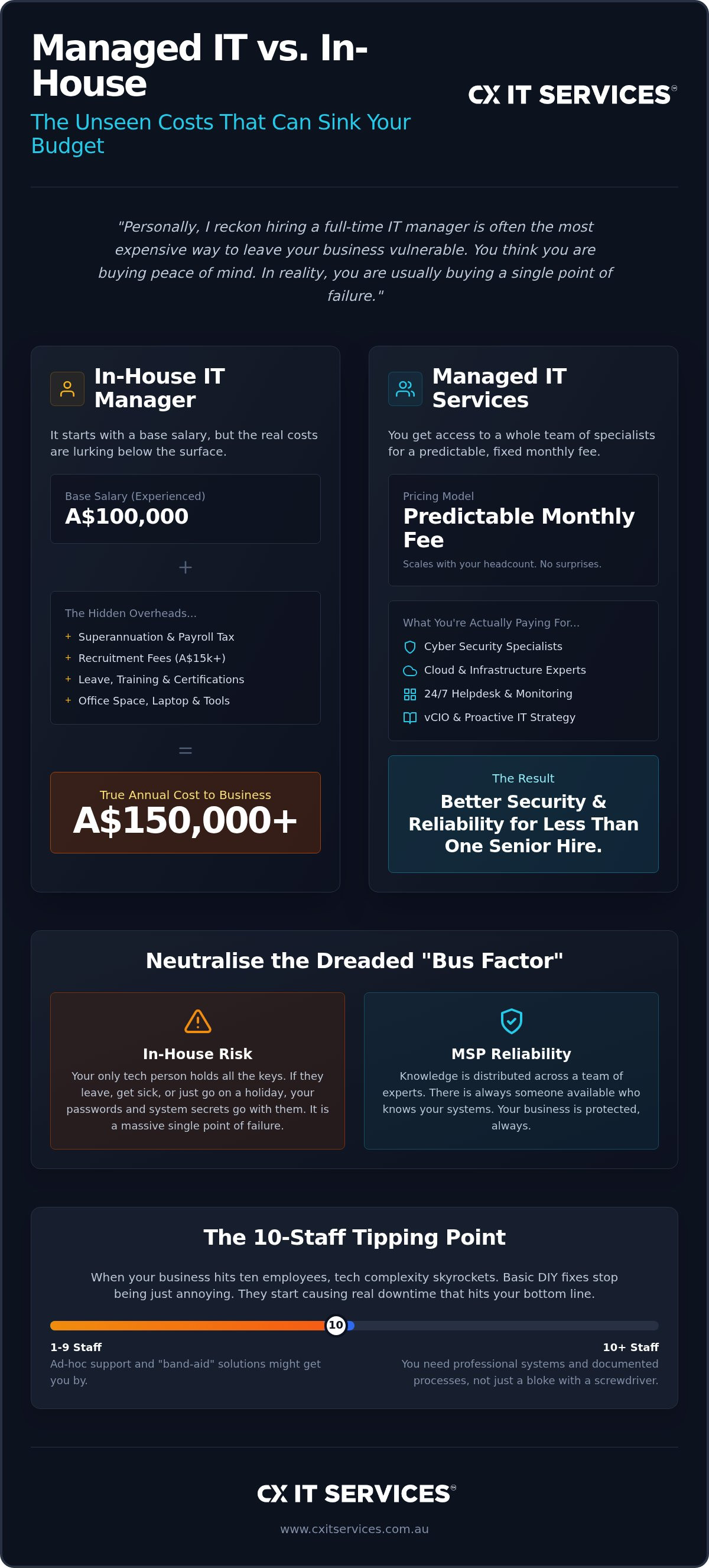
Personally, I reckon hiring a full-time IT manager is often the most expensive way to leave your business vulnerable. It is a common trap when weighing up managed IT services vs in-house IT.
You think you are buying peace of mind.
In reality, you are usually buying a single point of failure.
If your only tech person gets hit by a bus or heads off on an extended break, your passwords and system secrets go with them.
It is easy to look only at a base salary.
But once you add on the super, the annual leave, and the recruitment drama, an internal expert starts looking like a massive budget leak.
I have seen too many Aussie business owners get stuck with tech projects that never seem to finish.
It is exhausting to feel like you are paying top dollar for technology that still gives you a headache every Monday morning.
I am going to give you a blunt, honest comparison of the actual costs and capabilities of both models so you can stop wasting money on the wrong setup.
We will break down the hidden expenses of hiring and show you how to get better security without the HR nightmares.
Key Takeaways
- Calculate the total cost of an IT hire by including super, leave, and recruitment fees rather than just the base salary.
- Understand why one internal generalist cannot keep up with the rapid pace of modern cybersecurity and AI requirements alone.
- Compare managed IT services vs in-house IT to see which model provides the 24/7 reliability your business needs to avoid costly downtime.
- Explore co-managed IT as a middle ground that allows your internal staff to focus on strategy while a partner handles the daily grind.
- Neutralise the "Bus Factor" risk by distributing your technical knowledge across a team of experts instead of a single individual.
The myth of the one-man IT department
Personally, I reckon the idea of a "dedicated IT guy" is a bit outdated for most modern Australian businesses. Back in the day, you just needed someone who could swap out a hard drive or tell people to turn their computers off and on again. Those days are dead and buried.
One person simply cannot know everything. Technology moves too fast. You cannot expect a single brain to master cloud architecture, complex cyber security protocols, and the latest in AI automation all at once. When you hire just one person, you usually end up with a jack of all trades and a master of none. They are spread too thin to be truly effective at anything.
The "he's just down the hall" argument loses its shine pretty quickly in the real world. I have seen it happen dozens of times. Your internal IT person is stuck under a desk trying to clear a paper jam in a printer while your main server is having a meltdown. Your entire team is sitting idle, losing money by the minute, because your only tech resource is busy with a low-level hardware problem. It is a massive waste of a salary.
This is why the Managed services model has become the standard for firms that actually want to scale. It provides a team of specialists instead of a single generalist who is constantly underwater.
The 10-staff tipping point
When your business hits ten employees, your tech needs suddenly get a lot more complex. It is a natural growing pain. At this size, basic DIY fixes and "band-aid" solutions stop being just annoying. They start causing real downtime that hits your bottom line. You cannot rely on ad-hoc support anymore. You need professional systems and documented processes, not just a bloke with a screwdriver. This is usually the moment when the managed IT services vs in-house IT debate becomes a serious conversation for the owners.
Why proximity doesn't equal productivity
Having a desk in your office doesn't mean your IT person is fixing the right things. In fact, physical proximity often leads to "drive-by" support requests that derail important security updates. Modern remote management tools mean an MSP is often faster at resolving an issue than a staff member walking up the stairs. True strategic growth requires more than just reactive "break-fix" support. It requires IT strategy and proactive oversight that keeps you ahead of the curve rather than just keeping the lights on.
The true cost of managed IT services vs in-house IT
Personally, I reckon looking at a base salary is like looking at the tip of an iceberg. It is the stuff below the waterline that actually sinks your budget. A decent IT Manager in Australia isn't cheap, especially in 2026. You are likely looking at a base salary of around A$100,000 for someone with enough experience to not break things. But that is just the beginning of the story. It is the point where the bleeding starts, not where it ends.
When you sit down to compare managed IT services vs in-house IT, you have to look past the base salary. You need to count the extras. Managed services give you access to a whole team of specialists for less than the cost of one senior hire. You aren't just paying for a person. You are paying for a result. Fixed monthly fees mean no nasty surprises when a server blows up. It means no panic when a laptop gets dropped in a puddle. It is about stability and quiet competence.
To really determine if managed IT services are right for your business, you need to be honest about what an employee actually costs your bottom line.
The hidden overheads of a local hire
Superannuation, payroll tax, and workers' comp add up fast. They can easily push that A$100,000 salary closer to A$150,000. Then you have the "non-negotiables" that nobody talks about. Recruitment fees alone can cost you A$15,000 just to get someone in the door. You have to provide office space, a high-end laptop, and a desk. You also have to pay for their ongoing training. Technology moves so fast that if you aren't paying for their certifications, they will be out of date within a year. If they leave, you lose all that invested knowledge. Then you start the expensive cycle all over again.
MSP pricing: predictability is king
Subscription models allow you to scale costs as you add staff. It is a linear, predictable expense. One invoice covers your helpdesk, security, and cloud monitoring. There is no guesswork. It allows you to plan your growth with certainty. Your costs are tied to your headcount, not to hardware failures or staff sick days. You can see how fixed monthly IT support keeps your budget on track. If you are tired of the financial roller coaster, see if our model fits your business.
Skill sets and the 24/7 headache
Personally, I reckon the biggest lie in tech is that one person can stay on top of everything. In 2026, the tech environment is a minefield of shifting regulations and evolving threats. One brain simply cannot keep up. Technology moves too fast for a single human to maintain mastery over cloud migrations, AI integrations, and network engineering simultaneously. When you choose between managed IT services vs in-house IT, you are choosing between a collective brain trust and a solitary generalist.
MSPs invest heavily in high-end monitoring and automation tools. These are the kinds of enterprise-grade systems that a small business simply cannot justify buying for one internal staff member. When you hire an MSP, you aren't just getting a tech. You are getting a strategy. You are getting a partner who has already seen your specific problem ten times this week at other firms. There is no "learning on your dime" because the solution is already part of our standard operating procedure.
Specialists vs Generalists
An MSP has dedicated experts for cyber security and cloud architecture. These people live and breathe their specific niche every single day. Your in-house person is likely Googling the solution while your team sits around the kitchen table waiting for the internet to come back. It is the difference between a GP and a surgeon. You wouldn't ask your family doctor to perform heart surgery. Why ask a generalist to defend your firm against a sophisticated ransomware attack? You can get access to a Virtual CIO without the six-figure salary. This gives you high-level direction and budgeting advice without the massive overhead of a C-suite executive.
Support that doesn't sleep
Hackers don't work nine to five. They actually prefer it when you are at home having a beer on a Friday night. That is when the real trouble usually starts. An MSP provides 24/7 monitoring that a single human can't match. A person needs to sleep, eat, and take the kids to footy practice. What happens to your business at 2 AM on a Sunday if the system crashes? In the managed IT services vs in-house IT battle, the MSP wins on coverage every time. While your internal guy is snoring, a managed team is already patching the vulnerability before you even wake up for your morning coffee. It is about having a safe pair of hands on the wheel at all times.
Risk, reliability and the dreaded Bus Factor
Personally, I reckon the scariest thing in business is the "Bus Factor." It is a simple, brutal metric. How many of your staff would have to get hit by a bus before your business grinds to a halt? If the answer is "one" for your tech department, you are in serious trouble. When you look at managed IT services vs in-house IT, you are really looking at the difference between a resilient system and a single point of failure.
If one person holds all the keys to your digital kingdom, you are effectively a hostage to their schedule. Holidays and sick leave shouldn't mean your tech support stops. I have seen Aussie businesses wait three weeks for a critical software update because their only IT person was on a fishing trip in Exmouth. That is not a strategy. It is a gamble. Consistency is the biggest advantage of a managed team. A professional provider doesn't go on holiday. The service just keeps running.
What happens when they walk out?
Losing an internal IT person often means losing years of "unwritten" knowledge. They know which server cable is dodgy and why the printer in accounts only works on Tuesdays. When they quit, all that tribal knowledge walks out the door with them. Recruiting a replacement in the current Australian market takes months of pain and lost productivity. You have to hope the new person can figure out the mess left behind. With an MSP, the documentation and processes belong to the business. Everything is recorded, audited, and accessible. Knowledge is power, and you should own it.
Redundancy that actually works
MSPs have layers of staff to ensure someone is always available. You get a disaster recovery plan that doesn't rely on one person's memory or a handwritten notebook. When you weigh up managed IT services vs in-house IT, you have to value the peace of mind that comes with redundancy. It is about sleeping better at night knowing the "keys" are safe in a professional vault. You aren't relying on a single person's memory. You are relying on a documented system that works 24/7. If you want to stop worrying about the Bus Factor and start focusing on your actual work, book a strategy session with us today.
The middle ground: Co-managed IT
Personally, I reckon the biggest mistake people make in the managed IT services vs in-house IT debate is thinking it has to be a divorce. You don't always have to sack your IT guy to get the benefits of a professional provider. Sometimes, the smartest move is to let them work together. It is about building a partnership that actually scales.
Co-managed IT is the ultimate middle ground. It is designed for Australian businesses that are growing fast and starting to see the cracks in their current setup. Your internal person is probably a legend. They know your staff by name. They know exactly which desk has the dodgy Wi-Fi signal. But they are likely drowning in low-level tickets and "have you tried turning it off and on again" requests.
This creates a massive bottleneck. When your IT guy is busy fixing a mouse, they aren't working on the big projects that actually move the needle for your business. They aren't looking at AI automation or long-term infrastructure strategy. By bringing in backup, you give them a safety net. They get to focus on high-value strategy while we handle the repetitive, boring stuff in the background. No more burnout. No more 2 AM panic calls.
Backing your team without the fluff
We provide the heavy-duty tools and 24/7 monitoring that would be too expensive for a single business to buy on its own. Your internal person stays as the face of IT for your staff. They remain the hero on the ground, but they have a whole team of specialists sitting behind them. It is about augmenting their skills, not replacing them. You can read more about how co-managed IT works in practice to see if it fits your culture.
How to make the switch
If you are feeling the pressure, the first step is an audit of your current risks and hidden costs. You need to know where the leaks are before you can plug them. Transitioning to a hybrid model doesn't have to be a bloody nightmare if you have a clear roadmap. It is a structured process that respects your existing team while adding the layers of security and redundancy you have been missing.
In the end, the managed IT services vs in-house IT choice comes down to what helps your business grow without the constant tech headaches. If you are ready to see if you have outgrown your current setup, apply for a consultation here. We will give you a straight answer on what actually works for your specific situation.
Secure your business growth without the tech drama
Personally, I reckon the choice isn't just about a budget line item. It is about how much sleep you want to get at night. When you weigh up managed IT services vs in-house IT, the decision usually comes down to risk. You can keep betting on a single person who might leave tomorrow, or you can back your firm with a team that never takes a holiday.
We have been Australian owned and operated for over 26 years. We provide fixed monthly fees with zero hidden costs and 24/7 national support coverage. It is a safe pair of hands for businesses that have outgrown the "bloke down the hall" approach. Technology should be the engine of your growth, not the anchor holding you back.
It is time to move past the recruitment drama and the constant tech headaches. You deserve a setup that actually works while you focus on your clients. Stop guessing and get a clear IT roadmap for your business.
Building a stable foundation today is the best way to protect your tomorrow. Let's get to work.
Frequently Asked Questions
Is managed IT services cheaper than hiring a full-time employee in Australia?
Yes, usually. Hiring a senior IT manager in 2026 often costs around A$100,000 base. When you add super, payroll tax, and recruitment fees, that figure climbs toward A$150,000. An MSP provides a full team of specialists for significantly less than a single senior hire. It turns a massive, variable salary expense into a predictable monthly cost. This is a core part of the managed IT services vs in-house IT debate.
What is the 'Bus Factor' in IT and why should I care?
The "Bus Factor" is the number of staff members who would have to get hit by a bus before your business fails. If only one person knows your passwords and system secrets, your factor is one. It is a massive risk. If that person leaves or gets sick, you lose the keys to your kingdom. Managed services remove this risk by sharing knowledge across a documented team.
Can I keep my current IT person and still use managed services?
Yes, you can. This model is known as co-managed IT. Your internal person stays as the face of tech for your staff while we handle the complex background work. We take care of 24/7 security monitoring and server maintenance so your guy can focus on big projects. It stops your internal hire from burning out and gives them a professional safety net.
Does an MSP provide on-site support if something physically breaks?
Yes. While we fix most issues remotely to save you time, physical hardware sometimes fails. If a server dies or a switch goes bang, you need someone on the ground. A national provider ensures a technician can get to your office to swap out gear or fix local wiring. Remote support is fast, but on-site support is essential when the hardware itself is the problem.
How long does it take to transition from in-house IT to an MSP?
A standard transition usually takes between 30 and 90 days. We don't just flip a switch. The first month is dedicated to a thorough audit and documenting every corner of your network. We then phase in our monitoring tools and security protocols. This methodical approach ensures there is no downtime or lost data while we take over the management of your systems.
What happens to my data and passwords if I switch to an MSP?
You keep full ownership of everything. We use professional, encrypted password vaults to store your credentials, and you have master access at all times. Switching to an MSP actually makes your data safer. It moves your secrets out of an IT person's memory or a dodgy spreadsheet and into a secure, audited system. You are never locked out of your own business.
Are managed IT services secure enough for legal or financial firms?
They are generally more secure than a single-person setup. MSPs use enterprise-grade threat detection and encryption tools that are often too expensive for small internal teams. For legal and financial firms, this provides the high-level security and documented audit trails required by Australian regulations. We act as a safe pair of hands for your most sensitive client information.
Do I have to sign a long-term contract for managed IT support?
Contract lengths vary between providers. While a fixed-fee model often works best on a 12-month term to provide budget stability, the focus should be on the service level. You want a partner who earns your business every single month through results. A good agreement should be clear about what is covered so there are no nasty surprises on your invoice in the managed IT services vs in-house IT comparison.