
Explore managed IT services vs in-house IT for your Aussie business. Our 2026 guide breaks down hidden costs, security risks, and how to scale safely.
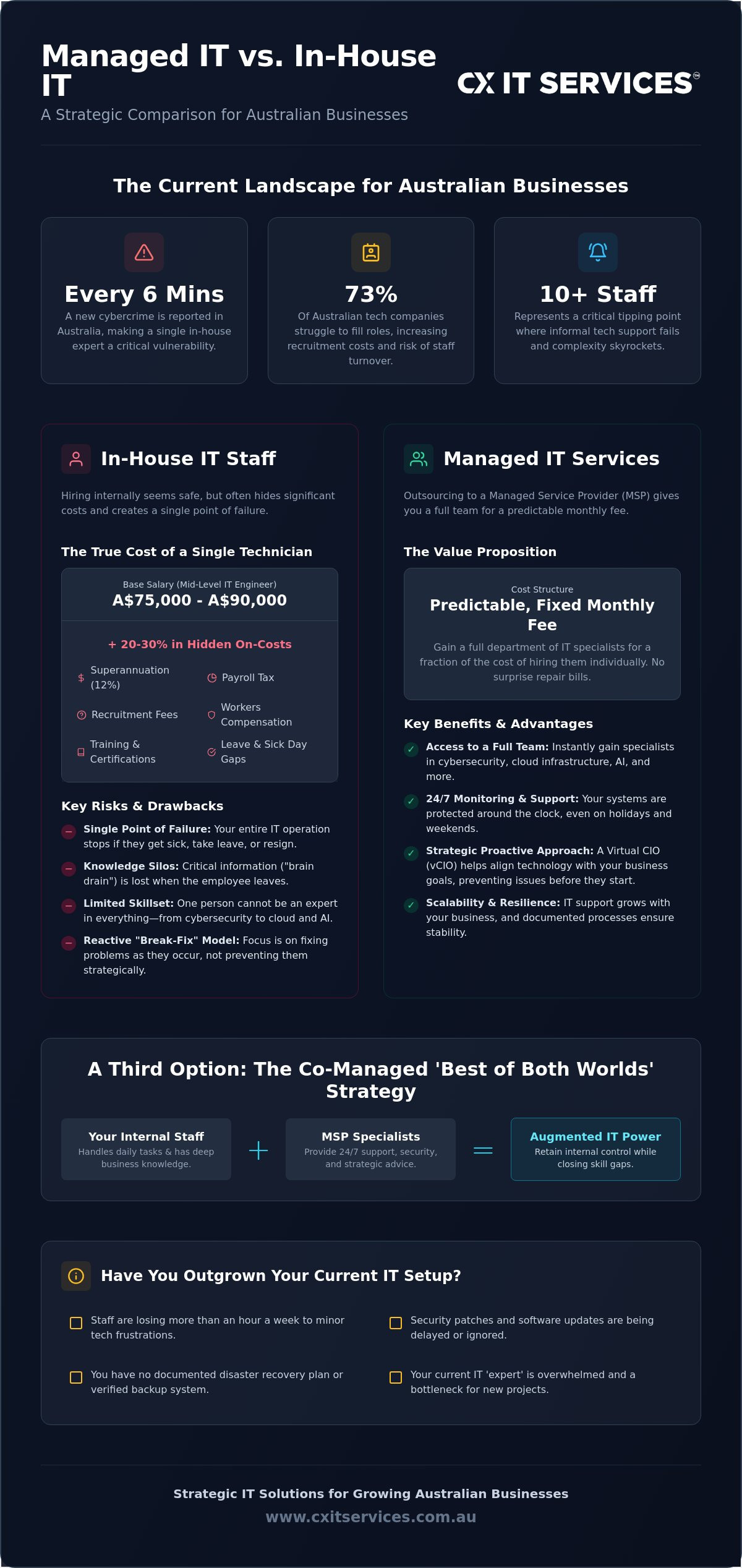
Hiring a dedicated internal technician might seem like the safest way to control your technology, but in 2026, it often creates the very single point of failure you're trying to avoid. With 73% of Australian tech companies currently struggling to fill technical roles, the risk of your only IT expert resigning has never been higher. You are often left juggling recruitment fees and rising superannuation costs while security vulnerabilities mount in the background.
We know you want stability and predictable monthly outgoings rather than a pile of surprise repair bills. It is difficult to expect one person to defend against a cybercrime report that now occurs every six minutes in Australia. This guide provides a clear-eyed comparison of managed IT services vs in-house IT to help you find a model that scales. We will reveal the real cost-to-benefit ratio of outsourcing versus hiring to ensure your technology remains an asset, not a liability.
You will get a detailed look at current Australian salary benchmarks, the hidden overheads of internal staff, and how to choose a strategic path that secures your business for the years ahead.
Key Takeaways
- Learn why reaching the 10-employee milestone represents a critical tipping point where informal tech support fails to manage increasing digital complexity.
- Uncover the hidden expenses of internal hiring, such as superannuation and recruitment fees, to calculate your real Total Cost of Ownership.
- Evaluate the financial impact of managed IT services vs in-house IT by comparing fixed monthly fees against the risk of unpredictable repair bills.
- Discover how a co-managed approach allows you to retain internal staff while augmenting their skills with specialist security and AI expertise.
- Use our strategic framework to assess your current downtime costs and security vulnerabilities before committing to a long-term IT model.
The 10-Staff Tipping Point: Why Your IT Needs Are Evolving
When you're running a boutique operation, technology is often background noise. You might rely on a "tech-savvy" employee to fix a jammed printer or reset a password between their actual duties. But as your team expands toward the 10-employee mark, that background noise becomes a roar. Managing a handful of laptops is simple; managing a network of ten or more users with diverse access levels, remote requirements, and security needs is a full-time responsibility. This is where the debate over managed IT services vs in-house IT typically begins, as business owners realise that "getting by" is no longer a viable strategy for growth.
The 10-staff tipping point is the moment IT moves from a utility to a strategic asset. At this stage, the risk of downtime is no longer just a nuisance. It is a direct hit to your bottom line. If ten employees are sitting idle because the server is down or a cloud sync has failed, you aren't just losing time; you are burning thousands of dollars in wages every hour. Professional management ensures your systems are built for resilience rather than just basic functionality.
The Complexity Trap for Growing Teams
Complexity doesn't grow linearly; it grows exponentially. Once you hit ten staff members, you are likely managing at least 10 Microsoft 365 licences, 10 to 15 mobile devices, and various cloud-based applications. Standardising security protocols across this fleet is impossible without a dedicated system. You cannot expect "the guy who knows computers" to stay on top of the latest Australian cyber threats while also performing their primary job. A professional managed service provider brings a level of oversight that a generalist simply cannot match, especially regarding 24/7 uptime and secure remote access for a hybrid workforce.
Transitioning from Reactive to Strategic IT
Most small businesses operate in a "break-fix" cycle. Something breaks, you pay to fix it, and you wait for the next disaster. Growing businesses cannot afford this volatility. Shifting to a strategic model means leveraging AI and automation to streamline workflows before problems even arise. This is where a Virtual CIO (vCIO) perspective becomes invaluable. Instead of guessing your tech spend, you establish long-term budgets and hardware procurement cycles that align with your business goals. You stop reacting to technology and start using it to drive efficiency.
Common signs your business has outgrown its current setup include:
- Staff members are losing more than an hour a week to minor tech frustrations.
- Security patches and software updates are being delayed or ignored entirely.
- You have no documented disaster recovery plan or verified backup system.
- Your IT "expert" is overwhelmed and becoming a bottleneck for new projects.
Recognising these symptoms early allows you to choose a path between managed IT services vs in-house IT that supports your trajectory rather than hindering it.
The True Cost of In-House IT: Beyond the Base Salary
Hiring an internal technician often starts with a look at the base salary. In July 2026, SEEK reports that a mid-level IT Support Engineer in Australia earns between A$75,000 and A$90,000. However, this figure is deceptive. When weighing managed IT services vs in-house IT, you must look at the Total Cost of Ownership. You aren't just paying a salary. You're paying for superannuation, which reached 12% in July 2025, plus payroll tax, workers compensation, and office overheads. These extras usually add 20% to 30% on top of the base pay before a single ticket is even raised.
Recruitment is another hurdle that many businesses underestimate. With 73% of Australian tech companies currently unable to fill roles through standard processes, you'll likely face high agency fees just to find a candidate. If that hire leaves, you lose the institutional knowledge they've built. This "brain drain" forces you back into a costly hiring cycle while your systems remain vulnerable. It's a revolving door that drains both your budget and your operational stability.
Recruitment and Training Realities
Keeping an internal expert effective requires constant investment. Technology moves fast; you must fund ongoing certifications and professional development to ensure your staff can handle modern threats. If you don't, your "expert" quickly becomes obsolete. A single employee also cannot work 24/7. When they take annual leave or sick days, your business is exposed. Contrast this with the pros and cons of using an MSP, where a team provides continuous coverage without the training overhead.
The Infrastructure and Tooling Gap
Professional IT management requires enterprise-grade tools. This includes ticketing systems, remote monitoring software, and advanced security layers. If you buy these internally, the licensing costs are immense. Most businesses find that a fixed monthly fee for managed IT support actually covers a tech stack that would cost thousands separately. An internal hire often lacks the budget for these tools, leading to a "make-do" approach that increases your risk. Given the average self-reported loss for Australian small businesses is now A$56,600 per incident, the cost of inadequate tooling is a risk you can't afford to take.
Managed IT Services: Gaining a Full Department for a Fixed Fee
While an internal hire represents a variable risk, the managed model offers a clear, fixed path for growth. Gartner defines an MSP as a provider that delivers services such as network, application, infrastructure, and security via ongoing support and active administration. For the Australian business owner, this translates to a per-user, per-month fee that remains constant regardless of how many support tickets your team raises. It effectively eliminates the "bill shock" associated with emergency repairs or unexpected hardware failures.
When comparing managed IT services vs in-house IT, the talent pool is the most significant differentiator. A single hire is usually a generalist who can handle day-to-day troubleshooting. However, they rarely possess deep expertise in cloud architecture, advanced cybersecurity, and AI integration simultaneously. An MSP provides a bench of specialists. You gain access to a security officer, a cloud engineer, and an automation expert for a fraction of the cost of hiring those roles individually. This model scales effortlessly; as you add new staff, your IT capacity expands without increasing the management burden on your leadership team.
Modern managed services also bridge the widening AI skills gap. While 60% of technology employees now use AI regularly, only 22% have received formal training. An MSP uses AI and automation to solve problems before they impact your operations. Automated scripts handle routine maintenance, patch management, and security scans in the background. This ensures your systems are always optimised, allowing your team to focus on high-value work rather than technical hurdles.
Predictable Budgeting for National Operations
Forecasting annual spend becomes a simple calculation when you use a fixed-per-user model. CFOs appreciate the transparency of knowing exactly what technology will cost as the business expands. You can consolidate your VoIP, internet, and support into a single monthly invoice, reducing administrative friction. This creates Predictable Technology Spending with Fixed Monthly IT Support, allowing you to reallocate capital toward strategic initiatives instead of emergency tech fixes.
Leveraging Advanced Technology
You aren't just buying support; you're buying an enterprise-grade infrastructure. This includes 24/7 monitoring that never takes a holiday or a sick day. If a server fails at 2 AM on a Sunday, an automated alert triggers a response from the MSP team. Your business stays online without you ever having to pay overtime or worry about an internal staff member being unreachable. This proactive oversight is a standard inclusion that provides a "safe pair of hands" for your digital assets.
Co-Managed IT: The 'Best of Both Worlds' Strategy
Choosing between managed IT services vs in-house IT doesn't have to be a binary decision. Many growing Australian businesses find themselves in a difficult position. They have a trusted internal IT manager who understands the company culture, yet that person is often drowning in daily support tickets and routine maintenance. Co-managed IT solves this by creating a partnership. It allows you to keep your internal expert focused on high-level strategy while an external team provides the heavy lifting for infrastructure and security.
This model addresses the common fear of losing control. You don't hand over the keys and walk away. Instead, you gain a strategic ally that supplements your existing talent. Your internal lead remains the primary decision-maker, but they no longer have to worry about server patches at 3 AM or troubleshooting a routine hardware issue at one site while trying to roll out a new ERP system across the business. It's about augmenting your capabilities, not replacing your people.
How to Organise a Co-Managed Partnership
Success in this model depends on a clear division of labour. We typically recommend that the MSP handles "the noise." This includes helpdesk tickets, routine maintenance, and 24/7 monitoring. When the external team manages these repetitive tasks, your internal staff can Scale Your Technology with Strategic Co-Managed IT by focusing on business-specific projects. It turns your IT department from a reactive cost centre into a proactive driver of efficiency.
Maintaining Sovereignty and Security
Transparency is the foundation of a co-managed relationship. We use shared dashboards that give your internal team real-time oversight of every ticket and security alert. You maintain sovereignty over your data while benefiting from collaborative disaster recovery and backup protocols. This "safe pair of hands" approach ensures that even if your internal IT lead is on leave, your business remains protected by a full team of specialists. If you want to explore how this hybrid model fits your growth plans, talk to us about a co-managed strategy that supports your team.
Making the Decision: A Framework for Australian Business Owners
Deciding between managed IT services vs in-house IT requires an honest audit of your current business risks. If your technology is managed by a single person, you aren't just paying a salary; you're carrying the risk of that person being the only one who knows your passwords, network architecture, and backup protocols. This single point of failure is often the most significant hidden cost for growing Australian companies. When you factor in the average self-reported loss of A$56,600 per cybercrime incident, the value of a team-based approach becomes clear.
For businesses with 10+ staff, the ROI of Managed IT typically surpasses in-house hiring within the first 6 months. This rapid return on investment occurs because you immediately bypass recruitment fees, superannuation increases, and the capital expense of enterprise-grade security tools. Instead of paying for a person to sit at a desk, you're paying for a result: 100% uptime, hardened security, and a scalable foundation for your next stage of growth.
The Decision Matrix
| Feature | In-House IT | Managed IT Services | Co-Managed IT |
|---|---|---|---|
| Cost Structure | High (Salary + Overheads) | Fixed Monthly Fee | Shared / Mid-range |
| Expertise | Generalist (Single person) | Specialist Team (Bench) | Hybrid (Internal + External) |
| Scalability | Slow (Requires new hires) | Instant (Per-user model) | Flexible |
| Security | Reactive / Limited | Proactive (24/7) | Collaborative |
You may be ready for a Virtual CIO if your technology decisions are currently driven by what's broken rather than what will drive revenue. A vCIO provides the strategic technology planning that a technician cannot, ensuring your hardware procurement and software choices align with your 2026-2027 financial goals.
Transitioning for Growth
Moving to a professional managed model is a structured process designed to minimise friction. In the first 30 days, you should expect a comprehensive audit of your current environment, the documentation of all assets, and the immediate hardening of your security perimeter. This onboarding phase ensures that your team feels supported from day one, replacing technical frustration with a sense of stability and control. If you're ready to move beyond reactive fixes, you can book a discovery call to see how fixed-fee Managed IT can scale your business and protect your bottom line.
Secure Your Competitive Edge for 2026 and Beyond
Technology should be the engine of your growth rather than the anchor holding you back. As we've explored, the decision regarding managed IT services vs in-house IT is ultimately about risk management and scalability. By moving beyond the limitations of a single internal hire, you gain access to a full department of specialists who ensure your systems are proactive, secure, and always available.
We bring over 26 years of industry experience to your business. As an Australian owned and operated partner, we provide the stability of a fixed monthly fee combined with 24/7 support. This approach eliminates unpredictable repair bills and ensures your technology aligns with your long-term commercial objectives. Our team is ready to act as your strategic guide, providing the oversight needed to navigate an increasingly complex digital environment.
Take the first step toward a more efficient and secure operation today. Get a Fixed-Fee Managed IT Quote for Your Team.
Your business deserves a technology foundation that supports your ambition without compromise.
Frequently Asked Questions
Is managed IT services cheaper than hiring a full-time IT manager?
Managed IT services are generally more cost-effective for growing businesses because you avoid the full burden of a senior salary, superannuation, and payroll tax. Instead of paying a single person for 40 hours a week, you pay for a specific outcome. This model eliminates the high costs of recruitment and ongoing training while providing access to a diverse team of specialists for less than the price of one senior hire.
Will I lose control of my data if I outsource to an MSP?
You don't lose control; you actually gain better oversight through formalised reporting and shared dashboards. A professional provider act as a manager under your direction, ensuring all digital assets are documented and secure. You retain full ownership of your data while benefiting from enterprise-grade management protocols that are often more transparent than an informal internal setup.
Does managed IT support include cybersecurity and cloud management?
Yes, modern support plans prioritise cybersecurity and cloud optimisation as standard inclusions. This involves proactive threat monitoring and the active management of workloads in environments like Microsoft 365. Given that a cybercrime report is filed every six minutes in Australia, having these protections built into your IT model is essential for maintaining business continuity.
What is the "per-user" pricing model for IT services?
The per-user model is a predictable billing method where you pay a fixed monthly fee for every staff member supported. This approach makes it easy to forecast your annual spend because the cost only scales when your head count changes. It covers all the devices and applications each person uses, which eliminates the "bill shock" of unpredictable hourly rates when comparing managed IT services vs in-house IT.
Can an MSP work with my existing internal IT person?
Yes, we often partner with internal technicians in a co-managed capacity to augment their existing skills. In this scenario, the external team handles the repetitive maintenance and 24/7 security monitoring while your internal lead focuses on high-level business strategy. It's a collaborative partnership that provides your staff with enterprise-grade tools and a "safe pair of hands" for backup support.
How does an Australian-owned MSP differ from global providers?
Australian-owned providers offer regional reliability and a deep understanding of local regulations like the Notifiable Data Breaches scheme. You deal with experts who work in your time zone and understand the specific market conditions affecting your industry. This local focus creates a more accessible relationship where you're treated as a partner rather than just another ticket in a global queue.
What happens if we have an IT emergency after hours?
Our 24/7 monitoring systems identify and resolve most infrastructure issues before they impact your morning operations. If a critical failure occurs outside of standard business hours, our response protocols ensure that a technician is alerted immediately to begin remediation. This continuous oversight provides a level of protection that a single internal hire simply cannot sustain without risking burnout.
How long does it take to transition from in-house to managed IT?
A standard transition typically takes 30 days to ensure a seamless handover of responsibilities. This period includes a comprehensive audit of your current environment, the documentation of all network credentials, and the deployment of monitoring tools. We follow a methodical onboarding process designed to protect your data and prevent any disruption to your daily workflows during the move to managed IT services vs in-house IT.