Running a 50-person Aussie firm? This guide covers managed IT services for 50 employees, breaking down 2026 costs, security, and how to find a local partner.
Personally, I reckon 50 staff is the exact moment a business outgrows its "IT guy" and needs proper managed IT services for 50 employees.
It's the point where your single point of failure, usually a stressed-out internal manager, becomes a genuine liability for the whole firm.
Most Aussie bosses just want to know they won't be ignored by a global call centre the moment a server goes bang or a laptop starts acting up.
You probably feel like you're constantly waiting for the next ransomware headline or a surprise bill that ruins your monthly budget.
It’s a stressful way to run a ship.
I know you want predictable costs and a partner who actually knows your name when they pick up the phone.
This guide is about getting you there.
We are going to break down the reality of IT support in 2026. I’ll show you how to audit your current setup against new Australian cyber laws and how to find a partner who provides security that actually works. No fluff. Just a clear path to getting your weekends back.
Key Takeaways
- Identify why 50 staff is the critical tipping point where DIY support fails and downtime becomes a business-killing liability.
- Learn what a fair dinkum subscription actually includes, focusing on proactive monitoring rather than just waiting for things to break.
- Get a clear breakdown of why managed IT services for 50 employees typically cost between $120 and $250 per user in 2026.
- Discover how to spot providers selling corporate slop and why an Australian owned partner is better for your bottom line.
- Follow a proven roadmap for transitioning your IT support without the usual headaches or messy service gaps.
Why 50 Employees is the IT Breaking Point for Aussie Firms
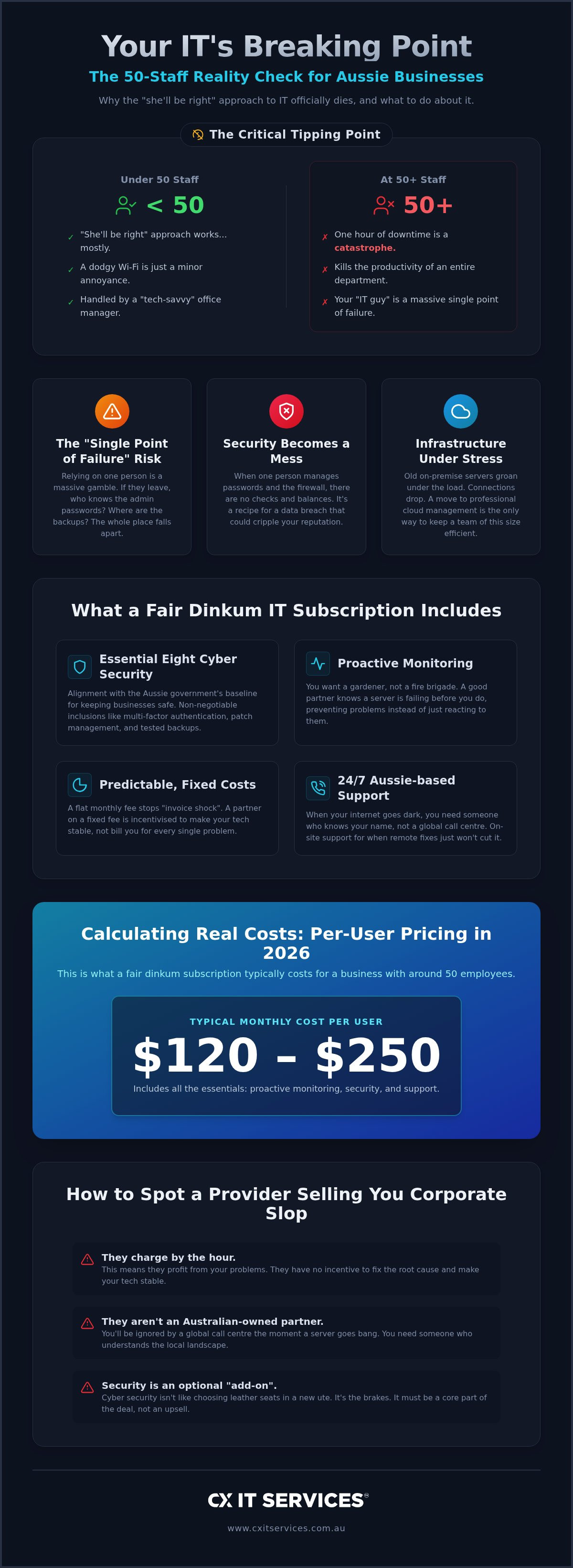
Personally, I reckon 50 staff is the moment the "she’ll be right" approach to IT officially dies.
When you have five employees, a dodgy Wi-Fi router is a minor annoyance. At 50, it is a catastrophe. One hour of downtime doesn't just frustrate one person. It kills the productivity of an entire department. It flushes thousands of dollars in wages down the toilet while everyone sits around staring at their screens.
Most Aussie businesses at this size have outgrown their "tech-savvy" office manager or the lone internal IT guy. You know the one. He hasn't taken a proper holiday since 2022 because the whole place falls apart if he isn't there to reboot the server. Complexity increases exponentially once you hit 50 users. Identity management, data access, and security become beasts that a single person simply cannot tame alone. This is where what are managed IT services? becomes a critical question for your leadership team to answer. Investing in managed IT services for 50 employees isn't just about fixing broken laptops; it is about ensuring 50 people can actually do their jobs without fighting the tools they were given.
The "Single Point of Failure" Risk
Relying on one internal person is a massive gamble for your business continuity. I've seen it too many times. The "IT guy" leaves for a better offer, and suddenly no one knows the admin passwords or where the backups are stored. There is also the hidden cost of "Dave from Finance" spending half his day fixing printer issues. Every minute Dave spends on a paper jam is a minute he isn't doing the job you actually hired him for. Worse still, your security becomes a mess. When the person in charge of resetting passwords is also the one managing your firewall, there are no checks and balances. It is a recipe for a data breach that could cripple your reputation.
Infrastructure Stress and the Move to Cloud
For many firms, 50 users is the absolute limit for older on-premise servers. The hardware starts to groan under the load. Connections drop. The fan in the server cupboard sounds like a jet engine taking off every afternoon. Transitioning to professional cloud infrastructure management is the only way to keep a team of this size mobile and efficient. You need systems that scale with you, not ones that hold you back. Your internet and phone systems also need to handle 50 simultaneous connections without the lag that makes Zoom calls unbearable. At this scale, you aren't just managing computers. You are managing an ecosystem that needs to be fast, secure, and always on.
What Should Be Included in Your Managed IT Subscription?
A fair dinkum managed service provider (MSP) should offer more than just a helpdesk phone number. If you are only paying for someone to answer the phone when things break, you are basically paying for a digital fire brigade. You want a gardener instead. Proactive monitoring must be part of the deal. Your provider should know a server is failing before your staff even walk into the office. This is a core part of deciding if managed IT is right for your business. When evaluating managed IT services for 50 employees, you need to look past the basic ticket system.
For a firm of this size, cyber security is no longer an optional "add-on". It's not like choosing the leather seats in a new ute. It's the brakes. You need predictable costs to keep the partners happy. Look for a fixed monthly fee that includes everything you actually need. This stops "invoice shock" from ruining your month. If your IT guy charges by the hour, he has no incentive to fix the root cause of your problems. A fixed-fee partner is incentivised to make your tech boring and stable. Managed IT services for 50 employees should be a flat rate that covers your entire infrastructure.
Essential Eight and Cyber Security Compliance
Your MSP must align with the Australian Signals Directorate Essential Eight framework. This isn't just tech jargon. It's the baseline for keeping Aussie businesses safe from ransomware and data theft. Mandatory inclusions should cover multi-factor authentication, rigorous patch management, and regular backups that are actually tested. For a deeper look at how this fits into your long-term plan, check out our guide on Cyber Security Management Services. Security is a non-negotiable pillar of modern business operations.
24/7 Helpdesk and On-site Support
Remote support is great until it isn't. When the internet goes dark or a physical switch dies, you need on-site technicians available across Australia. A 24/7 helpdesk is also vital. Partners often work late or travel across time zones. They shouldn't have to wait until 9:00 AM AEST to get a password reset. Most importantly, your team should actually like calling IT. Support should be a relief, not a chore. If your current setup feels more like a hindrance than a help, it might be time to see if a fixed-fee model fits your firm. You deserve a partner who actually gives a toss about your uptime.
Calculating Real Costs: Per-User Pricing in 2026
Personally, I reckon if a quote looks too good to be true, it usually is. In 2026, quality managed IT services for 50 employees will set you back between $120 and $250 per user every month. This isn't just a number pulled from thin air. It covers the expertise, software, and proactive monitoring needed to keep your firm running. The price fluctuates based on your "legacy baggage". If you're still running applications designed in the early 2000s, it takes more effort to keep them secure and stable. Modern, cloud-first businesses usually sit at the lower end of that scale.
Transparency is king here. You want a single managed billing point. This should include your support, security, and SaaS licensing like Microsoft 365. A lower headline rate often hides "billable extras" that make your monthly invoice look like a phone book. You end up paying for every little thing, from printer setups to password resets. It's a headache you don't need. Following government guidance on IT services ensures you aren't cutting corners that lead to bigger costs later. When everything is bundled, you get a clear view of your overheads without the nasty surprises.
Why "Cheap" IT is the Most Expensive Mistake You Can Make
The "Break-Fix" model is a trap. You are essentially paying someone to wait for you to fail. If your IT provider only makes money when your systems are down, your interests aren't aligned. One ransomware incident can wipe out ten years of "savings" from a budget provider in a single afternoon. This is where strategic IT consulting proves its worth. It helps you prevent multi-million dollar mistakes before they happen. Quality managed IT services for 50 employees shouldn't be seen as a cost. It is an insurance policy for your productivity.
SaaS and Telecommunications Consolidation
Managing 50 Microsoft 365 licenses shouldn't be your headache. Your MSP should handle the onboarding, offboarding, and security of these accounts. You can also consolidate your business internet and VoIP into your managed IT agreement. This gives you one neck to wring if things go wrong. Looking ahead, AI and automation are starting to reduce long-term per-user costs. They increase efficiency and handle the grunt work. This allows your team to focus on high-value tasks instead of fighting with their tools. By consolidating these services, you simplify your tech stack and your accounting. One bill. One partner. Total control.
How to Spot an MSP That Isn’t Just Selling You Corporate Slop
Personally, I reckon you shouldn't be fooled by shiny brochures or global office maps. A provider might have a fancy website with stock photos of people in glass boardrooms, but that doesn't help when your network goes down in Melbourne. If you are looking for managed IT services for 50 employees, a global footprint is often a red flag. It usually means you are a small fish in a massive, impersonal pond. You want a partner who is Australian owned and operated. They understand our local market, our specific compliance laws, and the fact that you need someone to pick up the phone right now.
Check if they actually use the tech they are trying to sell you. Specifically, ask about their own use of AI automation. If an MSP is still doing everything manually, they are inefficient. That inefficiency eventually becomes your problem, either through higher costs or slower response times. The "Safe Pair of Hands" test is simple. Do they talk about your business goals and your growth, or do they just drone on about their own "stack" and ticket numbers? A good partner focuses on your uptime, not their own internal metrics.
The Value of vCIO and IT Strategy
Once you hit 50 people, you can no longer afford to wing it. You need a Virtual CIO to plan your technology roadmap for the next three years. This moves your business away from reactive "firefighting" where you only deal with tech when it breaks. A vCIO ensures your technology actually supports your business objectives. They also make sure your hardware procurement is handled professionally. You don't want to end up with a cupboard full of expensive paperweights because you bought the wrong gear in a hurry.
Authentic Support vs. Call Centre Scripts
There is a massive difference between a local expert and a scripted Tier 1 agent sitting in an overseas call centre. When your staff are under the pump to meet a deadline, they don't want to be read a script. They want a human being who knows their name and understands how their specific software works. Culture fit matters. Your team needs to trust the people on the other end of the line. You also need a partner who isn't afraid to give you the blunt truth. If your current server is a ticking time bomb, they should tell you straight. Honesty is the only way to build a real partnership. If you are tired of the corporate run-around, it might be time to apply for a strategy session with a local team that actually gives a toss.
Transitioning to Managed Services Without the Headache
Personally, I reckon moving your IT shouldn’t feel like open-heart surgery. It is a common fear among Aussie business owners. I have spoken to plenty of directors who stay with a rubbish provider just because they are terrified of the switch-over chaos. They assume that changing their managed IT services for 50 employees will result in a week of lost productivity and staff mutiny. It shouldn't be that way.
A professional transition starts with a deep-dive audit of what you actually have. We need to look under the bonnet. You cannot secure a network if you don't even know half the devices exist. Communication with your staff is the secret sauce here. If they know what is happening and why, they will be on your side. If you just spring a new helpdesk on them on a Monday morning, you are asking for trouble. Not alone. Together. That is how a proper partnership works.
The 30-Day Onboarding Roadmap
Getting your managed IT services for 50 employees right from day one requires a roadmap. The first ten days are about the full system audit and security assessment. We find the "ticking time bombs" before they go off. The middle phase involves cleaning up your technical debt. This means fixing the dodgy workarounds and old patches that have been ignored for years. Finally, we introduce your team to the new support protocols. They need to know exactly who to call and what to expect when they need a hand. A smooth rollout builds trust from the very first ticket.
Co-Managed IT: A Hybrid Solution
You might already have an internal IT person who knows your business inside out. If you aren't ready to outsource everything, you can supplement your internal IT team with a hybrid model. This is called Co-Managed IT. It is about defining the boundaries so everyone knows their role. Your internal staff can focus on high-level strategic projects that grow the firm. The MSP handles the boring "grunt work" like 24/7 monitoring, security patches, and backups. It gives your internal person a life and gives you the peace of mind that nothing is falling through the cracks. It is about backing your team, not replacing them. When you combine local knowledge with a fair dinkum support structure, your business becomes unstoppable.
Taking Control of Your Firm's Digital Future
Personally, I reckon you shouldn't have to fight your tech every single morning. At 50 staff, you have reached a size where "good enough" IT is actually a danger to your reputation and your bottom line. You need predictable costs and a partner who actually understands your specific business goals. We have seen every possible challenge over the last 26 years of Australian IT experience. No corporate slop. Just direct expert support from a local team that knows the Aussie market inside out.
Whether you need a full transition or a co-managed setup to back your internal team, the goal is the same. Stability. Security. Growth. Managed IT services for 50 employees should simplify your life, not add another layer of stress to your plate. With on-site technicians available nationally and 24/7 support, you are never left in the lurch when a deadline is looming.
It is time to stop the tech headaches and get a fixed-fee quote today. Apply for a strategy session and see the difference a real partnership makes. Your firm is ready for the next level. Let's get you there.
Frequently Asked Questions
How much does managed IT services for 50 employees typically cost in Australia?
Market rates for quality support in 2026 generally fall between $120 and $250 per user each month. This range depends on the complexity of your network and the level of cyber security you require. A firm with older hardware or higher compliance needs will usually sit at the higher end. It is much more cost-effective than paying ad-hoc hourly rates that lead to unpredictable monthly bills.
What is the difference between managed IT and a regular IT helpdesk?
A helpdesk is reactive, but managed IT is proactive. A standard helpdesk waits for you to call when something is already broken. Managed IT services for 50 employees involve 24/7 monitoring to catch and fix issues before they cause downtime. It includes strategic planning, security management, and regular audits. You are paying for a stable environment rather than just a quick fix.
Does my business need a full-time internal IT person if we have 50 staff?
Not necessarily, as a single person often becomes a bottleneck for a firm of this size. One internal staff member cannot be an expert in everything from cloud architecture to ransomware protection. Many Aussie firms find that a co-managed model works best. This allows your internal person to focus on high-level projects while the MSP handles the daily grunt work and security patches.
Can an MSP help with our specific industry software, like LEAP or MYOB?
Yes, a professional provider will manage the relationship with your specific software vendors. While the MSP doesn't develop the software, they handle the installation, server requirements, and updates for tools like LEAP or MYOB. They ensure your infrastructure is optimised so these applications run without lag. This stops the common problem of software companies and IT guys blaming each other for errors.
What happens to our current hardware when we switch to a managed service?
You keep the hardware that is still fit for purpose and only replace what is failing. A thorough audit is the first step in any transition. We don't believe in binning good gear just for the sake of it. However, we will create a roadmap for hardware procurement to ensure your staff aren't struggling with ancient laptops that kill their daily productivity.
How does a fixed monthly fee handle new staff members joining the team?
Your agreement typically scales on a simple per-user basis. When you hire a new staff member, your monthly fee increases by one unit. It is a transparent way to manage growth without hidden onboarding fees or surprise setup costs. This makes your technology overhead completely predictable. You can budget for your next ten hires with total accuracy.
Is 24/7 support really necessary for a standard 9-to-5 office?
It is vital because cyber threats and system failures don't stick to office hours. Ransomware often strikes in the middle of the night to avoid detection. Having 24/7 monitoring means these threats are neutralised before your team even arrives at their desks. Also, senior partners often work late or on weekends. They shouldn't be left stranded by a locked account until Monday morning.
How long does it take to transition from in-house IT to a managed provider?
A professional transition usually takes about 30 days from start to finish. The first week is dedicated to a deep-dive audit and securing your perimeter. We then spend time cleaning up technical debt and setting up monitoring tools. By the end of the month, your team is fully onboarded and knows exactly how to access support. It is a methodical process designed to prevent any service gaps.