Sick of useless security? If you're not hunting threats, you're cactus. We explain managed detection and response australia in plain English. No corporate slop.
Personally, I reckon most Australian business owners are being sold a pup when it comes to cyber security.
You’ve likely spent thousands on firewalls and antivirus software that sits there doing absolutely nothing until it’s far too late. In 2026, if you aren't actively hunting threats, your security is probably cactus. This is why managed detection and response australia has become the new standard for anyone who actually wants to stay in business.
I know you’re sick of the information overload and the constant fear-mongering from IT firms that refuse to speak plain English. It’s exhausting to pay for protection that feels like a black hole for your budget.
You want results. Not a sales pitch.
I’m going to show you how Managed Detection and Response actually works to stop hackers before they bin your business, without the usual corporate fluff or technical slop.
We’ll look at how real-time threat hunting keeps the lights on and why having a partner who actually watches your back 24/7 is the only way to get some proper peace of mind. No jargon. Just a clear path to keeping your data where it belongs.
Key Takeaways
- Learn why traditional antivirus is no longer enough to stop modern hackers and why reactive security is a recipe for disaster.
- Discover how managed detection and response australia gives you a dedicated team of experts hunting for threats in your network 24/7.
- Understand the true cost of DIY security and why hiring a specialist team is the only way to get real protection without the massive overhead.
- Find out how to spot a security partner who speaks plain English instead of hiding behind technical jargon and shiny brochures.
- See how active remediation stops attacks in their tracks so you can focus on your actual job with proper peace of mind.
Why traditional antivirus is failing Australian businesses
Personally, I reckon the old way of doing security is dead. It’s a hard truth for many to swallow, especially if you’ve just dropped five figures on a shiny new firewall. But the reality in 2026 is that hackers aren’t just sending dodgy emails with broken English anymore. They are using sophisticated AI to bypass basic defences and find the path of least resistance into your network.
If your current strategy is "set and forget," your business is probably cactus. You can’t just install a piece of software and hope for the best. Modern attacks are human-led and move faster than any automated tool can handle alone. This is exactly why managed detection and response australia has moved from a "nice to have" to a non-negotiable part of your cyber security stack. Without active monitoring, you are just waiting for your turn to get hit.
The myth of the "unbreakable" firewall
Firewalls are often sold as an impenetrable shield, but they are really just digital fences. Think about a physical fence around a warehouse. It might stop a casual trespasser, but a determined thief will always find a way over, under, or through it if they have enough time. Firewalls work on rules, and hackers are experts at finding the exceptions to those rules.
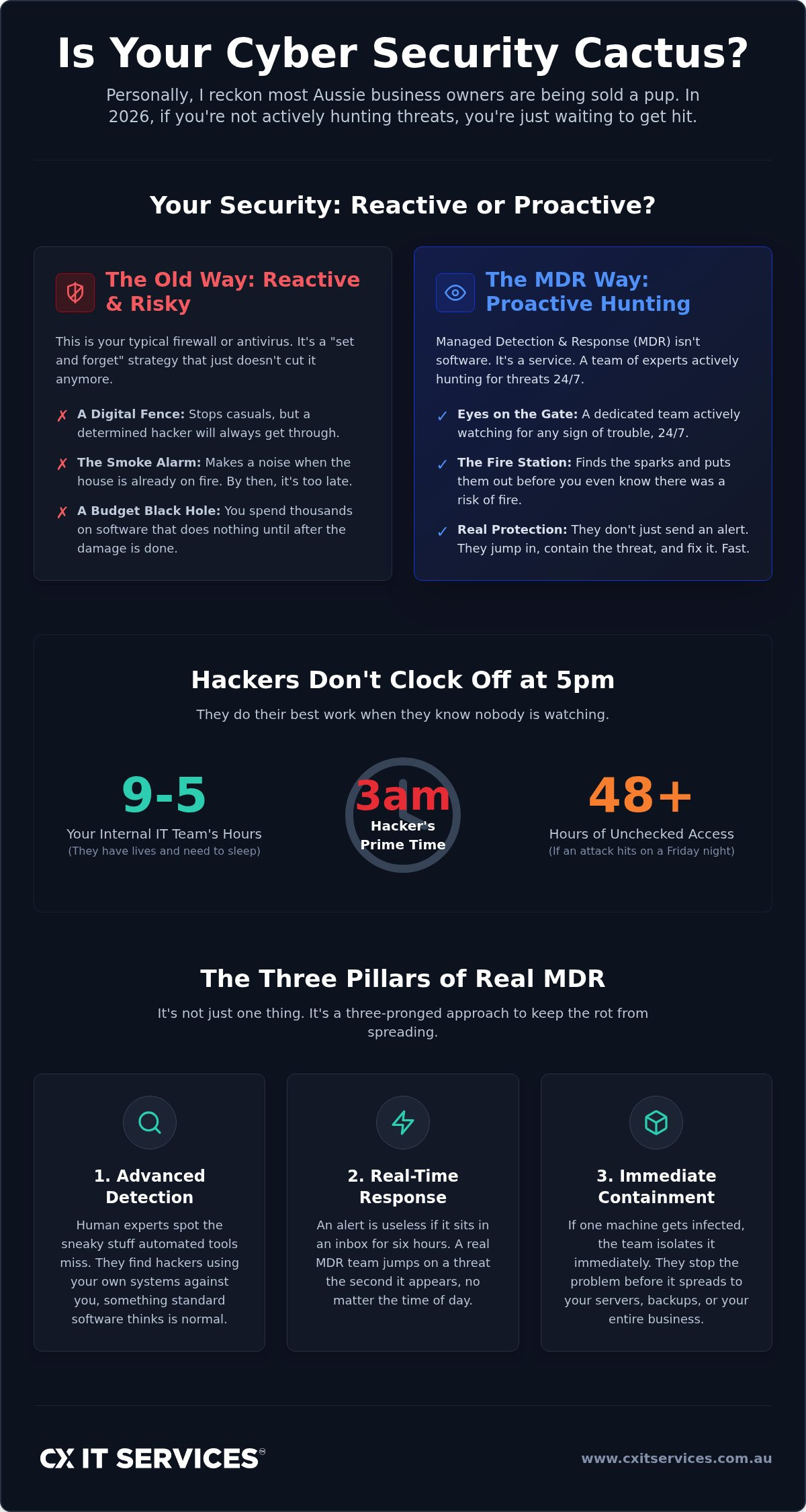
Relying solely on a firewall is a reactive move. You are waiting for something to hit the fence before you react. By the time an alert pings your inbox, the intruder is already inside your server room. To stay safe, you need to understand what is Managed Detection and Response? and why it matters. It’s about having someone actively watching the gate 24/7, looking for the subtle signs of a breach that automated tools miss.
Why hackers love the 5pm finish
Most internal IT teams go home when the sun goes down. They have lives, families, and a need for sleep. Cyber criminals, often operating from different time zones, don't have those constraints. They do their most devastating work at 3am on a Sunday morning because they know nobody is watching the monitors.
If an attack starts at midnight on a Friday, and your team doesn't see it until Monday morning, that’s over 48 hours of unrestricted access to your files. Real security never clocks off. It requires a proactive stance that hunts for threats in real-time, ensuring that a weekend intrusion doesn't turn into a business-ending ransomware event. Implementing managed detection and response australia ensures that your network is being scrutinised every minute of every day, regardless of whether it's a public holiday or the middle of the night. You need a partner who stays awake so you don't have to.
What is Managed Detection and Response? (No corporate fluff version)
Personally, I reckon the biggest lie in the IT world is that you can just "set and forget" your security. Most people think Managed Detection and Response (MDR) is just a fancy name for a better version of antivirus. It isn't. Not even close.
MDR is not a piece of software you install and ignore. It is a service. It is a team of living, breathing experts who spend their entire day hunting for trouble inside your network. Most security tools are like a smoke alarm. They make a loud noise when the house is already on fire. By then, you're already in trouble.
This is where managed detection and response australia changes the game. It is like having a fire station built right inside your office. These experts don't just wait for an alarm to go off. They walk the halls. They look for oily rags, dodgy wiring, and open windows. If they find a spark, they put it out before you even know it was there. They don't just tell you there is a problem. They jump in and fix it while you are still fast asleep.
The three pillars of real MDR
Real MDR stands on three legs. First, it focuses on detecting the sneaky stuff that standard antivirus simply cannot see. Hackers today are clever. They use common cyber threats like "living off the land" attacks, where they use your own administrative tools against you. Standard software thinks this is normal behaviour. A human expert knows it isn't.
Second, it is about responding in real time. An alert is useless if it sits in an IT manager's inbox for six hours while they are at lunch or stuck in a meeting. Third, it is about containment. If one laptop in your office gets infected, the MDR team isolates it immediately. They stop the rot before it spreads to your server, your backups, or your entire fleet. They kill the connection and kick the hacker out before they can do any real damage.
Human intelligence vs. basic automation
Software is smart, but humans are devious. An automated system follows a rigid script. If a hacker does something slightly outside that script, the software often blinks and lets them through. This is why you need an Aussie expert who knows the local landscape and can spot the subtle patterns that look "almost" normal but are actually malicious.
Automation is great for handling the background noise. It filters out the thousands of low-level probes every business gets daily. But when a real human hacker targets your business, you need a human on your side of the fence to fight back. People handle the fight. Automation just handles the busy work. If you want to see how this level of protection fits your specific setup, you can chat with our team about a tailored security plan.
You don't want a report on Monday morning telling you that you were hacked on Friday night. You want a partner who saw the attempt at 2am on Saturday and shut it down before a single file was encrypted. That is the difference between having a tool and having a team.
MDR vs. DIY: Why you cannot just "set and forget" anymore
Building your own security operations centre from scratch is bloody expensive. It is a common trap. Business owners think they can just hire "a security guy" and call it a day. But hackers do not work nine-to-five. They don't respect your office hours or your public holidays.
To get true 24/7 coverage, you would need to hire at least five specialists. You need people to cover nights, weekends, and annual leave. In the current Australian market, good luck finding them. The war for talent is real. The salary expectations for high-level security experts are through the roof, and most small to medium firms simply cannot compete with the big banks for staff.
This is why managed detection and response australia is the only logical choice for most firms. It provides the same level of oversight and protection used by global corporations, but at a fraction of the cost. You are essentially sharing the cost of a world-class security team with other businesses. It is efficient. It is smart. It works.
The true cost of a DIY security fail
If your DIY setup fails, the fallout is devastating. Downtime costs more than just the ransom. For a law firm, an accounting practice, or a medical clinic, being offline for even a day is a catastrophe. You have staff sitting around doing nothing while your overheads keep ticking over. The lost billable hours alone can be enough to sink a business.
Then there is the reputation damage. Trust is the currency of the professional services sector. Once you lose it, it is gone for good. Personally, I would rather pay for prevention than a cure. Trying to save a few bucks on security is like skipping insurance on a multi-million dollar property. It is just not worth the risk. Implementing managed detection and response australia ensures you never have to make that awkward phone call to your clients.
Why your current IT guy might be overwhelmed
Your internal IT manager is likely a legend. Generalists are great for fixing printers, managing M365, and keeping the network moving. But asking them to also hunt for advanced persistent threats at 2am is a big ask. Security is a whole different beast in 2026. It requires constant monitoring of global threat feeds and a very specific set of skills that your average IT guy just hasn't had the time to master.
It is unfair to expect one person to be an expert in everything. You can give your team a hand with co-managed IT support. This lets your local guy focus on the strategic projects that grow your business, while a specialist team handles the technical slop of 24/7 threat hunting. Not alone. Together.
Finding an MDR provider that actually speaks your language
Personally I reckon half the battle with cyber security is just cutting through the sales slop. It is easy for a company to show you a shiny brochure full of stock photos and complex diagrams. It is much harder for them to actually show you how they stop a breach at 2am on a Tuesday. Choosing a provider for managed detection and response australia shouldn't feel like you're trying to decode a foreign language.
If a provider cannot explain their process in plain English, you should walk away immediately. Jargon is often used to hide a lack of substance. You want a partner who sits on your side of the table. You don't want a vendor who disappears the moment the contract is signed. A real partner is someone you can call when things go sideways, knowing they already have the tools in hand to fix the mess.
The "No Bullshit" checklist for MDR
Before you sign anything, you need to grill them on the specifics. Don't accept vague promises. Use this checklist to separate the experts from the pretenders:
- Is it actually 24/7? Some firms claim they monitor your network but only have staff available during business hours. A hack doesn't wait for Monday morning.
- Is the pricing fixed? You should look for a fixed monthly fee model. Avoid providers who hit you with hidden "incident response" fees every time a sensor blinks.
- Where is the team? Ask if you will talk to a real person in Australia when things go south. You don't want your emergency call routed to a global call centre where nobody knows your business.
Why being Australian owned and operated matters
There is a massive advantage to working with a local team that understands our specific backyard. When you choose a provider that is Australian owned and operated, your data stays on our shores. This is critical for meeting local privacy standards and keeping your clients' trust. We understand the local regulatory landscape because we live in it every day.
Time zones also matter more than you think. When you need a hand, you need it now. You don't want to wait for a team in Europe or the US to wake up before your problem gets addressed. Being in the same time zone means we are awake when you are. It means we can jump on a call or get on-site if the situation demands it. If you want a security partner who actually has your back, you can apply to work with us today and get a straight answer about your security.
How we keep your business safe while you sleep
Personally, I reckon the best part of my job is when a client tells me they finally stopped checking their phone for alerts at 3am. They have reclaimed their weekends. They have peace of mind. That only happens when you move away from the "hope and pray" method of security and start using a system that actually fights back.
We don't just watch the screens. We take action. If our sensors pick up a suspicious login from a country you don't do business with, we don't just send you a report on Monday morning. We kill the connection immediately. We isolate the device. We stop the threat before it has a chance to breathe. This is how managed detection and response australia should actually work. It is about active intervention, not just passive observation.
Our team integrates directly with your existing setup. We aren't here to rip and replace everything you have worked hard to build. We are here to wrap a layer of professional 24/7 oversight around it. We handle the cyber security management so you can get back to running your business. Not alone. Together.
Proactive hunting, not just reactive fixing
Waiting for an alarm to go off is a loser's game in 2026. We spend our time looking for the holes before the hackers find them. We call it threat hunting. It involves scouring your network for subtle signs of compromise that automated tools often miss. A hacker might be sitting quietly in your system, waiting for the right moment to strike. We find them and kick them out before they can pull the trigger.
Regular updates and patches are a core part of the deal. We don't just wait for you to ask. We ensure your systems are hardened against the latest exploits. It is about staying two steps ahead of the bastards who want to disrupt your livelihood. If we find a vulnerability, we patch it. If we see a dodgy pattern, we investigate it. We stay proactive so you can stay productive.
Your next steps for a more secure 2026
You have a choice to make. You can keep paying for security that doesn't actually do anything, or you can start protecting your business properly. Stop worrying about the "what ifs" and start building a resilient operation. The threats are only getting more sophisticated, and the old ways of doing things are well and truly cactus.
A real security plan needs to be part of your broader business goals. This is why we recommend getting a vCIO strategy that actually includes security as a foundation, not an afterthought. It is about aligning your tech with your growth and making sure a single attack doesn't wipe out years of hard work.
Let us have a chat about your current setup. No high-pressure sales. No technical slop. Just a straight conversation about where you are and how we can help you get to where you need to be. The first step is simply deciding that "good enough" isn't good enough anymore.
Stop waiting for the hack that breaks your business
Personally, I reckon you have two choices. You can keep hoping your basic antivirus holds up while hackers use AI to find every crack in your network. Or, you can get serious about your survival.
The old "set and forget" way of doing things is well and truly cactus. To stay safe in 2026, you need a team that hunts threats before they become disasters. This is why managed detection and response australia is the only way to get real peace of mind. Not alone. Together.
CX IT Services has been Australian owned and operated for over 26 years. We provide 24/7 national support coverage and a fixed monthly fee model with no surprises. You get big-business protection without the corporate slop or technical jargon.
Don't wait for the 3am wake-up call that ends your business. Take control of your security today. Book a straight-talking security review with CX IT Services and let's get your network sorted. You have built a great business. Let's keep it that way.
Frequently Asked Questions
What is the difference between EDR and MDR?
EDR is the tool. MDR is the service. Endpoint Detection and Response (EDR) is the software that gathers data from your computers and servers. Managed Detection and Response (MDR) is the team of experts who actually watch that data 24/7. Think of EDR as the security cameras in your office. MDR is the guard who watches the monitors and stops the thief before they can steal your data.
Do I still need antivirus if I have MDR?
Yes. You need both to be properly covered. Antivirus is great for stopping the "known" junk like basic malware and common viruses. MDR is built to find the "unknown" threats and human hackers who know how to hide from software. By using both, you get a layered defence. Antivirus handles the background noise. Your managed detection and response australia team handles the real fights that could end your business.
How much does Managed Detection and Response cost in Australia?
Pricing depends on your user count and specific security needs. We avoid the "per incident" trap that many firms use to pad their bills. Instead, we use a fixed monthly fee model. This gives you a predictable cost for 24/7 protection without any nasty surprises when things go south. It is an investment in your business continuity. It ensures you can focus on your work while we handle the technical complexity.
Is MDR suitable for a business with only 15 employees?
It is perfect for you. Hackers love targeting firms with 15 to 50 staff because they often have valuable data but weaker security than big corporations. If you have 10 or more employees, MDR is the most cost-effective way to get enterprise-grade protection. It scales to your size. It gives you a dedicated security team without the massive overhead of hiring five specialists to cover the night shift.
What happens if a threat is detected at 2am on a public holiday?
Our team jumps on it immediately. Our 24/7 monitoring means we don't wait for business hours to start remediation. If a hacker tries to breach your server at 2am on Christmas Day, our team is already there to isolate the threat and kick them out. You won't wake up to a business-ending disaster on Boxing Day. We stay awake so you and your team can enjoy your time off.
Can MDR help my business meet the Essential Eight requirements?
It is a massive help for your compliance journey. The Essential Eight is a great framework, but it is hard to manage manually. MDR provides the continuous oversight needed to meet the maturity levels for incident response and monitoring. It spots when your other controls, like multi-factor authentication, are being targeted or bypassed. It turns a static checklist into a living defence that actually protects your sensitive client files and financial data.
How long does it take to get MDR up and running?
We can usually have your systems protected within a few business days. The setup process is designed to be seamless. We integrate the monitoring tools with your existing fleet without disrupting your staff or slowing down your network. Once the sensors are active, our team starts threat hunting immediately. We handle the technical slop in the background, so your managed detection and response australia service starts delivering value from day one.