
Tired of your clunky old server? This plain-English guide to managed cloud services Australia cuts the jargon to show you how to get reliable IT with no surp...
Why are you still paying for a humming metal box in a dusty cupboard that costs a fortune just to keep the fans spinning?
Personally, I reckon most of the talk around managed cloud services Australia is designed to sound more complicated than it actually is. After 26 years in the industry, I've seen every IT fad come and go, but the cloud isn't one of them. It's enough to make any sane business owner want to stick with their old server, even if it means staff can't work from home without a headache. It's expensive. It's unreliable. And frankly, it's a bit of a dinosaur.
I get it. You want your IT to just work so you can get back to your actual job. You're tired of "IT surprise" bills and worrying if your backups will actually hold up when things go pear-shaped. You deserve a setup that offers stability without the technical jargon or the hidden fees.
This guide is a plain-English breakdown of what the cloud is and why your business should care. I'm stripping away the corporate fluff to show you how to get a reliable setup with predictable monthly costs. We'll look at how to secure your data properly and why moving your office to the cloud is the smartest move you'll make this year.
Key Takeaways
- Strip away the jargon and understand why the cloud is just a high-tech way to run your business on someone else's hardware.
- See how managed cloud services Australia provide a reliable IT setup that lets your team work from home without the usual technical glitches.
- Compare public, private, and hybrid models to figure out which one provides the best security for your specific industry without wasting money.
- Learn why moving your data to a professional centre is the only way to get true peace of mind regarding backups and cyber threats.
- Find out how to start your migration the right way with a thorough audit that ensures nothing gets left behind.
Forget the jargon: what is the cloud actually?
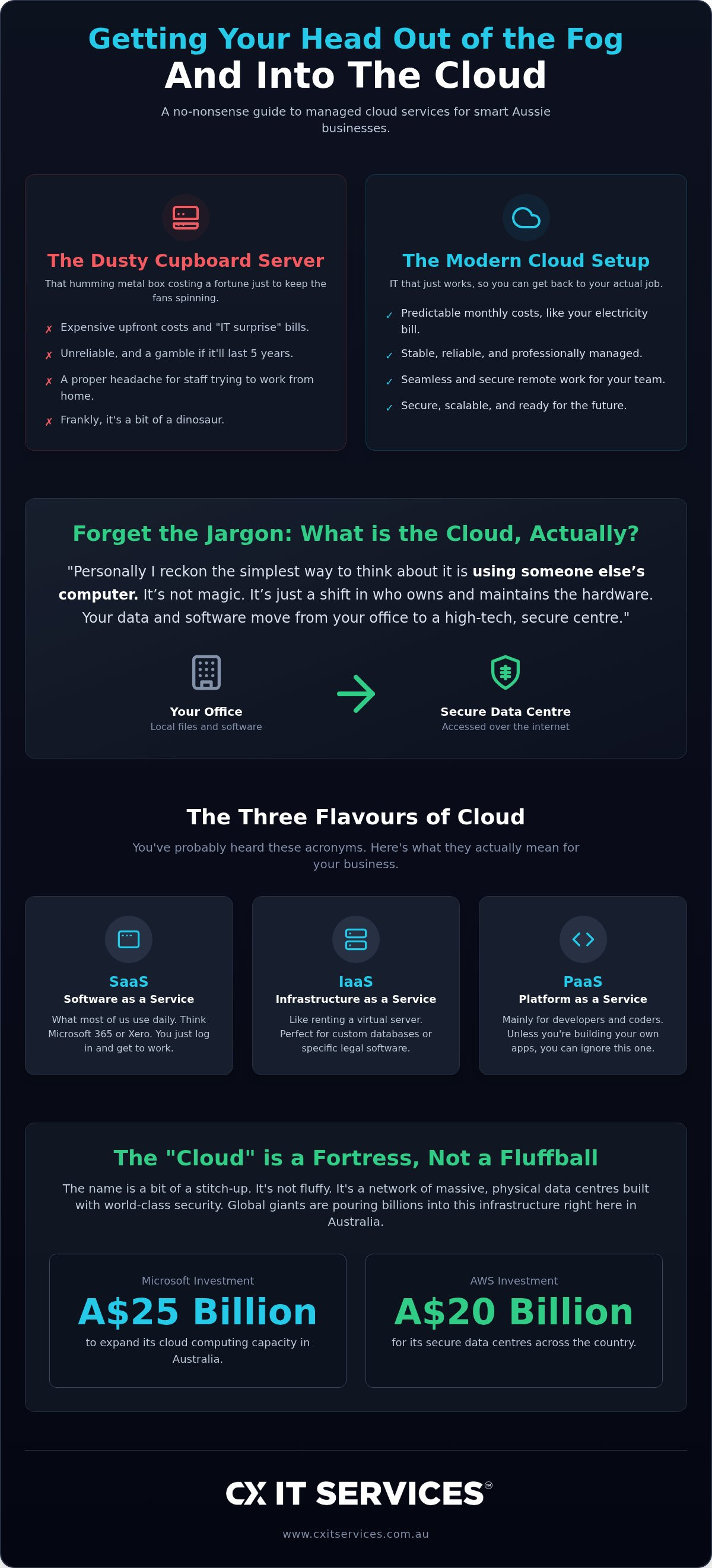
Personally I reckon the simplest way to think about it is using someone else’s computer. It is not magic. It is just a shift in who owns and maintains the hardware. Instead of a hot, noisy server room in your office, your data sits in a high-tech centre designed specifically for the job. You access your files and software over the internet rather than a local cable plugged into a wall in the hallway.
Cloud computing is a service delivery model that provides on-demand access to computing resources over the internet, shifting the focus from owning hardware to purchasing outcomes. When you partner with a Managed Service Provider (MSP), they handle the technical heavy lifting. They ensure those remote systems are always running, updated, and secure. This is the foundation of managed cloud services Australia, and it is how smart businesses are getting ahead without the traditional IT baggage.
The cupboard server vs the cloud
Traditional IT meant buying a big box every five years. You had to pay a massive upfront cost and just hope it did not blow up before you got your money's worth. It was a gamble. The cloud changes that entirely. Managed cloud services Australia mean you pay for what you use, sort of like your electricity bill. If you hire ten more staff, you scale up. If things quieten down, you scale back.
You stop worrying about cooling, backup power, or the office cat tripping over a cord and taking the whole network offline. You can find more about how we handle these transitions on our Cloud Services page. It is about moving from a reactive "fix it when it breaks" mindset to a stable, predictable model that just works.
Why the name is a bit of a stitch-up
The name "the cloud" is a bit of a stitch-up because it sounds fluffy and ethereal. It is actually the opposite. It is a network of massive, secure data centres spread across the country. It is not a literal cloud in the sky; it is physical infrastructure that is built like a fortress. Global giants are pouring billions into this. Microsoft has committed A$25 billion to expand its capacity, and AWS has committed A$20 billion for its centres across Australia.
When you move to the cloud, you are just renting space on the world’s most powerful and secure hardware. These facilities have multiple layers of security and redundant power supplies that no small office could ever afford on its own. You get the benefit of world-class infrastructure while only paying for your small slice of it. It is grounded, physical, and incredibly reliable.
How managed cloud services work without the technical headache
Most business owners I talk to don't care about the nuts and bolts. They just want their email to load and their files to be there when they need them. I reckon the simplest way to understand how managed cloud services Australia actually work is to look at virtualisation. It is just a fancy way of taking one massive, incredibly powerful computer and splitting it into hundreds of smaller, private ones. You get your own private slice of the pie without having to pay for the whole bakery. It is efficient. It is smart. And it is why you no longer need to own the hardware yourself.
Because your data is sitting in a secure centre, it needs a way to get to your office safely. We use encrypted tunnels to move information back and forth. This keeps the hackers at bay by making your data unreadable to anyone trying to intercept it. To make this feel seamless, you need a high-quality business internet connection. When the speed is right, those files in the cloud feel like they are sitting right on your desk. This shift to outsourced IT management means you stop being a part-time technician and start being a full-time professional again.
The three flavours: SaaS, IaaS, and PaaS
You have probably heard these acronyms thrown around at networking events. I like to keep it simple. Software as a Service (SaaS) is what most of us use daily. Think Microsoft 365 or Xero. You just log in and get to work. Infrastructure as a Service (IaaS) is like renting a virtual server. It is perfect if you have a custom database or specific legal software that needs a home. Platform as a Service (PaaS) is mainly for the developers and coders. Unless you are building your own apps, you don't need to worry about it. Most Aussie firms live and breathe in the SaaS and IaaS space.
Pay-as-you-go vs buying the lot
Cloud resources are elastic. This means they grow or shrink with your team in real time. If you hire five new staff on Monday morning, they can have full access to their tools by Monday afternoon. You don't have to wait for a technician to show up with a screwdriver and a new hard drive. More importantly, you stop paying for what you do not use. If your team size drops, your bill follows suit. It is a fair dinkum win for the budget and provides the kind of predictability that keeps accountants happy. If you are ready to see how this fits your specific business, you can chat with our team about a tailored setup.
Public, private, and hybrid: which one is not a waste of money?
Choosing a cloud model is often where business owners get bogged down in technical specifications they don't actually need. Personally, I reckon you should look at it like property. Public cloud is like living in a secure, modern apartment block. You share the underlying infrastructure, the plumbing, and the security with others, but your own front door is locked tight. It is the most common choice for managed cloud services Australia because it is efficient and incredibly cost-effective.
Private cloud is your own detached house with a massive fence. It is dedicated solely to your business. While it offers the highest level of control, it also comes with a much higher price tag. Then you have the hybrid model. This is the best of both worlds. It is what most of our clients end up using. You keep your daily driver apps in the public cloud but tuck your sensitive or legacy data into a private space. It is about matching the right tool to the right job without burning cash on overkill setups.
The case for the public cloud
Microsoft Azure and AWS are the heavy hitters here. For a smaller team, this is the fastest way to get enterprise-grade technology without an enterprise-grade budget. You are leveraging the billions of dollars these companies spend on security every year. In fact, public cloud security is often significantly better than anything you could afford to build yourself. It is a smart way to get high-end protection while only paying for your specific slice of the pie. It is reliable. It is fast. For the vast majority of Aussie businesses, it is the correct answer.
When to go private or hybrid
Not every business can go fully public. If you are running a legal or financial firm, you might have strict data compliance rules that demand a private setup. This ensures your data residency is locked down and you have total oversight of the environment. Hybrid is also a fantastic bridge. If you have an old piece of niche software that refuses to run in the cloud, you can keep that on-site while moving everything else. This prevents a rip and replace scenario that could cripple your operations. For a bit of tailored advice on what fits your firm, check out our Cloud Services options. We focus on finding the balance between rock-solid security and a monthly bill that actually makes sense.
Why smart Aussie businesses are making the jump
If you are still tethered to a physical office because your server lives there, you are doing it the hard way. Smart firms across the country are moving to managed cloud services Australia because it finally delivers on the promise of true flexibility. Working from home should not involve a twenty minute wrestling match with a dodgy VPN. It should just work. When your files live in the cloud, your team can be productive from a home office, a client site, or a cafe in Noosa without skipping a beat.
Beyond just remote access, these cloud-based tools are the foundation for AI automation that handles the repetitive grunt work for you. It is about gaining efficiency that your competitors are already using. When your data is organised and accessible, you can plug in modern tools that actually save you time instead of creating more admin. It is a strategic shift that moves IT from a cost centre to a growth driver.
Then there is the money side of things. I have seen too many businesses get hit with a nasty five figure hardware surprise when their old server finally gives up the ghost. With a managed model, you get predictable monthly costs. You know exactly what is going out. No surprises. No stress. It is a fair dinkum relief for any professional firm trying to manage a tight budget. You stop paying for maintenance on old iron and start investing in outcomes.
Security that actually sleeps at night
Your data is objectively safer in a Tier 4 data centre than it is under your desk or in a broom closet. These centres are built like fortresses with redundant power and cooling. Cloud providers spend billions on security every year. You get the benefit of that massive investment without having to write the cheque yourself. Plus, automatic backups mean a coffee spill on a laptop is just a bad morning, not a total business disaster. You can see how we layer this protection on our Cyber Security page.
Collaborate without the drama
We have all lived through the version control nightmare. You end up with a folder full of documents named FINAL_v2_REAL_FINAL and no one knows which one is current. The cloud fixes this. Teams can work on the same document at the same time. It is seamless. Microsoft 365 is the gold standard for Aussie professional services here. It keeps everyone on the same page, literally. If you want your team running at full speed, our Microsoft 365 management ensures the setup is actually optimised for your specific workflow.
If you are ready to stop fighting your IT and start using it as a tool for growth, let's talk about your cloud migration.
Getting your head out of the fog and into the cloud
Moving to the cloud is not just about flicking a switch. I reckon if you try to move everything on a Friday night and hope for the best on Monday, you will end up in a right mess. It takes a bit of a plan. Personally, I have seen too many migrations go pear-shaped because the business didn't actually know what they were moving in the first place. You need a strategy that respects your staff's time and your business continuity.
We reckon you should always start with a thorough audit of what you actually have. Most Aussie businesses are carrying a fair bit of tech debt. This includes old software that won't play nice with modern systems and data that hasn't been touched in years. You need to clean house before you move. If you move a mess, you just end up with a mess in a different location. It is that simple.
Do not try to move everything at once. It is too much of a shock to the system. Partner with someone who has done this a thousand times before. This is where managed cloud services Australia become invaluable. You need a team that knows the pitfalls and the shortcuts. Someone who has seen the weird errors and knows how to fix them before they stop your team from working. Proactive. Not reactive.
The CX IT Services roadmap
We look at your team, your goals, and your current tech debt. We don't just move files; we move workflows. We build a migration plan that does not stop your staff from working. This usually means moving things in stages. One department at a time. One workload at a time. You also get a fixed monthly fee so you can actually plan your cash flow. No more guessing what next month's IT bill will look like. Predictability is everything.
A safe pair of hands for your migration
We have 26 years of experience keeping Aussie businesses online. We are Australian owned and operated. You won't find any corporate fluff or sales-speak here. Just direct advice and technicians who actually know their stuff. We are a safe pair of hands for your data. You can see how we manage the whole lot on our Managed IT Support page. It is about stability. It is about control. It is about getting your business into the cloud without the technical headache.
Build a business that isn't tied to a desk
Personally, I reckon the move to the cloud is less about technology and more about freedom. It's about giving your team the tools to work from anywhere without the usual technical glitches or VPN battles. You trade in those expensive, unpredictable hardware failures for a stable environment and a fixed monthly fee that actually makes sense for your budget. It's a strategic shift that lets you stop being a part-time IT manager and start being a professional again.
After 26 years of keeping Aussie businesses out of the digital fog, we know exactly what a successful migration looks like. We provide managed cloud services Australia can rely on, backed by a team that's 100% Australian owned and operated. You get a safe pair of hands to manage the transition with no hidden surprises or corporate fluff. We focus on results that keep your data secure and your staff productive.
Don't let tech debt or a dusty server cupboard hold your firm back. It's time to get a clear, honest picture of what your setup could actually look like. Get a no-nonsense cloud audit for your business today. We'll help you find a reliable path forward that just works.
Frequently Asked Questions
Is cloud computing safe for sensitive legal or financial data?
Yes, it is actually safer than having a physical server in your office. Personally I reckon your data is more secure in a Tier 4 centre than it is under a desk. These facilities have multiple layers of physical and digital protection that no small firm could afford. For legal and financial professionals, we ensure everything meets Australian privacy standards and uses high-level encryption to keep hackers out.
Do I still need a server in my office if I move to the cloud?
In most cases, you can ditch the physical server entirely. The cloud becomes your new virtual server room. Some businesses choose a hybrid model to keep specific niche software on-site, but the goal for most firms using managed cloud services Australia is to get rid of the hardware headache. This means no more worrying about server fans failing or the office power tripping and corrupting your database.
What happens to my data if the internet goes down?
If your internet goes down, you'll lose the live connection to your cloud files. However, most modern tools sync local copies to your devices so you can keep working offline. We always suggest a 4G or 5G failover as a backup. When your main line comes back, your work syncs automatically. It is why we prioritise a high-quality business internet connection as part of any cloud migration.
How much does it cost to move a business to the cloud?
The cost depends on your data volume and the complexity of your current software. We don't believe in hidden surprises, so we provide a clear project fee for the migration after a thorough audit. Once you are in the cloud, you move to a fixed monthly fee. This covers your support and licensing, making your IT budget predictable for the first time in years.
Is the cloud cheaper than buying my own hardware?
I reckon it is when you look at the total cost of ownership. Buying hardware means a massive upfront bill for a box that starts losing value the day you plug it in. The cloud lets you pay for exactly what you use. You avoid the costs of power, cooling, and the inevitable replacement every few years. It is a shift from a gamble to a guaranteed service.
Where is my data actually stored when I use the cloud?
Your data is stored in high-security data centres located right here in Australia. We use facilities in Sydney and Melbourne to ensure you meet all local data sovereignty requirements. This is critical for firms in the legal and medical sectors. Your data isn't just in the "cloud"; it is on physical, world-class hardware protected by some of the best security teams in the world.
Can I use my existing software in the cloud?
Yes, we can usually make it work. If your software is modern, there is likely a cloud version ready to go. If you use older, bespoke programmes, we can host them on a virtual server in the cloud. We identify any potential issues during our initial audit. This ensures that your critical business tools remain functional and fast after the move, regardless of how old they are.
How long does a cloud migration typically take for a team of 20?
A typical migration for a team of 20 takes about two to four weeks of planning and testing. We do the heavy lifting in the background so your staff can keep working. The final cutover usually happens over a weekend to ensure zero downtime. We believe in a methodical approach that prioritises stability over speed. You'll be up and running by Monday morning without the drama.





 Microsoft Partner