
Flying blind with your tech spend? Our IT roadmap consulting gives you a clear plan to stop the bleed and get your technology actually working for you.
Personally, I reckon most business owners are flying blind when it comes to their tech spend.
You're likely paying for software that your team hasn't touched in months.
Or worse, you're constantly putting out tech fires instead of actually doing the work that pays the bills.
It's frustrating. It's expensive. And frankly, it's bloody exhausting.
I've seen this cycle repeat for years. You want a technology setup that just works, but right now, you've got no clear idea what your IT is going to cost you by this time next year.
We can agree that throwing money at random tools isn't a strategy. Through IT roadmap consulting, you can finally align your technology with your actual business goals and stop the bleed.
I'm going to show you how to trade those constant distractions for a predictable budget and a sense of total control over the digital side of your business.
We'll look at how a structured plan supports staff productivity and ensures your digital assets are working for you, rather than against you, as we head into 2026.
Key Takeaways
- Identify the 10-staff tipping point where your current tech starts to fail and learn how to build a system that actually scales.
- Use IT roadmap consulting to trade unpredictable tech fires for a clear, three-year budget that aligns with your business goals.
- Uncover the hidden security and operational risks that DIY technology planning often misses before they become expensive problems.
- Follow a practical five-step framework to ensure every piece of software you pay for actually makes your team more productive.
- Discover how vCIO services provide executive-level tech leadership for your firm without the massive overhead of a full-time hire.
The 10-Staff Tipping Point: Why Your Tech is Starting to Creak
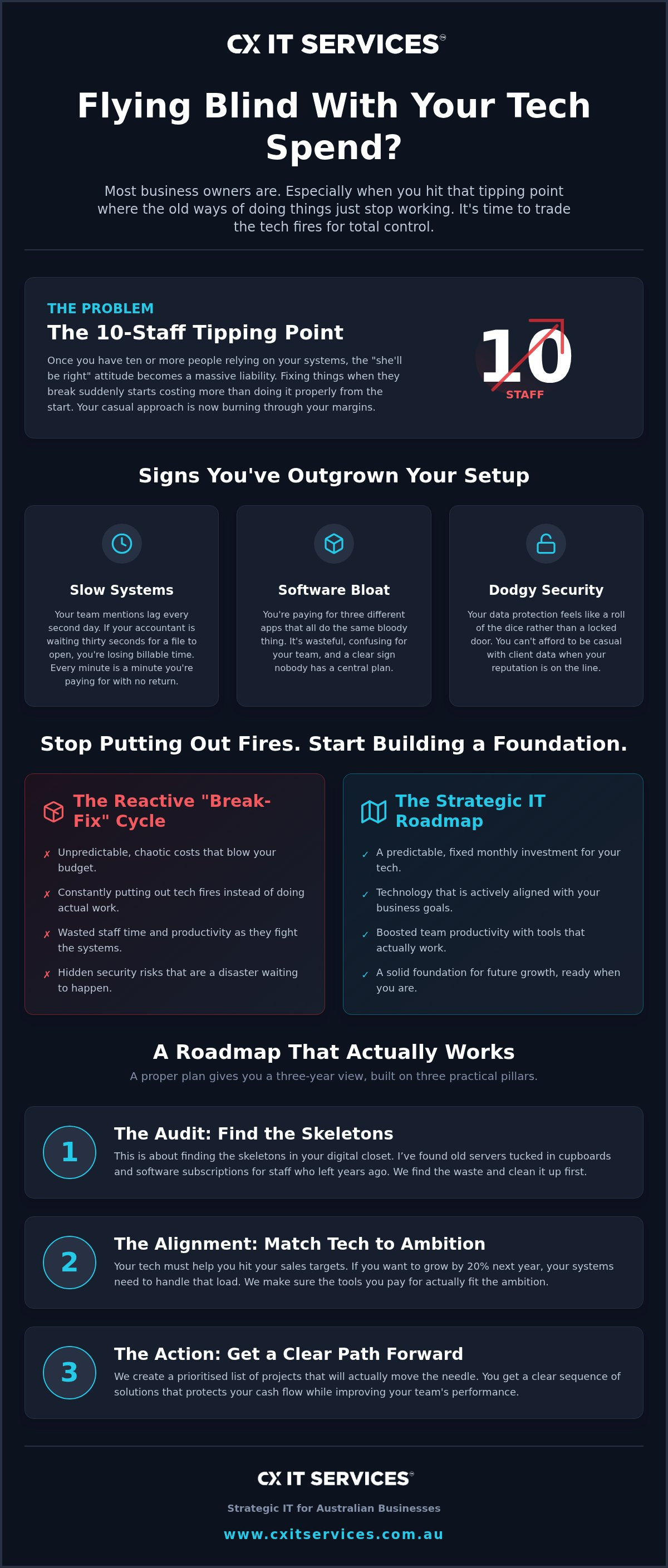
Personally I have seen it a hundred times. A business hits ten staff and the old ways of doing things just stop working. Before you hit that double-digit headcount, you can usually manage with a bit of sticky tape and a "she'll be right" attitude. But once you have ten or more people relying on your systems, that casual approach becomes a liability. It's the point where "fixing things when they break" starts to cost more than actually doing it properly.
The reality is that IT roadmap consulting isn't just about computers. It's about business survival. This is the process of auditing your current mess and mapping a path to a system that actually scales as you grow. I look at it as a technology roadmap that serves as a strategic bridge between your business goals and your hard-earned cash. Without one, you're just guessing. And guessing with ten salaries on the line is a quick way to burn through your margins.
Signs You Have Outgrown Your Current Setup
You'll know the tipping point has arrived when the quiet grumbles from your team turn into daily complaints. Usually, the first sign is staff mentioning slow systems every second day. If your accountant or lawyer is waiting thirty seconds for a file to open, you're losing billable time. Every minute of lag is a minute you're paying for without getting a return.
Another classic sign is software bloat. I often find businesses paying for three different apps that all do the same thing because nobody has a central plan. It's wasteful and confusing for the team. Finally, there's the security factor. If your data protection feels like a roll of the dice rather than a locked door, you've outgrown your current setup. You can't afford to be casual with client data when your reputation is on the line.
Why Growth Requires a Strategic Shift
Real growth requires moving from reactive "break-fix" habits to proactive planning. You need to stop calling someone only when the server is smoking. Instead, you need a strategic guide who looks at where the business is going over the next three years. IT roadmap consulting gives you that long-term vision.
There is a massive difference between a technician who fixes a printer and a consultant who builds a foundation. If you don't build that foundation now, everything will crumble when you try to hire person number eleven. You need tech that supports productivity. You don't need tech that creates more work for the people you're trying to lead. It's about being ready for the next level, not just surviving the current one.
What IT Roadmap Consulting Actually Delivers (Beyond the Fancy PDF)
Personally, I reckon a lot of consultants love the sound of their own voice. They will hand you a 50-page PDF full of jargon and think their job is done. I have seen those documents gathering dust in bottom drawers across the country. That isn't a strategy. It is a waste of paper.
A real roadmap is a living tool. It needs to be practical. It needs to be blunt. The whole point of IT roadmap consulting is to give you a three-year view of your technology so you can stop being blindsided by big bills. When you combine this with professional vCIO and IT strategy, you get long-term oversight that actually makes sense. The goal is total clarity. You should know exactly what to buy, when to buy it, and why it matters to your profit margin.
The Three Pillars of a Solid Plan
A roadmap built by someone who actually understands the Australian business landscape focuses on three specific areas:
- The Audit: This is about finding the skeletons in your digital closet. I have found old servers tucked in cupboards and software subscriptions running for staff who left three years ago. We clean that up first.
- The Alignment: Your tech must help you hit your sales targets. If you want to grow by 20% next year, your systems need to handle that load. We make sure the tools fit the ambition.
- The Action: We create a prioritised list of projects that move the needle. We give you the sequence of solutions that protects your cash flow while improving your performance.
Budget Predictability for Aussie Owners
I know how much Aussie owners hate "random tech expenses." One month everything is fine. The next, you're hit with a five-figure bill because your backup failed or a workstation died. A roadmap fixes this by turning those chaotic costs into a predictable, fixed monthly investment.
It helps you avoid the "emergency hardware run" to the shops. You shouldn't be buying critical business gear from a retail shelf on a Sunday afternoon because you didn't see a failure coming. We plan for lifecycle replacements. We know when your gear is likely to die, and we schedule the replacement before it causes a disaster. If you want to see how this works for your specific setup, you can talk to our team about a strategy session. Planning means you are never caught off guard, which is exactly how a professional operation should run.
The High Cost of Flying Blind: DIY vs. Strategic Consulting
Personally I reckon many business owners think they can handle the technology planning themselves. They sit down with a spreadsheet and a prayer, hoping that whatever they buy today will still work in two years. It rarely does. Professional IT roadmap consulting uncovers the structural risks that a non-technical owner will always miss. You might be an expert in law, accounting, or medicine, but that doesn't mean you should be designing a server architecture.
There are massive invisible costs to the DIY approach. When your systems go down, you aren't just losing the cost of the repair. You are losing the billable hours of your entire team. The average cost of a single cyber incident for an Australian SME has climbed to approximately $46,000. Compare those unpredictable, business-killing losses against the fixed cost of a managed strategy. It is about stability. It is about knowing your business won't grind to a halt because of a basic oversight.
The DIY Trap
I have seen the DIY trap play out in three predictable ways:
- Buying for the price, not the purpose: You buy the cheapest hardware because it feels like a win at the checkout. But when it's slow and requires constant reboots, it ends up costing you double in lost productivity.
- Siloed systems: You set up systems that do not talk to each other. Now your staff are manually entering data twice because your software lives on different islands.
- The CEO as the IT person: This is the biggest cost of all. If you are spending your Tuesday morning troubleshooting a VPN or a printer, you aren't running your business. That is a massive waste of your talent and time.
The Strategic Advantage
Strategic consulting gives you access to enterprise-grade tools without the enterprise-grade price tag. You get a "Safe Pair of Hands" to manage the technical complexity while you focus on your clients. We also treat cyber security as a core part of the roadmap, rather than an afterthought you bolt on later.
This long-term vision isn't just a document. It integrates directly with your Managed IT Support. Your daily helpdesk and your strategic vision should work together. One keeps the lights on today. The other makes sure you have a building to put the lights in tomorrow. Don't wait for a crisis to find out your DIY plan has holes in it.
5 Steps to Building a Technology Roadmap That Actually Works
Personally I reckon most tech plans are too bloody long. You don't need fifty pages of corporate fluff to run a successful accounting firm or medical clinic. You need a plan that works in the real world. A proper strategy should be concise, actionable, and focused on where you want the business to be in 2026. Through professional IT roadmap consulting, we strip away the noise and focus on the five steps that actually move the needle for an Australian business.
Audit and Alignment
The first step is getting a grip on what you actually own. Inventory everything. I am talking about every laptop, every cloud subscription, and that old server in the corner that nobody wants to touch. You can't plan for the future if you don't know what is currently draining your bank account. We look for the "zombie" subscriptions that you are paying for but never use. It is about stopping the bleed before we start the build.
Next, you have to talk to the team. Find out where they are actually struggling every day. If your solicitors are losing ten minutes every morning just trying to log in remotely, that is a massive productivity leak. Once you have that feedback, write a single sentence defining your top business goal for the next twelve months. If you want to double your staff, your tech needs to be ready for that load today. We align every tech decision to that one sentence.
Prioritisation and Execution
Fixing the foundations is the core of effective IT roadmap consulting. It is tempting to jump into fancy AI tools because they look good in a brochure. But you need to secure the network and ensure your data is backed up before you play with the shiny stuff. We also have to address the unique Aussie challenges that global templates ignore. You need to account for NBN reliability and regional connectivity if you have staff working from home across different parts of the country.
A roadmap that works in a metropolitan head office might fail in a regional branch if you haven't planned for local infrastructure limits. Create a timeline that does not overwhelm your staff. You can't change every system in a single weekend without causing a revolt. For a deeper look at this process, check out our guide on IT strategy consulting for future-proofing your business.
Finally, review the plan every quarter. Technology moves fast. Your roadmap should be a living document that evolves with your needs. If you are tired of guessing what your next IT bill will be, you can apply for a technology audit to get your 2026 strategy sorted today.
Getting Your Strategy Sorted: The CX IT Services Approach
Personally I reckon most IT companies are just hardware salesmen in disguise. They want to sell you a new server or a fleet of laptops because that's where the quick margin is. We don't operate like that. We are here to be your strategic partner. Our approach to IT roadmap consulting is built on the idea that technology should serve the business, not the other way around.
Through our vCIO and IT strategy services, we give you C-suite tech leadership without the six-figure salary. You get the benefit of 26 years of industry experience to help you make decisions that actually make sense for your bottom line. We operate on a fixed monthly fee model because we believe in total transparency. There are no nasty surprises or hidden costs. If your tech is working perfectly, we've done our job. If it isn't, it's on us to fix it without charging you extra for the privilege.
Directness and Results
We provide a blunt, honest assessment of where you are at right now. If your current setup is a mess, we'll tell you. Our IT roadmap consulting isn't about fancy reports. It's about clear, actionable outcomes. We focus on three things:
- Practicality: No corporate slop. Just steps that improve your bottom line.
- Stability: Systems that work while you sleep.
- Oversight: We handle the heavy lifting so you can focus on your clients.
It is about giving you back your time and your sanity. We manage the complexity. You reap the rewards.
National Reach, Local Feel
We are Australian owned and operated. That matters because we understand the local market and the specific challenges Aussie businesses face. We provide 24/7 national support for your entire team, no matter where they are located. Whether you have ten staff or fifty, you get the same level of dedicated care. We take the stress out of IT so you can get back to work without worrying about the next "tech fire."
Building a roadmap is just the beginning. To see how this fits into a broader strategy for growth, take a look at our Managed IT Services Australia pillar. It provides the bigger picture for any business looking to lead their industry in 2026. Stop flying blind. Let's get your strategy sorted properly.
Take Control of Your Technology Strategy Today
Personally I reckon 2026 is the year you finally stop fighting your tech and start using it as a lever for growth. We have covered how hitting that ten-staff mark changes the game. You have seen why a DIY approach is a recipe for expensive downtime and why a three-year view is the only way to get a predictable budget. IT roadmap consulting isn't just about avoiding a server crash. It's about ensuring every dollar you spend on software and hardware actually makes your team more productive.
At CX IT Services, we back our approach with 26 years of experience and 24/7 national support. We offer transparent, fixed-fee pricing so you can plan for the future without the nasty surprises. It is time to trade the constant tech fires for total transparency and a sense of control over your digital assets. You have done the hard work of building a solid business. Now let's make sure your technology is ready to help you lead the market.
Stop flying blind. Get a strategic IT roadmap that actually works.
Frequently Asked Questions
What is the difference between an IT roadmap and an IT strategy?
An IT strategy defines your high-level business goals and how technology supports them, while a roadmap is the tactical execution plan. Think of the strategy as your destination and the roadmap as the step-by-step navigation. Through IT roadmap consulting, we turn your broad vision into a prioritised list of projects with specific timelines. This ensures your technology investments actually align with your growth targets rather than being random, reactive purchases.
How much does IT roadmap consulting typically cost for an Australian business?
The cost of developing a technology plan depends on the complexity of your current infrastructure and the size of your team. We provide this as part of our strategic consulting services, often integrated into a fixed monthly fee model. This approach ensures you get ongoing leadership without the shock of a massive one-off bill. It is better to view this as an investment in stability that prevents the five-figure losses associated with major system failures.
Does my business really need a roadmap if we only have 15 employees?
Yes, because fifteen staff is well past the tipping point where casual tech management starts to fail. At this size, your team relies heavily on shared systems, security protocols, and reliable connectivity to remain productive. Without a plan, you are likely wasting money on duplicate software or aging hardware that will eventually cause a crisis. A roadmap provides the structure you need to scale from fifteen employees to fifty without your systems crumbling.
How often should we update our technology roadmap?
I reckon you should review your roadmap every quarter and perform a major update once a year. Technology moves fast, and your business goals can shift just as quickly. Regular reviews allow us to adjust for new security threats or take advantage of emerging tools like AI and automation. By keeping the plan current, you ensure that your technology remains a competitive advantage rather than a legacy burden that slows your entire team down.
Can a roadmap help reduce our overall IT spending?
IT roadmap consulting is one of the most effective ways to slash wasteful spending. We identify zombie subscriptions for software nobody uses and consolidate redundant tools that perform the same tasks. Beyond direct savings, a roadmap prevents the emergency tax you pay when gear fails unexpectedly and you have to buy retail replacements at the last minute. It turns chaotic, reactive costs into a predictable, manageable business investment that supports your bottom line.
What happens if we do not have a technology plan in place?
Flying blind leaves you vulnerable to massive productivity leaks and serious security risks. Without a plan, one in three data breaches originates from human error, and the average cost of a single cyber incident for an Aussie SME is now approximately $46,000. You also face the invisible cost of frustrated staff waiting on slow systems. Eventually, you will hit a wall where your technology simply cannot support your business growth, leading to an operational halt.
How long does it take to create a professional IT roadmap?
A professional audit and the initial roadmap development typically take between two to four weeks. We start with a deep dive into your current inventory and interview your team to find their daily pain points. This isn't a rushed job because we need to ensure the alignment with your business goals is perfect. Once the foundation is set, we deliver a clear, actionable plan that you can start implementing immediately to improve your stability.
Do we need to hire a full-time CIO to manage our technology strategy?
You don't need a full-time CIO on a six-figure salary to get executive-level tech leadership. Our vCIO services provide that strategic oversight at a fraction of the cost. We act as your Safe Pair of Hands, managing the complexity and long-term planning while you focus on running the business. This gives you access to 26 years of industry experience without the massive overhead and commitment of another permanent hire in your leadership team.





 Microsoft Partner