
Sick of surprise tech bills? Master IT budget planning and forecasting to cut the guesswork, manage cash flow, and build a predictable tech roadmap that works.
Let's be honest about IT budget planning and forecasting, most corporate plans are just guesswork wrapped in academic jargon.
Your last emergency hardware failure wasn't bad luck.
It was a predictable lifecycle event that your current spreadsheet simply ignored.
Personally, I reckon you are sick to death of opaque licensing costs creeping up every single month without warning.
You want a clear, predictable technology expense roadmap, not another surprise capital expenditure bill hitting your desk.
I completely agree that technology should be a stable business discipline, not an ongoing source of financial anxiety.
This guide will show you how to build a reliable technology roadmap, stop surprise expenses, and align your IT spend with business growth without the corporate polish.
We will break down how to eliminate operational friction from legacy infrastructure and ensure your security posture matches your strict regulatory duties.
Key Takeaways
- Treat IT budget planning and forecasting as a commercial discipline rather than a technical mystery to avoid jargon traps and hidden costs.
- Categorise your technology spend into distinct buckets for operational and capital expenses to maintain clear oversight of your cash flow.
- Protect your profit margins by accounting for vendor price hikes and inflation before they hit your monthly statement.
- Build a reliable technology roadmap by looking at past performance to predict future needs without needing complex enterprise software.
- Use a Virtual CIO to turn variable, messy tech expenses into a single, predictable monthly fee that supports your business growth.
Why most Australian IT budget planning and forecasting falls flat
Personally, I reckon most tech budgets fail because they are treated as tech problems. They aren't. Technology is a commercial tool, and its cost should be as predictable as your office rent. Too many business leaders get cornered by technical jargon. They end up signing off on hidden costs simply because they don't want to look out of the loop. This leads to a reactive spending cycle that always costs more than a planned, proactive technology strategy.
When you lack a proper framework for financial management for IT services, your cash flow is at the mercy of the next "unexpected" failure. Real IT budget planning and forecasting should be about stability. It should stop you from getting hit by sudden licensing hikes or hardware that gives up the ghost at the worst possible time. If you aren't looking three years ahead, you aren't budgeting. You are just reacting. It is a stressful way to run a business and it is entirely avoidable.
The trap of the break-fix mentality
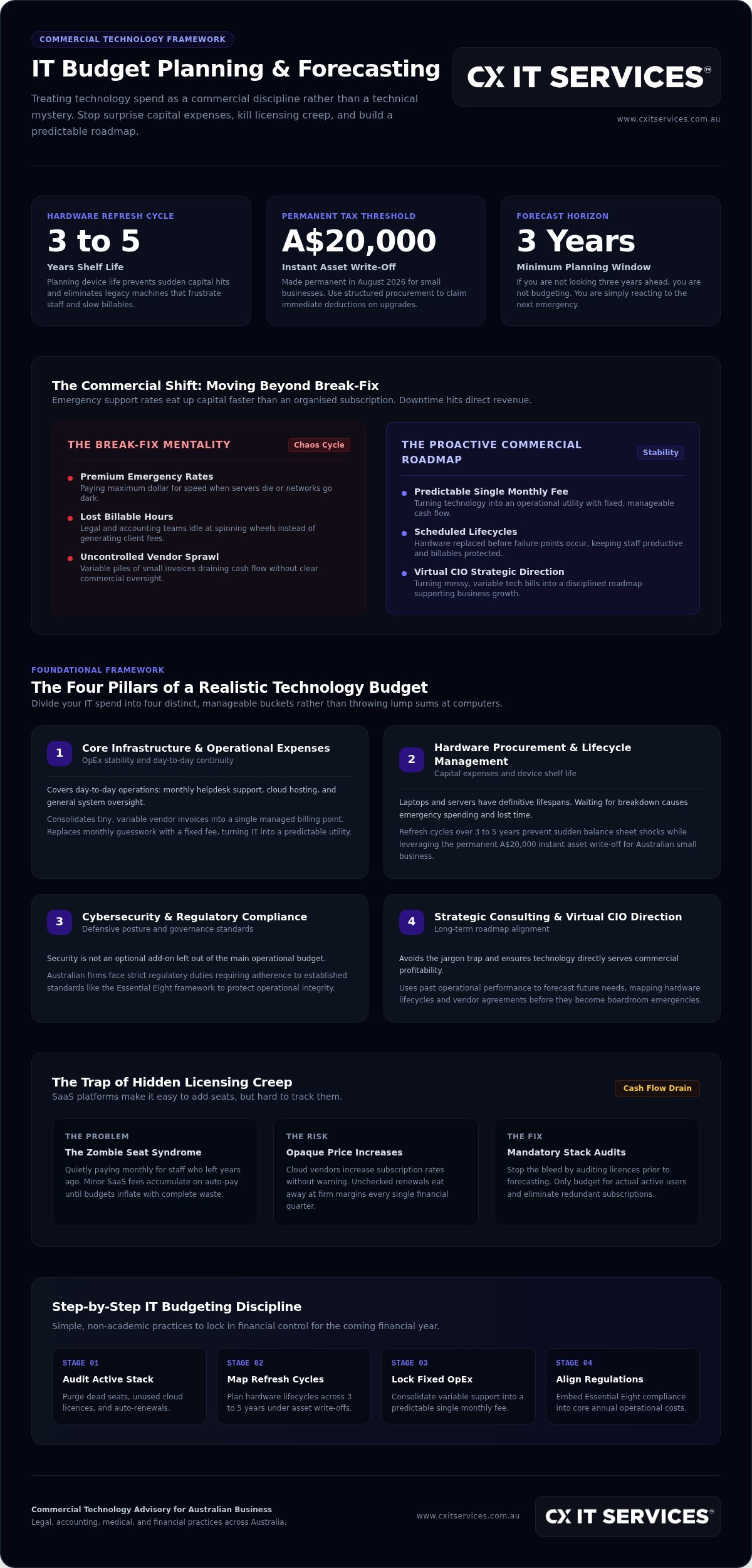
Waiting for things to break before spending money is a recipe for disaster. It feels like saving money in the short term. It isn't. Emergency IT support rates eat up capital faster than an organised subscription. When a server dies or a network goes dark, you pay a premium for speed. You are no longer in control of the price. The situation is.
Then there is the downtime. Downtime costs your business real money while your staff sit around waiting for a fix. If you are running a legal or accounting firm, every hour of lost productivity is a direct hit to your billables. You can't bill clients while you are staring at a spinning wheel on a screen. A Virtual CIO can help you move away from this chaos by mapping out hardware lifecycles before they become emergencies. Not alone. Together.
Hidden licensing creep in your software stack
SaaS platforms make it incredibly easy to add users. They make it bloody hard to track them. Unused cloud subscriptions quietly drain your bank account month after month. It is just a few dollars here and there until you realise you are paying for ten staff who left three years ago. This licensing creep is one of the biggest reasons budgets fall flat.
You need a clear process to audit your licences before forecasting next year. Don't just renew everything because it's on auto-pay. Without a regular audit, your IT budget planning and forecasting will always be inflated by waste. Stop the bleed. Audit the stack. Build a plan that actually reflects who is using what. It is much easier to grow when you aren't dragging the weight of dead subscriptions behind you.
The four pillars of a realistic technology budget
Effective IT budget planning and forecasting relies on structure. You cannot simply throw a lump sum at "computers" and hope for the best. An accurate forecast requires dividing your tech spend into four distinct, manageable pillars: operational stability, capital investment, hardware lifecycles, and security compliance. Operational expenses keep the lights on while capital expenses cover long-term infrastructure. Shifting towards fixed operational expenses provides the financial predictability growing teams need to scale without cash flow shocks.
Core infrastructure and operational expenses
Your day-to-day operations live here. This pillar includes your monthly helpdesk support, cloud hosting, and general system management. Personally, I reckon the biggest headache for Australian business owners is the pile of tiny, variable invoices from different vendors. Consolidating these into a single managed billing point makes tracking effortless. When you use managed IT support, you replace the guesswork with a fixed fee. It turns your technology into a utility rather than a variable drain on your time.
Hardware procurement and lifecycle management
Laptops and servers have a definitive shelf life that you must track. If you wait until a device dies, you are paying for an emergency fix and lost time. Planning your hardware refresh cycles over three to five years prevents sudden capital hits. It also allows you to take advantage of the A$20,000 instant asset write-off for small businesses, which was made permanent in August 2026. Using structured hardware procurement ensures you aren't stuck with a fleet of legacy machines that slow down your staff and frustrate your clients.
Cybersecurity and regulatory compliance obligations
Cybersecurity cannot be an afterthought left out of your main operational forecast. Australian businesses face real threats that require strict adherence to frameworks like the Essential Eight. As of 2026, Maturity Level 2 is the recommended baseline for almost every industry, not just government agencies. Budgeting for these maturity strategies protects your commercial reputation and keeps you on the right side of the law. If you want to see how these costs fit into a larger plan, check out our cyber security management services guide. It is better to invest in a shield now than to pay for a breach later.
If your current budget feels like a work of fiction, you can book a strategy session to get your tech spend back on track.
How to build your IT budget step by step
Building an accurate forecast requires a methodical approach that looks backward before moving forward. You don't need fancy enterprise software or complex AI platforms to get this right immediately. A simple, logical spreadsheet is often more effective than a bloated tool you don't know how to use. The goal is to align your technology spending with your commercial goals so that every dollar spent actually helps you grow. Before you even think about next year, you must conduct a thorough audit of your current infrastructure to identify exactly where your money is going.
Effective IT budget planning and forecasting isn't about guessing. It is about visibility. Personally, I reckon the reason most budgets fail is that they are based on what people think they spend, rather than what the invoices actually show. Follow this clean process to get your house in order.
Audit your historical technology spending
Gather your invoices from the past twelve months to find every recurring charge. Don't just look at the big tickets. You need to identify any rogue software subscriptions that your team signed up for independently on the company credit card. These small, ten-dollar monthly fees add up to thousands across a medium-sized firm. Categorise every expense into fixed monthly costs or variable emergency bills. If your variable bills are high, you have a stability problem that needs fixing before you can forecast accurately.
Map your business growth targets to technical capacity
Your tech budget must be a reflection of your business plan. If you plan to hire ten more staff, your budget must reflect their licences, hardware, and onboarding time. More staff means more strain on your helpdesk and your internet infrastructure. If you already have an internal IT manager who is drowning in support tickets, you might consider co-managed IT support to supplement their capacity. Planning for growth ensures that technology remains an accelerator rather than a bottleneck.
Factor in mandatory technology lifecycles
Check the warranty status of every laptop, desktop, and server in use. Hardware has a definitive shelf life. If you ignore it, you are just waiting for an emergency to happen. Schedule your upgrades before the equipment becomes a liability to your daily operations. You also need to account for the cost of secure disposal and e-waste recycling requirements. It is much cheaper to replace a five-year-old laptop during a scheduled refresh than to deal with a total failure in the middle of a major project.
Common forecasting mistakes that cost Australian businesses thousands
The biggest mistake I see in IT budget planning and forecasting is ignoring the reality of inflation and vendor price adjustments. In Australia, total IT spending was projected to hit A$172.3 billion in 2026. That is an 8.9% increase from the previous year. If you haven't adjusted your forecast by at least that margin, you are effectively cutting your operational capacity. Software vendors are notorious for increasing subscription costs at the end of financial cycles. These hikes often arrive with very little warning. Personally, I reckon if you aren't building a 10% buffer into your software line items, you are asking for a nasty surprise in your June reporting.
Another common oversight is failing to budget for staff training. You can buy the most advanced AI tools on the market, but they are worthless if your team struggles to use them. Training isn't a luxury. It is a necessary component of your technology investment. Without it, you lose money through inefficiency and user error. Similarly, leaving out data backup protocols leaves you exposed to massive recovery expenses that can easily bankrupt a mid-sized firm.
Underestimating the true cost of data security
A basic antivirus plan is no longer enough to protect sensitive client data. Cyber insurance underwriters now demand proof of maturity, often requiring alignment with the Essential Eight framework. You must budget for proactive security monitoring and incident response capabilities. If you only pay for the software and skip the management, you are only half-protected. Proper cyber security solutions involve ongoing oversight to detect threats before they become breaches. Not alone. Together.
Ignoring business continuity and backup requirements
Assuming your data is safe just because it sits in the cloud is a dangerous gamble. The cloud is not a backup service. If a user deletes a file or ransomware hits your cloud drive, you need a way to get it back. You need to allocate specific funds for dedicated disaster recovery protocols. The cost of a data breach in Australia averaged A$4.03 million in 2023. Spending on proper backups is the cheapest insurance policy you will ever buy.
If you want to stop the guesswork and build a budget that actually works, apply for a technology audit today.
Streamline your forecasting with strategic IT consulting
Personally, I reckon you have better things to do than wrestling with a spreadsheet full of technical variables. You don't have to figure out this complex planning process on your own. While global corporations might rely on distant AI deployment agents, mid-sized Australian firms need a local partner who understands their specific commercial goals. Partnering with an experienced provider gives you access to a dedicated Virtual CIO. This ensures your IT budget planning and forecasting is based on reality, not just optimistic guesswork.
A fixed monthly fee model turns variable tech headaches into a clean operational expense. It removes the stress of technical complexity and replaces it with a sense of stability. You get to stop worrying about the "how" and start focusing on the results. Let an expert handle the technical roadmap so you can focus on running your business. Efficiency is not an accident. It is a choice.
The commercial value of a Virtual CIO
A Virtual CIO provides executive technology leadership without the massive full-time salary. They act as your strategic guide. They translate your business goals into a structured, predictable technology roadmap. If you want to expand your legal practice or open a new financial services branch, they ensure the tech stack is ready before the first new staff member arrives. Check out our guide on IT strategy consulting to see how this future-proofs your operations. It is about having a safe pair of hands to manage the complexity while you focus on growth.
This level of oversight ensures that your security posture matches your regulatory duties. You no longer have to guess if your backups are working or if your software is compliant. Your Virtual CIO manages these details as part of your broader commercial plan. Not alone. Together.
Take control of your technology spending today
Stop guessing what your technology will cost your business next quarter. It is time to move away from the reactive cycle that drains your capital and frustrates your team. A professional roadmap makes IT budget planning and forecasting simple by aligning your spend with your actual business needs. You deserve a clear, predictable plan that backs your team and protects your data. Stability is the foundation of growth.
To get started on a predictable roadmap, apply for a strategic assessment. We will audit your current infrastructure and build a plan that eliminates surprise expenses for good. Get the confidence that comes with knowing exactly where your technology is headed. No jargon. Just results.
Take control of your technology roadmap
Technology should be a stable pillar of your business growth, not a source of financial anxiety. You now have the framework to move beyond reactive spending by treating IT budget planning and forecasting as a commercial discipline. By auditing your historical spend and mapping hardware lifecycles, you stop being a victim of sudden capital hits. Personally, I reckon the peace of mind that comes from a predictable roadmap is worth more than any fancy software tool.
With over 26 years of Australian IT strategy experience, we know how to turn messy tech bills into a single, fixed monthly fee. Our comprehensive support covers everything from cybersecurity to cloud management, ensuring your business stays compliant and operational. You don't have to navigate this transition alone. Together, we can build a plan that actually works.
If you are ready to stop the guesswork, apply for a strategic technology budget assessment with CX IT Services. Let's get your technology spend back on track and focused on your commercial success.
Frequently Asked Questions
What is the difference between IT budget planning and IT forecasting?
Planning sets your financial targets for the year based on your business goals. Forecasting is the reality check that predicts your actual spending trajectory using real-time data. Personally, I reckon you need both to stay solvent. Effective IT budget planning and forecasting allows you to adjust for vendor price hikes or new hires before they hit your bank account. It turns guesswork into a disciplined commercial strategy.
How much should a mid-sized Australian business spend on IT support?
Personally, I reckon you should view IT as a fixed investment per head rather than a random percentage of revenue. Most mid-sized firms find that a fixed-fee model provides the best commercial value. It replaces messy, variable invoices with a single, predictable monthly payment. This covers your helpdesk, security, and cloud management. It makes managing your margins easier because you aren't constantly worried about hourly rates or hidden call-out charges.
How often should we review our corporate technology budget?
You should review your technology budget every quarter at a minimum. A lot can change in three months, especially with software vendors adjusting their subscription rates at the end of financial cycles. An annual review is fine for major capital projects, but quarterly check-ins allow you to catch licensing creep early. It keeps your forecast accurate. It ensures you aren't paying for staff who left months ago.
What are the most common hidden costs in an IT budget?
Licensing creep is the silent killer of most technology budgets. It is incredibly easy to add users to cloud platforms but very hard to remember to remove them when they leave. Other hidden costs include emergency support fees for legacy hardware and the lost billables caused by staff downtime. Personally, I reckon if you aren't auditing your software stack twice a year, you are probably wasting thousands on tools nobody uses.
How do we budget for cybersecurity compliance like the Essential Eight?
Cybersecurity compliance must be a fixed line item in your operational expenses rather than a one-off project. It is an ongoing requirement for business insurance and your regulatory duties. Personally, I reckon you should budget for Maturity Level 2 of the Essential Eight as your baseline. This includes proactive monitoring and incident response capabilities. It is much cheaper than paying the A$4.03 million average cost of a data breach recovery.
Can a managed IT service provider help us reduce our overall tech spend?
Yes, a managed provider reduces costs by consolidating multiple vendors into one point of contact. You stop paying separate bills for internet, phones, and helpdesk support. By moving to a fixed monthly fee, you eliminate the expensive break-fix cycle that ruins your cash flow. This makes your technology spending much more predictable because you know exactly what is leaving your account every month. No surprises. Just stability.
What is a Virtual CIO and do we really need one for planning?
A Virtual CIO is a strategic advisor who provides executive-level leadership without the massive salary of a full-time hire. You absolutely need one if you want your technology to support your business growth. They translate your commercial goals into a structured, predictable roadmap. Personally, I reckon trying to plan a three-year tech strategy without a Virtual CIO is like trying to build a house without a blueprint. It is a recipe for disaster.





 Microsoft Partner