Stop paying for a dodgy phone line. This no-nonsense guide shows Aussie firms how a hosted phone system for business delivers clear calls and one simple bill.
What if your office phone system was a strategic asset for billable efficiency rather than just another bloody utility bill you have to pay?
I have seen too many good Aussie firms lose business because their hosted phone system for business is actually just a collection of outdated copper wires and broken promises.
The line crackles.
Or worse, your staff are forced to use personal mobiles because the office system is a relic.
It is a mess. It is expensive. With the final phase of the PSTN shutdown hitting us in 2026, it is also a massive risk to your operations.
You probably feel like your phone bill is a riddle and your hardware is a liability. I agree. It shouldn't be this hard to talk to people. A modern system is supposed to make your life easier, not add technical debt.
This guide is here to clear the air. I will show you how to modernise your communications with a setup that actually works. We will look at how to get crystal clear call quality, one simple monthly fee, and a setup that lets your team work from anywhere without the security nightmares.
Key Takeaways
- Stop throwing good money after bad on copper-wire relics that are destined for the scrap heap.
- See why a hosted phone system for business is the most reliable way to maintain crystal clear call quality across Australia.
- Pinpoint the essential features for professional firms, from call recording for compliance to auto-attendants that handle your first impressions.
- Follow a structured path to migrate your numbers without the usual technical downtime or missed client calls.
- Get rid of the finger-pointing by having one local partner manage your internet, phones, and security in one go.
Why your old office phone system is costing you more than just the bill
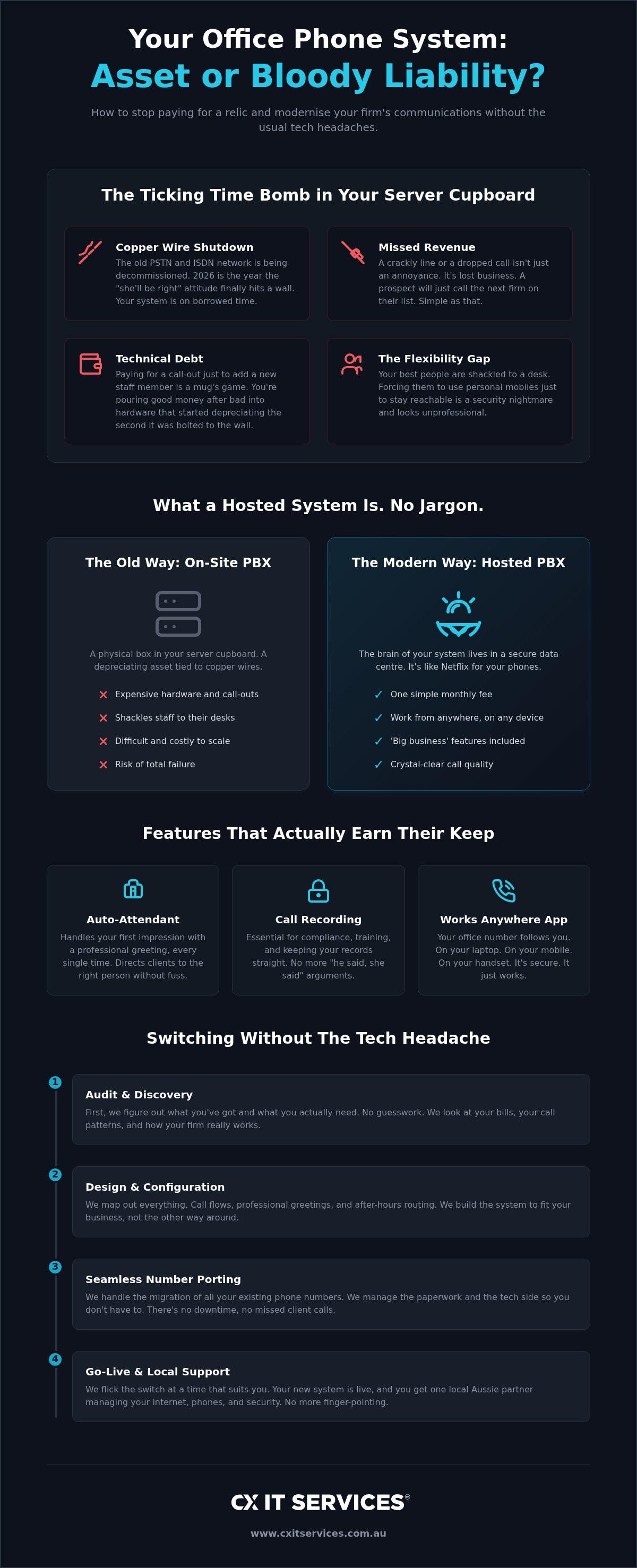
The old copper lines under our streets are a ticking time bomb. It is that simple. If you are still running a legacy Business telephone system, you are essentially gambling with your firm's connectivity. Most of the old PSTN and ISDN infrastructure is being decommissioned as we speak. 2026 is the year where the "she'll be right" attitude finally hits a wall.
Maintaining a physical PBX box in your server cupboard is a mug's game. It is a piece of hardware that starts depreciating the second you bolt it to the wall. It requires specialised technicians for every minor change. It sucks up power. It breaks when you least expect it.
For professional services like law or accounting, missed calls are missed revenue. There is no way around it. If a prospective client gets a busy signal or a dead line, they just call the next firm on the list. Your staff are also likely fed up with being tethered to a physical desk just to answer a landline.
The hidden trap of technical debt
Every time you hire a new staff member, you have to pay for a call-out just to add an extension. It is ridiculous. Legacy systems are built on a model that rewards complexity and expensive site visits. This is the definition of technical debt.
Finding parts for these old systems is becoming a nightmare. You are often looking for refurbished gear on eBay just to keep the lights on. Personally, I reckon most firms wait until a total failure before they act. They treat the phone system like a fridge. They ignore it until the milk goes sour.
By then, the damage is done. You are offline for days while you scramble for a replacement. A hosted phone system for business removes this risk entirely by moving the brain of your phones to the cloud.
The flexibility gap in a hybrid world
Your best people don't want to be tethered to a physical desk. They need to take office calls from the car, the couch, or even the courtroom. Traditional systems are rigid and force your team to give out personal mobile numbers just to stay reachable.
This creates a security nightmare. It also makes it impossible to track client interactions or maintain a professional front. Switching to a hosted phone system for business solves this by giving everyone a virtual extension that works anywhere.
Your office number follows you on an app. It works on your laptop. It works on your handset. It stays secure. It just works. Your firm can finally operate nationally without missing a beat.
What exactly is a hosted phone system and why should you care?
A hosted phone system for business lives in the cloud, not in your cupboard.
It is a complete departure from the old days of bolting a grey box to the server room wall.
Instead of physical wires and circuit boards on-site, the whole system runs as software. It uses your business internet to send voice as data packets. This is often called a Cloud PBX or a Hosted PBX.
Personally, I reckon the name doesn't matter as much as the result. You get all the "big business" features like call queues and professional greetings without the massive upfront price tag. It is about looking established and professional from day one.
You get features that used to cost tens of thousands of dollars. Things like time-of-day routing. Automated attendants. Hold music that actually sounds decent. It is a level playing field for firms of any size.
How the tech works without the jargon
Think of it like Netflix for your phones. You don't need a stack of DVDs and a player anymore. You just need a screen and a decent connection.
The "brain" of the system sits in a secure data centre. When someone calls your office, the data centre handles the routing and sends the call to your handset, computer, or mobile app.
A hosted PBX is a virtual switchboard that manages calls over the internet.
The difference between VoIP and Hosted PBX
People use these terms interchangeably, but they aren't quite the same thing. VoIP is the raw technology that lets you make calls over the web. Hosted PBX is the managed service built on top of it.
One is just a dial tone. The other is a full management suite.
If you care about professional greetings, call recording, or managing extensions for a growing team, you need the suite. You also need to be aware of the security risks of VoIP if it isn't managed properly. This is why we treat phones as a core part of your security perimeter.
A hosted phone system for business ensures your calls are encrypted and your data is protected. It is not just about making calls. It is about doing it safely.
If you want to see how this fits your specific firm, you can see if you qualify for a managed setup.
The must-have features for legal, financial, and medical firms
Professional firms don't need generic gadgets. You need a setup that handles the high stakes of your industry. Personally, I reckon a lot of tech companies miss the point here. They focus on the shiny hardware when they should be focusing on your liability and your reputation.
Call recording is essential. If a client disputes a piece of advice or a medical instruction, having that recording is your best insurance policy. It is about dispute resolution and compliance. A hosted phone system for business makes this effortless by storing those recordings securely in the cloud rather than on a dusty tape in a drawer.
Auto-attendants are another big win. They ensure a professional first impression every single time. "Press 1 for legal counsel" sounds a lot better than a distracted receptionist shouting across the room. It organises your incoming traffic before it even hits a desk.
Privacy is the other side of the coin. Your staff shouldn't have to give out their personal mobile numbers just to work from home. Mobile app integration and softphones allow your team to use their personal phones or laptops as office handsets. The client only ever sees your professional office number. Your staff keep their private lives private. It is a win for everyone.
Call management for busy practices
Practice management is hard enough without fighting your phone system. Time-of-day routing is a lifesaver. It ensures calls don't ring out into the void after hours. You can route them to an on-call service or a professional voicemail instead. It keeps the firm running even when the lights are off.
For medical clinics, call queues handle the 8:00 AM rush without giving patients a busy signal. It keeps people in the loop and reduces the stress on your front-desk team. We also see a lot of value in voicemail-to-email. If you are stuck in a meeting or a consultation, the message lands in your inbox as a sound file. You can listen to it between appointments without dialling into a clunky menu.
Security and privacy considerations
When you are switching to VoIP, security cannot be an afterthought. Encryption is non-negotiable for financial and legal data. You are discussing sensitive client matters. Those conversations must stay private.
Your phones are just another endpoint on your network. This means they must be part of your broader cyber security strategy. If your phone system is wide open, your whole firm is at risk. We treat voice data with the same level of paranoia we use for your servers and your email. It is the only way to operate safely in 2026. Security is not a feature. It is the foundation.
How to switch to a cloud PBX without the typical tech headache
Do not believe the "plug and play" marketing fluff. Switching your firm over to a hosted phone system for business is a project that requires a bit of actual thought. I have seen too many offices try the DIY approach only to have their lines go dark for three days because they missed a simple step. It is a nightmare you do not need.
A successful migration starts with a proper audit of your current call flows. You need to map out exactly how a call moves through your office. Who answers first? Where does the call go if they are busy? How many people are on the line at once during your busiest hour? If you do not map this out before you switch, you are just moving your current chaos to a new platform. We want to fix the flow, not just change the hardware.
The importance of a connectivity audit
Voice data needs a clean, prioritised path to work properly. If your staff are downloading massive legal files or syncing accounting databases while you are on a client call, the audio will drop out. It is that simple. Bad internet equals bad call quality, no matter how much you spent on the phones.
You must check your business internet to ensure it can handle the load. We always test for jitter and latency before we plug in a single handset. It is about stability. If your connection is flaky, your phones will be flaky too. You need a rock-solid foundation before you build the system on top of it.
Porting numbers without the pain
Losing your main business number is a total disaster. It is your identity. Porting your existing numbers is the most critical step in the whole process, and it is also the part where things usually go sideways. Carriers are notoriously difficult to deal with when you are trying to move a number away from them.
Professional providers manage this process for you. We handle the paperwork and the timing with the carriers so the switch happens in the background. It takes time, often several weeks, so do not leave it until the last minute. You want the old system and the new system running in parallel for a few days to ensure there is zero downtime.
Once the tech is in, you have to train your staff. If they do not know how to use the mobile app or the softphone features, you have wasted your investment. A bit of education goes a long way in making sure the new hosted phone system for business actually delivers the efficiency you are paying for.
If you want a migration that does not break your firm, apply for a managed transition plan.
Why managing your phones and IT together is the only way to work
Personally, I reckon there is nothing more frustrating than being caught in the middle of a finger-pointing match between your phone provider and your IT guy. If your calls are dropping or the audio sounds like it is coming from underwater, you don't want excuses. You want it fixed. When you buy a phone system from one company and your internet from another, you are asking for trouble.
This is the old way of doing things. It is inefficient. It is expensive. It is a massive waste of your time. In 2026, your hosted phone system for business is not a separate utility. It is a core part of your digital infrastructure. It is just another computer on your network that needs to be managed, monitored, and secured.
Having one point of contact means there is only one throat to choke when something goes wrong. We take full responsibility for the whole stack. If there is a problem with a call, we look at the handset, the local network, the firewall, and the internet connection in one go. No excuses. Just solutions.
This integrated approach also opens the door for better AI and automation in the future. Imagine your phone system automatically logging call notes into your practice management software or using AI to summarise client meetings. You can't do that with a basic standalone line. You need a system that is part of a larger, smarter network.
The MSP advantage for professional teams
We don't just sell you a plastic handset and wish you luck. Your phone system should be a line item in your managed IT support agreement. This is the only way to ensure everything talks to each other properly.
Your firewall needs to know that voice traffic is the priority. If it doesn't, your calls will suffer every time someone in the office sends a large email. By managing the IT and the phones together, we can configure your network to give your calls a "green light" through the traffic. It is about engineering a result rather than just hoping for the best.
Scaling your business without the friction
Growth should be exciting, not a technical headache. When you hire a new solicitor or accountant, adding them to the system should be as easy as sending a single email to your support team. You don't need to wait for a technician to come out and punch wires into a block. We just provision a new extension in the cloud and you are good to go.
A managed service gives you predictable costs with a fixed monthly fee. You know exactly what your overheads are per user, which makes planning your growth a lot easier. It removes the "bill shock" of unexpected maintenance or call-out fees. You can stop worrying about the tech and get back to your billable work. That is the outcome that actually matters.
Secure your firm's communications for 2026
The days of tolerating crackly lines and missed calls are over.
Personally, I reckon if your phone system isn't helping you bill more hours or protect your client's privacy, it is time to bin it. We have shown why legacy copper is a liability and how a modern hosted phone system for business gives your team the flexibility they actually need to work from anywhere.
Don't let your phones be a standalone headache. By managing your communications and IT under one roof, you get rid of the finger-pointing. You gain a rock-solid foundation for growth. It is about stability. It is about control.
With 26 years of Australian IT experience, we specialise in helping teams of 10 or more move to a fixed monthly fee model that makes sense. You get 24/7 national support and a partner who treats your security as the top priority.
If you are ready to modernise without the usual tech drama, apply for a managed phone strategy session.
Your firm deserves a system that just works. Let's get it sorted.
Common questions about hosted phone systems
Can I keep my existing business phone numbers?
Yes, you can keep every single one of your numbers. We manage the entire porting process with your current carrier to move your local and 1300 numbers over to the new cloud platform. Personally, I reckon this is the most critical part of the migration to get right. You don't want to lose your identity. We handle the paperwork so there is zero downtime for your clients.
How much internet speed do I need for a hosted phone system?
You need approximately 100kbps of upload and download bandwidth for every concurrent call. For a team of 10, a standard business NBN connection is usually plenty. However, it is not just about raw speed. You need a connection with low latency and jitter. We always perform a connectivity audit before installing a hosted phone system for business to ensure your office internet can handle the traffic properly.
What happens to my phones if the internet goes down?
Your calls won't just vanish into the void. Because the system lives in the cloud, it stays active even if your office goes dark. You can set up automatic failover to send calls to mobile apps or a secondary location. Most of my clients use the mobile app as a backup. If the NBN cuts out, your team just keeps working on their mobiles using the office number.
Is call quality as good as a traditional landline?
It is actually better in most cases. Modern IP-based systems use high-definition voice codecs that provide much clearer audio than old copper wires. The trick is your local network setup. If your provider configures your router to prioritise voice traffic, you will get crystal clear audio every time. If you have flaky internet, you will have flaky phones. It is that simple. We fix the network first.
Do I need to buy new hardware to switch to a hosted system?
No, you don't strictly need new desk phones. You can run the whole system through softphones on your laptops or apps on your mobiles. However, most professional firms still prefer physical handsets for their desks. If you want to keep your old analogue phones, you can use an adapter. I usually recommend upgrading to modern IP handsets because they offer better features and much higher security than legacy gear.
Can I use my office number on my mobile phone?
Yes, and it is a game changer for hybrid teams. You just install an app on your smartphone. When someone dials your office extension, your mobile rings. When you call out from the app, the client sees your professional office number, not your private mobile. It keeps your personal life private. Personally, I reckon this is the best way to stop staff from giving out their private numbers to clients.
How long does it take to set up a hosted phone system for a team of 10?
The technical setup usually takes a few business days. We can have your new extensions and call flows ready to test very quickly. The part that takes time is porting your numbers from your old carrier. This can take anywhere from two to six weeks depending on the complexity of your current service. We run both systems in parallel during this time to ensure you never miss a call.
Is a hosted phone system secure for a law or accounting firm?
Yes, provided it is managed as part of your broader security strategy. We use enterprise-grade encryption for all voice data to prevent eavesdropping. Because the system is software-based, we can apply security patches and updates automatically. For firms handling sensitive financial data, a hosted phone system for business is often more secure than an old on-site PBX that has not been updated in a decade.