
Tired of dud laptops and supply chain dramas? This blunt guide to hardware procurement helps Aussie businesses stop wasting money and build a solid IT strategy.
Buying a laptop shouldn't feel like a high-stakes gamble. Yet most Aussie business owners are currently paying a "cheap gear tax" they don't even know exists. Personally, I reckon there is nothing more frustrating than watching a new starter sit idle for two weeks because their gear is stuck in a supply chain bottleneck. Or worse, seeing a "bargain" laptop die after eighteen months because it wasn't built for the rigours of professional work.
You probably feel like you're constantly chasing your tail with hardware procurement. You're dealing with hidden vendor margins, dodgy deals, and a growing pile of electronic waste in the corner of the office. It's a massive drain on your time and your bank account. It is time to stop treating IT like a series of emergency trips to a retail store.
I'll show you how to stop wasting money on expensive paperweights and organise a hardware strategy that actually backs your team. We will cover how to build a standardised fleet of reliable devices, achieve zero-touch deployment for new hires, and navigate the strict e-waste laws enforced by the new National Environmental Protection Agency. This is about turning your hardware into a strategic shield against downtime.
Key Takeaways
- Calculate the true cost of your technology by identifying the "Cheap Gear Tax" that hides behind low invoice prices and high failure rates.
- Discover how a strategic approach to hardware procurement protects your business from supply chain volatility and ensures new staff are ready to work on day one.
- Implement zero-touch deployment to eliminate the hours your team wastes manually configuring new laptops and devices.
- Stay compliant with new 2026 environmental regulations by integrating secure e-waste recycling into your equipment lifecycle.
- Align your technology spending with your three-year business plan by using a Virtual CIO to move from reactive buying to proactive scaling.
Why hardware procurement is usually a total shambles
Personally, I reckon most businesses treat buying gear like a Sunday trip to Bunnings. You walk in, grab whatever looks shiny on the shelf, and hope it does the job. This approach works fine for a garden hose. It is a disaster for a professional firm. Hardware procurement is not just about shopping. It is a strategic procurement process that involves sourcing, vetting, and managing the physical tech your team relies on every single day.
It is about more than just clicking "buy" on a website when someone complains their screen is flickering. Dodgy hardware choices lead to a shittier experience for your team and your clients. If your staff are fighting with slow machines, they aren't billing hours or solving problems. They are just getting frustrated. A proper strategy ensures your gear backs your team instead of holding them back.
The retail trap vs business-grade gear
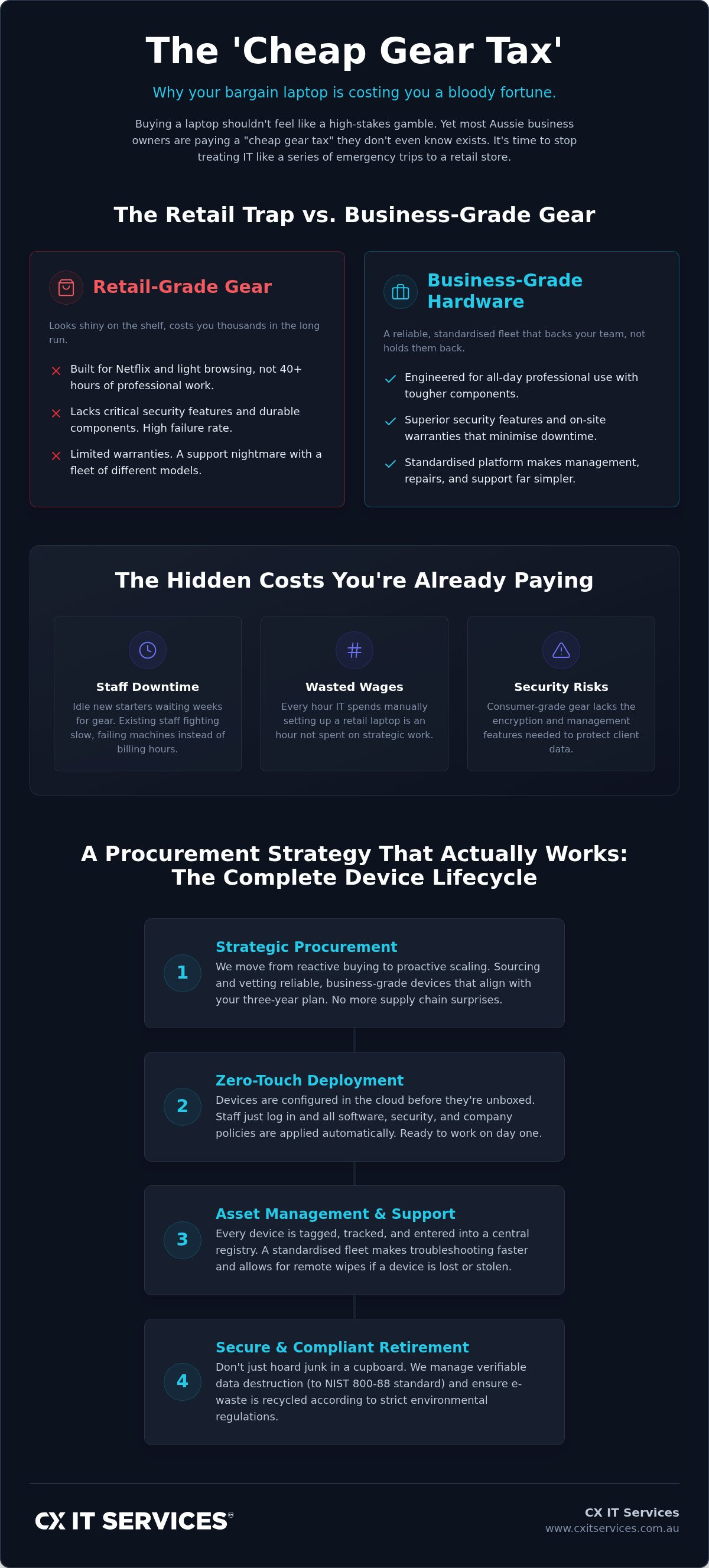
Consumer laptops are built for Netflix and light browsing. They are designed for the home user who might open it twice a weekend. They are not built for 40 hours of heavy work. Retail-grade gear often lacks the security features and durable chassis required for a professional environment. Business-grade hardware procurement focuses on machines with tougher components and superior on-site warranties.
Buying retail might save you a few hundred bucks today. However, it will cost you thousands in downtime when the device fails. Business-grade devices are easier to repair and maintain. They offer a standardised platform that makes it much simpler to manage your entire fleet. Reliability is not a luxury. It is a baseline requirement for any growing Aussie business.
Lead times and the supply chain reality in 2026
Waiting six weeks for a laptop because you did not plan ahead is a management failure. In 2026, supply chain volatility is the new normal. According to current research, 68 percent of supply chain professionals cite rising costs and inflation as their main concern. You cannot simply assume that the gear you need is sitting in a warehouse ready for overnight shipping.
Strategic procurement means having a predictable refresh cycle or a small buffer of pre-configured gear. We see too many firms scrambling when a new hire starts next Monday. They end up overpaying for whatever is left in stock at a local retailer. This leaves the new staff member without the tools they need to succeed. It makes your business look disorganised. It is an avoidable mess that a proactive strategy solves before it starts.
The lifecycle of a device from box to bin
A laptop should not just arrive in a box and be handed to a staff member. That is the quickest way to kill productivity on a Monday morning. Effective hardware procurement means managing the entire journey. It starts the moment the order is placed and ends the day the device is securely destroyed. If you are just handing out sealed boxes, you are leaving your security and your staff's time to chance.
Everything needs to be tagged, tracked, and secured before it hits a desk. If you do not know where your assets are, you cannot protect your data. Every device should be entered into a central registry. This allows for remote wipes if a laptop is lost at an airport or stolen from a car. It also means you know exactly when a warranty is expiring before the machine actually dies.
Standardisation and the fleet mentality
Having ten different models of laptops is a support nightmare. Personally, I reckon it is the single biggest cause of IT friction in growing firms. Standardising your fleet makes troubleshooting faster and spare parts easier to find. It keeps the user experience consistent across your whole national team. When every desk has the same setup, your staff can move between offices or desks without missing a beat. This level of consistency is a hallmark of professional technology systems, like those found at utdtech.com, which focus on reliability across all commercial environments.
Configuration and pre-deployment
We organise the software and security settings before the staff member even sees the device. This is a core part of managed IT services. We use "zero-touch" deployment. The device is configured in the cloud and applies your company policies the moment it connects to the internet. Staff should be able to log in and start working immediately. No waiting for updates. No manual software installs.
If you are not managing the end-of-life, you are just hoarding old junk in the stationery cupboard. Across Australia, the disposal of e-waste in landfill is becoming increasingly restricted, with many regions already having specific prohibitions in place. The new National Environmental Protection Agency is cracking down on businesses that treat electronics like general waste. Proper retirement requires verifiable data destruction to the NIST 800-88 standard. This is the only way to avoid massive privacy penalties and ensure your old data doesn't end up in the wrong hands.
If you want a fleet that just works without the configuration headache, you might want to see if we are a good fit for your team.
Calculating the Cheap Gear Tax and hidden costs
Personally, I reckon the price on your hardware invoice is a bit of a lie. It is not that the vendor is being dishonest. It is just that the sticker price only accounts for about 30 percent of the total cost of ownership. The other 70 percent is what I call the "Cheap Gear Tax." This is the hidden penalty you pay for choosing the lowest bidder or grabbing whatever was on sale at the local retail outlet.
Hidden costs are everywhere. They are in the four hours your senior accountant spent trying to get a dodgy webcam to work for a client meeting. They are in the three days of lost productivity when a bargain-bin laptop motherboard gives up the ghost. Reliability is a feature you have to pay for upfront. If you don't, you will end up paying for it through a thousand tiny cuts to your billable hours. A "cheap" laptop that breaks twice a year is a bloody expensive mistake.
CAPEX vs OPEX and the rise of leasing
Buying everything upfront (CAPEX) can kill your cash flow. For a growing Aussie business, dropping A$30,000 on a fleet refresh in a single month is a heavy lift. This is why we are seeing a shift toward leasing or Device-as-a-Service models (OPEX). It keeps your tech fresh without the massive upfront bill. It makes your hardware procurement predictable and easy to budget for. You get the latest gear, full support, and a fixed monthly fee that doesn't jump around when a device fails.
The real cost of downtime
Work out what an hour of your team’s time is actually worth. If five people are sitting around because a cheap network switch is cooked, you are losing serious money every minute. You aren't just losing the cost of the hardware. You are losing the revenue those five people should be generating. Good procurement is basically insurance against these moments. It is about sourcing business-grade gear that has been vetted for your specific environment. When your gear works, your people work. It is as simple as that.
The goal is stability. By investing in a standardised, high-quality fleet, you eliminate the constant fire-fighting that comes with a "mismatch" of cheap devices. This proactive mindset applies to all physical infrastructure; for instance, you can explore Security and IT Infrastructure Solutions to see how professional surveillance and access control systems are implemented to protect commercial assets globally. This is how you move from being a reactive business to a proactive one that focuses on growth rather than repairs.
Building a procurement strategy that actually works
Personally, I reckon most businesses wait until something catches fire before they replace it. That isn't a strategy. It's a panic. To build a system that actually works, you need to stop being reactive and start being strategic with IT strategy consulting. This moves your tech from a surprise expense to a planned investment that actually supports your growth.
Start by auditing what you have right now. You need to know exactly what is sitting on every desk so you can decide what needs to be binned. If you are running five-year-old machines, you are already behind. You need to work with a partner who actually knows the Aussie market and the current vendor landscape. This ensures your hardware procurement is based on what is available and reliable today, not what was popular three years ago.
Lifecycle management and knowing when to quit
Trying to squeeze five years out of a laptop is a losing game. It might look like you're saving money on the balance sheet. In reality, you are bleeding cash through lost time. The performance drop-off after year three usually costs more in lost productivity than the price of a brand-new machine. Planned obsolescence is annoying. Ignoring it is just plain stupider. Set a strict refresh cycle of three to four years for laptops and stick to it. Your team will thank you. Your bottom line will too.
Vendor management without the headache
You should not have to spend your afternoon on hold with a manufacturer in a different time zone. A good procurement partner handles the warranties and the returns for you. If a screen flickers or a battery swells, it shouldn't be your problem to solve. It is about having one throat to choke when things go wrong. We manage the relationships with vendors so you can focus on running your firm. You get the gear you need without the administrative headache.
If you are ready to stop fighting with old gear and start scaling your business, apply to work with us today.
How we handle your hardware without the corporate slop
We aren't just here to sell you boxes. Personally, I reckon there are enough generic websites where you can click a button and hope the courier doesn't drop your gear in a puddle. We take a different approach. We manage your entire hardware infrastructure as part of a broader commitment to your business stability. This means no hidden margins, no technical jargon, and absolutely no corporate slop. You get gear that works and a team that stands behind it.
Our vCIO services are the engine room of this strategy. We don't just look at what you need today. We look at your three-year business plan and align your tech to match those goals. If you plan to double your headcount, we ensure your hardware procurement process is ready to scale without the usual growing pains. It is about quiet competence. We do the thinking so you can do the doing.
Strategic sourcing and national support
We use our established vendor relationships to get you business-grade gear at the right time. In a market where supply chain delays are still a primary risk, having a partner who knows how to navigate the landscape is vital. We don't just ship a laptop and wish you luck. We have a national network of on-site technicians across Australia. Whether your team is in a city office or working remotely, we can provide the physical support they need. It is about being a partner, not just another supplier on your accounts payable list.
End-to-end management from box to bin
We handle the heavy lifting of unboxing, custom imaging, and secure delivery to your staff's door. You focus on running your business while we make sure the tools are ready to go the moment they are opened. But our job doesn't end when the warranty does. When a device reaches its limit, we take the old stuff away. We handle e-waste recycling properly. We ensure that your data is destroyed to the NIST 800-88 standard.
With the new National Environmental Protection Agency overseeing regulations in 2026, you cannot afford to be sloppy with disposal. We provide the certificates of destruction and the peace of mind that comes with doing things right. We are a safe pair of hands for your tech from the day it is ordered to the day it is recycled. It is a disciplined, methodical approach that prioritises your growth over our margins.
Ready to fix your hardware mess? Apply to work with us here.
Stop fighting your tools and start scaling
Personally, I reckon you've got enough on your plate without worrying about flickering screens or supply chain delays. We've talked about the "Cheap Gear Tax" and why retail laptops are a trap for professional firms. You now know that a real hardware procurement strategy involves managing the entire lifecycle from the first unboxing to secure data destruction.
Stability isn't a happy accident. It's the result of methodical planning and business-grade gear. As an Australian owned and operated firm with 26 years of industry experience, we help you swap the tech chaos for a fixed monthly fee managed IT model that actually makes sense. It's time to treat your hardware as a strategic asset rather than a series of expensive paperweights.
If you're ready to ditch the corporate slop and move to a fleet that just works, apply for a Strategic IT Review today. Let's get your team the gear they actually deserve.
Frequently Asked Questions
How often should my business refresh its hardware?
Refresh your laptops every three to four years. Personally, I reckon trying to squeeze five years out of a machine is a false economy. By year four, battery life is usually shot and performance lag starts costing you billable hours. Business-grade warranties also tend to expire after three years. Replacing gear on a strict cycle ensures your team stays productive and your IT costs remain predictable rather than a series of expensive emergencies.
Is it better to lease or buy IT hardware in Australia?
Leasing is often better for cash flow and keeping tech fresh. For the 2025-2026 financial year, small businesses can use the instant asset write-off for eligible items under A$20,000. However, leasing turns hardware into a predictable monthly OPEX cost. This avoids the massive cash hit of a fleet refresh. It also ensures you aren't stuck with expensive paperweights when the next generation of AI-optimised hardware arrives for your team.
What is the difference between consumer and business-grade laptops?
Business-grade laptops are built for 40 hours of heavy work every week. Consumer gear is designed for light home use and Netflix. Professional machines feature tougher chassis, better security chips, and superior on-site warranties. If a business laptop breaks, a technician usually comes to your office to fix it. If a retail laptop breaks, you are stuck in a queue at a shopping centre service desk for weeks while your staff sit idle.
Can I just buy my own gear and have you manage it?
You can, but it usually ends in a total shambles. When you buy your own gear, you often miss out on the specific business-grade specs and on-site support your team needs. We prefer to handle the hardware procurement to ensure every device is standardised and ready for zero-touch deployment. This prevents the mismatch of devices that creates massive support headaches and slows down your whole operation when things inevitably go wrong.
How do I handle e-waste for my old office computers?
You must use a certified recycler to avoid massive fines. In 2026, the National Environmental Protection Agency is strictly enforcing e-waste regulations. You cannot just chuck old PCs in a skip. Proper disposal involves verifiable data destruction to the NIST 800-88 standard. We handle this entire process for our clients. We ensure your old data is wiped and the physical materials are recycled responsibly according to current Australian environmental laws.
What are the current lead times for business hardware in 2026?
Lead times in 2026 remain volatile due to ongoing supply chain disruptions. You should generally allow four to six weeks for business-grade laptops with specific configurations. Banking on next day delivery is a risky move for a growing firm. Strategic planning and maintaining a small buffer of pre-configured gear is the only way to avoid leaving new staff without tools. Research shows 68 percent of supply chain professionals are still worried about rising costs.
Does hardware procurement include mobile phones and tablets?
Yes, it absolutely does. Mobile phones and tablets are essential tools for most Aussie professional teams. We treat these devices with the same strategic oversight as laptops or servers. This includes sourcing the right models and ensuring they are enrolled in your mobile device management system. Effective hardware procurement isn't just about computers. It is about every physical asset your team uses to access company data and communicate with your clients.
How do you handle hardware failures for remote staff?
We use our national on-site technician network to support staff wherever they are located. If a device fails, we don't expect your remote team to travel to a central office. We can ship a pre-configured replacement device overnight so they are back online immediately. The broken machine is then collected and repaired or recycled. This keeps downtime to a minimum and ensures your remote workforce feels just as supported as those in the office.





 Microsoft Partner