


Sorting out essential eight compliance australia shouldn't break your business. Here is a no-nonsense guide to maturity levels, realistic priorities, and fixes.
What should you tackle first when working towards Essential Eight maturity, without disrupting the business? I hear that concern from Australian organisations trying to understand essential eight compliance australia. The framework is practical, but turning its requirements into day-to-day work can feel like a lot.
That’s understandable. The Essential Eight isn’t a simple tick-box exercise. Its maturity model has four levels, and your overall level is set by the lowest level you achieve across the eight strategies. One gap can hold back the whole result. Treat it as a risk roadmap, with clear priorities and evidence to show progress.
This article explains what the eight strategies mean in practice, how the maturity levels work and where to start. It covers the records and controls worth reviewing, and how to plan improvements around staff needs and business continuity. When the work spans IT and cyber security, managed support can help keep it organised and moving.
Key Takeaways
- Understand what essential eight compliance australia involves, and why the framework isn’t a universal certificate for every legal or contractual requirement.
- See how the eight strategies fit together and why your overall maturity level depends on every strategy, not just the strongest controls.
- Use a clear assessment workflow to set scope, review controls, gather dated evidence and record gaps.
- Choose priorities with your business context in mind, using current ASD guidance rather than treating a maturity target as one-size-fits-all.
- Turn identified gaps into a practical improvement plan, with accountable owners and remediation coordinated around daily operations.
What Essential Eight compliance means for Australian businesses
The Essential Eight is a set of cyber security mitigation strategies developed by the Australian Signals Directorate (ASD) to help organisations reduce exposure to common cyber threats. In practice, “compliance” usually means putting relevant strategies in place and being able to show how they’re implemented. It doesn’t mean your business has earned a universal government certificate.
The Essential Eight is an ASD framework for reducing cyber security risk through practical mitigation strategies and a structured way to assess how well they’re implemented. It gives business leaders and IT teams a shared starting point, but it can’t guarantee protection from every attack.
That distinction matters. A business can adopt some strategies to strengthen security without claiming a particular maturity level. Demonstrating a target level takes a structured assessment of whether controls meet the relevant ASD guidance, supported by evidence. “Compliance” can sound like a pass-or-fail badge. It’s more useful to treat it as a clear account of your controls, gaps and progress.
Why the Essential Eight is a framework, not a one-size-fits-all badge
The strategies and maturity guidance help organisations organise cyber security work. They don’t replace advice about obligations that apply to a particular business, contract or sector. Use the framework to inform security planning, then assess any separate requirements on their own terms. A control that supports good security doesn’t automatically satisfy every external obligation.
For example, a business might implement controls across its systems but still need to provide specific evidence for a customer contract. The framework can help structure that work, but the contract sets its own requirements. Keep the distinction clear: implementing strategies is not the same as demonstrating that a particular target has been met.
Who should consider Essential Eight maturity
Business leaders can use a maturity review to understand where security investment should go. Operations managers can identify changes that may affect staff workflows, while internal IT teams can map technical controls to the systems they manage. It’s a practical conversation between people responsible for risk, daily operations and technology, not just an IT exercise.
A review may make sense when customers ask about security, internal governance calls for a clearer view of cyber risk, or changes to your systems affect how they’re protected. The right maturity target depends on your business context and any applicable requirements. Not every Australian business has the same mandatory target. For example, the ASD’s Level 2 requirement applies to non-corporate Commonwealth entities, not automatically to every business in Australia.
For essential eight compliance australia, start by identifying why your organisation is assessing the framework. Then check current ASD guidance and review any relevant contract, sector or governance requirements separately. That gives you a defensible scope for the work, without mistaking a useful security framework for a universal sign-off.
The eight Essential Eight strategies and how the maturity model fits
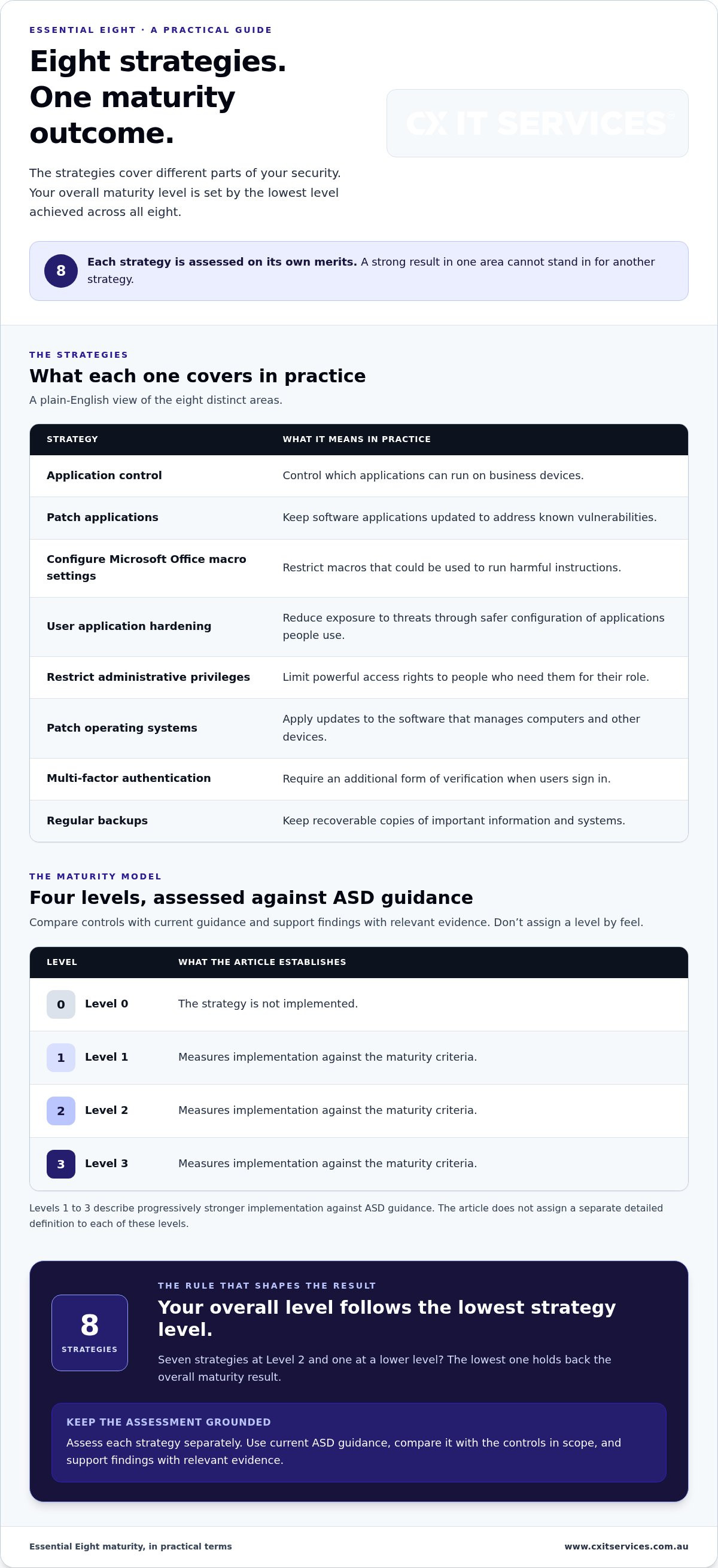
It helps to separate two things: the strategies describe areas of security practice, while the maturity model describes how implementation measures against ASD guidance. One control can’t stand in for another. The strategies describe what to put in place; the maturity model describes how implementation measures against defined criteria.
The eight strategies in plain English
Here’s what the strategies mean in everyday business terms:
- Application control: Control which applications can run on business devices.
- Patch applications: Keep software applications updated to address known vulnerabilities.
- Configure Microsoft Office macro settings: Restrict macros that could be used to run harmful instructions.
- User application hardening: Reduce exposure to threats through safer configuration of applications people use.
- Restrict administrative privileges: Limit powerful access rights to people who need them for their role.
- Patch operating systems: Apply updates to the software that manages computers and other devices.
- Multi-factor authentication: Require an additional form of verification when users sign in.
- Regular backups: Keep recoverable copies of important information and systems.
These are distinct parts of the business environment, from what software can run to how accounts are protected and information can be restored. The Australian Signals Directorate’s guidance explains how to assess each strategy. Use that guidance to work out what applies to the systems in scope, rather than treating the list as a one-size-fits-all technical recipe.
What Essential Eight maturity levels tell you
The maturity model describes how implementation measures against its criteria. It has four levels: Level 0, Level 1, Level 2 and Level 3. Level 0 means a strategy is not implemented. The higher levels describe progressively stronger implementation against ASD guidance. Don’t assign a level by feel. Compare controls with current guidance and support findings with relevant evidence.
Assess each strategy on its own merits. The organisation’s overall maturity level is determined by the lowest level achieved across the eight strategies. If seven meet Level 2 criteria but one meets only Level 1, the overall result is Level 1. That makes the weakest area important, even when most controls appear well established.
Present a maturity result with its assessed scope and evidence, not as a promise that incidents won’t occur or that every risk has been covered. For Australian businesses assessing Essential Eight compliance, current ASD guidance provides the basis for understanding what each level requires. Make clear which systems and evidence the assessment covers, so the result helps identify further work rather than becoming just a label.
If you’d like help coordinating security improvements with day-to-day IT operations, you can outline your business IT needs.
How to assess your Essential Eight position and prioritise gaps
A useful assessment starts with a clear boundary. Decide what you’re reviewing, compare the controls with current Australian Signals Directorate (ASD) assessment guidance, then turn gaps into owned work. Keep the evidence alongside your findings. Without it, a maturity rating can look more certain than the review behind it.
Set scope before assessing controls
Write down which systems, users and business operations are included. Consider endpoints, identities, cloud services and backup arrangements, along with the business processes that rely on them. Note exclusions and assumptions too. If a system sits outside the review, say so plainly. That stops a scoped assessment being mistaken for a picture of the whole organisation.
Use this workflow to work through the assessment:
- Set the scope. Record the systems, user groups and operations covered, plus any exclusions and assumptions.
- Review the controls. Compare what’s in place with the current ASD guidance for each relevant strategy. Don’t rely on policy documents alone if they don’t show how a control operates.
- Collect evidence. Gather records that support your findings, such as relevant configuration information, process records or approval documentation. Note when each item was collected.
- Record gaps. Describe what doesn’t meet the guidance, which part of the scope it affects and what evidence supports that conclusion. Mark missing evidence separately from a confirmed control gap.
- Assign owners. Give each action to someone with the authority and capacity to move it forward. Name dependencies, such as a change needing system-owner approval or coordination with a business team.
- Schedule reviews. Set a planned review point for actions and revisit the assessment when the environment or scope changes. Keep dates visible so old evidence isn’t mistaken for current evidence.
Turn assessment findings into owned actions
A finding only helps if someone can act on it. Record the gap, evidence, accountable owner and planned review point together. Group related work where that makes sense, but keep dependencies visible. For instance, a change affecting staff access may need to be planned with the teams who rely on it, rather than pushed through without warning.
Prioritise using business risk, dependencies and available capacity. Address urgent exposure and foundational work in a sensible order, but don’t invent a score and mistake it for ASD guidance. A short, realistic sequence of changes is often easier to manage than a large batch that strains staff or interrupts operations. Keep a decision log when an action is deferred, including why and when it will be reconsidered.
An internal review can help your team understand its position and plan improvements. It isn’t automatically equivalent to a formal or independent assessment. The purpose, scope, evidence requirements and reporting expectations may differ, so be clear about what your review can support. For broader oversight, connect the findings to your wider cyber security management approach. That’s the practical value of essential eight compliance australia: a documented view of the work, not just a maturity label.
Common Essential Eight compliance misunderstandings to avoid
Don’t treat a maturity result as proof that every cyber security obligation has been met. The Essential Eight can help organise security work, but it doesn’t automatically cover every law, contract, customer requirement or sector-specific expectation that may apply to a business.
Treat Essential Eight evidence as a record of what was assessed and supported, not as a blanket claim that every obligation is met or every incident prevented. That keeps reporting clear and shows where separate checks may still be needed.
Does Essential Eight automatically satisfy every compliance obligation?
No. Map requirements that apply to the business separately, because they can differ by regulation, contract, customer and sector. Record what each requirement asks for, what evidence supports it and who is responsible. Don’t assume alignment with one framework settles the rest. For example, consider email-related threats as part of the wider security picture, including the risks explained in this business email compromise protection guide.
This mapping isn’t legal advice. Where a requirement needs interpretation, get advice specific to that obligation. The practical point is to keep framework findings and obligation-specific evidence distinct, so a security review doesn’t make claims it can’t support.
Why the target maturity level needs context
Set a target by considering the organisation’s risk, operating environment and relevant external requirements. Current Australian Signals Directorate guidance explains the model’s criteria, but a target still needs to make sense for the systems and obligations in scope. The same target won’t suit every organisation.
Don’t treat a completed checklist as a permanent result. Systems, users and business processes change, so findings can become stale. Set review points and revisit assumptions when the environment changes. Keep evidence dates visible, too, so older records aren’t mistaken for a current view of controls.
For Australian organisations working towards Essential Eight alignment, treat reviews as ongoing governance work. Record what was assessed, what remains outside scope and which actions are open. That gives leaders a clearer picture of progress without suggesting risk has disappeared. If you’re ready to plan security improvements for your business, share your IT and cyber security requirements.
Build a practical Essential Eight improvement plan with the right support
Turn assessment findings into owned work, rather than leaving them sitting in a report. Start with a defined scope, check current Australian Signals Directorate (ASD) guidance, document gaps and assign someone accountable for each action. Then plan changes around the people and systems they affect. A security control still needs to work in the business.
For an Essential Eight improvement plan, record what needs attention, why it matters, who owns it, what it depends on and when it will be reviewed. If a change could affect staff access, cloud services or normal workflows, involve the relevant people before scheduling it. That helps avoid last-minute surprises.
Coordinate security improvements with business operations
Coordinate IT support, cloud administration and cyber security work where they touch the same systems. That gives teams a clearer view of the order of changes and where staff may need guidance. For instance, a change to access controls may need to be planned alongside helpdesk processes, so staff know how to raise issues and the right team can respond.
CX IT Services supports businesses with ten or more employees through managed IT and cyber security. The Australian-owned provider offers 24/7 support and on-site technicians across Australia, including Melbourne, Brisbane and Sydney. Managed support can help coordinate remediation with daily IT operations while keeping responsibilities and dependencies visible. It isn’t a shortcut to a maturity rating or a promise of compliance. Managed cyber security services can form part of a broader security approach.
Keep staff needs in view, too. A control may change how people sign in, access information or request assistance. Clear communication and a planned support process can make those changes easier to manage, particularly when several teams rely on the same systems.
Choose a realistic next step for your business
If the work feels large, don’t try to fix everything at once. Confirm the scope, compare current controls with ASD guidance and document the gaps you can evidence. Then assign accountable owners and agree on a review point for each action. Prioritise according to business risk, dependencies and the capacity available to do the work properly.
Support is useful when internal teams need help keeping those moving parts aligned. Managed IT and cyber security support can help organise ownership, coordinate changes and track follow-through alongside operational requirements. The goal is steady, documented improvement, not a claim that every risk has disappeared.
To plan the next step for your business, apply to work with CX IT Services.
Make security improvement part of business planning
Security work sticks when it has a place in ordinary business planning, not just a folder labelled “compliance”. Set a regular point to review open actions, accountabilities and changes to your systems. That way, new projects and shifting business needs can be considered before they leave controls out of date.
For essential eight compliance australia, the useful measure is whether your business can keep improving with a clear view of its priorities. You don’t need to solve every gap in one hit. You do need a plan people can own, revisit and adjust as the business changes.
CX IT Services is Australian-owned and brings more than 26 years of industry experience to managed IT and cyber security support for Australian businesses. To put a practical plan around your security work, apply to work with CX IT Services. A clear first step is enough to get the work moving.
Frequently Asked Questions
What is Essential Eight compliance in Australia?
The Essential Eight is an Australian Signals Directorate (ASD) framework of eight mitigation strategies intended to help organisations reduce cyber security risk. Businesses often use “compliance” to mean they’ve implemented the strategies or aligned their controls with the framework. That wording alone doesn’t prove every legal, contractual or sector-specific obligation has been met. For essential eight compliance australia, check current ASD guidance for the framework’s definitions and assessment criteria.
Is Essential Eight mandatory for every Australian business?
No single answer applies to every organisation. Whether a target is required can depend on your organisation’s circumstances and the requirements attached to relevant contracts or other obligations. The framework can still guide security improvements even where a particular maturity target isn’t prescribed. Map obligations separately, including requirements in customer agreements, and verify them against current authoritative guidance. Don’t assume another organisation’s target automatically applies to your business.
What are the eight Essential Eight strategies?
The eight are application control; patch applications; configure Microsoft Office macro settings; user application hardening; restrict administrative privileges; patch operating systems; multi-factor authentication; and regular backups. Together, they address different aspects of cyber risk, including what software runs, how access is controlled and whether information can be restored. Use the current ASD wording when documenting them. Naming a strategy doesn’t show that its controls are implemented or meet a particular maturity level.
What is an Essential Eight maturity level?
A maturity level describes how an organisation’s implementation measures against defined criteria in the ASD model. The model uses Level 0 and Levels 1 to 3, with the detailed requirements set out in current ASD guidance. A result should identify what systems and controls were assessed and what evidence supports the finding. It describes the review, not a guarantee that the organisation can’t experience a cyber incident.
How do I assess my business against the Essential Eight?
Start by defining which systems and users are in scope, then compare relevant controls with current ASD guidance. Gather evidence such as configuration records or documented processes, note gaps, and assign someone to each follow-up action. For example, a written policy may not show how a control is applied across devices. An internal review helps plan work, but shouldn’t be presented as equivalent to a formal assessment unless it meets the applicable requirements.
Does Essential Eight compliance guarantee my business is secure?
No framework can promise that every cyber incident will be prevented. The Essential Eight is intended to help organisations reduce risk, but its value depends on appropriate implementation and review as systems and business needs change. It also doesn’t cover every possible risk or automatically address separate contractual or sector requirements. Treat the framework as one part of security management, alongside other controls and processes suited to your organisation.
How long does Essential Eight implementation take?
There’s no reliable generic timeframe. The work depends on what’s in scope, which controls are already operating, technical dependencies and the resources available to make changes. A business with several systems or teams involved may need to coordinate work differently from one with a narrower environment. Set priorities and owners, then sequence changes around operations. Build any timeframe from an assessment of actual gaps, not a broad estimate.





 Microsoft Partner