
Need an Essential Eight assessment Melbourne businesses can actually use? Ditch the bloated spreadsheets and get clear, practical priorities for your team.
What good is an Essential Eight score if it leaves you with a long list of fixes and no clear idea where to start? A practical Essential Eight assessment Melbourne businesses can act on should show which controls are in place, what evidence supports them and which gaps deserve attention first.
Personally, I reckon the hard part isn’t understanding that security matters. It’s working out what the findings mean for your people, systems and budget without turning the next year into one giant IT project. An assessment should give you a clearer view, not just another spreadsheet to worry about.
Here, I’ll explain what an assessment examines across the eight strategies, how to interpret maturity levels and evidence, and how to turn gaps into prioritised improvements. The goal is a plan you can explain to stakeholders and fit around day-to-day operations.
Key Takeaways
- An Essential Eight assessment Melbourne businesses can use should show what was reviewed, what evidence supports the findings and where gaps need attention.
- Findings reflect the systems and evidence included in the review at that point in time. They don’t automatically cover every part of the business.
- Your maturity target should reflect business risks, obligations and operational needs, not a score chosen in isolation.
- Turn findings into a workable plan by validating gaps, prioritising improvements and assigning each action an owner and review date.
- Connect security improvements with ongoing cyber security management and IT support, so the plan keeps moving after the assessment.
What an Essential Eight assessment in Melbourne can tell your business
I’d describe an Essential Eight assessment as a point-in-time review of an organisation’s security controls against the ASD Essential Eight maturity model, based on the systems and evidence included in the review.
For a Melbourne business, the useful part is knowing what was reviewed, what supports the findings and where attention may be needed. Check the scope before treating results as a view of every system, supplier or process. If something wasn’t included, the findings can’t tell you how well it’s controlled.
Timing matters too. Findings reflect what was in place and evidenced during the review. Systems change, people come and go, and new services get added. I see the result as a baseline for decisions, not a permanent stamp of approval. For wider context, here’s an Information Security Overview.
Who benefits from an Essential Eight assessment?
Business owners, operations leaders and internal IT decision-makers benefit when they need a clearer view of what’s working and what needs follow-up. A legal practice might want to understand access to client files. An accounting firm may need visibility across staff devices and business applications. A medical clinic or financial services firm may want to know which controls protect the systems its team relies on.
Growing teams add moving parts. More users, devices and systems mean more settings to manage and more places for assumptions to creep in. I’d rather see what’s actually covered than rely on “we think IT has that sorted”.
What an assessment can and cannot establish
An assessment can bring controls, supporting evidence and gaps into one structured view. That helps a business decide what to investigate or improve. It can’t promise that a cyber incident won’t happen. A control may look fine in a document and still fall over in everyday use.
An assessment isn’t formal certification or legal advice. A result against the ASD Essential Eight maturity model doesn’t, by itself, prove your business meets every legal, contractual or industry requirement. Those questions need their own proper advice.
For me, the value is a clearer starting point: what was reviewed, what the evidence showed and what needs a decision. That’s more useful than a score sitting on its own.
How an Essential Eight assessment examines controls and evidence
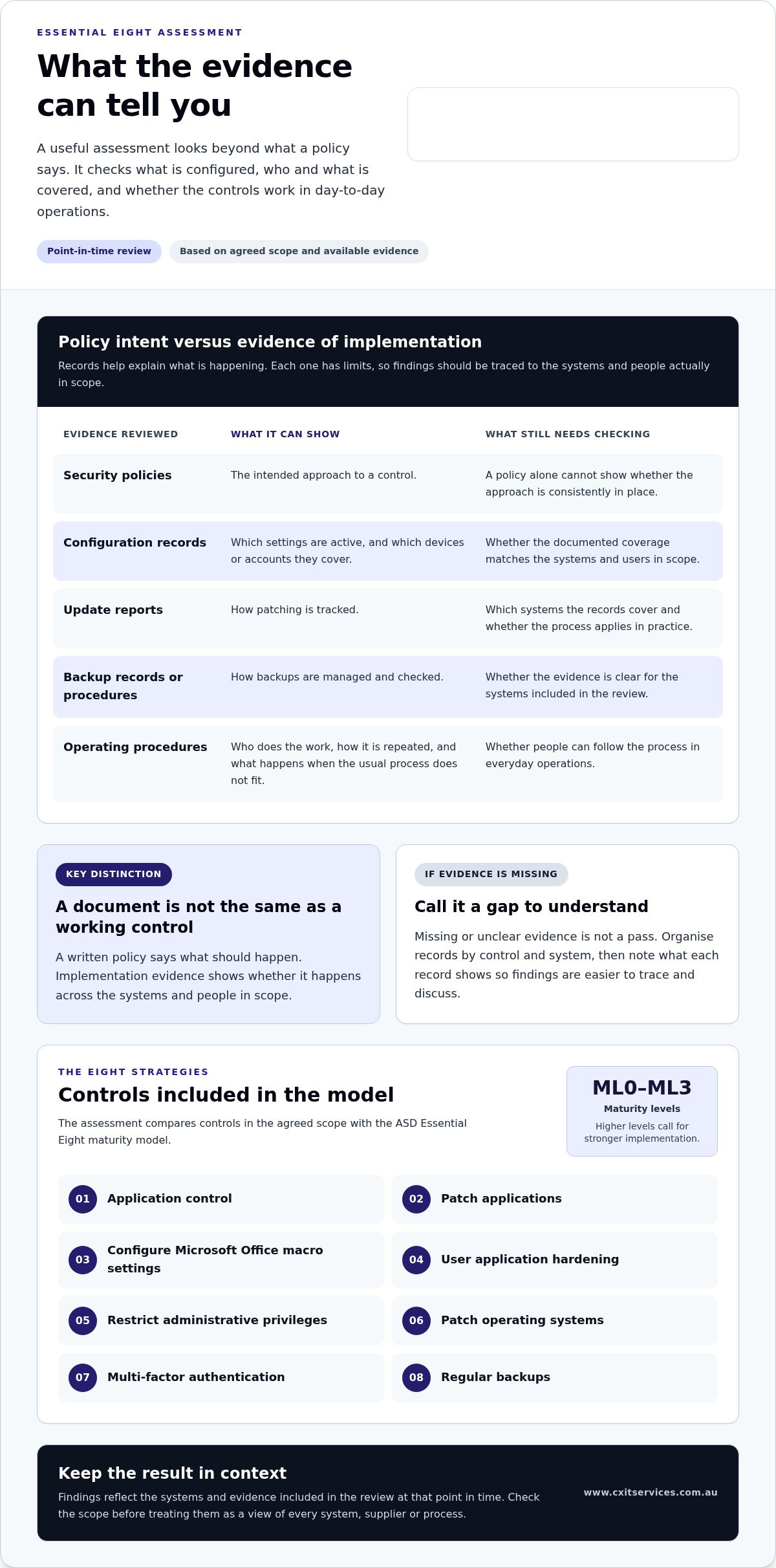
An Essential Eight assessment compares the controls in the agreed scope with the ASD Essential Eight maturity model. I’d look beyond what a policy says. The practical questions are whether settings are configured, which systems and users they cover, and whether there’s evidence the controls work in day-to-day operations.
The ASD names these eight strategies:
- Application control
- Patch applications
- Configure Microsoft Office macro settings
- User application hardening
- Restrict administrative privileges
- Patch operating systems
- Multi-factor authentication
- Regular backups
Scope shapes the review. A control may be handled differently across devices, user groups or business systems, so the evidence needs to show what applies where. A policy can explain the intended approach. On its own, it can’t show whether that approach is consistently in place.
I reckon this is the key distinction: a written policy says what should happen, while implementation evidence shows whether it happens across the systems and people in scope.
Evidence reviewers may examine
Examples include security policies, configuration records, update reports and backup evidence. Configuration records can show which settings are active and what devices or accounts they cover. Update reports may show how patching is tracked. Backup records or procedures can explain how backups are managed and checked.
Operating procedures matter too. They can show who does the work, how it gets repeated and what happens when the usual process doesn’t fit. A control that exists on paper is one thing. A process people can actually follow is another.
These are examples, not a mandatory document list. The right records depend on the scope, the systems being reviewed and how your business runs them. If evidence is missing or unclear, call it what it is: a gap to understand, not a pass dressed up in nice wording.
Organise evidence by control and system, then add a short note about what each record shows. That makes findings easier to trace and discuss. If the work points to broader security improvements, CX IT Services can support practical cyber security and ongoing IT management. Start a conversation about your IT needs.
Which Essential Eight maturity level should a Melbourne business target?
I wouldn’t pick a maturity target just because a higher number sounds safer. The right level depends on the threats your organisation faces, what customers or contracts expect, the requirements that apply to your sector, and what your systems and team can realistically maintain.
The ASD Essential Eight maturity model runs from ML0 to ML3. These levels describe stages of implementation against the model’s requirements, with each higher level calling for stronger implementation. That’s different from simply having a few security tools switched on.
How to interpret maturity levels without chasing a number
For an Essential Eight assessment Melbourne businesses can use to plan improvements, put three things side by side: the current state shown by evidence, the target that makes sense for the business, and the work needed to close the gap. A business serving government or defence customers may face different expectations from one with a different risk profile. Set the target for a reason, then make sure the steps are manageable.
A higher score isn’t proof that every risk is covered. The model focuses on specific mitigation strategies. Supplier relationships, cloud services, staff practices and systems outside the assessment scope may need separate attention. Keep those risks on the table when deciding what to improve.
Assessment versus compliance and certification
Treat an assessment as findings against the maturity model and agreed scope, not as certification. It doesn’t automatically show that a business meets every legal or contractual obligation. Requirements can depend on the contract, sector and rules that apply to the organisation.
If a customer or contract sets a maturity requirement, pin down exactly what it asks for and what evidence it expects. For legal interpretation, get advice from an appropriately qualified adviser. Keep that separate from the security plan, which should spell out what to address, in what order and with what impact on daily operations.
My rule of thumb: write down why you’ve chosen the target, what needs work, who owns each action and when you’ll review it. A maturity level is useful when it guides real decisions, not when it becomes a number to chase for its own sake.
How to prepare for an Essential Eight assessment and act on findings
A bit of preparation makes an Essential Eight assessment Melbourne businesses can act on far more useful. Start by agreeing what’s in scope, including the systems, users and locations being reviewed. Gather relevant records, validate potential gaps with the people who manage the systems, then turn confirmed findings into actions with clear owners.
What to organise before the review
Pull together current policies, system inventories and relevant configuration, update or backup records. Identify business-critical systems, key IT and business contacts, and known exceptions, such as a system that can’t follow the usual update process. Keep records factual and current. Creating paperwork just to make the business look tidy won’t help anyone understand what’s actually happening.
Be clear about scope. If a system or group of users sits outside it, record that rather than assuming the assessment covers them. This helps prevent gaps in coverage from getting lost in the detail.
Turning findings into a usable improvement plan
Once findings are reviewed, group actions by business impact, dependencies and available internal capacity. Separate work that may reduce an immediate exposure from improvements that need planning, testing or budget. Don’t invent a risk ranking to make a spreadsheet look decisive. Record why an action needs attention and what could delay it.
A simple findings register can keep the work grounded:
- Control: the relevant Essential Eight strategy or requirement.
- Evidence: the record or configuration reviewed.
- Gap: what’s missing, inconsistent or unclear.
- Owner: the named person responsible for moving it forward.
- Next action: the agreed step and a realistic review date.
Assign one owner to each action, even if other people need to help. Track completion evidence, not just an intention to change a setting. If a task depends on a system upgrade or business decision, record the dependency and set a date to review progress. Otherwise, it can sit on the list until everyone forgets why it was there.
Assessment findings are more useful when they feed into ongoing cyber security management, rather than becoming a one-off report. Use the review to build a plan your team can maintain, then revisit it as systems and business needs change.
If you’re ready to discuss practical security improvements and IT support, talk with CX IT Services about your business needs.
How CX IT Services can support practical cyber security improvements
An assessment only helps if the findings lead to work your business can keep moving. CX IT Services is a Melbourne-based, Australian-owned managed IT provider with more than 26 years of industry experience. We support businesses with practical cyber security and IT services, helping connect identified gaps with realistic improvements and day-to-day operations.
From assessment findings to ongoing security management
Once you have findings, decide what needs attention, who will own it and how progress will be maintained. Managed cyber security support can help organise improvement work alongside operational IT needs, rather than leaving a report to gather dust. Depending on the work required, that may mean improving security controls, tracking agreed actions or coordinating changes with your internal team.
Our cyber security services connect security improvements with ongoing IT support. CX IT Services has onsite technicians available across Australia, including support for businesses in Melbourne, Brisbane and Sydney. The aim is practical: make security part of how your systems are managed, not a separate project that gets forgotten when urgent jobs arrive.
The Australian Cyber Security Centre publishes guidance to help organisations improve their cyber security. Use that alongside a clear view of your own environment, priorities and available capacity. Guidance is useful, but the work still needs to fit the systems and people your business relies on.
Start with your business security priorities
If you’re a business owner, operations leader or IT decision-maker in Melbourne, Brisbane or Sydney, bring the basics into the conversation: which systems your team relies on, what concerns are already on your radar, and what business goals the security work needs to support. That keeps the discussion grounded in your operating reality, whether you manage IT internally or share responsibility with a support partner.
An Essential Eight assessment Melbourne businesses undertake can provide a basis for planning, but the right next steps depend on its scope and findings. CX IT Services can discuss practical cyber security improvements and managed IT support without treating an assessment as certification or promising a particular result.
Apply to discuss your cyber security needs.
Turn your findings into the next practical step
An Essential Eight assessment Melbourne businesses can use should leave you with more than a maturity score. It should clarify which controls are supported by evidence, where the gaps are and what actions make sense for your business. Set a target around your risks and obligations, then give each improvement an owner and a realistic review date.
Personally, I reckon that’s where the real value sits. A clear, manageable plan beats a long list of technical fixes that nobody has time to own.
CX IT Services is Australian-owned and operated, with more than 26 years of industry experience. Our cyber security and managed IT capabilities, 24/7 support and onsite technicians across Australia can help keep practical security improvements connected to day-to-day operations.
If you’re ready to talk through your business environment, current concerns and priorities, apply to discuss your cyber security needs. A clearer next step is a good place to start.
Frequently Asked Questions
Is an Essential Eight assessment mandatory for Melbourne businesses?
No, don’t assume every Melbourne business has the same requirement. Whether your organisation must meet a particular security standard can depend on its contracts, sector, customers and applicable obligations. An assessment can still help you understand your controls and gaps, but it doesn’t determine legal compliance by itself. Check how any formal requirement applies to your business with an appropriately qualified adviser.
What does an Essential Eight assessment include?
An Essential Eight assessment reviews the eight strategies against a defined scope and examines evidence of how relevant controls are implemented. The systems and records considered depend on the review scope. Findings should make clear what was reviewed, what the evidence showed and where practical improvements may be needed. A maturity score is only part of that picture, not a guarantee that your business is secure.
How long does an Essential Eight assessment take?
There’s no single timeframe that applies to every business. The scope, number of systems, complexity of the environment and quality of available records all affect the work involved. Start by identifying the systems and locations to be reviewed. Once the scope is clear, the business and people conducting the review can agree on a realistic process and schedule, rather than relying on a generic duration.
What are the Essential Eight maturity levels?
The ASD maturity model uses levels from ML0 to ML3 to describe how an organisation implements the Essential Eight strategies. The levels represent increasing maturity, but the precise requirements differ, so use the current ASD wording when explaining or assessing them. A level describes implementation against the model. It isn’t a stand-alone certificate or a promise that your organisation is protected from every cyber threat.
Does an Essential Eight assessment certify that a business is compliant?
No. An assessment records findings against a defined scope and framework at a point in time. It isn’t automatically a certification or blanket compliance result. Legal, regulatory and contractual obligations may include requirements beyond the Essential Eight. Be precise about what the review covered, and seek advice from an appropriately qualified adviser when you need to interpret formal obligations for your business.
Can a small Melbourne business complete an Essential Eight assessment?
Yes. A small business can use the Essential Eight maturity model to understand and improve its security controls. The appropriate scope and target depend on its systems, risks, operations and obligations. Start by identifying important accounts, devices, data and business services, then gather the evidence you already have. Keep the improvement plan proportionate, with actions that fit your business and your team’s capacity.
What should a business do after an Essential Eight assessment?
Turn the findings into an improvement plan with a named owner, next action and review date for each gap. Prioritise work based on business impact and dependencies, then record evidence when an action is complete. Review progress as systems and business needs change. For organisations in Melbourne, Brisbane and Sydney, ongoing cyber security and managed IT support can help keep agreed improvements moving beyond the initial review.





 Microsoft Partner