
Your 2026 cyber security risk assessment Australia guide. No jargon, no fluff. A straight-up plan to avoid ransomware and those new $50 million fines.
Personally, I reckon the "she'll be right" attitude is the most expensive mistake an Australian business owner can make in 2026. Last year, a cybercrime was reported every six minutes in this country. Most professionals I talk to are fed up with IT providers who talk in circles. They are tired of technical jargon used to hide the fact there is no real plan. It makes a cyber security risk assessment Australia feel like an academic headache rather than a business priority. It is frustrating, and it is a waste of your time.
I understand the frustration. You want a clear roadmap to security and the peace of mind that your operations won't be shut down by ransomware tomorrow. This guide is designed to identify your vulnerabilities without the corporate fluff. I will show you how to navigate the retirement of the Essential Eight and the new SOCI Act reforms. We will also cover how to avoid those $50 million privacy penalties that are now a reality for local firms. No academic filler. Just the practical steps you need to protect what you have built.
Key Takeaways
- Move past the "she'll be right" attitude and start treating digital security as a core business survival strategy rather than a compliance chore.
- See why the Essential Eight is still your best starting point for a cyber security risk assessment Australia while the government transitions to the new Essentials series.
- Get a blunt look at the financial reality of data breaches, where costs for medium businesses in 2026 now average nearly $100,000 per incident.
- Create a practical roadmap that focuses on fixing the most dangerous vulnerabilities first instead of getting bogged down in technical jargon.
- Learn how to hand off the technical heavy lifting to a safe pair of hands so you can focus on running your firm with total peace of mind.
Why Australian businesses are sitting ducks in 2026
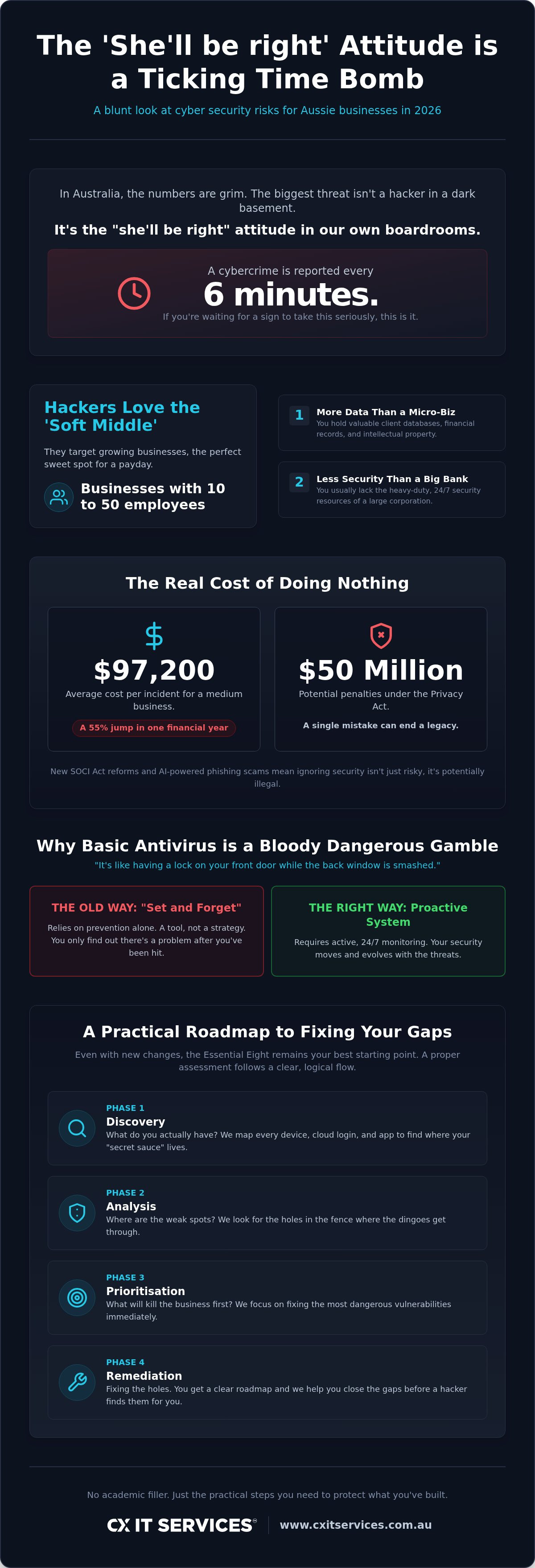
Personally, I reckon the biggest threat to Australian business isn't a hacker in some dark basement. It is the "she'll be right" attitude that lives in our boardrooms and office kitchens. We have a habit of thinking we are too small to be a target. The reality is that in the last financial year, a cybercrime was reported every six minutes in Australia. If you are waiting for a sign to take this seriously, that is it.
Think of a cyber security risk assessment Australia as a digital health check. You wouldn't run a marathon without checking your heart first. You shouldn't run a business without checking your network. Hackers love the "soft middle." These are growing businesses with 10 to 50 employees. You have more data than a micro-biz but usually lack the heavy-duty security of a big bank. It is the perfect sweet spot for a payday.
The evolving threat to your local operations
Ransomware isn't just a headline for the big end of town anymore. In the 2024-25 financial year, the average cost of cybercrime for a medium business jumped 55% to $97,200 per incident. That is enough to wipe out the yearly profit for many local firms. AI has changed the game. It allows criminals to create phishing scams that look and sound exactly like your real suppliers or staff. The "Nigerian Prince" emails are gone. They have been replaced by perfectly written, authentic-looking invoices.
The legal landscape has shifted too. New rules under the SOCI Act that commenced in July 2026 mean risk management is now a direct obligation for more sectors. If you provide services to critical infrastructure, you are now part of the chain. Ignoring your security isn't just risky. It is potentially illegal. With Privacy Act penalties now reaching up to $50 million, a single mistake can end a legacy built over decades.
Why basic antivirus is a bloody dangerous gamble
Antivirus is the bare minimum. It is like having a lock on your front door while the back window is smashed and the side gate is wide open. It is a tool, not a strategy. Old-school IT setups fail today because they rely on prevention alone. Modern threats require active monitoring and a deep understanding of the anatomy of an assessment to find the gaps before someone else does.
I have seen too many businesses rely on a "set and forget" approach. They pay for a subscription and think they are safe. Personally, I reckon that is a recipe for disaster. You need a proactive system that watches your shop 24/7. When a threat evolves, your security needs to move with it. If your IT provider is still just "fixing things when they break," you are already behind the eight ball.
The Essential Eight and the anatomy of an assessment
Personally, I reckon the Essential Eight is still the best starting point for any business. Even with the ASD transitioning to the new "Essentials series" in 2026, these eight pillars remain the most effective way to stop the majority of targeted attacks. We aren't just counting the sheep here. We are looking for the holes in the fence where the dingoes get through. A thorough A practical roadmap for an assessment follows a logical, methodical flow. It moves from discovery to action without getting bogged down in theory.
A proper cyber security risk assessment Australia wide should follow these phases:
- Discovery. What do you actually have?
- Analysis. Where are the weak spots?
- Prioritisation. What will kill the business first?
- Remediation. Fixing the holes.
It is a simple process, but it requires a disciplined eye. You need to be honest about your current setup. If the fence is falling down, there is no point pretending it just needs a coat of paint. We find the gaps so you can close them before a hacker finds them for you.
Mapping your digital assets without the fluff
You can't protect what you don't know you have. We start by identifying exactly where your "secret sauce" lives. This might be your client database, your intellectual property, or your financial records. Many firms think their data is safe just because it is "in the cloud." That is a dangerous assumption to make. If you are already using managed IT support, this discovery process is much faster. We look at every device, every cloud login, and every third-party app. We map out the flow of information to see who has access and why.
Applying the Essential Eight to a real Aussie shop
Once we know what we are protecting, we apply the framework. In 2026, some things are simply non-negotiable. Patching applications must happen within hours, not weeks. Restricting admin privileges is vital because not every staff member needs the keys to the kingdom. Multi-factor authentication (MFA) is the absolute bare minimum for every single login. Finally, your backups must be regular, tested, and stored off-site. If your backups are connected to your main network during a ransomware attack, they will be encrypted along with everything else. That is a mistake you only make once.
If you want to see how your current setup stacks up against these standards, you can apply for a security review with our specialists.
Calculating the real cost of a 'she'll be right' approach
Personally, I reckon most business owners don't realise how close they are to a total wipeout. Calculating the real cost of a data breach is a sobering exercise. It is not just about the money you lose today. It is about whether your firm still exists in twelve months. A cyber security risk assessment Australia wide is the difference between a predictable business expense and a catastrophic, unbudgeted loss.
Reputation takes years to build. It takes minutes to lose. If your clients find out their private medical or financial data is on the dark web, they won't care about your excuses. They will just leave. Compare a fixed monthly fee for managed security to a six-figure ransom demand. One is a manageable cost of doing business. The other is a gun to your head. You don't want to be making financial decisions while a hacker is holding your database hostage.
Direct costs versus the hidden sting
The direct hits are bad enough. You have legal fees, data recovery costs, and those massive government fines. Under current Australian laws, the maximum penalty for serious data breaches is now the greater of $50 million or 30% of your adjusted turnover. That is not a typo. It is a business-ending number. But the hidden sting is what usually kills the operation. It is the cost of your team sitting idle for a week because they can't log in. It is the missed deadlines, the lost contracts, and the staff stress that leads to good people quitting.
Without a solid plan for disaster recovery, your overheads keep running while your revenue hits zero. You are still paying rent and wages, but you aren't billing a cent. That is a gap most local firms simply cannot bridge. We focus on closing that gap before it swallows your profit margin.
Professional assessments versus the DIY disaster
I often hear about people using their "cousin's kid" who knows a bit about computers. Honestly, that is a bloody dangerous gamble. Security in 2026 is a specialised field, not a hobby. It requires an unbiased, expert third-party perspective to see what you are too close to notice. We use our 26 years of experience to spot the tiny cracks that an amateur will miss. We aren't here to judge your current setup or talk down to you. We are here to make sure it works when the dingoes start circling.
An assessment is about clarity. It is about knowing exactly where you stand so you can sleep at night. You shouldn't have to be a tech expert to run a successful practice. You just need a safe pair of hands to watch the gate. Not alone. Together. That is how we handle these risks.
A practical roadmap to fixing your security gaps
Personally, I reckon a report is bloody useless if it just sits in a drawer gathering dust. I have seen it happen too many times. A business pays for a high-end review, gets a 50-page PDF of technical jargon, and then does absolutely nothing because the manager is overwhelmed. That is a waste of your money and my time. A real cyber security risk assessment Australia should be a living checklist for action.
We start by picking off the low hanging fruit. You don't need to rebuild your entire server room on day one. Most of the time, the biggest holes are the easiest to plug. It is about making your business a harder target than the guy next door. If you want to see how this fits into a broader plan, you need a strategy for cyber security management services that actually makes sense for a local shop.
Cleaning up your data and user access
Stop giving every staff member "God mode" access to your systems. I see this in accounting and legal firms all the time. The receptionist doesn't need to see the payroll data. The junior clerk doesn't need delete-access to the main archives. It is called the principle of least privilege. If an account gets hacked, you want the damage contained to a small corner, not the whole building.
While you are at it, delete the old accounts for people who left three years ago. Leaving those active is like leaving a spare key under the mat of a house you no longer live in. Organise your files. Know exactly where the sensitive stuff lives. If you don't know where your data is, you can't protect it. It is that simple.
Training your staff without the corporate yawn-fest
Security is a team sport. It is not just an IT problem. Your staff are your first line of defence, but most corporate training is a total yawn-fest that people click through while eating their lunch. Personally, I reckon you need to make it part of the daily rhythm. You don't need a four-hour seminar. You need short, sharp reminders that actually stick.
Run simple drills. Send a fake phishing email and see who clicks. Don't punish them if they do. Use it as a teaching moment. When security becomes a conversation rather than a lecture, it actually sticks. It is about building a culture where people feel comfortable saying "hey, this email looks a bit dodgy." That one sentence can save you $100,000. It is about being alert, not alarmed.
If you are ready to stop guessing and start securing your firm, book your assessment with our team today.
Partnering with CX IT Services for ongoing protection
Personally, I reckon the best security strategy is one you don't have to think about every single day. You have a business to run. You have clients to see and staff to manage. You didn't get into your profession to spend your weekends worrying about firewall logs or patch management. That is where our "Safe Pair of Hands" philosophy comes in. We take the burden off your shoulders. We handle the technical heavy lifting so you can get back to what you actually enjoy doing.
A cyber security risk assessment Australia is just the start. It is a snapshot in time. But the digital world moves fast. A hole that was plugged today might be ripped open by a new exploit tomorrow. That is why we focus on building a partnership that lasts longer than a single report. We are awake when you are not. Our 24/7 monitoring means we are watching the gate while you are sleeping. If something goes wrong at 3 AM on a Sunday, we are already on it before you even open your laptop on Monday morning.
From assessment to active managed security
A one-off audit is like a single trip to the gym. It is a good start, but it won't keep you fit forever. Real protection requires ongoing maintenance. We move you from that initial assessment into active cyber security services that evolve with the threat landscape. Our fixed monthly fee model means your security spending is predictable. There are no nasty surprises or "emergency" invoices when things get hairy. You get high-end protection for a transparent, manageable cost. It is about stability. It is about growth.
The CX IT Services difference: Aussie owned and direct
We are Australian owned and operated. We have been doing this for 26 years. When you call us, you aren't put through to an offshore call centre or a generic ticket queue. You get direct access to technicians who know your name and understand your business. We don't do corporate fluff. We don't hide behind polished jargon. We give you blunt, honest advice and practical solutions that work. You deal with experts who have seen every challenge in the book and know how to fix them fast.
If you are tired of IT providers who talk in circles, let's have a no-nonsense chat. We can look at your current setup and show you exactly where the gaps are. No pressure. No sales pitch. Just a clear path forward for your business. Not alone. Together. Book your initial security consultation here and let's get your shop sorted.
Securing your firm's future today
Personally, I reckon you now have the tools to stop being a sitting duck. We have covered why the old "she'll be right" attitude is a death sentence for local firms in 2026. You know that a cyber security risk assessment Australia is the only way to find the holes in your fence before the dingoes do. It is about moving from a one-off audit to a practical, living roadmap that protects your reputation and your profit margins.
You don't have to navigate this shifting landscape alone. We bring 26 years of Australian IT experience to the table. Our team provides a safe pair of hands with fixed-fee managed security and 24/7 national support. This means we are watching the gate while you focus on running your business. Stop guessing and start securing your legacy. It is time to get your shop sorted once and for all.
Book a no-nonsense security chat with the CX IT team
I am here to help you build a more stable, secure future for your practice. Let's get to work.
Frequently Asked Questions
What is a cyber security risk assessment and do I really need one?
A cyber security risk assessment Australia wide is essentially a digital health check for your business. It is designed to find the holes in your fence before a hacker does. Personally, I reckon every firm with ten or more staff needs one to survive. You need it to identify where your sensitive data lives and ensure you are meeting current Australian standards. It is about moving from "she'll be right" to a documented plan.
How much does a professional cyber security assessment cost in Australia?
Costs for a professional assessment vary depending on the size of your firm and the complexity of your network. We don't provide a one-size-fits-all price because every Aussie shop is different. Instead of looking at it as a sunk cost, I suggest viewing it as a predictable business expense. It is a tiny fraction of the $97,200 average cost that medium businesses face after a single cyber incident in 2026.
How long does the assessment process usually take for an SME?
For most small to medium enterprises, the initial discovery phase usually takes a few days. The full analysis and reporting process might stretch to a couple of weeks depending on how many cloud apps and remote devices you have. We focus on being methodical and fast because we know you are time-poor. You get a clear roadmap without the process dragging on for months or disrupting your daily operations and billable hours.
What is the Essential Eight and why does the government keep mentioning it?
The Essential Eight is a set of strategies developed by the Australian Signals Directorate to protect against cyber threats. While the ASD is transitioning to a new "Essentials series" in 2026, these eight pillars remain the benchmark for local security. The government mentions it because it works. It covers the basics like patching and multi-factor authentication. If you haven't ticked these boxes, you are leaving the front door wide open for dingoes.
Can my in-house IT manager handle the risk assessment themselves?
Your in-house manager knows your systems well, but personally, I reckon a third-party audit is vital. It is hard to grade your own homework without being biased. An external expert brings a fresh set of eyes and 26 years of experience to spot the cracks your team might have grown used to. We work alongside your internal staff to strengthen the business. It is about having a safe pair of hands.
What happens if the assessment finds a massive hole in our security?
If we find a massive hole, we don't panic. We prioritise the fix immediately. An assessment is about finding the "low hanging fruit" that offers the most protection for the least effort. We provide a clear, prioritised roadmap so you know exactly what needs fixing today and what can wait until next month. It is about taking control of the situation rather than letting a vulnerability sit there like a ticking time bomb.
How often should an Australian business conduct a new risk assessment?
I recommend conducting a new cyber security risk assessment Australia wide at least once a year. You should also run one whenever you make a major change, such as moving to a new office or switching to a new cloud provider. Threats evolve daily, and your security needs to move with them. Regular checks ensure your protection stays ahead of the criminals and keeps you compliant with the latest 2026 Australian regulations.





 Microsoft Partner