
Buying a cyber security assessment Australia firms can trust? Compare scopes, spot useless reports, and turn findings into practical action. Read the guide.
A security assessment is only useful if someone can act on its findings. For a cyber security assessment Australia businesses can use, start by asking whether the results will explain what matters, who should address it and what to tackle first. A long list of weaknesses is no help if it doesn’t point to practical action.
It’s reasonable to want a clear picture of risk across your systems, staff practices and cloud services. The challenge is that a risk assessment, vulnerability assessment and penetration test answer different questions, and providers don’t all use the same scope. You could pay for work that doesn’t address the decision your business needs to make.
This guide explains what an assessment can cover and how to compare providers by scope, evidence and reporting. You’ll also learn what to look for in the findings, so you can prioritise risks and turn them into realistic next steps with an owner, rather than filing the report away.
Key Takeaways
- Set the assessment scope around the people, processes, systems and cloud services you need to understand. Don’t assume every review covers everything.
- Choose between a risk assessment, vulnerability assessment or penetration test based on the decision you need the work to inform.
- Compare cyber security assessment Australia providers by scope, methods, evidence, exclusions and how clearly they explain findings to decision-makers.
- Prepare by agreeing the business question, confirming who needs to be involved and gathering relevant evidence before work begins.
- Turn each finding into a prioritised next action with an owner and review point, so the report leads to practical improvements.
What does a cyber security assessment in Australia actually cover?
Start by identifying the decision your business needs to make. A cyber security assessment Australia businesses commission should be a scoped review of security risks, controls and evidence. It is not a promise that the business is safe from every attack.
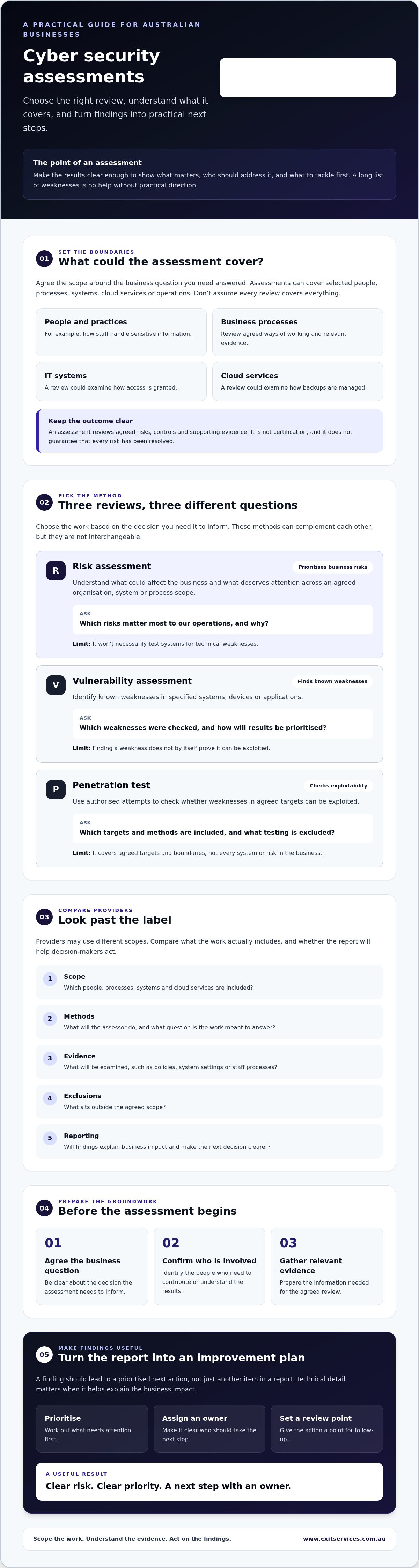
A cyber security assessment is a review of agreed business risks, security controls and supporting evidence, designed to help decision-makers understand what needs attention. It is not a certification or a pass or fail guarantee of security.
The scope might cover staff practices, business processes, IT systems, cloud services or selected operations. For example, a review could examine how access is granted, how backups are managed or how staff handle sensitive information. These are possible areas, not a standard checklist used by every provider. The information security audit concept offers useful background on examining security controls and activities, but your assessment still needs a clear, agreed scope.
Set the scope according to what matters to your operations, which controls you already have and what leadership needs to know. A broad review may sound thorough, but if it doesn’t answer a real business question, it can produce plenty of detail without giving you direction.
What questions should an assessment answer?
Begin with the essentials: which information and systems are critical to keeping the business running, and what could disrupt them? Then clarify what evidence will be examined and how the assessor will judge whether existing controls appear effective, unclear or in need of review.
The findings should help decision-makers choose what to investigate or improve next. Technical detail matters when it explains the business impact. It shouldn’t obscure it. A useful result makes the next decision clearer.
Assessment, health check or certification: what’s the difference?
A self-check or health check can help you identify questions to explore and find relevant guidance. It’s a starting point. A scoped assessment goes further by examining agreed evidence, such as relevant policies, system settings or staff processes. Ask the provider exactly what they’ll review and what sits outside the scope.
An assessment doesn’t automatically award certification or prove every risk has been resolved. Certification involves a defined standard and a separate certification process. Keep those outcomes distinct when comparing proposals.
Once findings are delivered, the work shifts to decisions and follow-through. Ongoing cyber security management can help provide context as you implement improvements over time. CX IT Services outlines its cyber security services. Confirm directly whether a specific assessment is available before treating it as part of the scope.
Risk assessment, vulnerability assessment or penetration test: which do you need?
These methods answer different questions. A risk assessment helps you understand what could affect the business and what deserves attention. A vulnerability assessment looks for known weaknesses in specified systems. A penetration test uses authorised attempts to find out whether weaknesses can be exploited. The methods can complement each other, but they aren’t interchangeable.
Here’s the practical distinction:
| Approach | Purpose and typical focus | Useful buyer question | Limit |
|---|---|---|---|
| Risk assessment | Understand and prioritise cyber risks across an agreed organisation, system or process scope. | Which risks matter most to our operations, and why? | It won’t necessarily test systems for technical weaknesses. |
| Vulnerability assessment | Identify known weaknesses in specified systems, devices or applications. | Which weaknesses were checked, and how will results be prioritised? | Finding a weakness doesn’t by itself prove it can be exploited. |
| Penetration test | Make authorised attempts to validate whether weaknesses in agreed targets can be exploited. | Which targets and methods are included, and what testing is excluded? | It covers agreed targets and boundaries, not every system or risk in the business. |
Put simply, a risk assessment prioritises business risks, a vulnerability assessment searches for known weaknesses, and a penetration test checks whether selected weaknesses can be exploited. Choose the method that answers the decision your Australian business needs to make. The Australian Cyber Security Centre’s Australian government's mitigation strategies include guidance such as the Essential Eight. Ask whether that guidance fits your scope instead of assuming every assessment uses it as a benchmark.
When is a cyber security risk assessment the better starting point?
Choose this approach when leadership needs a wider view of business risks, existing controls and priorities. The scope can focus on selected systems or processes rather than the entire organisation. Before agreeing, ask what evidence the provider will review, how they’ll form conclusions and what sits outside scope. This helps you avoid paying for technical detail that doesn’t answer the business question.
When should a business consider vulnerability assessment or penetration testing?
Consider technical testing when you need to understand weaknesses in specified systems or applications. Before a penetration test, get written authorisation and agree the targets, testing boundaries and how unexpected findings will be handled. Ask what happens if testing affects a live system and who will be notified. A short test window does not show that systems outside the agreed targets are secure.
If you’re weighing up which approach fits your business, you can apply to discuss your needs. Confirm directly what assessment work is available before assuming a particular test is included.
How to compare cyber security assessment providers in Australia
Compare the proposal before weighing up the sales pitch. A cyber security assessment Australia businesses can act on needs a clear scope, a suitable method and findings that make sense to IT staff and business leaders alike.
Check each proposal against the same points:
- Business scope: Which systems, users, locations, suppliers and operations are included? What’s excluded?
- Assessment method: What work will the provider actually perform, and why does it fit the question you need answered?
- Evidence sources: Will they examine documents, system settings, interviews or other agreed evidence? Ask how each finding is supported by evidence.
- People and independence: Who conducts the work? If the provider also supports your IT, ask how they’ll handle independence and disclose any relevant relationship.
- Reporting and involvement: Who from your business needs to contribute, and how will the provider explain technical findings to non-specialists?
Don’t settle for a proposal that says it will review “your IT environment” without defining what that means. A broad phrase can hide a narrow scope. Ask the provider to name the systems and business areas they’ll examine, along with the limits of the work.
Questions to ask before approving an assessment
Get practical details in writing. Ask how the provider plans to minimise disruption and how they’ll contact you if they find an urgent issue. Confirm who owns the final report, who can access it and how sensitive information will be handled. These are ordinary parts of agreeing what the work involves.
Clarify who needs to be available from your business, too. If the assessor needs input from IT, operations or leadership, find out when and why. This helps avoid a last-minute scramble to find the person who understands how a critical system works.
What makes an assessment report useful to a business?
A useful report gives each material finding a clear evidence trail, a plain-language explanation of potential impact and any relevant limitations. It should distinguish what the assessor observed from what they inferred. If a conclusion depends on information they couldn’t verify, that should be stated.
Look for recommendations that explain relative priority and practical next steps, not promises that following them will remove every risk. Ask whether the provider will discuss the findings with both technical staff and business leaders. The report should help both groups understand what needs attention.
If you’re also considering ongoing support to implement improvements, CX IT Services outlines its cyber security services. Confirm directly what support fits your needs, and don’t assume a particular assessment or testing service is included.
How to prepare for a cyber security assessment without creating chaos
Set the business question before staff start chasing files or arranging access. A cyber security assessment Australia businesses can use should fit around their work, not create a second job for staff.
Use this sequence to get organised:
- Define the decision. Write down what leadership needs to understand or decide after the assessment.
- Agree the scope. List the business processes and key systems involved, then record what’s explicitly out of scope.
- Nominate a business owner. Choose someone who can connect leadership priorities with IT and operational staff, coordinate approvals and resolve questions.
- Gather agreed evidence. Ask the provider for its evidence requests. What’s needed depends on the scope, so don’t assume every business needs to produce the same documents.
- Confirm timing and communications. Agree access arrangements, key contacts, check-in points and how urgent issues will be raised.
Set the scope and business priorities first
Make a short list of the processes the business relies on, the systems that support them and the risks leadership wants clarified. Note known constraints, dependencies and planned changes, such as a system upgrade or a major operational change. These details can affect what the provider reviews and when.
Be clear about exclusions before access or testing begins. If a supplier’s system, a particular application or a business process isn’t included, record that. It’s better to be explicit than to discover later that everyone had a different idea of what “the assessment” covered.
Coordinate people, access and communications
Your nominated contact should know who can approve access, answer evidence requests and escalate concerns. Agree the communication channels with the provider before work starts, including who should be contacted if an unexpected issue comes up.
Give relevant staff a simple heads-up about what to expect and who may contact them. Keep it proportionate. There’s no need to circulate sensitive technical details to people who don’t need them.
Implementing recommendations may require broader planning and ongoing support, not just a one-off review. CX IT Services outlines its cyber security services as part of that wider context. To discuss your business needs, apply to speak with CX IT Services.
Turn assessment findings into a practical cyber security improvement plan
A report only earns its keep if someone acts on it. For each finding from a cyber security assessment in Australia, record who owns it, the next action, why it has that priority and when the business will review progress. This turns technical observations into work people can track.
Not every finding needs the same response. Separate issues that may expose the business to immediate harm from foundational control gaps and longer-term improvements. Set timing according to the finding, business impact, available resources and dependencies. There’s no universal deadline that suits every organisation, so agree a realistic review point rather than choosing dates without a reason.
Prioritise findings against business impact
Ask what could happen if an issue remains unresolved. Could it disrupt a core service, expose sensitive information or affect systems other teams rely on? A technical weakness in a system that supports essential operations may deserve attention ahead of a less consequential issue.
Ask the assessor to explain the evidence behind each priority and where uncertainty remains. A finding based on direct evidence may call for a different response from one that needs further investigation. Don’t treat every item as equally urgent, and don’t assume a checklist or completed action removes all cyber risk.
Choose support for the work that follows
Some actions may sit with your own IT team. Others may need your existing IT provider or a specialist with the right capability. Make the hand-off explicit: name the person responsible, agree what they’ll do and set a point to check whether the change worked. If an action depends on a supplier or business owner, involve them rather than letting it drift between teams.
Managed IT support may help maintain systems and coordinate agreed improvements as part of ongoing operational work. CX IT Services provides managed IT and cyber security services, which may be relevant for businesses planning follow-through after an assessment. Its managed IT support information outlines that service area. Confirm directly whether the support fits the specific actions your business needs to take.
If your business has ten or more employees and you’re considering ongoing IT or cyber security support, you can apply to discuss your requirements. That’s a conversation about your needs, not a promise of a particular assessment or testing service.
Make the findings your next practical step
A useful cyber security assessment Australia business leaders can rely on starts with a clear scope and ends with decisions people own. Choose the assessment method that answers your business question. Check the provider’s evidence, exclusions and reporting before you approve the work.
Then make the findings useful. Give each action an owner, a reason for its priority and a review point. Separate urgent exposure from foundational gaps and longer-term improvements. The report isn’t the finish line. It helps you decide what happens next.
If you need help with the ongoing IT and cyber security work that may follow, CX IT Services is Australian-owned and operated, with more than 26 years of industry experience. The business describes 24/7 support and on-site technicians across Australia, and its managed IT services are designed for businesses with ten or more employees. This doesn’t mean a specific assessment service is included, so discuss your requirements directly.
Apply to discuss your business IT and cyber security needs. A clear next step is a good place to start.
Frequently Asked Questions
What is included in a cyber security assessment in Australia?
A cyber security assessment usually examines an agreed scope of business risks, systems, processes and security controls. The work depends on what your organisation needs to understand and the provider’s method. If you’re searching for “cyber security assessment Australia”, focus on the scope before comparing proposals. Ask which systems and evidence are included, what’s excluded and what the report will cover. Don’t assume one review covers every supplier, technology or risk.
Is a cyber security assessment the same as penetration testing?
No. A cyber security assessment is a broad review of risks and controls within an agreed scope. Penetration testing is a specific type of authorised technical testing that attempts to verify whether selected weaknesses can be exploited. A business might need one approach or both. Ask the provider what question its proposed method will answer, which systems it will cover and what will remain untested.
How often should a business have a cyber security assessment?
There’s no single review interval that suits every organisation. Consider reassessing when business operations, systems or suppliers change, or when previous findings need follow-up. Ask the provider which changes should trigger another review and how to track open actions in the meantime. A past assessment describes an agreed scope at a point in time. It doesn’t prove systems remain secure after changes or that new risks haven’t emerged.
Can a small business benefit from a cyber security assessment?
Yes, if the assessment answers a genuine business question and the business can follow up on the findings. A smaller organisation can focus on its most important systems, processes or risks instead of commissioning a broad review it may not need. Agree the boundaries and reporting expectations upfront. Nominate someone to own the next steps, too. A concise assessment with useful actions can be more practical than a long report no one has time to use.
How much does a cyber security assessment cost in Australia?
The cost depends on the agreed scope, systems involved, assessment method, evidence required and provider effort. There isn’t one reliable figure without those details. Request a written proposal that spells out inclusions, exclusions, assumptions and any circumstances that could lead to additional work. Compare the actual work and deliverables across proposals, not just the headline fee. If the scope is unclear, ask for clarification before deciding what represents value.
What happens if an assessment finds serious security weaknesses?
Ask the provider to explain the evidence, possible business impact, limitations and recommended next actions. Confirm how urgent findings will be raised and who in your organisation should make decisions about them. Assign an owner to each action, agree its priority and track progress to a review point. The assessment can identify issues within its agreed scope, but it won’t fix them automatically or confirm that no other weaknesses exist.
Does a cyber security assessment guarantee that a business is secure?
No. An assessment provides information about an agreed scope at a particular point in time. It can’t guarantee that every risk has been found or removed, especially if some systems or suppliers weren’t included. Treat the findings as one input to ongoing risk management. Before approving the work, ask the provider to state its assumptions and limitations, and explain what business changes might prompt another review.





 Microsoft Partner