Straight talk on co-managed IT services pricing Australia for 2026. No hidden fees, no jargon. Just clear costs so your IT team can finally breathe.
Your internal IT manager is currently flat out like a lizard drinking, and the last thing they need is another complex project they don't have the hours to finish. It's a stressful position to be in. You want to support your team and secure your network, but the fear of being locked into a rigid contract with hidden fees often keeps you hitting the brakes. I know you've likely seen budget blowouts before, and you're tired of the corporate jargon that masks the true cost of support.
I believe you deserve predictable monthly spending and a partner who backs your internal team instead of trying to replace them. This guide provides the straight talk you need regarding co-managed IT services pricing Australia for the 2026 landscape. We've stripped away the fluff to give you a clear, honest breakdown of what it actually costs to keep your systems stable and your staff productive.
In the following sections, I'll explain how the fixed monthly fee model works, which hidden costs to watch out for, and how to structure an agreement that finally lets your IT manager take a real holiday. We'll look at the specific variables that drive investment, from licensing to security oversight, so you can make an informed decision for your business.
Key Takeaways
- Discover how co-managed IT empowers your internal team by offloading repetitive tasks so they can focus on high-level strategy.
- Get a clear breakdown of co-managed IT services pricing Australia to help you identify the most cost-effective model for your specific headcount.
- Learn to spot the hidden "out of scope" fees that often lurk behind low-cost quotes and threaten your monthly budget.
- Understand the critical role of cybersecurity in modern pricing and why it is now a non-negotiable part of a stable network.
- See why a fixed-fee structure is the most reliable way to ensure your IT manager can finally take a holiday without the system crashing.
What is Co-Managed IT and Why Does the Price Vary?
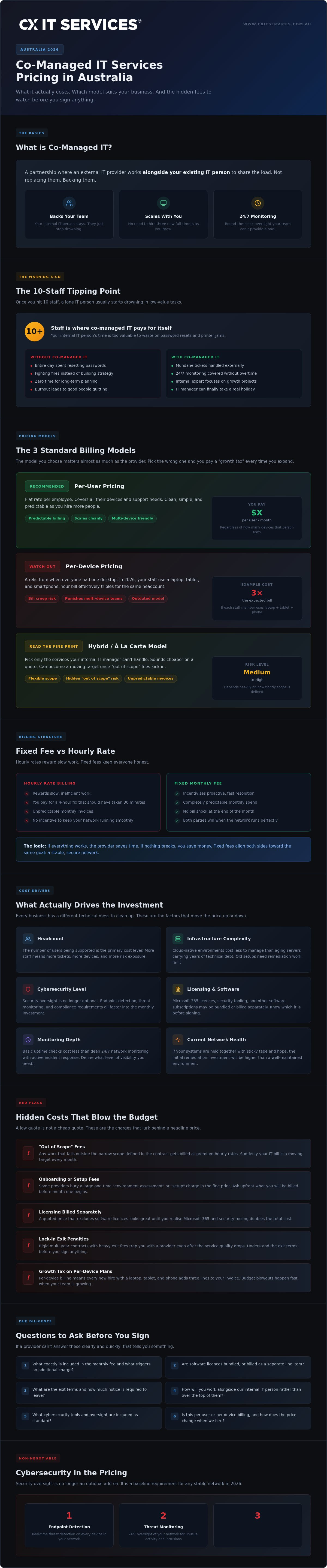
Co-managed IT is exactly what it sounds like: a partnership where we work alongside your existing IT person to share the load. It isn't about replacing your staff or making them redundant. It's about giving them the backup they need to actually do their jobs. Personally, I reckon it's the smartest way to scale your operations without the crushing overhead of building a massive internal department from scratch. You get the benefit of local expertise and high-end tools, often delivered through an AI platform for managed service providers, without having to hire three new full-time employees.
Understanding co-managed IT services pricing Australia requires looking at the specific needs of your network. Pricing varies because every business has a different technical mess to clean up. Some companies have pristine, cloud-native environments, while others are struggling with aging servers and years of technical debt. We price based on the level of oversight and remediation required to make your network stable and secure. If your systems are currently held together with sticky tape and hope, the initial investment to reach a baseline of security will be higher than a modern, well-maintained setup.
The 10-Staff Tipping Point
Once your business hits the 10-staff mark, your lone IT person usually starts drowning. They spend their entire day resetting passwords, fixing printer jams, and fighting fires. This leaves zero time for strategic work like AI automation or long-term infrastructure planning. This is where the value of co-managed IT kicks in. We take over the mundane tickets and the 24/7 monitoring, freeing your internal expert to focus on projects that actually grow the business. It stops the burnout that leads to good people quitting.
Why a Fixed Fee Beats Hourly Rates
Hourly rates are a trap that rewards slow work and inefficiency. If a provider takes four hours to fix a problem they should have solved in thirty minutes, you're the one who pays the price. I prefer a fixed monthly fee model because it keeps everyone honest and focused on the result. You get predictable spending, and we are incentivised to keep your network running perfectly. If everything works, we both win. This transparency is a core part of how we approach co-managed IT services pricing Australia, ensuring there are no nasty surprises or "bill shock" when the invoice arrives at the end of the month.
Breaking Down the Standard Pricing Models in Australia
Most Aussie providers use one of three main ways to bill you. In my experience, the model you choose matters almost as much as the provider itself. It dictates how your costs will scale as you hire more people or adopt new technology. If you pick the wrong structure, you might find yourself paying a "growth tax" every time you expand your team. Here is how the common models stack up in the real world.
Per-User vs Per-Device Pricing
Per-user pricing is usually the cleanest for growing teams. It is simple; you pay a flat rate per employee, and that covers their support regardless of how many gadgets they use. This makes your monthly bill incredibly predictable as you hire more people. You know that adding a new staff member costs exactly "X" amount, which makes budgeting for new hires a breeze.
On the other hand, I have seen many businesses get burnt by per-device pricing. This model is a relic of the era when everyone had a single desktop computer. In 2026, your staff likely use a laptop, a tablet, and a smartphone. If you are paying per device, your bill effectively triples for the same headcount. It creates a frustrating situation where you might hesitate to give your team the tools they need because you are worried about the extra device fees. We prefer the per-user model because it removes that friction and keeps the focus on supporting your people.
The Hybrid or "A La Carte" Model
This is where you pick only the specific services your internal IT manager cannot handle alone. It is common for businesses to outsource 24/7 monitoring or heavy cybersecurity while keeping day-to-day helpdesk tasks in-house. It allows you to fill specific gaps in your internal expert's skillset without paying for a full-service suite.
While this can look cheaper on a quote, you have to watch out for the "extra" charges. Many providers use a narrow scope to keep the headline price low, then hit you with "out of scope" fees for every small request that falls outside that tiny window. It turns your IT bill into a moving target. If you want to see if your current setup is actually cost-effective, you can apply for a review of your current infrastructure. When evaluating co-managed IT services pricing Australia, always ask for a "total cost of ownership" view. Don't just look at the base fee; look at what happens when you add five staff or need an emergency disaster recovery response.
The Real Cost Drivers: What You Are Actually Paying For
When evaluating co-managed IT services pricing Australia, it's easy to assume you're just paying for a bloke to answer the phone when things go pear-shaped. That's a common misconception. In 2026, the helpdesk is actually the smallest part of the value proposition. You're primarily investing in a suite of sophisticated tools, enterprise-grade security, and the expertise required to manage them. This level of oversight, provided by veteran firms like Uptime Co., ensures your network administration is handled with the benefit of over 30 years of experience. Licensing costs from vendors like Microsoft are a significant factor. While these are largely out of a provider's control, how they are managed and optimised can save your business thousands over the long run.
Cyber Security and Compliance
Cybersecurity is the biggest chunk of the bill these days, and for good reason. Basic antivirus software simply doesn't cut it anymore against modern threats. You are paying for proactive, 24/7 monitoring and rapid threat response. This involves advanced tooling like Endpoint Detection and Response (EDR) that your internal IT person likely doesn't have the time to manage alone. For a comprehensive look at what's included in a modern defence strategy, you can view our cyber security services. This layer of protection is what keeps your business compliant and your data safe from increasingly frequent ransomware attacks.
AI and Automation Integration
If your provider isn't talking about AI, they are living in the past. In 2026, automation is the primary driver for keeping long-term costs down. Setting up AI tools properly takes significant expertise, but the payoff is huge. It allows for self-healing systems that fix minor issues before they even reach your internal IT manager's desk. We use AI automation to save hours of manual labour. This efficiency allows us to keep our fixed fees stable even as your environment grows more complex. It's not just about flashy tech; it's about making your network more resilient and less dependent on manual intervention.
The "On-Site" Factor
Remote support is highly efficient, but sometimes you need a tech on the ground. Whether it's a hardware failure or a complex network overhaul, having access to physical assistance is vital. National coverage costs more because of the logistics involved, but it saves your bacon when a critical piece of kit fails in a branch office. Our on-site support capabilities ensure that your team isn't left stranded when a problem can't be solved over a screen share. This physical presence is a key component of a reliable co-managed partnership that provides true peace of mind for your internal IT staff.
Avoiding the "Cheap Quote" Trap: How to Compare Providers
If a quote looks too good to be true, it probably is. I have seen too many Australian businesses get lured in by a low headline figure, only to realise they have signed up with a vendor rather than a partner. In the world of co-managed IT services pricing Australia, the cheapest option usually ends up being the most expensive after you factor in the friction and the constant stream of extras. You want a team that feels like an extension of your own, not a faceless ticketing system that nickel-and-dimes you for every interaction. A true partner focuses on your uptime, while a vendor focuses on their billable hours.
The "cheap quote" strategy is a classic move by providers who plan to recoup their margins through "out of scope" fees. They give you a bare-bones price that covers almost nothing, then hit you with an invoice every time your internal IT manager asks a question. This creates a combative relationship where you are afraid to call for help because of the cost. You should also ask who actually answers the phone when things go wrong. If your "local" support is actually a low-cost call centre overseas, your internal team will spend more time explaining the problem than fixing it. High-quality support requires people who understand the Australian business landscape and your specific regulatory requirements.
The Hidden Costs to Watch Out For
On-boarding fees are the first hurdle. Some providers charge a fortune just to set up their software on your machines, often hiding this in the fine print. You should also look for charges related to simple, everyday tasks. I have seen contracts where adding a new user or resetting a complex permission costs a flat fee on top of the monthly sub. Another common trap is travel time. If you need someone on-site, check if you are being billed for the time they spend sitting in traffic on the Monash or the M1. These micro-fees blow your budget every month and make it impossible to plan your IT spend with any certainty.
Questions That Put Salespeople on the Spot
To avoid these traps, you need to ask the hard questions before signing anything. Start by asking, "What exactly is NOT included in this monthly fee?" If they cannot give you a definitive list of exclusions, they are likely leaving the door open for extra charges later. You should also ask how they support your internal IT manager when they finally take a holiday. A good co-managed partner should be able to step in and provide full cover, ensuring the business doesn't grind to a halt just because one person is at the beach. Finally, confirm if they are truly Australian owned and based. This affects everything from data sovereignty to the speed of on-site response. If you want a transparent breakdown of what a fair agreement looks like, apply for a tailored quote that covers your specific needs without the hidden BS.
Fixed-Fee Co-Managed IT: Backing Your Team Without the BS
We do things a bit differently at CX IT Services. We've seen how the traditional models can leave businesses feeling frustrated and internal IT managers feeling burnt out. We reckon a fixed monthly fee is the only way to play it fair. It removes the conflict of interest inherent in hourly billing and ensures that our goals are perfectly aligned with yours. When your network is stable and secure, we both win. There is no corporate fluff here; just solid, reliable support that acts as a safety net for your team.
Our approach to co-managed IT services pricing Australia is built on the principle of partnership. We handle the "boring" stuff like 24/7 monitoring, patch management, and routine security oversight. This frees up your internal IT manager to focus on the high-value projects they were actually hired for. Instead of spending their days resetting passwords or fighting fires, they can focus on innovation and efficiency. We provide the tools and the extra hands required to make them a legend within your organisation. It's about backing your people, not replacing them.
Strategic Guidance from a Virtual CIO
We don't just fix PCs and servers. We help you look at the bigger picture to ensure your technology is actually driving your business forward. Our vCIO and IT strategy service is designed to help you plan for the next three years. We look at your goals and align your tech stack to meet them. It is about making sure your technology helps you make money, rather than just being a black hole for your monthly budget. We provide the high-level oversight that a lone IT manager often doesn't have the time to maintain while they are stuck in the day-to-day weeds.
Ready to Stop Guessing Your IT Budget?
If you have more than 10 staff, it is time for a proper chat about how to stabilise your IT spend. You shouldn't have to guess what your invoice will look like at the end of the month. We offer a transparent, fixed-fee structure that provides total peace of mind for both the business owner and the internal IT team. We don't do high-pressure sales or complex jargon. We just provide a clear look at what you need to keep your network secure and your staff productive. If you are ready for a more predictable way to manage your technology, apply for a strategy session with us today. Let's get your IT manager that holiday they've been waiting for.
Take Control of Your IT Budget and Strategy
Understanding the variables of co-managed IT services pricing Australia doesn't have to be a source of stress for your business. I've shown you how a fixed monthly fee model eliminates "bill shock" and keeps your focus on growth rather than constant troubleshooting. By choosing a partner that prioritises transparency, you avoid the "cheap quote" trap and ensure your internal IT manager has the backing they need to be truly effective. It's about moving away from reactive fire-fighting and towards a stable, predictable environment.
As an Australian owned and operated business with 26 years of industry experience, we understand the local market and the pressure your team faces. We provide a fixed monthly fee with no surprises, allowing you to plan your finances with absolute confidence. This partnership ensures your network remains secure while your internal IT person finally gets the breathing room they deserve. When the "boring" tasks are automated and monitored 24/7, your team is free to focus on the strategic projects that drive your business forward.
If you're ready to stop the budget blowouts and start building a more resilient business, let's have a straight-talk conversation about your needs. See if your team is a fit for our co-managed support. I look forward to helping you turn your technology into a genuine competitive advantage.
Frequently Asked Questions
What is the average cost of co-managed IT in Australia for 2026?
The cost is determined by your headcount and the complexity of your current infrastructure. Most providers calculate a fee based on the number of users we are supporting alongside your internal team. This ensures the investment scales logically as your business grows. While we avoid generic figures, a fixed monthly fee model is the standard for businesses seeking predictable co-managed IT services pricing Australia. It removes the uncertainty of hourly billing.
Does co-managed IT mean I have to fire my internal IT person?
No, co-managed IT is specifically designed to support and empower your existing IT staff. It isn't a replacement strategy. Instead, it's a partnership where we take over the repetitive maintenance and 24/7 monitoring. This allows your internal expert to focus on high-level projects that drive revenue. We act as a safety net, ensuring they don't burn out from being flat out like a lizard drinking every single day.
How does co-managed IT pricing differ from fully managed services?
Co-managed pricing is generally more targeted because we aren't handling every single aspect of your environment. In a fully managed model, the provider is responsible for everything from helpdesk to strategy. With a co-managed approach, the fee reflects the specific gaps we are filling for your internal team. You aren't paying for services your internal person is already handling effectively, which results in a more efficient use of your budget.
Are there extra costs for 24/7 support?
This depends entirely on your provider's specific service agreement. Some companies treat after-hours care as an out of scope extra with high hourly rates. At CX IT Services, we believe in a fixed monthly fee that includes 24/7 support availability to keep your network stable at all times. You should always check if weekend or late-night assistance is bundled into the base price or if it will trigger a surprise invoice later.
How do Microsoft 365 price increases affect my co-managed IT bill?
Vendor licensing costs, such as Microsoft 365, are separate from the service fees paid to your IT partner. These prices are set globally and can change based on vendor policy or currency fluctuations. While we manage and optimise these licences for you, any direct increase from Microsoft will be reflected in your total spend. We focus on ensuring you only pay for the licences your team actually uses to minimise waste.
Can I get co-managed IT on a month-to-month contract?
While some providers offer month-to-month terms, most professional partnerships involve a longer commitment to ensure stability. Setting up the necessary tools, security protocols, and automation takes time and initial investment. A longer-term agreement usually allows for a more competitive fixed monthly fee. It also ensures that we can provide the deep, strategic oversight required to protect your network effectively over the long run without constant disruption.
What happens if we need on-site support in a remote location?
Remote support handles the vast majority of issues, but physical hardware failures sometimes require a tech on the ground. If your business has offices in remote areas, you should confirm your provider's national coverage capabilities. There may be additional travel fees or lead times involved for locations outside major metropolitan centres. We coordinate with local resources or dispatch our own team to ensure your remote staff aren't left stranded during a crisis.
Is cybersecurity always included in the base price?
You should never assume cybersecurity is a standard inclusion in every quote. Some providers offer a lite version of support that only covers basic maintenance, leaving advanced security as a paid add-on. Given the threat landscape in 2026, we consider cybersecurity a non-negotiable component of co-managed IT services pricing Australia. Always verify that your quote includes proactive threat hunting and 24/7 monitoring rather than just a simple antivirus program.