Tired of dodgy IT support? This no-BS guide shows you what to look for in a managed IT service provider to get fixed fees and a partner who actually cares.
Personally, I reckon most IT providers are world-class at selling you a dream but bloody hopeless at answering the phone when your server goes bang. You are probably tired of monthly IT bills that look like a lucky dip. One month it is fine. The next you are being slugged with "out of scope" fees. Knowing exactly what to look for in a managed IT service provider is the only way to stop this cycle and regain control of your budget.
You have likely outgrown your current "IT guy" and need a safe pair of hands that actually owns the result. This is the no-BS 2026 guide to finding that partner. I am going to show you how to cut through the corporate fluff and find an IT partner that actually protects your business. No more guessing games and no more slow response times from support.
We will cover how to secure a fixed monthly cost that stays predictable. I will also explain how to move beyond reactive support and start using AI and automation to drive real growth in your firm. It is time for a secure, stable network that simply works. Let's get to work.
Key Takeaways
- Spot the signs that your business has outgrown the DIY IT approach. This usually happens once you hit the 10-staff tipping point and things start to crumble.
- Discover what to look for in a managed IT service provider to avoid the billable hour trap. Fixed fees mean your provider only wins when your tech works.
- Ensure your data is actually protected by checking for alignment with the Essential Eight framework. Security is no longer an optional extra for Australian firms.
- Transform IT from a cost centre into a growth driver. A proper partner provides strategic roadmaps and Virtual CIO advice to help you scale.
- Master the transition process to ensure switching is painless. A professional handover should be completely invisible to your clients and your team.
Knowing when your business has outgrown the DIY IT approach
Personally I reckon there is a specific moment when your IT stops being a tool and starts being a handbrake. It usually happens quietly. You don't notice it until a staff member spends three hours trying to fix a "simple" printer issue instead of billing a client. Knowing what to look for in a managed IT service provider starts with admitting that your current setup is held together with sticky tape and hope.
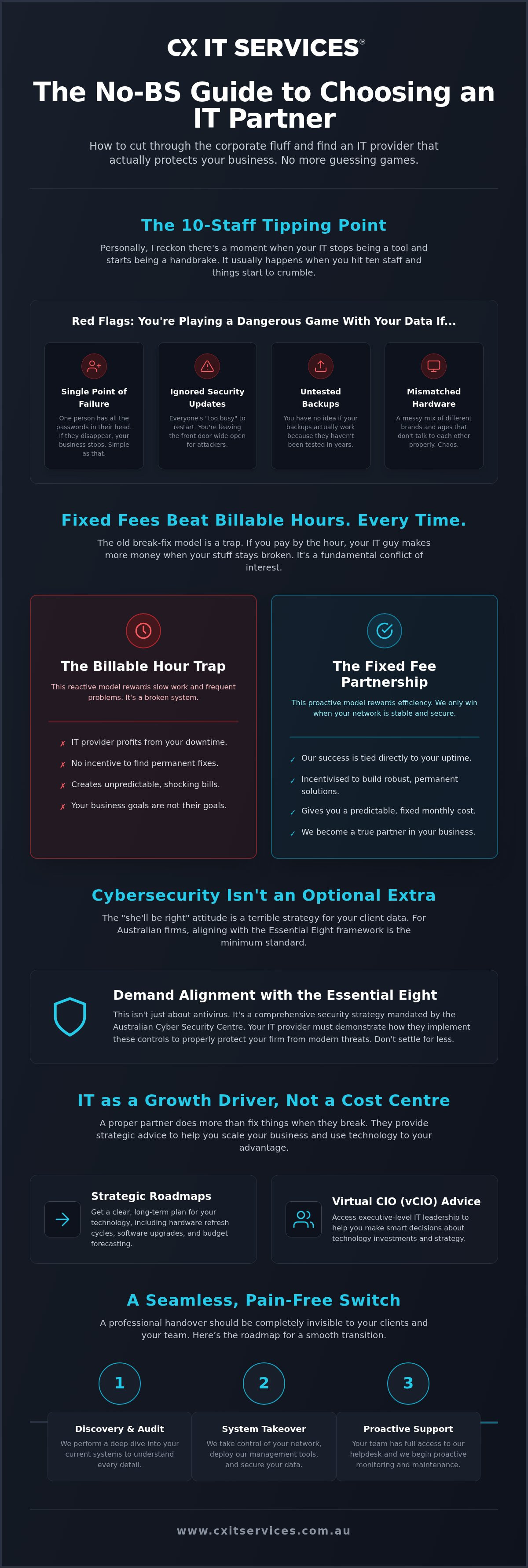
The 10-staff tipping point is real. I have seen it dozens of times over 26 years. When you have five people, you can manage. When you hit ten, the basic setups usually start to crumble. You need to look for a provider that understands the difference between fixing a laptop and managing a complex network. A good provider will not just react to problems. They will actively prevent them from happening in the first place. Proactive beats reactive. Every single time.
The signs you are playing a dangerous game with your data
If your staff are wasting hours every week troubleshooting their own tech issues, you are losing money. It is as simple as that. There are other red flags that suggest you have outgrown your current "IT guy" or the DIY approach:
- You are relying on a single person who has all the passwords and system knowledge in their head. If they disappear, your business stops.
- Security updates are being ignored because everyone is too busy to click restart or "doesn't want to lose their tabs."
- You have no idea if your backups actually work because they haven't been tested since the Bush administration.
- Your hardware is a mismatch of different brands and ages that don't talk to each other properly.
If these sound familiar, you are in the danger zone. You can find more warning signs in our checklist for when to outsource IT support to see if your growth has outpaced your infrastructure.
Why "she will be right" is a terrible strategy for business tech
In Australia, we love the "she will be right" attitude. It's great for a weekend BBQ, but it is a bloody terrible strategy for your client data. Relying on luck is not a business plan. If you are wondering What are managed services?, they are essentially the opposite of this "fix it when it breaks" chaos. It is a professional commitment to stability.
The cost of a single day of downtime often outweighs the monthly cost of professional support. Think about your wages, your rent, and your reputation. If you can't access your files for 24 hours, what does that cost you? Growing businesses need a partner who can scale as fast as they do. Part of knowing what to look for in a managed IT service provider is finding someone who views your tech as a strategic asset, not just a series of fires to be put out.
Why fixed monthly fees beat the billable hour every time
The old way of paying for IT was the break-fix model. I call it a trap. It is a reactive mess where you only call for help when something is already on fire. Personally I reckon this is the most expensive way to run a business because you are always paying for emergencies. When you are assessing what to look for in a managed IT service provider, the pricing model should be your first red flag.
If you pay by the hour, your IT guy actually makes more money when your stuff stays broken. They have no incentive to fix the root cause of a recurring glitch. Why would they? A permanent fix stops the clock and kills their billable labour. This creates a fundamental conflict of interest between your business and your support team.
The conflict of interest in traditional IT support
Billable hours reward slow work and frequent problems. It is a broken system. A managed service model rewards efficiency and permanent fixes instead. I always say that if your IT provider is not incentivised to keep you running, they probably won't. They only become a "Safe Pair of Hands" when their own profit depends on your network stability.
One of the hallmarks of a great managed service provider is the total alignment of goals. We want your network to be boring. We want zero calls to the helpdesk. When your systems run perfectly, we both win. This is why a fixed monthly fee per user is the gold standard for modern Australian firms.
What should be included in your monthly subscription
Predictable costs allow you to actually plan your budget without worrying about bill shock at the end of the month. You should expect a comprehensive package that covers the basics and the big picture. Unlimited helpdesk support should be a standard part of the deal. Security monitoring and cloud backups must be included in the base fee to ensure you are never left vulnerable.
When you know what to look for in a managed IT service provider, you realise that predictability is the greatest asset you can buy. It turns IT into a utility like electricity. It just works. You can check out how we structure our managed IT support fees to see what a transparent inclusion list looks like. If you are tired of the invoice lottery, you might want to see if your business is ready for a fixed-fee model.
Evaluating cybersecurity and the safe pair of hands
Cyber security is not an optional extra anymore. It is the foundation of your entire business. Personally I reckon any provider who treats security as a "premium add-on" is a massive liability. Ownership is everything here. You want a partner who takes full responsibility for your data protection, not someone who points at a software vendor the moment things go pear-shaped.
A provider that does not talk about 24/7 monitoring is not taking your security seriously. The bad guys don't knock off at 5 PM on a Friday. In fact, that is usually when they start. When you are considering how to choose a managed service provider, you need to look for a "Safe Pair of Hands" that stays awake while you sleep.
The Essential Eight and why it matters for Aussie businesses
In Australia, we have a clear roadmap for security. You need to ask if your potential partner follows the Australian Cyber Security Centre Essential Eight framework. It is the baseline for keeping the door locked. Ask them specifically how they implement application whitelisting and patch management. If they look at you blankly, they aren't the right fit.
Multi-factor authentication (MFA) should be non-negotiable for every single login. No exceptions. If a provider tells you it is "too hard for staff," they are prioritising convenience over your survival. Knowing what to look for in a managed IT service provider means finding someone who has the guts to tell you what you need to hear, not just what you want to hear. You can read our guide on cyber security management for the full breakdown of these standards.
Backups and disaster recovery protocols
A backup is useless if it has never been tested. I have seen businesses lose everything because they thought their "set and forget" backup was working. It wasn't. You must ask exactly how long it would take to get your business back online after a total server failure. This is your Recovery Time Objective (RTO).
Don't settle for vague promises. Look for a provider that offers comprehensive disaster recovery as part of their core service. They should be able to show you proof of regular test restores. If they can't prove it works, assume it doesn't. Real security is about being ready for the worst day, not just hoping for the best one.
Looking for strategic growth instead of just technical support
Most IT providers will keep your systems running. A great one will help you grow faster because of them. There is a real difference between a provider who closes support tickets and one who sits down with you quarterly to ask, "Where is your business heading, and is your technology ready to take you there?" Knowing what to look for in a managed IT service provider means demanding the second type.
If your IT partner has never once mentioned a technology roadmap, a budget forecast, or a three-year plan, they are managing your past. Not your future.
The role of a Virtual CIO in a growing business
A Virtual CIO is essentially a senior technology strategist without the full-time executive salary. They stop you from making expensive mistakes, like buying a server that you'll outgrow in eight months, or signing a software contract that locks you into a platform your team will hate.
Strategic planning at this level is about business outcomes, not technical specs. A good Virtual CIO asks what you are trying to achieve commercially, then works backwards to figure out what technology actually supports that goal. They should be helping you manage your IT strategy and hardware procurement as a unified plan, not as separate line items that nobody coordinates.
This is where a proper partner separates from a glorified helpdesk. One fixes problems. The other prevents them from ever becoming relevant.
Leveraging AI and automation for a competitive edge
AI is not a buzzword anymore. It is a genuine competitive advantage for Australian firms that are willing to use it properly. The question to ask any potential provider is blunt: "What have you actually helped other businesses automate in the last twelve months?"
If they hesitate, move on. A modern MSP should be leading the way here, not playing catch-up.
The real wins are not glamorous. They are the repetitive, low-value tasks that eat your team's time every single day. Think about how much time your front office spends on manual data entry, appointment reminders, or chasing documents. A good provider will show you how to automate front office tasks that free your staff to do actual billable work instead of grunt work.
For legal, accounting, and medical firms especially, this is where the numbers get interesting fast. Removing repetitive manual processes from your daily operations is not a "nice to have." It is a direct cost reduction.
A provider who only talks about keeping your systems stable is selling you a floor, not a ceiling. You deserve both. If you are ready to find a partner who thinks about your growth, not just your uptime, see if your business qualifies for a strategic IT partnership.
The roadmap for a seamless transition to managed services
I know that switching providers feels like a massive risk. It is the digital equivalent of an organ transplant. You are likely worried about downtime, lost emails, and the general chaos of a handover gone wrong. But a professional transition should be invisible to your clients. If they notice anything at all, it should only be that your team is suddenly more responsive and less stressed.
When you are narrowing down what to look for in a managed IT service provider, ask to see their documented onboarding process. If they don't have one, run. You want a provider that has a refined process for taking over a network. This ensures nothing falls through the cracks during the move. A documented plan is the difference between a smooth handover and a total disaster.
If you already have an internal IT person, you don't necessarily need to replace them. You should look at co-managed IT support as a way to back your team. It gives your local person the tools and the 24/7 helpdesk they need without the corporate fluff. This allows them to focus on high-level projects while we handle the daily grind.
What to expect in the first 30 days
The first step is always a full audit of your current hardware and security gaps. We need to know exactly what we are inheriting. Your new provider should also handle the breakup with your old IT guy. You shouldn't have to deal with that awkwardness. We manage the technical handover and the password transfers directly so you can stay focused on your business.
Expect a bit of a clean-up phase in these first few weeks. This is when the old bugs that have been ignored for years are finally squashed. We stabilise the network and ensure your security is up to scratch. It is about creating a clean slate so we can move forward with confidence.
How to handle the transition without downtime
The move should be organised in stages to avoid disrupting your staff. We don't just pull the plug on a Monday morning and hope for the best. A dedicated project manager should oversee the entire migration from start to finish. They are your single point of contact and their job is to ensure every laptop and server is transitioned correctly.
Personally I reckon a good transition is one where the staff only notice that things have stopped breaking. They get to work, they log in, and everything just works. No drama. No downtime. Just a stable system and a safe pair of hands looking after it. Once the transition is finished, you can finally stop worrying about IT and start focusing on growth.
Secure your business future today
Personally I reckon you now have the tools to spot a winner from a pretender. You know that outgrowing your current setup isn't a failure. It is a sign of success. But you need to protect that success with a partner who actually owns the result. Stop settling for an IT guy who only shows up when things are already broken.
Knowing what to look for in a managed IT service provider comes down to three things. Demand fixed monthly fees to stop the billable hour trap. Insist on the Essential Eight framework for real security. Look for a Virtual CIO who actually cares about your three-year growth plan. If they can't provide all three, they aren't the right fit for a growing firm.
We have been supporting Australian businesses for 26 years. Our team provides 24/7 national support with on-site technicians available when you need them. We offer no-BS fixed monthly fees with no hidden surprises. You get a safe pair of hands that lets you focus on your actual job while we handle the tech. It is time to stop playing tech-support roulette.
Get a fixed-fee quote for your business today and let's get your network sorted once and for all. You have built something great. Let's make sure your technology is ready to back you up.
Common questions about IT partnerships
How much do managed IT services typically cost in Australia?
Most providers charge a fixed monthly fee per user to ensure your budgeting stays predictable. This model is far superior to hourly rates because it removes the risk of bill shock when a major system fails. You should look for a provider that is completely transparent about what is included in that base fee. Avoiding hidden "out of scope" charges is a critical part of what to look for in a managed IT service provider.
Can a managed service provider work with my existing IT manager?
Yes. This hybrid model is called co-managed IT. It is a brilliant way to support an internal person who is currently overwhelmed by the daily grind. The MSP takes over the repetitive tasks like security patches and backups. This frees your IT manager to focus on high-level business projects that actually drive revenue. It gives you enterprise-grade tools without the cost of hiring another full-time staff member.
How do I know if an MSP is actually secure?
You must ask for their specific security protocols and verify if they follow the ACSC Essential Eight framework. Look for a provider that enforces multi-factor authentication on every single login and offers 24/7 monitoring. If they cannot explain how they protect their own internal systems, they certainly cannot protect yours. Certification and a clear track record in your specific industry are non-negotiable requirements for a safe pair of hands.
What is the difference between an MSP and a regular IT support company?
A regular support company is usually reactive. They wait for you to call them when a server is already on fire. A managed service provider is proactive. They use monitoring tools to find and fix problems before your staff even notices them. They act as a strategic partner rather than just a repair man. This shift from fixing things to preventing things is vital for business growth and long-term stability.
Do I have to sign a long-term contract?
Many providers require a 12 or 36-month commitment to cover the initial setup costs and security tools. However, you should look for a provider that offers some flexibility and clearly defines the service level agreement. If a provider is confident in their results, they won't need to rely on "gotcha" clauses to keep you as a client. The contract should protect both parties and ensure a high standard of ongoing care.
Will I lose control of my technology if I outsource?
Not at all. You still own all your data and hardware. The MSP simply handles the day-to-day management so you don't have to. A professional provider gives you full transparency through a client portal. You can see all your support tickets and system health in real-time. You are essentially hiring a team of experts to run your engine while you stay firmly in the driver's seat of your business.
How quickly should an MSP respond to my issues?
You should look for a service level agreement that guarantees a response for critical issues within an hour. For non-urgent staff requests, a same-day response is the standard in 2026. If your current provider takes days to get back to you, it is a clear sign you have outgrown their capacity. Rapid response is a core part of what to look for in a managed IT service provider when your productivity is on the line.