
Stop scammers draining your business. Our guide to business email compromise protection gives you a practical plan your staff can actually follow. Keep your ...
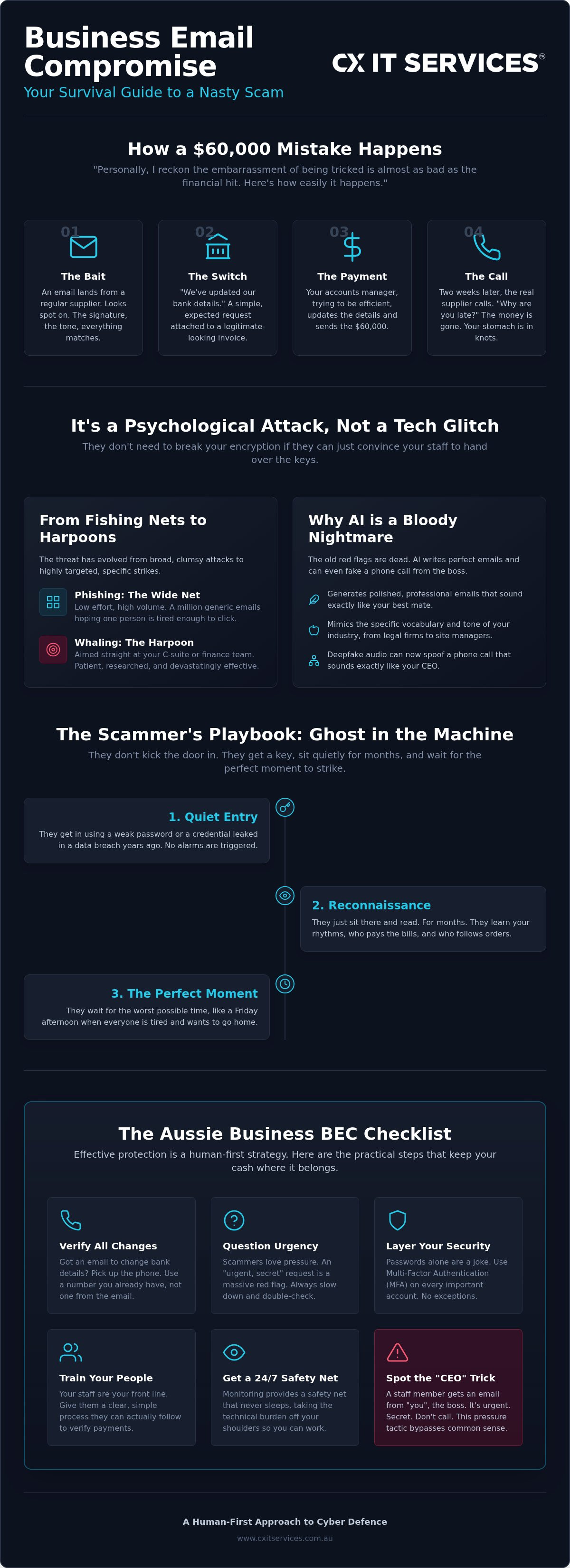
Your accounts manager gets an email from a regular supplier. It looks spot on. The signature is right. This is where business email compromise protection stops being an IT line item and starts being a survival strategy.
The invoice is expected. They just need to update their bank details for this month's payment.
You send the $60,000.
Two weeks later, the real supplier calls asking why you are late. The money is gone. The scammer is long gone. Your stomach is in knots.
Personally, I reckon the embarrassment of being tricked is almost as bad as the financial hit. It makes you second-guess every notification that lands in your inbox. You aren't alone. Most Aussie business owners I talk to are fed up with jargon and the constant fear of one wrong click.
Effective protection isn't about buying the most expensive firewall. It's about a human-first strategy that works in the real world.
I'll show you how to shield your business with a clear process your staff can actually follow. We'll get straight to the practical steps that keep your cash where it belongs. Peace of mind is the goal.
Key Takeaways
- BEC is a psychological attack on your trust rather than a technical glitch. Learn why scammers lurk in your inbox for weeks before they pounce.
- Passwords alone are a joke. Discover how business email compromise protection uses layered security to stop unauthorised access before it starts.
- Your staff are your front line. Get a practical process they can actually follow to verify invoices and spot a fake CEO before money leaves your account.
- 24/7 monitoring provides a safety net that never sleeps. See how a managed approach takes the technical burden off your shoulders so you can get back to work.
What is Business Email Compromise and why is it worse in 2026?
Personally I reckon Business Email Compromise (BEC) is the nastiest scam out there because it targets trust. It is not just a dodgy link anymore. It is a criminal pretending to be your CEO or a trusted supplier you have worked with for a decade. These scammers do their homework. They scrape LinkedIn to see who handles your accounts. They find your suppliers on public tenders. They even check social media to see who is away on annual leave. By the time they send that fake invoice, they have often been sitting in your system for months, reading every thread and learning your rhythms.
It is a psychological attack rather than a technical one. They don't need to break your encryption if they can just convince your staff to hand over the keys. This is why robust business email compromise protection is no longer optional for Aussie firms. You are fighting an enemy that knows your business almost as well as you do.
The evolution from phishing to whaling
Phishing is a wide net. It is low effort and high volume. Scammers send a million emails hoping one person is tired enough to click. Whaling is different. It is a harpoon aimed straight at your C-suite or finance team. The attackers aren't interested in your password for the sake of it. They want to watch how you talk. They wait for a high-value contract or a big month-end run. When they finally send that urgent request to change bank details, it looks identical to your usual process. Standard cyber security isn't enough on its own. You need a strategy that accounts for human error and targeted deception.
Why AI has made BEC a bloody nightmare
In 2026, the old red flags like bad spelling or weird grammar are dead. Generative AI writes emails that sound exactly like your best mate. It is polished. It is professional. It is terrifyingly accurate. Scammers now use AI & automation to generate thousands of unique, highly targeted messages in seconds. They can mimic the specific vocabulary of a legal firm or the blunt tone of a site manager.
Worse still, deepfake audio can now spoof a phone call from the boss. You get an email followed by a quick call that sounds just like your CEO. They tell you to push that payment through because they are stuck in a meeting. It is a bloody nightmare for staff who are just trying to be helpful. Without dedicated business email compromise protection, your team is essentially flying blind against tools designed to deceive the human eye and ear.
How the BEC scam actually works
Scammers don't usually kick the door in. They prefer a quiet entry. Most of the time, they get in using a weak password or a credential leaked in a data breach years ago. Once they are inside your Microsoft 365 or Google Workspace, they don't start changing things. They just sit there. They read your emails. They watch your calendar. They are effectively a ghost in your machine.
They are looking for the "power map" of your business. They want to know who has the authority to pay the bills and who is likely to follow orders without asking questions. This reconnaissance phase can last for months. By the time they strike, they know exactly how you talk to your suppliers and which clients are currently expecting an invoice. They are waiting for the perfect moment to exploit that trust.
The strike almost always happens at the worst possible time. Personally, I have seen it happen most often on a Friday afternoon. Everyone is tired. Your accounts team is trying to clear their desk so they can get home or head to the pub. That is when the "urgent" email arrives. It relies on the fact that your guard is down. This is why active business email compromise protection is your best friend. It fills the gaps when your team is too buggered to spot a fake.
The invoice redirection trap
This is the most common way Aussie businesses lose their shirts. You get an email from a supplier you have used for years. The letterhead is perfect. The tone is right. They tell you they have changed their bank details and need this month's payment sent to a new account. Because you trust them, you update the system and pay the invoice. The money goes to a "mule" account and is moved offshore within minutes. By the time you realise the real supplier hasn't been paid, the cash is gone for good.
The "CEO is in a meeting" trick
This one is about pure pressure. A staff member gets an email that looks like it is from you. You say you are in a high-stakes board meeting and need a "secret deal" funded immediately. You tell them not to call because you cannot talk. The staff member feels like a hero for helping the boss out of a bind, so they bypass the usual checks. Scammers love urgency. It is the best tool they have to bypass common sense. If you are worried your team might fall for this, it might be time to chat about a security audit to see where your holes are.
Comparing your protection options
Passwords are a joke. If that is your only defence, you are essentially leaving your vault open and hoping for the best. Personally I reckon relying on a single password in 2026 is like using a screen door to stop a bushfire. It might make you feel better for a second, but it won't stop the heat. You need layers.
Most people think multi-factor authentication (MFA) is the finish line. It isn't. It is the bare minimum. It is the baseline entry fee for being online. Scammers have already found ways around simple SMS codes. They use "push fatigue" to trick your staff into clicking 'Approve' at three in the morning. Effective business email compromise protection requires a system that looks for unusual behaviour rather than just checking a list of bad files.
A managed IT service provider organises these layers so you can focus on your actual job. We take the chaos of technical security and turn it into a structured, predictable process. It is about having a safe pair of hands watching the gate while you sleep.
MFA vs. Advanced Threat Protection
MFA stops the easy stuff. It is like having a solid lock on the front door. It keeps the opportunistic thieves out. But Advanced Threat Protection (ATP) is like having a security guard inside the building who knows everyone's face. ATP is much smarter. It can spot when an email comes from a "lookalike" domain that looks perfect to the human eye. For example, it might flag an email where a scammer has replaced an 'i' with an 'l' in your supplier's web address. It sees the deception that your tired accounts manager will miss every single time.
The role of 24/7 security monitoring
Scammers do not work 9 to 5. They love 2 AM on a Sunday morning. They know you are asleep and your IT manager is probably at the beach. This is where 24/7 security monitoring proves its worth. It catches a login from a country you have never visited before the first fake email is even drafted. It identifies the "ghost" sitting in your inbox and kicks them out before they can learn your payment schedules. It is the ultimate safety net for a modern Aussie business. You get the peace of mind knowing someone is always on duty. With a fixed monthly fee, there are no nasty surprises when we have to jump into action.
The Aussie business BEC checklist
Security is about process as much as it is about software. Personally, I reckon the best business email compromise protection starts with a healthy dose of scepticism. If an email feels wrong, it probably is. Trust your gut. It is usually smarter than your inbox filter. Scammers rely on you being too busy to notice a tiny detail. We reckon every Aussie business needs five things in place today: MFA, 24/7 monitoring, a strict verification process, hardened mail settings, and a team that knows the red flags. It is about organising the chaos into a clear routine.
You don't have to be a tech genius to stop a $50,000 fraud. You just need a system that doesn't rely on luck. Not alone. Together.
Verify every bank change
Never trust an email about bank details. Ever. It doesn't matter if the letterhead looks perfect or if they mention a project you are actually working on. Scammers are experts at mimicking your suppliers. Pick up the phone. Call the supplier on a number you already know. Do not use the phone number listed in the suspicious email. We tell our clients to implement a "Call-Back Rule" for their finance teams. It is a single, non-negotiable sentence: Every change to a BSB or account number must be verified by a voice call to a known contact before a cent leaves the building.
Tighten your Microsoft 365 settings
You can make your system much harder to crack with a few strategic tweaks. Turn on "External Sender" warnings. It adds a clear flag to any email originating from outside your organisation. It is a simple visual cue that saves businesses from making expensive mistakes every day. You should also disable legacy protocols. These are old connection methods that scammers love because they can often bypass your MFA settings. If you need help with the technical heavy lifting, our team provides expert Microsoft 365 management to keep your environment locked down tight.
Organise regular staff awareness training
Your team is your front line. They can be your best defence or your weakest link. It all depends on how you train them. Run regular "fire drills" using fake phishing emails to see who is paying attention. It is not about catching people out. It is about building muscle memory so they spot the fake CEO request before they hit send. Show them real examples of BEC attacks. Make it practical and relevant to their daily work. When your staff know the tricks, the scammers lose their biggest advantage.
If you want a safe pair of hands to audit your current setup and run through this checklist with you, apply for a security review here. We can help you close the gaps before someone exploits them.
How CX IT Services organises your cyber defence
We have been in the IT game for 26 years. That is a long time to be watching the front lines. In that time, we have seen every trick in the book. We've watched scammers evolve from sending clunky, broken emails to using sophisticated AI to drain business accounts. This experience is why we don't just sell you a box of software and walk away. That approach is lazy and it simply doesn't work in 2026.
Effective business email compromise protection requires a proactive strategy. We act as your Virtual CIO to build a defence that fits your specific workflow. It is about organising the chaos into a structured, manageable process. You get the benefit of our full suite of Managed IT Services for a fixed monthly fee. There are no surprises and no hidden costs. Just solid protection. Not alone. Together.
National 24/7 support and monitoring
Scammers love the middle of the night. They wait until you are fast asleep to execute their final move. Our team provides national support that watches your systems 24 hours a day, 7 days a week. If a scammer tries to get in, we are already on it. We identify the threat and neutralise it before it can do any real damage. You can check out our full range of Cyber Security Services to see exactly how we lock down your environment. We provide the ultimate safety net so you don't have to spend your weekends worrying about your inbox.
A safe pair of hands for your business
We take the technical crap off your plate. You didn't start a legal or accounting firm to spend your days worrying about email protocols or legacy settings. We are Australian owned and operated. When you call us, you speak to a local expert right here in Australia. There are no overseas call centres and no scripted responses. Personally I reckon that makes a huge difference when things go pear-shaped. You need someone who understands the local business landscape and can act fast.
We position ourselves as a safe pair of hands. We are dependable, experienced, and calm under pressure. We don't just react to problems. We prevent them. By modernising your security and integrating the right tools, we ensure your business remains stable and secure. You get peace of mind knowing a professional is always watching the gate. It is about giving you the confidence to grow without the fear of a single email draining your hard-earned cash.
Take control of your inbox today
Scammers are getting smarter, but they still rely on you being too busy to check the details. Personally, I reckon the biggest risk isn't a weak firewall. It is the pressure of a Friday afternoon and a fake invoice that looks just right. Protecting your Aussie business means moving beyond basic passwords and embracing a layered, human-first approach.
You need a system that combines hardened Microsoft 365 settings with 24/7 security monitoring. This is where professional business email compromise protection makes the difference between a normal business week and a total financial disaster. With 26 years of Australian IT experience, we have seen the damage these scams cause. We don't want your business to be the next statistic.
It is time to stop second-guessing every notification that lands in your inbox. We provide a safe pair of hands to organise your security and monitor for threats while you sleep. We focus on results rather than technical jargon. No fluff. Just protection.
We are here to help you lock the gate and keep the scammers out for good. You don't have to navigate this technical minefield alone.
Get a safe pair of hands for your business security.
Frequently Asked Questions
Is business email compromise the same as phishing?
No, it is a far more targeted beast. While phishing is a wide net cast to catch anyone's password, BEC is a precision strike. It involves a criminal impersonating a specific person you trust, like your boss or a regular supplier. They often use information gained from lurking in your inbox for months. It is less about a dodgy link and more about a psychological trick designed to move large sums of money.
Can a small business really be a target for BEC?
Absolutely. Scammers actually prefer small and medium businesses because they often lack dedicated business email compromise protection. They reckon you are a soft target compared to a big bank. In the 2024-25 financial year, the average loss for a small business cybercrime report was $56,600 according to the ACSC. You are never too small to be noticed by a criminal looking for a quick payday through a fake invoice.
How much does BEC protection cost for a mid-sized firm?
We don't provide a one-size-fits-all price because every business has different needs. Instead, we offer a fixed monthly fee model that covers your specific requirements without nasty surprises. This approach ensures you get comprehensive security monitoring and strategic support without worrying about hourly rates every time you have a question. It is about providing a predictable cost for total peace of mind and a safe pair of hands watching your systems.
What happens if we have already paid a fake invoice?
You need to move bloody fast. Call your bank immediately to see if the transaction can be reversed or frozen. Every minute counts before the money is moved offshore. Once you have spoken to the bank, report the incident to the Australian Cyber Security Centre (ACSC) via cyber.gov.au. You must also secure your email accounts immediately. Change all passwords and check your mail forwarding rules to ensure the scammer isn't still reading your outgoing messages.
Is Microsoft 365 secure enough on its own?
Not out of the box. While Microsoft 365 has great security tools built-in, they are often not configured correctly by default. You need to harden your settings by disabling legacy protocols and setting up advanced threat protection. Even then, software is only half the battle. You still need active monitoring to catch unusual behaviour that the automated systems might miss. Relying on default settings is a risk most Aussie businesses can't afford to take.
How often should we train our staff on email security?
Once a year isn't enough. We reckon you should be running short, practical awareness sessions or fire drills at least every quarter. Scammers change their tactics constantly, so your team needs to stay sharp. Monthly phishing simulations are a great way to keep security top of mind without being a massive drain on everyone's time. It is about building a culture where double-checking an invoice is just part of the daily routine.
Can AI help me detect these scams?
AI is a double-edged sword. Scammers are using it to write perfect emails, but we use it to catch them. Modern business email compromise protection uses AI-driven monitoring to spot patterns that a human would never see. It looks for subtle changes in writing style or unusual login locations. While AI is a powerful tool in our kit, it still needs an experienced professional to interpret the data and make the final call when things look pear-shaped.
What is the first thing I should do if my email is hacked?
Lock the account down immediately. Change your password to something long and unique, then use the sign out of all sessions feature to kick the intruder out. Check your email rules straight away. Scammers love to set up hidden forwarding rules that send a copy of every email you receive to their own inbox. If you don't clear those rules, they will stay in your business even after you have changed your password.





 Microsoft Partner