Stop scammers from draining your bank account. Get blunt, no-nonsense business email compromise protection that actually works for Aussie small business.
Personally, I have seen the fallout when a local firm gets a "revised" invoice that looks perfect. The bank details are slightly off. The money is gone. And the client is rightfully furious. It is a nightmare that plays out every six minutes across Australia, making business email compromise protection more than just a box to tick.
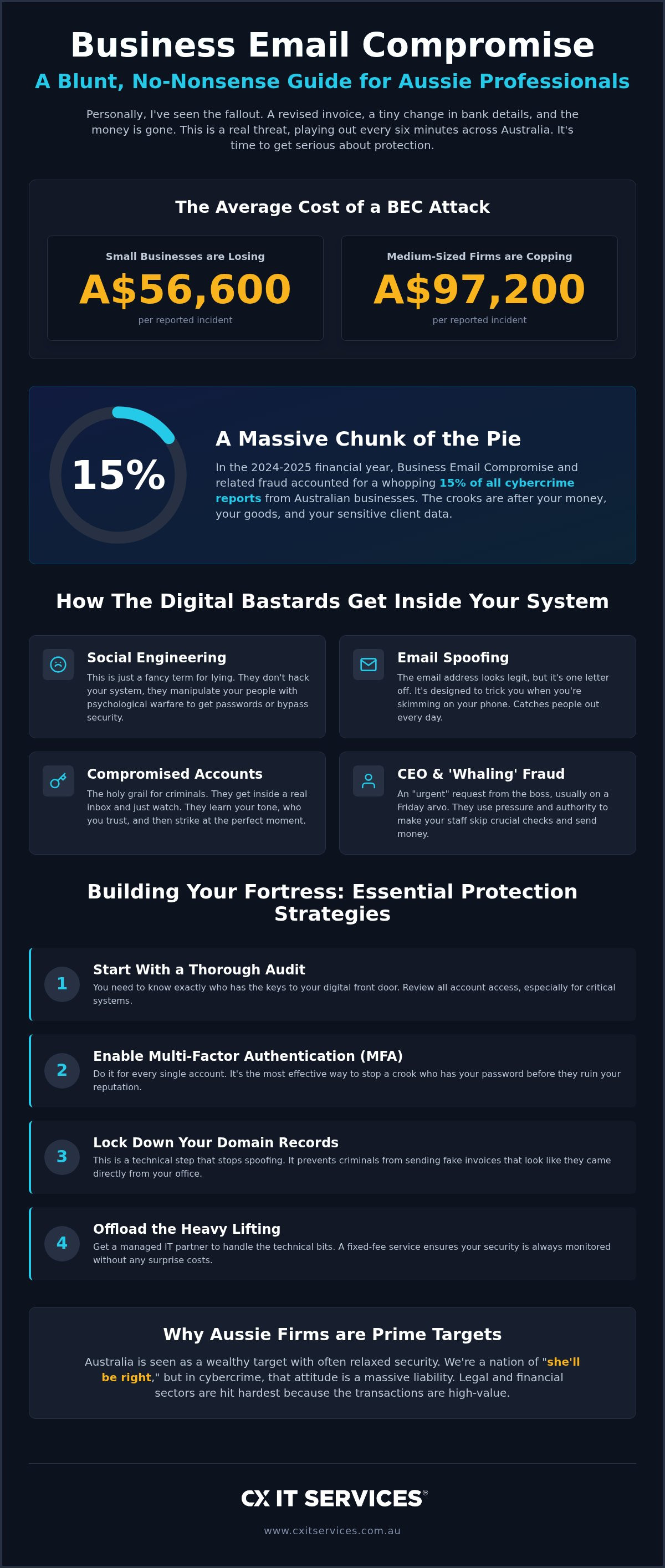
Small businesses are currently losing an average of A$56,600 per report. Medium-sized firms are copping even harder hits, averaging A$97,200 in losses. You are not paranoid for worrying about fake invoices or losing client trust. Most IT advice you get feels like a slick sales pitch for tools that do not actually solve the human side of the problem.
I am here to change that. This is a blunt, no-nonsense roadmap that actually works for Aussie professionals. We will cover how to secure your email properly. We will discuss how to ensure your team knows exactly what to look for. Finally, I will show you how to find a partner to manage the technical bits so you can get back to work with total confidence.
Key Takeaways
- Understand that BEC is about manipulation rather than just technical hacking. Scammers pretend to be people you trust so they can drain your accounts.
- Start your business email compromise protection with a thorough audit. You need to know exactly who has the keys to your digital front door.
- Enable multi-factor authentication for every single account. It is the most effective way to stop a breach before it ruins your reputation.
- Lock down your domain records to stop spoofing. This prevents criminals from sending fake invoices that look like they came from your office.
- Offload the technical heavy lifting to a managed IT partner. A fixed-fee service ensures your security is always monitored without any surprise costs.
What is Business Email Compromise and why should you care?
Personally, I reckon BEC is the nastiest threat facing Aussie businesses today. It is not some random virus that breaks your computer or makes your screen go blue. It is a calculated, cold-blooded criminal pretending to be someone you trust. They don't want to break your system. They want to join your conversation.
In the 2024-2025 financial year, Business email compromise and related fraud accounted for 15% of all cybercrime reports from Australian businesses. That is a massive chunk of the pie. These crooks are after three things: your money, your goods, and your sensitive client data. They are patient, and they are very good at what they do.
The damage is not just a line item on a balance sheet. While small businesses are losing an average of A$56,600 per report, the real killer is the loss of reputation. If you accidentally send a client's settlement funds to a scammer because you didn't have business email compromise protection in place, that trust is gone forever. It is hard to win back. It is even harder to ignore when the lawyers get involved.
The 'Digital Bastards' are doing their homework
Scammers do not just spray and pray. They spend weeks, sometimes months, inside a compromised account just watching your email patterns. They learn how you talk to your vendors. They see when you pay your monthly bills. They identify who has the authority to change bank details.
It is professional and highly organised. They wait for the perfect moment to strike, usually a Friday afternoon when everyone is rushing to finish up. They send a "revised" invoice with new bank details. Because it comes from a real email thread, it looks legitimate. It is a business model for them. A very profitable one.
Why Aussie firms are prime targets in 2026
Australia is seen as a wealthy target with often relaxed security standards. We are a nation of "she'll be right," but in the world of cybercrime, that attitude is a liability. We are friendly, we are trusting, and we are often too busy to check every digit in a BSB number.
Legal and financial sectors are hit hardest because the transactions are high value. One mistake by a tired employee can lead to a catastrophic financial drain. This is why robust cyber security is no longer a luxury for big corporations. For a local firm, implementing business email compromise protection is a survival requirement. Without it, you are just waiting for your turn in the statistics.
How the scammers actually get inside your system
Most people think of hackers as kids in hoodies typing code at breakneck speed. The reality is far more boring and far more dangerous. They don't always hack your system. Sometimes they just trick your people.
Social engineering is the fancy term the industry uses for lying to get what you want. It is psychological warfare. The goal is to get an employee to bypass a security protocol or hand over a password through a fake login page. Once they have that, they have the keys to the castle. They don't need to break a window when you have handed them the front door key.
Spoofing is another common trick that catches people out. This is where an email address looks like it belongs to your boss or a trusted partner. It might be one letter off, like using a 'v' and an 'l' to look like a 'w'. If you are skimming on a phone between meetings, you will never spot it. This is why business email compromise protection has to be more than just a spam filter.
However, compromised accounts are the real holy grail for a criminal. This is when a scammer actually gains access to a real employee's inbox through a previous data breach or a phishing link. They don't send anything immediately. They sit. They watch. They wait. They learn your tone of voice and who you trust before they make their move.
The 'CEO Fraud' and 'Whaling' tactics
Scammers love a hierarchy. They send an "urgent" and "confidential" request for a wire transfer that seems to come from the top. They use pressure to stop employees from double-checking the request. "I'm in a meeting, just get this done now," is the classic line they use to bypass common sense.
The timing is usually deliberate. Scammers love a Friday afternoon. Everyone is tired. Everyone is rushing to get to the pub or get home to the family. In that rush, a quick payment seems like a small task to clear the desk. In reality, it is a A$50,000 mistake that could have been avoided with a simple phone call.
Invoice redirection: The silent killer
This is the most common way money actually leaves Aussie bank accounts. A criminal watches your email threads and waits for a legitimate invoice to arrive. They then send a follow-up email from the "supplier" claiming their bank details have changed for "auditing purposes."
The money goes to a criminal account. Usually, it is moved offshore within minutes. You won't even know you've been hit until the real supplier calls three weeks later asking why they haven't been paid. By then, the trail is cold and the money is long gone. Verified processes are the only way to stop this from happening. If you want to see where your current gaps are, you can request a security audit with our team to lock down your workflow.
Effective business email compromise protection requires a mix of smart tech and even smarter people. You can't just set it and forget it. You need a system that flags when a BSB has changed or when an email is coming from an unusual location. Without those alerts, you are flying blind.
Building your fortress: Essential BEC protection strategies
Stop looking for a magic button. There isn't one. Effective business email compromise protection is built on layers. It is about making your firm so difficult and annoying to attack that the scammers move on to an easier target. Software is part of the answer, but strategy is what actually keeps the money in your bank account.
Multi-factor authentication (MFA) is the single most important thing you can do. If you are not using MFA in 2026, you are basically leaving your front door wide open. It is the digital equivalent of a deadlock. Even if a criminal steals a password, they still can't get in without that second physical check. It is simple. It is effective. It is non-negotiable.
Email filtering software should catch the obvious rubbish before it ever hits an inbox. These tools look for weird links, mismatched domain names, and known criminal IP addresses. However, remember that strategy beats tools every single time. A tool is just a hammer. You need to know where to swing it to build a proper defence.
Beyond the basic password
Not all MFA is created equal. Personally, I reckon you should use authenticator apps or hardware keys rather than just SMS codes. SMS can be intercepted through SIM swapping. Apps are much harder to crack. You also need to organise your team so they only have access to what they actually need. This is the "principle of least privilege." If a junior staffer's email is hit, the damage is limited because they don't have the keys to the master billing system.
For a deeper look at how to structure this, check out our guide on Cyber Security Management Services. It breaks down how to build a strategy that fits your specific business size and risk profile.
The 'Human Firewall' is your best defence
Your staff are your biggest risk, but they are also your best defence. You need to train your team to spot the red flags without being bored to tears by corporate slide decks. Show them real examples of fake invoices. Explain how a "CEO fraud" email actually looks on a mobile screen. When they understand the "why," they are much more likely to follow the "how."
Create a culture where it is okay to pick up the phone and verify a request. If a supplier suddenly changes their bank details, your team should feel empowered to call a known contact at that company. A simple "is this legit?" phone call takes thirty seconds. It can also save you hundreds of thousands of dollars. Verification is not a sign of distrust. It is a sign of a professional, secure business. Building this "Human Firewall" is a core part of any business email compromise protection plan.
Your step-by-step roadmap to securing your business email
Personally, I reckon the biggest mistake local firms make is assuming their email is "just working." If you have more than 10 people in your office, you have outgrown the basic setup you started with years ago. You need a proper roadmap for business email compromise protection that goes beyond just hoping for the best. It is about being proactive before the money disappears from your account.
Start with a proper audit. Check who has access to your systems right now. You would be surprised how many "ghost" accounts are still active for people who left the company six months ago. Every active account is a potential entry point for a criminal. Locking down access and removing old permissions is the first step in stopping the rot. If you don't know who has the keys, you don't have a secure building.
Technical 'Hygiene' for your domain
SPF, DKIM, and DMARC are the three pillars of email authentication. Think of them as a digital passport for your emails. They tell the receiving server that an email is definitely from you and not a fake sent from a basement overseas. Without these records, scammers can easily spoof your domain to trick your clients or your own accounts team. It is technical work that requires precision, but it is essential for keeping the scammers out of your inbox. You can see how we handle this technical heavy lifting for our clients at Domain and DNS Management.
Verification protocols for the real world
Technical tools are great, but they cannot stop a staff member from making a manual bank transfer. You need clear rules for how financial changes are authorised in your firm. Never change bank details based solely on an email request. Use a second channel, like a phone call to a known number or a text message, to confirm the change. Write these rules down and make sure every single staff member follows them every single time. A written policy is your best defence when someone is under pressure to pay an invoice on a Friday afternoon.
Finally, get a professional to look over your shoulder. You are busy running a legal practice or an accounting firm. You don't have the time to track every new scam variant that pops up in 2026. A reliable partner ensures you don't miss a critical setting that could ruin your reputation or drain your bank account. If you are ready to stop guessing and start securing your firm properly, you can book a security roadmap session with us today. It is the only way to ensure your business email compromise protection is actually doing its job.
Why Managed IT is the only way to sleep at night
Let's be honest. Security is a full-time job. You already have one of those to do. Managing a legal firm or a medical clinic is hard enough without worrying about whether your DNS records are leaking or if a staff member just clicked a dodgy link. You need a "safe pair of hands" to handle the technical heavy lifting while you focus on your clients.
A fixed monthly fee structure changes the dynamic of your security entirely. In the old days of "break-fix" IT, your provider made more money when things went wrong. That is a massive conflict of interest. With managed services, our interests are perfectly aligned. We want you to be secure. We want your business email compromise protection to be bulletproof. If you stay safe, we both win. Not alone. Together.
We handle the updates, the 24/7 monitoring, and the "digital bastards" so you don't have to. It is about having a strategic guide to help you grow without carrying a mountain of technical debt. When you have a professional team looking over your shoulder, you stop being a target and start being a fortress.
From reactive to proactive protection
Waiting for something to break before you fix it is a recipe for disaster. In the world of cybercrime, by the time you notice something is broken, the money is already in a criminal's account. Managed IT means we see the smoke before the fire even starts. We use proactive oversight to spot unusual login patterns or unauthorised rule changes before they can cause damage. You can learn more about how we keep Aussie firms running smoothly at Managed IT Support.
Ready to get serious about your security?
Stop guessing. Stop hoping that your current setup is "good enough" to keep the scammers at bay. As we discussed earlier, the average cost of cybercrime for an Australian medium business has surged to A$97,200 per report. That is a high price to pay for a gap in your defences that could have been closed with a proper strategy.
We offer a neighbourly professional service that actually listens to your needs. With 26 years of experience, we have seen every trick in the book and we know how to stop them. We don't do fluff or corporate jargon. We just provide stable, secure, and efficient IT systems. Give us a bell to see how we can organise your business email compromise protection once and for all. Let's get your security sorted so you can finally get a decent night's sleep.
Take Control of Your Email Security Today
Personally, I've seen enough local businesses get burnt to know that hope isn't a strategy. You can't just cross your fingers and pray that your inbox stays clean. Implementing robust business email compromise protection is about building a culture where verification is the norm and technical gaps are closed before they're exploited.
MFA and strict phone-verification rules for bank changes are your first line of defence. But for long-term stability, you need a partner who watches the "digital bastards" while you focus on your actual job. We've spent over 26 years keeping Aussie businesses safe. Our fixed monthly fees mean there are no hidden surprises. Our 24/7 national support is based right here in Australia. We're the safe pair of hands you need to move from reactive panic to proactive control.
Stop letting the threat of a fake invoice keep you up at night. You've worked too hard to let a scammer drain your accounts in a single Friday afternoon. Secure your business with CX IT Services and get the professional oversight your firm deserves. You've got this.
Common Questions About Email Security
What is the first thing I should do if I think my email has been compromised?
Change your password immediately from a separate, clean device and force a logout of all active sessions across your accounts. This kicks the intruder out of your inbox so they can no longer monitor your conversations. Personally, I reckon your next move should be a phone call to your bank and your IT provider to lock down your financial accounts and start a forensic audit.
Do not send a warning email to your team or clients from the compromised account. The hacker is likely watching your sent items and will delete your warning before anyone sees it. Use a different channel like a phone call, text, or a secure messaging app to let your key contacts know what has happened.
Is business email compromise really that common in Australia?
Yes, it is the second highest category of cybercrime reported by Australian businesses for financial loss. A cybercrime is reported approximately every six minutes in this country. Criminals target Aussie firms specifically because our transaction values are high and our verification habits are often too relaxed.
How can I tell if an email from my boss is actually a fake?
Look past the display name and check the actual email address for tiny spelling errors or unusual domains. Scammers often use display name spoofing to make an email appear as if it is from a director. If the request involves an urgent bank transfer, a change in BSB details, or an odd request for secrecy, it is a massive red flag.
The only foolproof way to tell is to pick up the phone and speak to them. A thirty-second conversation can prevent a catastrophic financial mistake. If they are too busy to take a call about a large payment, that is exactly when you should be most suspicious.
Does antivirus software protect against business email compromise?
Antivirus software is designed to stop malicious files, but it rarely stops a scammer who is simply lying to you. BEC is a human problem that uses social engineering rather than software viruses. Scammers use legitimate platforms and real accounts to send their messages, which means they often fly right under the radar of traditional antivirus tools.
You need dedicated business email compromise protection that includes MFA, domain hardening, and staff training. Antivirus is just one small tool in the shed. It cannot stop an employee from being tricked into changing a BSB number on a "revised" invoice.
What are SPF, DKIM, and DMARC and do I really need them?
These are technical records in your domain settings that act like a digital passport for your emails. SPF lists who is allowed to send mail for you, DKIM adds a digital signature, and DMARC tells other servers what to do if an email fails these checks. You absolutely need them if you want to stop criminals from pretending to be you.
How much does it cost to implement professional BEC protection?
The cost depends on the size of your firm and the level of monitoring you require. Most professional firms with 10 or more staff find that a managed IT service with a fixed monthly fee is the most cost-effective path. It removes the guesswork and ensures your business email compromise protection is always up to date without the shock of a massive bill after a breach occurs.
Can AI help stop these types of email scams?
AI is a double-edged sword. Scammers use it to write perfect, error-free emails that look exactly like they were written by a local professional. However, we use AI-driven security tools to monitor for unusual behaviour, like a login from an odd location or an invoice that doesn't match a supplier's typical formatting.
What should I do if I accidentally paid a fraudulent invoice?
Call your bank immediately. Do not wait. Minutes matter for stopping a transfer or freezing funds before they vanish offshore. Once you have spoken to the bank, report the crime to the ACSC via ReportCyber and contact your IT provider to find out exactly how the scammer got into your workflow so they cannot strike twice.