Server down? Don't pay staff to stare at a wall. Our 2026 guide to a business continuity plan Australia needs is a no-fluff roadmap to keep you working.
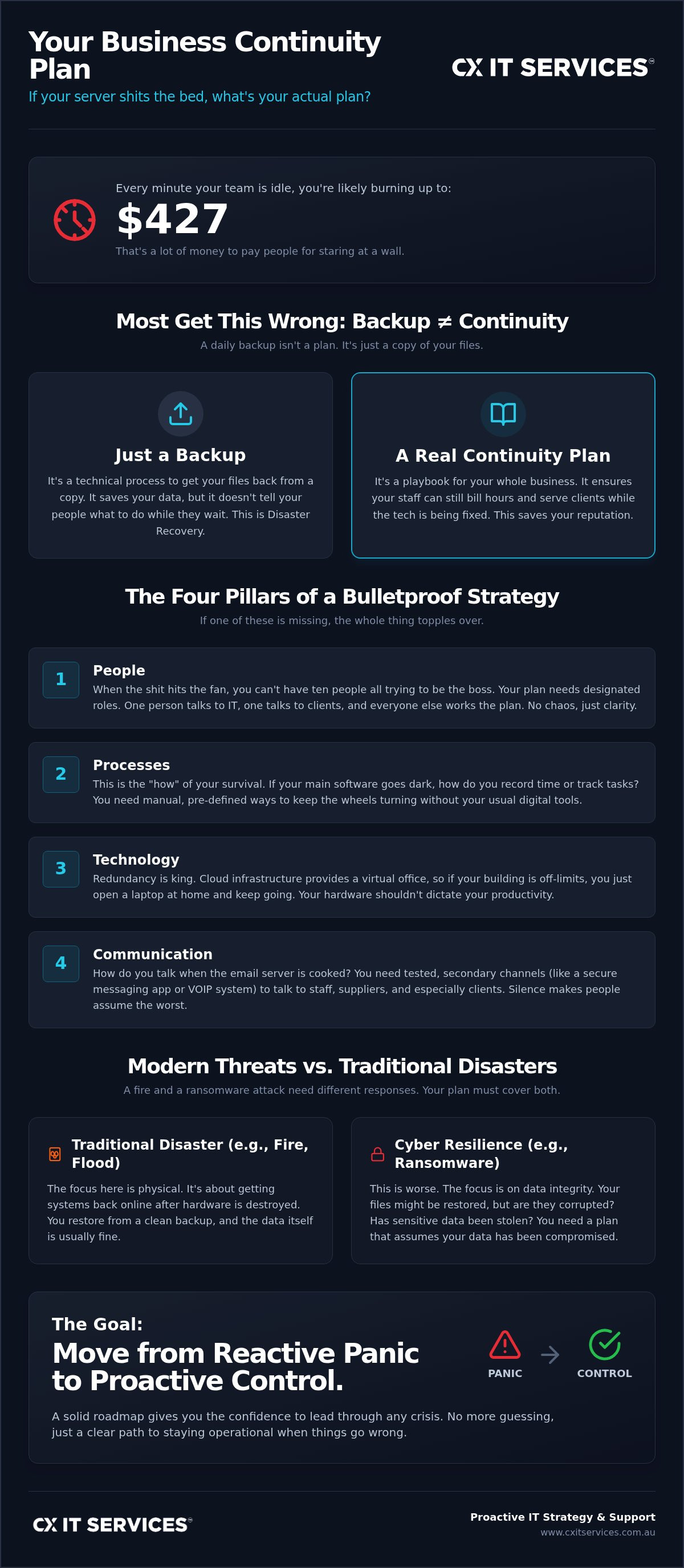
If your server shits the bed tomorrow, do you actually know what your team will be doing ten minutes later? Personally, I reckon most business owners think a daily backup is the same thing as a business continuity plan Australia requires. It isn't. While you're faffing about trying to restore files, you're likely burning up to $427 every single minute in lost output and idle wages. That is a lot of money to pay people for staring at a wall.
I know the frustration. You want to be protected, but those 50-page government templates are enough to make anyone's eyes glaze over. It feels like a choice between total chaos or drowning in paperwork. You need a middle ground that actually works when the power cuts or a ransom note pops up. You need to know that your client data is safe and your staff can actually keep working.
This guide shows you how to build a resilient strategy for 2026. We are moving past the dusty folder era. I will give you a practical roadmap to ensure your downtime stays near zero. We are going to cover the new 2026 standards and the exact steps to keep your business running without the corporate fluff. No more guessing. Just a clear path to staying operational when things go wrong.
Key Takeaways
- A real business continuity plan Australia requires is more than just a backup. It is a functional playbook to keep your staff working when systems fail.
- Focus on the four pillars of strategy. Learn why people and processes matter more than the tech itself during the first hour of an outage.
- Understand why ransomware is often worse than a fire. Your strategy must address data integrity differently than traditional disaster recovery.
- Identify your most critical business functions. We show you how to analyse the true cost of losing these services for 24 hours.
- Move from reactive panic to proactive control. A solid roadmap gives you the confidence to lead through any crisis.
What is a business continuity plan in the Australian context?
Think of a BCP as your playbook for when the unexpected happens. It is the document you pull out of the drawer when the office is under water or your main server decides to give up the ghost. Personally I reckon it is the most undervalued document in most Aussie offices. We spend a fortune on insurance for our cars and buildings, but we often leave our actual ability to work to pure luck. No plan. No protection. Just hope.
A business continuity planning approach is about much more than just ticking a compliance box. It goes beyond simple data backups. A backup is just a copy of your files sitting in a vault. A business continuity plan Australia needs is a strategy that ensures your staff can still bill hours and serve clients while the tech is being fixed. It is the difference between a minor hiccup and a total business collapse.
The difference between BCP and disaster recovery
Disaster recovery is about getting the tech back online. It is a technical process usually handled by your IT provider. Business continuity is about how the whole business survives the outage. If a fire hits your office, disaster recovery focuses on restoring your servers and data. Your BCP focuses on where your staff will sit, how they will access client files, and how they will answer the phones. You need both to stay afloat. One saves your data. The other saves your reputation.
Why a 10-person team needs a formal strategy
Small teams feel the sting of downtime immediately. If you have a massive corporation, a few people offline for a day is a rounding error. If you have ten staff, losing everyone for eight hours is a disaster. Manual workarounds, like using pens and paper, do not scale past a few staff members anymore. Our systems are too integrated. Clients in 2026 expect 100 per cent availability. They do not want excuses about IT outages. They want results. Having a vCIO & IT strategy in place ensures your small team has the same resilience as the big end of town. No excuses. Just results.
The four pillars of a bulletproof continuity strategy
I have seen government guides that focus on stocking up on emergency torches and bottled water. Look, torches are great if the power goes out, but they won't help you bill a client or access a legal file when your server is fried. A modern business continuity plan Australia relies on four specific pillars to actually hold up under pressure. If one of these is missing, the whole thing topples.
People are your first priority. This isn't just about physical safety, though that is obviously the top concern. It is about knowing who is in charge of what. When the shit hits the fan, you cannot have ten people all trying to be the boss. You need designated roles. One person talks to the IT provider. One person talks to the clients. Everyone else keeps their heads down and works the plan. Without clear roles, you just have a room full of panicked people.
Processes are the "how" of your survival. These keep the wheels turning without your usual tools. If your main practice management software goes dark, do you have a manual way to record time or track tasks? Technology provides the infrastructure, but the processes define the movement. Finally, communication ensures nobody is left in the dark. This includes your staff, your vendors, and most importantly, your clients. If you stay silent, people assume the worst.
Securing your digital workspace
Redundancy is king in 2026. If your physical office is inaccessible or your local hardware fails, your team needs to be able to work from anywhere without missing a beat. This is why cloud infrastructure management is the foundation of a modern business. It isn't just about storage. It is about having a virtual environment that mirrors your office. If the building is off-limits, you just open a laptop at home and keep going. It is that simple. You want a setup where the hardware doesn't dictate your productivity.
Communication protocols that actually work
How do you talk when the email server is cooked? I have seen firms grind to a halt because they had no way to message each other once Outlook died. You must establish secondary channels before you actually need them. Whether it is a secure messaging app or a dedicated VOIP system, it needs to be ready and tested. You can use an emergency management plan template to map out these contact lists, but the tech must be live. Keep it simple. If the protocol is too complex, people will just ignore it under pressure.
If you are not sure if your current setup would survive a real-world test, you might want to chat with us about a strategy audit to find the gaps before they become expensive problems.
Cyber resilience vs traditional disaster recovery
A fire is a bloody nightmare, but at least you know what is gone. You can see the charred remains of the server. Ransomware is different. It is invisible, it is malicious, and it is often much worse for an accounting firm or a medical clinic. If your building burns down, your insurance covers the hardware. If your data is encrypted and leaked, your reputation might never recover. Trust is a lot harder to rebuild than a brick wall.
In the managed IT space, we see this every day. The old way of thinking was to plan for if you get hit. The 2026 reality is that you must plan for when. A traditional business continuity plan Australia used to focus on physical site recovery, like finding a spare desk if the roof leaked. Today, it has to focus on cyber resilience. It is about the integrity of your data, not just the location of your staff.
Traditional backups are no longer enough. If your backup drive is plugged into the infected server, the ransomware will likely encrypt the backup too. Now you have no data and no way to get it back. You need a strategy that assumes the primary systems are compromised. Modern plans focus on immutable storage and isolated environments that the hackers cannot touch.
The ransomware reality check
Recovery is not just about having the data. It is about how fast you can get it back. This is where your recovery time objectives (RTO) come into play. If it takes three weeks to scrub your systems and restore files, your business is effectively dead in the water. You need to look at cyber security management services to understand how to build these layers properly. Isolation is the best defence. If your backups are air-gapped or isolated from the main network, the virus cannot reach them. It is the only way to ensure you actually have something to restore when things go pear-shaped.
Protecting your reputation with clients
Downtime looks unprofessional, but a data breach is a different beast entirely. For a legal practice, a breach can be an extinction-level event. According to the OAIC, there were a record 1,205 data breach notifications in 2025. People are more nervous than ever. 82 per cent of Australians say data breaches are their top privacy concern in 2026. Transparency is your best tool during a crisis. If you have a plan, you can tell your clients exactly what is happening. If you are scrambling in the dark, they will smell the panic. A solid plan lets you lead with confidence instead of making excuses.
Step-by-step: Crafting your continuity response
Building a business continuity plan Australia can actually use doesn't require a massive committee or a 200-page manual. It requires a cold, hard look at your operations. Personally, I reckon the biggest mistake is trying to plan for every tiny detail at once. You end up with a document that is too long to read and too complex to follow. Start with the basics. What are your most critical business functions? If you are a law firm, it is your case files. If you are a clinic, it is your patient booking system. Identify the core and ignore the rest for now.
Once you have your list, analyse the impact of losing those functions for exactly 24 hours. Don't worry about a month-long outage yet. Just think about tomorrow. If your team cannot access their files for one full day, what is the damage? Calculate the lost wages and the missed deadlines. This gives you a clear number to show the board or your partners. It turns a "tech problem" into a "business reality."
Assign clear responsibilities to your senior team. You need a captain for each area. One person handles the staff. One person manages the vendors. One person talks to the clients. You want people who can make decisions without waiting for a meeting. Under pressure, speed is more important than perfection. You need a safe pair of hands in every corner of the office. If everyone is responsible, nobody is responsible.
Risk assessment for Aussie professionals
What happens if your practice management software goes down? It is the most likely scenario for most professionals in 2026. Focus your energy on high-probability, high-impact events first. Don't waste time planning for a meteor strike if you haven't planned for a simple NBN outage. You can learn more about aligning your tech with your goals in our guide to IT strategy consulting. It is about future-proofing, not just reacting.
The importance of regular testing
A plan is just a theory until you test it. I have seen perfect-looking plans fail because nobody knew where the physical backup keys were kept. Run a tabletop exercise twice a year. Sit your key people in a room, give them a scenario, and see how they react. Fix the gaps you find without making a fuss. It is better to find a flaw during a drill than during a real crisis. Test it until it becomes muscle memory. Not just once. Every year.
If you want a professional eye to check your work and ensure your strategy is watertight, apply for a continuity review with our strategic team today.
Partnering with a safe pair of hands
Building a business continuity plan Australia can rely on is a massive task. Personally, I reckon you shouldn't try to do it alone. You are already busy running a legal practice, an accounting firm, or a medical clinic. You have clients to serve and a team to lead. Trying to become a disaster recovery expert on the side is a recipe for half-baked results. It is the kind of thing that feels fine until a real crisis hits and the gaps start appearing.
We provide the technical backbone for your continuity. It isn't just about giving you a list of things to do. It is about building the managed IT and security systems that make the plan work. We take the weight off your shoulders by handling the complexity in the background. You get the stability. We handle the stress.
Financial predictability is a core part of resilience. Our fixed monthly fee model means there are no nasty surprises when things break. You don't get hit with massive "emergency" bills just because a server died or a network went down. We are incentivised to keep you running, not to profit from your downtime. It is a partnership built on shared outcomes. Not alone. Together.
How our vCIO services lead the way
We act as your strategic guide through the entire process. A vCIO and IT strategy isn't just about fixing laptops. It is about looking at where your business wants to be in five years and building the tech roadmap to get you there safely. We align your technology with your long-term goals. We ensure your continuity plan grows as your business grows. It is a proactive approach that stops problems before they even start.
National support when it matters most
With 26 years of experience, we have seen every possible challenge. Our 24/7 national support means we are always watching. We often see trouble brewing and fix it before you even know there was a problem. If a physical issue arises, we have on-site technicians available across Australia to get you back on your feet. Being Australian owned and operated means we understand the local landscape and the specific pressures you face. We take the technical complexity out of the equation so you can focus on leading your business. You are in a safe pair of hands. Every hour of every day.
Secure your business future today
You've seen the numbers. Downtime isn't just a tech glitch. It's a massive drain on your revenue and your reputation. A solid business continuity plan Australia requires is the only thing standing between a minor incident and a total shutdown. You've learned that people and processes come first. The tech is just the tool that makes it all possible.
Personally, I reckon you've got enough on your plate without worrying about server air-gaps, immutable backups, or 2026 compliance. We've spent 26 years as an Australian owned and operated partner for firms just like yours. With 24/7 national support, we're always ready to jump in when things go pear-shaped. We take the technical complexity out of the equation so you can lead with confidence.
You manage the team. We'll manage the resilience. It's time to move from hoping for the best to knowing you're ready for anything. A resilient business is a successful one. You've got this.
Get a safe pair of hands for your IT strategy today and stop gambling with your uptime.
Common questions about business continuity
Do I really need a business continuity plan if I have cloud backups?
You absolutely need a plan because backups only solve half the problem. A backup is just a copy of your data sitting in a vault. A business continuity plan Australia requires is the playbook that tells your staff how to keep working while that data is being recovered. If you only have backups, your team will be sitting around twiddling their thumbs for hours or days. You need a strategy for the "now."
How often should an Australian business update its BCP?
Personally I reckon you should update your plan at least once a year. Your business changes fast. You hire new people, you adopt new software, and you change your workflows. If your plan is two years old, it is probably useless. Set a date in your calendar to review it every twelve months. You should also do a quick check whenever you make a major change to your IT stack or move offices.
What is the most common cause of business disruption in 2026?
Cyber incidents are the biggest threat to Aussie professionals right now. Ransomware and sophisticated phishing attacks are far more likely than a fire or a flood. In 2025, the OAIC saw a record 1,205 data breach notifications. This trend is only heading one way. While physical disasters still happen, a digital disruption is what will most likely knock your business sideways this year. You have to plan for the invisible threats.
Can a small business with 10 staff afford a professional BCP?
You can't afford not to have one. If ten staff members are idle for a full day, you are burning thousands of dollars in wages alone. A professional business continuity plan Australia can rely on doesn't have to be a massive capital expense. It is a strategic investment in your stability. Most small firms find that a managed approach is much cheaper than the cost of a single major outage. It is about protecting your cash flow.
Who should be in charge of the business continuity plan?
The business owner or a senior partner must own the plan. You cannot just outsource the responsibility and forget about it. While your IT provider handles the technical recovery, you are the one who understands your critical business functions. You need a lead person inside the office who can make executive decisions during a crisis. It works best as a collaboration between your leadership team and your strategic IT guide.
What is a Recovery Time Objective and why does it matter?
A Recovery Time Objective is simply the deadline for how long you can afford to be offline before the damage becomes permanent. It matters because it dictates your technology choices. If your deadline is two hours, you need a very different backup system than if your deadline is two days. Knowing your limits helps you spend your IT budget where it actually matters. It turns a vague goal into a measurable target.
Does insurance cover the costs of business interruption?
Insurance usually covers physical damage and some lost revenue, but it rarely covers the full cost of a cyber incident or a ruined reputation. Many policies also require you to have a tested plan in place before they will pay out. Don't assume your broker will solve everything. Insurance is a safety net, but a plan is the harness that stops you from falling in the first place. Read your fine print carefully.
How does AI help with business continuity planning?
AI helps by spotting patterns that humans miss. It can predict when hardware is likely to fail or detect a cyber attack in its earliest stages. In 2026, we use AI to automate the recovery process, which drastically reduces your downtime. It can also help simulate different "what if" scenarios during your testing phases. It makes your plan smarter and faster. It is about using modern tools to get a better outcome.