Stop burning cash on AI hype. This blunt guide shows Aussie teams how using AI to reduce business costs actually works, with tools and tips for 2026 compliance.
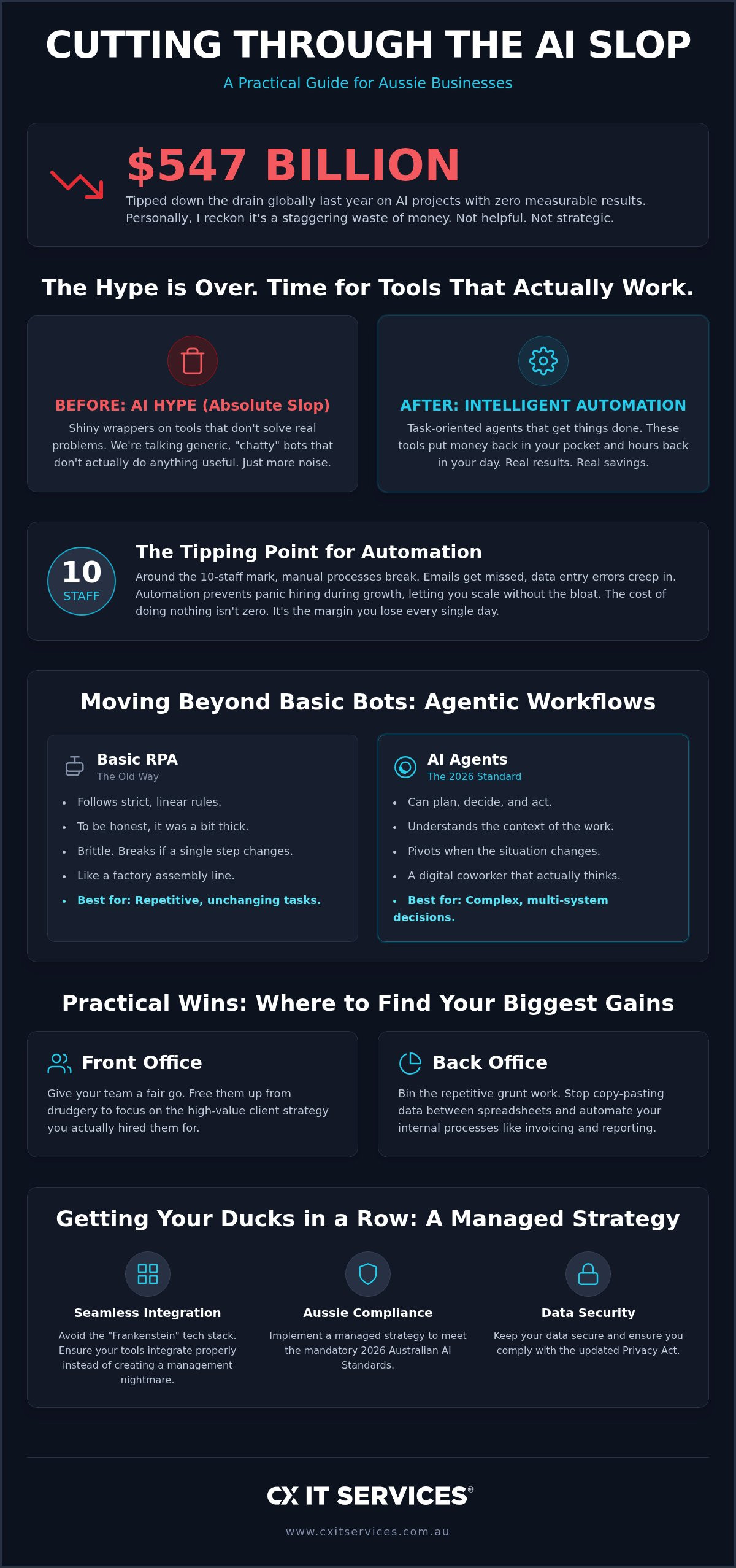
Personally, I reckon there is nothing worse than watching a good business burn cash on shiny toys that do not work. Last year, global firms tipped over $547 billion down the drain on AI projects that delivered zero measurable results. It is a staggering waste of money. Not helpful. Not strategic.
You are likely feeling the pressure to keep up with competitors while being buried under a mountain of AI "expert" noise. It is exhausting. You know that using AI to reduce business costs is the goal, but the fear of falling behind is often matched by the fear of making an expensive mistake. We all want to bin the repetitive data entry and high labour costs, but we need a plan that actually sticks. Real results. Real savings.
This is a blunt, practical guide to cutting through the hype and implementing automation that improves your bottom line. I will show you exactly how Aussie teams are using AI to get more time for high-value work without the corporate fluff. We will cover the new mandatory Australian AI Standards, the specific tools driving 40% productivity gains, and how to keep your data secure under the December 2026 Privacy Act amendments.
Key Takeaways
- Stop wasting cash on AI hype and focus on measurable outcomes by using AI to reduce business costs across your operations.
- Discover how agentic workflows are replacing basic bots to handle complex decisions and multi-step tasks autonomously.
- Avoid the "Frankenstein" tech stack by ensuring your automation tools integrate seamlessly rather than creating a fragmented management nightmare.
- Target high-impact wins in your front and back office to reclaim time for high-value strategic work.
- Implement a managed strategy to ensure your AI tools comply with the mandatory 2026 Australian AI Standards and the updated Privacy Act.
AI Hype is Over: Making Your Business Run Better
Personally, I reckon we have spent way too long talking about what AI might do. In 2026, the circus has finally packed up and left town. The focus has shifted from cool toys to measurable business outcomes. If a tool doesn't put money back in your pocket or hours back in your day, it is just noise. We don't have time for noise.
We are seeing a massive move away from generic, "chatty" bots that don't actually do anything. Instead, Aussie teams are deploying specific, task-oriented agents. This is the core of Intelligent Automation. It is about combining AI with real-world workflows to get things done without the constant babysitting.
Using AI to reduce business costs is not about replacing your best people. It is about giving them a fair go. No one went to uni for six years to spend their afternoon copy-pasting data between spreadsheets. Automation takes the "grunt work" off their plate. It lets them focus on the high-value strategy you actually hired them for. Less drudgery. Better results.
Cutting through the noise of AI slop
Walk onto LinkedIn and you will see that 90 percent of the AI tools being pushed are absolute slop. They are shiny wrappers for things that don't solve real problems. Identifying slop vs. genuine productivity enhancers starts with a blunt, honest look at your current processes. If your process is a mess, automating it just makes a mess faster. You need to find the "leaky buckets" in your workflow before you start talking about AI and automation solutions.
The 10-staff tipping point for automation
There's a specific moment when manual processes break. Usually, it's around the 10-staff mark. Things that worked for five people suddenly cause bottlenecks. Emails get missed. Data entry errors creep in. In the old days, you'd just hire another admin person to handle the overflow. In 2026, that is a tactical mistake.
Automation prevents the need for panic hiring during growth phases. While your competitors are bogged down in recruitment and high labour costs, you can scale without the bloat. The cost of doing nothing isn't zero. It is the margin you're losing every single day through inefficiency. Don't let your growth become your biggest overhead.
Moving beyond basic bots. Why agentic workflows are the new standard for efficiency.
Agentic workflows are self-managing systems that achieve specific business goals. A few years back, we relied on Basic Robotic Process Automation (RPA). It followed strict, linear rules. To be honest, it was a bit thick. If a single step in the process changed or a vendor updated their website layout, the whole thing broke. It was brittle. It was frustrating.
AI agents in 2026 are a different breed entirely. They can plan, decide, and act across multiple business systems without needing a human to click every button. They don't just move data from point A to point B. They understand the context of what they are looking at. If an agent sees an invoice that doesn't match a purchase order, it doesn't just push it through. It flags the discrepancy, searches your email for the relevant quote, and prepares a draft response for your approval. This is why experts call this the most important general-purpose technology of our era. It isn't just a tool. It is a digital coworker that actually thinks.
The difference between RPA and AI agents
RPA is the digital equivalent of a factory assembly line. It is fantastic for repetitive, unchanging tasks like moving data from a spreadsheet into an old legacy database. AI agents are more like a digital project manager that can pivot when the situation changes. Knowing when to use a simple bot versus a sophisticated AI agent is the secret to using AI to reduce business costs without wasting your budget on overkill. Simple for the simple stuff. Smart for the complex stuff.
How agents talk to your existing software
Most Aussie firms already have the foundation they need. Integrating AI with your Microsoft 365 environment is often the smartest first move. We use APIs to create a seamless flow of information between your CRM, your inbox, and accounting software like Xero or MYOB. It turns your scattered tech stack into a unified force. However, let's be real about one thing. Set and forget is a dangerous myth. These systems need professional oversight. You wouldn't leave a new employee to run the firm alone on their first day. AI is no different. It needs a safe pair of hands to keep it on track and secure.
If you want to see how these agents could fit into your specific setup, you can chat with our team about a strategy that actually works for your bottom line. No fluff. Just a strategic approach to using AI to reduce business costs while keeping your data locked down.
Choosing Your Tools: Picking AI That Works Together
The biggest mistake I see Aussie business owners make is signing up for ten different "silver bullet" tools that don't talk to each other. It starts with a clever tool for email, then another for lead gen, and maybe a third for document drafting. Before you know it, you have built a Frankenstein system. It is a fragmented, inefficient nightmare to manage. Instead of saving time, your team spends half their day manually syncing data between platforms that should have been integrated from the start.
When you are using AI to reduce business costs, your focus must be on cohesion. You want a tech stack where the left hand knows what the right hand is doing. This is why we advocate for platforms that offer AI & Automation as an integrated feature rather than a bolted-on afterthought. Security cannot be a "we will fix it later" problem either. If your AI tool is leaking client data to a public model, the cost of the breach will far outweigh any productivity gains.
Off-the-shelf vs custom-built automation
Personally, I reckon most SMEs should steer clear of custom-built AI from scratch. The research shows that custom implementation for Australian firms in 2026 can range from A$70,000 to over A$700,000. That is a massive pill to swallow. Unless you have a highly unique, proprietary workflow, a "configure, do not build" approach is almost always better. Modern SaaS tools are now sophisticated enough to handle 90 percent of what a professional firm needs. It is faster. It is cheaper. It actually works.
The Must-Have checklist for AI tools
Before you enter your credit card details for a new subscription, you need to ask three blunt questions. First, where is the data stored? With the Australian Privacy Act amendments in full effect as of December 2026, data sovereignty is a non-negotiable. For 82% of Australian financial and healthcare institutions, on-shore data hosting is now a mandatory requirement. If the tool hosts your data in a jurisdiction with weak protections, it is a liability.
Second, is it scalable? A tool that works for five people might choke when you hit 50 staff. You need to ensure that using AI to reduce business costs today doesn't create a technical debt that breaks your budget next year. Finally, look for audit trails. You must be able to see exactly why an AI made a specific decision. If you cannot audit the output, you cannot trust the results. Transparency is the only way to maintain control.
Practical automation for the front and back office. Where to find your biggest wins.
Personally, I reckon the quickest way to fail at automation is trying to boil the ocean. You don't need to reinvent your entire firm overnight. Start where the pain is highest and the technical complexity is lowest. This is the most effective way of using AI to reduce business costs without losing your mind. Focus on the low-hanging fruit first.
To find your biggest wins, I suggest a simple exercise. Give your team a basic tracking sheet for one week. Ask them to log every task that feels like "digital drudgery." Look for anything that involves moving data from one screen to another or drafting the same email for the tenth time. At the end of the week, tally the hours. You will likely find that 20% of your labour cost is being swallowed by tasks a machine could do in seconds. It is a massive drain on your margins.
Front office wins: Sales and client service
For a local accounting or legal firm, the front office is where you win or lose clients. You can automate lead qualification so your senior partners only talk to hot prospects. No more wasting time on tyre-kickers who don't fit your ideal client profile. AI can also draft personalised responses for common enquiries, pulling data directly from your website and linking it to your CRM without you lifting a finger. It keeps the momentum going while you focus on the work that actually bills.
Back office wins: Admin, HR, and Finance
The back office is where the real "invisible" costs live. Automating invoice processing and reconciliation can save your accounts team dozens of hours every month. Instead of manual entry, AI reads the invoice, checks it against your records, and flags discrepancies. It is also a game-changer for HR. You can streamline staff onboarding by automating document collection and verification.
For my mates in the legal and financial sectors, using AI to reduce business costs often looks like using agents to summarise 50-page documents in seconds. It doesn't replace the professional. It just gets them to the point of analysis faster. Efficiency is the name of the game here. If you are ready to stop the drudgery and actually scale your firm, apply for an automation strategy session with our team today. We will help you find the wins that actually matter.
Getting your ducks in a row. Why a managed approach beats a DIY tech disaster.
Personally, I reckon implementing AI without a strategy is like building a house without a slab. It might look the part for a week or two. But as soon as you put any real pressure on the system, the whole thing starts to crack. Using AI to reduce business costs is a long-term play for stability. It is not a quick fix you can just download and forget. You need a Safe Pair of Hands to ensure your automation does not break your core business logic or compromise your professional reputation.
This is why modern IT Strategy Consulting now includes AI as a foundational pillar. We look at how these tools fit into your broader goals over the next three to five years. It is about making sure your tech stack remains secure, scalable, and actually profitable. If you are using AI to reduce business costs, you have to account for the 15-25% annual maintenance cost required to keep these agents running smoothly as platforms evolve.
The security risks of Shadow AI
Letting your staff use random, unvetted AI tools is a Cyber Security nightmare. If your team is feeding sensitive client data into public models to draft letters, you are losing control of your intellectual property. With the Australian Privacy Act amendments coming into full effect on December 10, 2026, the stakes are massive. Failing to govern automated decision-making involving personal information can lead to penalties of up to A$50 million. You need a clear, enforced AI usage policy. Security is the foundation of trust.
Why a fixed monthly fee makes sense for AI
The DIY approach often leads to massive bill shock. Unmanaged API costs and token usage can spiral out of control if you don't have oversight. A fixed monthly fee model provides the predictability that a growing Aussie firm needs. It covers the strategy, the implementation, and the ongoing optimisations as the technology shifts. Choosing Managed IT Services Australia ensures you have a clear path to growth without the technical debt. You get the innovation of an efficiency expert with the reliability of a local partner. Steady. Secure. Smart.
Taking the Next Step Toward Actual Efficiency
Personally, I reckon the time for "wait and see" is finished. Using AI to reduce business costs is no longer a futuristic experiment. It is a fundamental utility that needs to be managed with the same discipline as your payroll or your cybersecurity. The Aussie teams winning in 2026 are those that have moved past basic bots to smart, agentic workflows that actually understand their business context. They are focusing on margin. They are focusing on growth.
You don't have to navigate this technical minefield alone. We are a 100% Australian owned and operated team with 24/7 national support. Our model is built on fixed monthly fees with no hidden surprises. We provide the professional strategy and the security oversight so you can focus on your high-value work without the DIY tech headaches. Stability. Control. Results.
If you are ready for a straight-talking partner who cares about your bottom line, book a blunt, no-nonsense AI strategy session with CX IT Services. Let's get your automation sorted properly and put those hours back in your day. You've got this.
Frequently Asked Questions
Is AI automation expensive for a small business to set up?
It depends entirely on the complexity of your workflows. While some custom enterprise builds are a massive investment, many Aussie firms find that using AI to reduce business costs is achievable through a fixed monthly fee model. This approach avoids the massive upfront bill and includes the ongoing strategy needed to keep the system profitable. It is about the return on investment, not just the initial spend.
Can AI automation replace my current staff?
I don't see AI as a way to sack your team. It is a way to bin the grunt work that they probably hate doing anyway. By using AI to reduce business costs, you are actually giving your people a fair go at high-value work. Australian businesses that adopt these tools report an average productivity increase of 40% within the first year. You keep your best talent; you just make them more effective.
How much time does it take to see results from AI automation?
You should start seeing measurable efficiency gains within the first three months. Quick wins usually happen in the back office, specifically in areas like invoice processing or data reconciliation. While the full strategic ROI can take up to a year to mature, the reduction in manual errors is often immediate. It is a steady progression toward a more streamlined operation, not an overnight miracle.
What happens if the AI makes a mistake in a client document?
Accountability always rests with the human professional. AI is a tool for drafting and analysis, but it is not a licensed expert. You must maintain a strict "human in the loop" process for every document that leaves your office. If you wouldn't trust a junior clerk to send a file without a final check, don't trust a machine. Properly managed systems include audit trails so you can see exactly why a decision was made.
Is my business data safe when using AI tools?
Only if you stay away from public, unvetted platforms. Feeding sensitive client data into free tools is a massive risk to your intellectual property. With the December 2026 Privacy Act amendments, the penalties for data mishandling are now up to A$50 million. We prioritise private, governed environments where your data stays on-shore and secure. Security must be baked into the strategy from day one.
Do I need to hire a full-time AI expert to manage these systems?
Personally, I reckon that is a waste of a salary for most SMEs. A managed IT partner can handle the heavy lifting of implementation and maintenance for a fraction of the cost. You get access to a team that lives and breathes this tech without the overhead of a full-time specialist. It provides a predictable path to growth. You get the expertise without the recruitment headache.
Can AI automation work with my old legacy software?
Yes, we often use Robotic Process Automation (RPA) as a bridge for older systems. If your legacy software doesn't have a modern API, a bot can be trained to interact with the user interface just like a human would. It allows you to modernise your workflows without the massive cost of replacing your entire core infrastructure. It is a practical way to extend the life of your existing tech stack.
What is the first step to start automating my business processes?
The first step is a blunt audit of your team's time. Track your hours for one week and identify every task that is repetitive, manual, and low-value. Once you have found where the hours are leaking, you have a clear target for automation. Don't buy the software until you have identified the problem. A strategic audit ensures you are solving real bottlenecks rather than just chasing shiny toys.