
Sick of surprise IT bills? This 2026 guide breaks down all-inclusive IT support pricing for Aussie firms. Get the real rates and stop getting ripped off.
Most IT blokes make more money when your business is falling apart. It’s a conflict of interest that’s as subtle as a brick through a window. Personally, I reckon if your tech is down, your provider should be the one sweating, not counting their extra billable hours.
I know the feeling. You open a monthly invoice expecting the usual fee, only to find a list of "out of scope" charges that cost more than the service itself. It’s frustrating. It's exhausting. And it’s a rubbish way to run a professional partnership.
You want to know exactly what you’re paying for without the nasty surprises. This guide breaks down everything you need to understand about all-inclusive IT support pricing for Australian businesses in 2026. No fluff. No hidden extras. Just a fair shake for your firm.
We will explore the standard market rates for comprehensive support, how to spot a contract that actually covers your cybersecurity, and why a single point of contact is the only way to keep your sanity while managing a growing team. Let’s get your tech sorted once and for all.
Key Takeaways
- Learn why traditional IT billing is a bit of a stitch-up. It is a conflict of interest that makes your provider more money when your tech breaks.
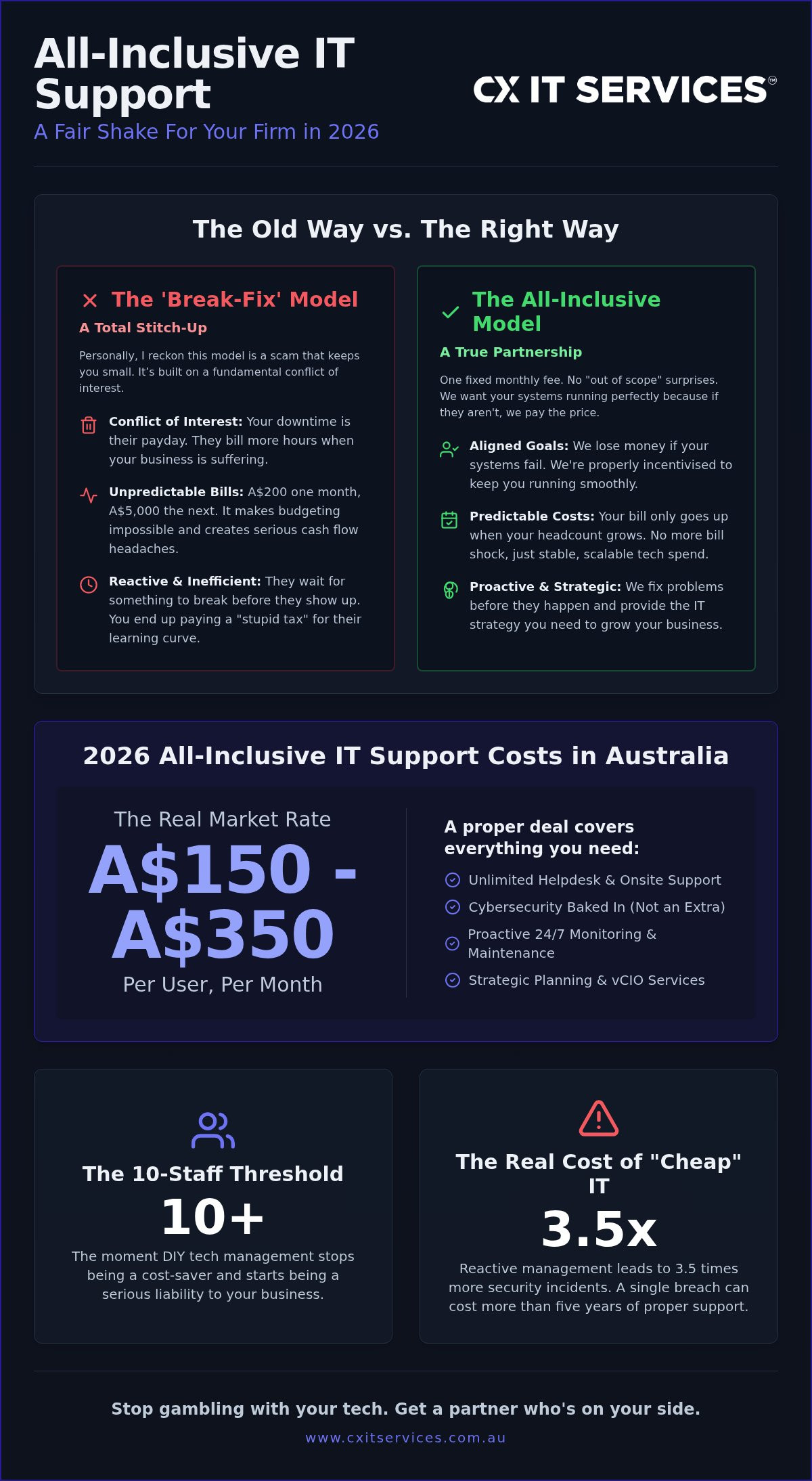
- Get the real numbers on all-inclusive IT support pricing for 2026. Expect to pay between A$150 and A$350 per user for a service that actually does the job.
- Spot the dodgy contracts that hide behind vague language. A real all-inclusive deal should cover your helpdesk, security, and planning without the bill shock.
- Stop treating cybersecurity like an optional extra. We show you why it needs to be baked into your monthly fee to keep your business safe.
- Understand the 10-staff threshold. This is the moment when DIY tech management stops being a cost-saver and starts being a liability.
Why traditional IT billing is a total headache for your bottom line
Personally I reckon the old break-fix model is a scam that keeps you small. It is built on a fundamental conflict of interest. Your IT guy makes more money when your business is suffering. If everything is running smoothly, they aren't billing. This creates a reactive cycle where they wait for something to snap before they show up. It is the opposite of a partnership. It's a rubbish way to run a business.
We see too many Aussie firms stuck in this loop of repairs and unpredictable invoices. You get a bill for A$200 one month and A$5,000 the next because a server decided to quit. This makes managed IT support and predictable all-inclusive IT support pricing look like a godsend for your cash flow. It moves you into a managed services model where the provider is incentivised to keep things working. If they don't fix it fast, they lose money. Not you.
The trap of the hourly rate
Hourly rates look great on a quote until a server goes down for three days during your EOFY rush. Suddenly, that "affordable" rate is bleeding you dry. You end up paying for the technician’s learning curve rather than their expertise. If they take four hours to fix a one-hour problem, you’re the one who pays the "stupid tax." It is inefficient and expensive.
Budgeting becomes impossible when your tech spend fluctuates. You can’t plan for growth when you’re constantly looking over your shoulder for the next big crash. A business needs stability to scale. Relying on hourly billing is like trying to drive a car while only looking in the rearview mirror. You only see the problems after you've already hit them.
Why "cheap" IT is actually a tax on your productivity
Budget providers often skip the proactive maintenance that prevents the big crashes. They aren't checking your backups or patching your systems unless you ask. If they aren’t monitoring your systems 24/7, you are the one doing their job for them. You become the unpaid IT manager. Your staff lose hours of work while waiting for a "cheap" technician to call them back.
The hidden cost of "cheap" hourly rates often shows up as massive downtime. According to the Australian Cyber Security Centre, reactive management leads to 3.5 times more security incidents than proactive care. A single security breach can cost more than five years of professional support. It isn't a saving. It is a gamble with your reputation and your clients' data.
Breaking down the all-inclusive IT support model
An all-inclusive model is exactly what it sounds like. One fixed monthly fee. No "out of scope" surprises. No hidden extras. It covers everything from your daily helpdesk tickets to your long-term vCIO and IT strategy. The goal is simple. We want your systems running perfectly because if they don't, we are the ones who pay the price in time and resources.
Personally I reckon this is the only way to run a business with 10 or more staff. At that size, you can’t afford to have your team sitting around because the printer is acting up or the cloud is down. You need a partner who is already three steps ahead of the problem. You need stability. You need control.
The per-user approach explained
In 2026, counting every individual laptop, tablet, and smartphone in the office is a waste of everyone's time. Most modern providers focus on the number of people in your team instead. This makes all-inclusive IT support pricing much easier to manage and far more transparent for your accounts department.
If you hire a new solicitor or accountant, you know exactly how much your bill will increase. It is predictable. It is scalable. It simplifies the invoice so you can actually understand what you are paying for without needing a degree in computer science.
- Your costs grow only when your headcount grows.
- One line item on the invoice replaces a dozen vague "per device" charges.
- You stop paying for "gadget management" and start paying for "people support."
Why incentives matter in IT support
The real magic of this model is the alignment of goals. In a traditional setup, the IT guy gets paid more when things break. In an all-inclusive agreement, the provider loses money if your systems fail. They have to fix it on their own time and their own dime. This shift in logic forces the provider to be proactive. They have to organise your systems properly from day one to avoid constant support calls later.
It turns your IT provider into a partner rather than just another vendor waiting for a crisis. This proactive approach is critical when you consider the rising cybersecurity threats for Australian businesses. You don't want someone who reacts to a breach after your data is already on the dark web. You want someone whose entire business model depends on preventing that breach from ever happening.
If you are tired of the "us versus them" relationship with your current tech provider, it might be time to see how a fixed-fee partnership works for your firm. It is about peace of mind. It is about getting back to work.
2026 All-inclusive IT Support Costs in Australia
Getting a straight answer on pricing in this industry is often like trying to nail jelly to a wall. But in 2026, the market has settled into a clear range for professional services. For a comprehensive managed service in Australia, you should expect to pay between A$150 and A$350 per user per month. This is the sweet spot. It provides enough margin for the provider to actually do their job properly while keeping your costs predictable.
If a quote lands on your desk for under A$100 per user, be careful. Personally I reckon you need to ask exactly what they are leaving out. Usually, it is the proactive stuff. They might give you a helpdesk, but they will skip the security patching or the strategic planning. You want to understand what a managed service provider is actually promising before you sign. A suspiciously low monthly fee almost always leads to "out of scope" charges and bill shock later.
Value is found in the middle of that range. You want a safe pair of hands without paying a premium just for a global brand name. You are paying for expertise, stability, and the assurance that your managed IT support won't disappear when you need it most.
Factors that drive the price up or down
Not every business has the same requirements. A law firm with strict compliance needs will always pay more than a small retail business with five tablets. The complexity of your cloud environment is a major driver. If you are running a complex hybrid setup with legacy servers and Microsoft 365, it simply takes more man-hours to manage and secure properly.
The level of cyber security required is the other big factor. In 2026, basic antivirus does not cut it. High-end all-inclusive IT support pricing often includes advanced threat detection and 24/7 monitoring. If your sector is a prime target for hackers, that extra investment is just smart insurance. Finally, consider your hours. Standard business hours support is naturally cheaper than a full 24/7 model.
Benchmarking your IT spend
How much should you actually be spending on tech? Most growing Aussie firms should budget around 4% to 6% of their annual revenue for technology. This is not just for support. it covers your hardware, your software, and your digital growth. When you are comparing quotes, look at the total cost of ownership rather than just the monthly support fee.
Don’t forget the extras that sit outside the support contract. You still have to pay for your software licences, your internet connectivity, and any specialist SaaS tools you use. The goal is to find a provider who acts as a strategic guide. You want someone who understands vCIO and IT strategy so they can help you spend that budget wisely and avoid wasting money on tools you don't need.
The essential checklist for a truly all-inclusive IT agreement
A real all-inclusive deal shouldn’t have a list of exclusions longer than the service list. Personally I reckon if you need a magnifying glass to find what isn't covered, you're being taken for a ride. The whole point of all-inclusive IT support pricing is to remove the guesswork. If your provider starts charging extra for every minor security update or server reboot, it isn't a managed service. It's just a subscription to more bills.
You want a contract that is simple. One that covers everything your team needs to stay productive. If the fine print says "on-site visits not included" or "security patches billed hourly," walk away. You deserve a fair shake. Not a bill for every time a technician picks up the phone.
The core inclusions you cannot ignore
Unlimited helpdesk support for all staff members during business hours is the baseline. Your staff shouldn't be afraid to call for help because of a ticking clock. If a junior accountant spends three hours fighting a printer, that is three hours of billable time lost. A proper agreement includes unlimited remote and on-site support to keep the wheels turning.
It must also include comprehensive cyber security as a standard feature, not an add-on. In 2026, security is not a luxury. It is the foundation. This means managing multi-factor authentication (MFA), email security, and advanced threat protection without you having to ask. Proactive patch management for all devices and servers is also non-negotiable. It keeps the bugs out before they become a crisis.
Modern extras for the 2026 landscape
The tech world has moved on. We are seeing a massive shift towards AI and automation services to help teams work faster. If your IT provider isn't talking to you about automation, they are keeping you in the past. They should also be managing your Microsoft 365 environment. This ensures you aren’t wasting money on unused licences or incorrect tiers.
Strategic advice from a Virtual CIO is what separates a support desk from a partner. You need someone looking at the big picture. This includes ensuring your disaster recovery is actually tested, not just talked about. If they haven't run a simulation in the last six months, your backup is just a hope, not a plan. Regular strategic reviews ensure your tech is actually helping you grow. If your current agreement feels like a list of reasons why they won't help you, get a quote for a real partnership instead. It’s time to stop paying for excuses and start paying for outcomes.
Predictable growth with CX IT Services
Personally I reckon your IT should be the least of your worries as a business owner. You have a firm to lead. You have clients who expect excellence. You shouldn't be spending your Tuesday afternoon arguing with a tech provider about why a software update cost you an extra A$400. At CX IT Services, we don't do corporate fluff or hidden fees. We do fixed monthly IT support that actually works.
With 26 years of industry experience, we provide a safe pair of hands for national businesses. Once you hit that 10-staff tipping point, professional support becomes non-negotiable. Our all-inclusive IT support pricing is built to reduce your costs through proactive management. We find the problems before they find you. This is how we maintain reliability for our clients across the country. Not alone. Together.
The CX IT Services difference
We are Australian owned and operated. Our focus is on national reliability. We ensure your team stays connected regardless of where they are working. We take a blunt, direct approach to technology. We prioritise results over jargon. If a tool isn't helping you grow, we will tell you straight.
We handle everything from your business internet to your AI and automation under one predictable fee. By consolidating your tech stack, we remove the stress of managing multiple vendors. You get a single point of contact. You get transparent all-inclusive IT support pricing that scales with your business. It is about efficiency. It is about stability.
Ready to stop the bill shock?
If you are tired of the "out of scope" excuses, it is time to switch to a partner who actually cares about your success. Vague contracts and reactive repairs only serve the provider's bottom line. They don't serve yours. We help you organise your tech so you can focus on the high-level work that moves the needle for your business.
Stop gambling with your productivity. Start building a foundation that supports your long-term growth. Apply for a strategy call with CX IT Services today. Let's get your technology sorted once and for all.
Secure your firm's future with predictable tech
You now have the full picture on all-inclusive IT support pricing for 2026. It's about more than just a monthly bill. It's about aligning your goals with a partner who actually wants your systems to work. Personally I reckon the peace of mind you get from knowing your cybersecurity and strategy are handled is worth every cent. You stop being a reactive repair shop and start being a modern, efficient business.
At CX IT Services, we bring 26 years of Australian IT expertise to the table. We provide a fixed monthly fee with zero hidden extras. Our national support network and on-site technicians ensure you're never left stranded. Not alone. Together.
It's time to stop the bill shock and start focusing on your growth. Apply for a fixed-fee IT strategy session today. Let's get your technology sorted once and for all.
Frequently Asked Questions
What is the average cost of managed IT services in Australia for 2026?
Most Australian businesses should expect to pay between A$150 and A$350 per user per month for a professional managed service. This range covers the middle ground where you get a safe pair of hands without paying for a global brand name. Personally I reckon if you find a quote for under A$100, you should look very closely at the exclusions. It is usually the proactive security and strategic planning that get cut first.
Does all-inclusive IT support include the cost of hardware?
No, the monthly support fee covers the management and maintenance of your technology, not the physical hardware itself. You still need to pay for laptops, servers, and networking gear separately. However, a good agreement includes hardware procurement services to help you find the right equipment at the right price. This ensures your gear is compatible with your systems from day one, which reduces long-term support headaches and keeps your team productive.
Are Microsoft 365 licences usually included in the per-user price?
Microsoft 365 licences are almost always billed as a separate line item rather than being baked into the support fee. This is because licence costs are set by Microsoft and can change independently of your support agreement. Your provider should manage these licences for you to ensure you aren't paying for staff who have left the firm. It keeps your all-inclusive IT support pricing transparent and prevents you from wasting money on unused software seats.
What happens if we have a major emergency after hours?
If you have a critical system failure outside of standard business hours, our 24/7 support availability ensures someone is ready to help. We provide on-site technicians across Australia for situations that can't be fixed remotely. Personally I reckon an emergency shouldn't be an excuse for a massive bill. A truly comprehensive agreement defines what counts as a priority incident and ensures you have a clear path to resolution regardless of the time.
Can all-inclusive pricing help reduce my overall IT budget?
Yes, it reduces your total cost of ownership by eliminating unpredictable "out of scope" charges and minimising expensive downtime. Proactive management stops small issues from turning into catastrophic failures that require emergency repairs at A$400 an hour. When your provider is incentivised to keep things running, you spend less on crisis management and more on strategic growth. It turns your technology from a black hole of expenses into a predictable, manageable line item.
Is cybersecurity always included in a managed IT agreement?
It should be a standard feature in 2026, but some budget providers still treat it as an optional extra. Personally I reckon a support contract without cybersecurity is like a car without brakes. It is dangerous and irresponsible. A professional agreement must include advanced threat protection, MFA management, and email security as part of the core fee. You need a provider who views security as a fundamental requirement rather than a way to upsell you.
What is usually considered "out of scope" in an all-inclusive contract?
Major projects like a full office relocation or a massive cloud migration are typically billed as separate professional service fees. These require significant one-off resources that sit outside daily maintenance. However, everything related to keeping your existing team running, like helpdesk tickets, security patches, and strategic reviews, must be included. If you are constantly being billed extra for "basic" tasks, your contract isn't truly all-inclusive. It is just a bait and switch tactic.
How often should IT support pricing be reviewed?
You should review your agreement annually to ensure it still matches your business goals and staff count. Personally I reckon the 10-staff tipping point is the most critical time to check your numbers. As you grow, your complexity increases and you might need more advanced security or strategic vCIO services. A regular review ensures your all-inclusive IT support pricing remains fair and that you aren't paying for services or licences you no longer use.





 Microsoft Partner