Stop leaking cash on tech you don't use. Our guide to Technology Expense Management shows Aussie businesses how to cut SaaS sprawl and fix your IT budget.
If you sat down and tallied every software subscription, cloud licence, and "incidental" tech fee hitting your business bank account this month, would you actually like the number you see?
Personally, I reckon most Aussie business owners would rather stare into the sun. Gartner forecasts total IT spending in Australia to reach over $172 billion in 2026. This is exactly why Technology Expense Management has shifted from a back-office chore to a survival skill. With SaaS spending alone hitting nearly $16.4 billion, the "subscription creep" is becoming a full-blown sprint.
You are likely dealing with Shadow IT where staff sign up for apps without a word to management. You are probably wondering if you are getting a fair go on contract pricing or if you are just paying the "lazy tax" on legacy accounts. I have seen enough balance sheets to know that most firms are leaking cash through dozens of tiny, unnoticed holes. It is frustrating, it is messy, and it is completely avoidable.
I am going to show you how to stop wasting money on tech you do not use and finally get your IT budget under control. We will explore how to build a single point of truth for every cent you spend. By the end of this, you will know how to lower your monthly overheads and move toward a model of predictable, fixed IT spending that actually makes sense for your bottom line.
Key Takeaways
- Understand why your tech budget is leaking through SaaS sprawl and staff buying apps without your knowledge.
- Learn why software tools alone cannot fix your bills without human discipline and a clear management process.
- Discover how to perform a thorough audit to identify duplicate subscriptions and "zombie" accounts you no longer need.
- See how Technology Expense Management fits into a wider vCIO strategy to keep your monthly overheads predictable.
- Find out how to trade bill fatigue for a single point of truth across every cent you spend on technology.
What is Technology Expense Management and why is it a mess?
Personally I reckon Technology Expense Management is just a fancy way of saying "stop wasting money on things you don't need." It is the process of tracking and optimising every single cent you spend on your business tech. This isn't just about your internet or your office phones anymore. It covers your entire digital footprint. Software. Cloud infrastructure. Mobile data. Hardware. Everything.
In 2026, most Aussie businesses are bleeding cash through unused licences. Fair dinkum, the amount of money left on the table is staggering. Gartner forecasts that Software-as-a-Service (SaaS) spending in Australia will reach almost $16.4 billion this year. That is a lot of money sitting in accounts that staff haven't logged into for six months. If you look at the basic foundations of What is Expense Management? it usually focuses on travel or stationery. But tech is different. It's invisible. It's recurring. And it's expensive.
With total IT spending in Australia set to hit $172.3 billion in 2026, the stakes have never been higher. We are seeing a massive shift toward AI and automation. This drives up infrastructure costs. If you don't have a handle on your baseline spending, these new costs will sink you. It's about visibility. It's about control. Without a strategy, you're just guessing.
The difference between Telecom and Technology management
Years ago, you just had a Telstra bill to worry about. Telecom management was simple. You checked the phone lines and the mobile data usage. Technology management is the whole lot. It includes your cloud services and server infrastructure. It looks at your managed IT support costs and every single SaaS subscription. The scope has exploded. If you are still only looking at the phone bill, you are missing 80% of the problem.
Why spreadsheets are where tech budgets go to die
Most firms still try to track this in Excel. I'll be blunt. It doesn't work. Manual tracking is out of date the minute you hit save. Staff members leave but their accounts stay active. Projects end but the cloud storage keeps billing. Spreadsheets do not alert you when a contract is about to renew. They don't tell you if you are being overcharged. You need a live system to catch these errors before they compound. Otherwise, you're just documenting your own financial loss.
From phone bills to SaaS sprawl: The evolution of TEM
I remember when managing tech expenses meant checking the monthly Telstra bill for any weird long-distance calls. It was simple. You had a few phone lines and maybe a basic internet connection. Gartner defines TEM in its original form as the management of these telecommunications expenses. But the world moved on. We aren't just managing phone lines anymore. We are managing an entire ecosystem of digital services.
Now, every department in your business has its own credit card and its own favourite apps. Marketing signs up for a design tool. HR buys a recruitment portal. Sales gets a new CRM. This is what we call Shadow IT. It is bloody expensive because nobody is looking at the big picture. When your departments operate in silos, you end up paying for the same features twice. Personally, I reckon half the businesses in Australia are currently paying for three different ways to do the exact same thing.
This evolution is why Technology Expense Management has become so critical. It is no longer a back-office accounting task. It is a strategic necessity. If you don't have a bird's-eye view of every subscription, you are effectively letting your budget bleed out from a thousand small cuts. If you want to see how we help firms get a handle on this, you can apply for a review of your current setup.
The rise of the "Subscription Trap"
Five dollars here and ten dollars there adds up fast. It feels like a rounding error on your bank statement until you multiply it by fifty staff. Unused licences are the biggest drain on modern IT budgets. I have seen teams paying for 20 staff seats on a platform when they only have 10 employees. They forget to cancel accounts when people move on. They pay for "pro" features that nobody actually uses. It is pure waste.
Cloud infrastructure and the hidden costs
Cloud services are great for flexibility, but they make it very easy to leave the digital lights on. Data storage costs can skyrocket if nobody is watching the meter. We call this cloud sprawl. Cloud sprawl is the silent budget killer where unmonitored cloud instances and abandoned data sets continue to rack up charges every single minute of the day. Without Technology Expense Management, you are just writing a blank cheque to your cloud provider every month.
Software alone will not save your budget
Personally, I reckon buying a Technology Expense Management tool to fix your budget is like buying a treadmill to lose weight. It sits in the corner. It looks impressive. But if you never step on it, nothing changes. Software is just a mirror. It shows you where the fat is. It doesn't do the hard work of trimming it away.
The tool is useless if you don't have the time or the expertise to use it properly. I see it all the time. A business owner buys a fancy dashboard, looks at it once, and gets overwhelmed by the data. They go back to ignoring the invoices because they have a business to run. You need analysts who actually know what they are looking at. You need experts who can interpret the spikes in your cloud usage or spot the billing errors that have been hiding in plain sight for years. Data without interpretation is just noise.
Managed services provide the hands-on work that software cannot. A dashboard won't pick up the phone to argue with a vendor. It won't sit through a contract negotiation to ensure you aren't being taken for a ride. This is about disciplined governance. It is about having a safe pair of hands to manage the complexity while you focus on your clients. If you aren't prepared to act on the data, the software is just another subscription you're wasting money on.
The Managed Service advantage
We do the auditing so you can run your business. It's that simple. While you are focusing on your billable hours, a partner is digging through the digital trash to find savings. This isn't just about cutting costs. It is about strategic oversight. A dedicated Managed IT Support partner can negotiate better rates because they know what the market is actually doing. They have the leverage that a single small business often lacks. They know when a price is "fair dinkum" and when you are being overcharged.
Why vendor neutral advice matters
Here is a dirty little secret. Some IT providers take kickbacks from carriers or software vendors. They recommend a specific cloud service or phone system because it pads their own pockets, not because it's right for you. Personally, I think that's rubbish. Trust is earned through transparency, not corporate polish. CX IT Services stays independent to get you the best deal. We don't have a horse in the race. If a cheaper service is better for your firm, that is what we recommend. Our goal is to make Technology Expense Management a source of stability for your budget. We want your IT spending to be predictable, not a monthly surprise that makes you wince.
A Fair Dinkum Audit: How to trim the tech fat
Gathering every single tech-related invoice for the last quarter is the only way to see the truth. Personally, I reckon most business owners are too busy to do this properly. They see a monthly charge and assume it is necessary. It often isn't. I have seen businesses pay for high-speed internet at an office they closed six months ago. That is a "zombie" service. It is dead, but it is still eating your cash. Effective Technology Expense Management starts with a clean slate and a critical eye.
Look for duplicate services that do the same thing. Do you have three different PDF editors across three different departments? Do you have two project management tools because Sales didn't like what Marketing was using? This happens more often than you think. It is not just about the big bills. It is about the $15 monthly charges that aggregate into thousands of dollars of waste every year. If you aren't looking, you are losing.
Step 1: The Inventory Roundup
One way to stop the bleed is by using industry-specific software that combines multiple functions. For music and performing arts services, read more about Xperios and how an all-in-one management platform can streamline your tech budget.
Start by listing every laptop, phone, and software seat you own. This is your baseline. If you are looking at Hardware Procurement, you need to know exactly what is already in the cupboard. I have a simple rule for this. If you cannot find it, you should not be paying for it. Check the serial numbers on your mobile plan. Match them to the physical devices in your staff's hands. You will likely find a few "ghost" handsets still on the bill from people who left the firm years ago.
Step 2: The Usage Reality Check
Ask your team which tools they actually use every day. Don't just look at the login data. Talk to them. You will be surprised how much software is just digital clutter that gets in the way of real work. A lot of Microsoft 365 Management involves scaling back licences to match reality. If someone only needs email and basic file storage, don't pay for the full suite of premium apps. Licences for staff who left the company months ago are the easiest win. Kill them immediately.
Step 3: Contract Renegotiation
Never let a contract auto-renew without a review. The "lazy tax" is real. Prices change and better deals are always out there. Carriers and software vendors count on you being too busy to check the market. They bank on your inertia. This is why having a strategic partner is vital. Our Virtual CIOs handle these negotiations for you to ensure you are always on the best possible rate without you having to lift a finger.
Trimming the fat isn't a one-time job. It is a habit that requires constant attention. If you want a professional eye to look over your bills and find the leaks, you should apply for a technology expense review and let us get your budget back under control.
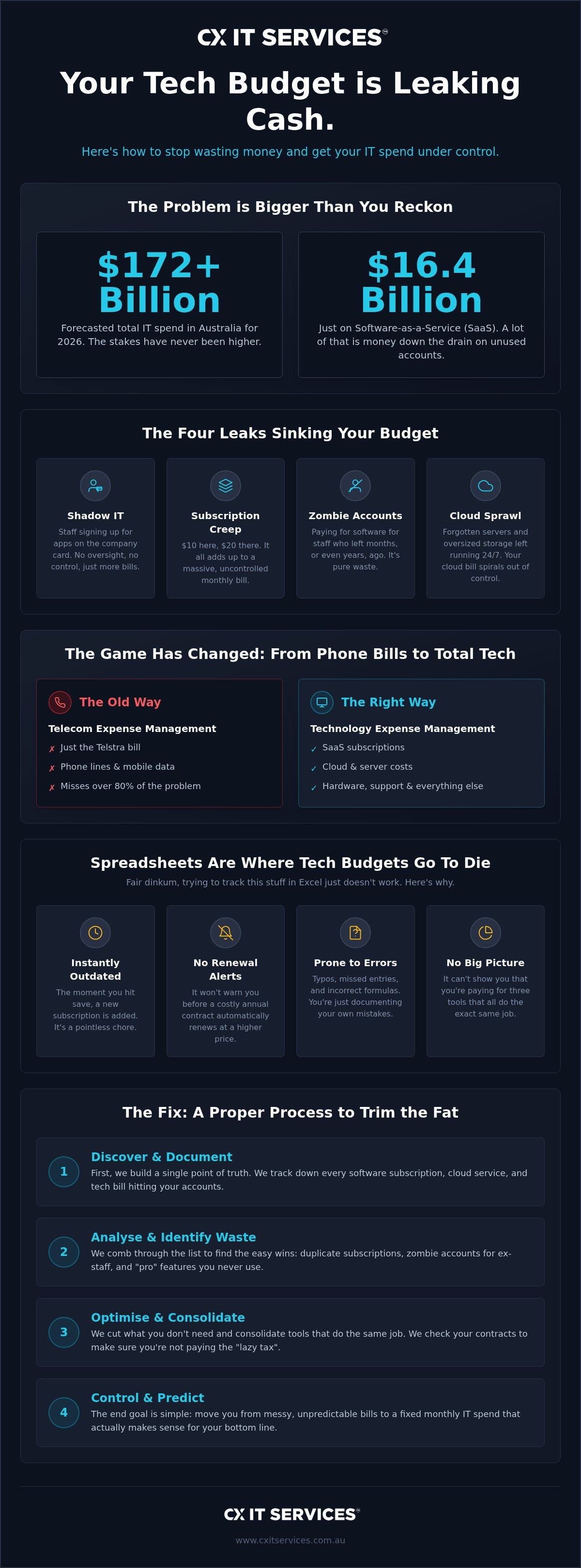
How CX IT Services corrals your technology costs
We don't just hand you a PDF report and walk away. Personally, I reckon that is the biggest load of rubbish in the IT industry. Identifying a problem is only half the battle. The real value is in the execution. We take full ownership of your Technology Expense Management because we know you don't have the time to chase vendors or audit cloud seats. No fluff. No corporate slop. Just results that show up on your balance sheet.
We act as your Virtual CIO to plan for the long term. This isn't just about cutting a few dollars off your phone bill this month. It is about building a three-year roadmap that aligns your tech spending with your business goals. We look at your Managed IT Support as a strategic investment rather than a black hole of costs. Our goal is to move you away from reactive firefighting and toward a model of quiet competence.
Our fixed monthly fee model is the ultimate antidote to the bill sprawl we have discussed. You get one predictable cost. It covers your management, your security, and your support. This transparency builds trust because we are in the same boat. If your tech is efficient, we both win. If your costs are spiralling, we haven't done our job. It is a partnership built on accountability.
Predictable spending for national teams
Managing a business with staff across different states is a logistical nightmare if your tech is fragmented. We provide a single point of truth for all your costs. One invoice. One point of contact. No hidden surprises at the end of the month. We use our national onsite support to audit physical assets in your offices. This ensures you aren't paying for hardware that doesn't actually exist. We manage the mess so you can focus on growth.
The 24/7 Safe Pair of Hands
With 26 years of industry experience, we have seen every trick in the book. We are Australian owned and operated, which means we actually understand the local market. Our 24/7 national support ensures we are there when things go wrong, no matter the time zone. We monitor your systems to prevent costly downtime before it even starts. Personally, I reckon it is the only way to scale a business in 2026. You need a partner you can trust. Not just another vendor. A safe pair of hands.
Take control of your digital bottom line
Personally, I reckon unmonitored tech spending is one of the fastest ways to erode your firm's profitability in 2026. We have seen how easily "zombie" services and unused licences can drain your cash. You can't fix this with another spreadsheet or a software tool you don't have time to use. You need a process. You need a partner who treats your budget like their own.
Effective Technology Expense Management isn't about cutting corners. It is about strategic oversight and knowing exactly where every cent goes. We have spent over 26 years helping Aussie businesses simplify their tech. As an Australian owned and operated team, we focus on providing fixed monthly fees for firms with 10 or more staff. We handle the mess so you can focus on your clients. No surprises. Just stability.
If you are tired of bill fatigue and want to see where the leaks are, it is time to act. Get your tech costs under control with CX IT Services today. You don't have to manage the complexity alone. Not alone. Together. We are here to help you build a more predictable, profitable future.
Frequently Asked Questions
What is the difference between TEM and ITEM?
TEM stands for Technology Expense Management and it focuses on the financial side of your tech, specifically billing, contracts, and usage costs. ITEM is IT Asset Management, which tracks the physical or digital life of the hardware and software itself. Personally, I reckon you need both to be efficient. While ITEM tells you where a laptop is, TEM tells you if you are being overcharged for the mobile data it uses.
How much can a business save with Technology Expense Management?
While every firm is different, Technology Expense Management can often uncover savings between 10% and 30% of your total tech spend. This isn't magic; it's just about cutting out "zombie" services and unused SaaS licences that have been racking up charges for months. By identifying these leaks early, you stop wasting money on tools your team doesn't actually use, which directly improves your monthly bottom line.
Does my business need a full-time IT manager for this?
You definitely don't need a full-time IT manager on the payroll to get your costs under control. Most Australian SMEs find it much more cost-effective to use a managed service provider or a Virtual CIO. This gives you access to high-level expertise and auditing tools for a fixed monthly fee. It's about getting the results of a seasoned expert without the massive overhead of a permanent salary.
What is Shadow IT and how does it affect my budget?
Shadow IT is when your staff sign up for apps or buy hardware without telling you or the IT department. It affects your budget because you end up paying for duplicate services across different teams. It's bloody expensive and creates massive security holes. We find that once you shine a light on these hidden subscriptions, you can consolidate them into a single, managed account that costs significantly less.
Can TEM software help with Microsoft 365 licensing costs?
It absolutely can. We use Technology Expense Management to identify Microsoft 365 seats that haven't been logged into for 30 days or more. Many businesses pay for premium E5 licences when a basic Business Standard licence would do the job just as well. Rightsizing these licences based on actual usage data is one of the fastest ways to lower your monthly cloud overheads without affecting productivity.
Is Technology Expense Management only for large corporations?
Not at all. While big corporations have used these strategies for years, SMEs with 10 or more staff often have the most to gain. Smaller firms usually don't have the time to audit every Telstra bill or software invoice. This makes them prime targets for "subscription creep." Managing your expenses is a survival skill for any growing business that wants to keep its overheads predictable and lean.
How long does a typical tech expense audit take?
A typical initial audit usually takes between two to four weeks to complete. This timeframe allows us to gather three months of historical billing data and map out your current inventory. It's not a "set and forget" job; it's a process. Once the initial leaks are plugged, we move into a monthly management rhythm to ensure new costs don't start spiralling out of control again.
What happens if we find billing errors from our carrier?
If we find a billing error, we take over the dispute process with the carrier on your behalf. You don't have to spend hours on hold waiting for an explanation. We provide the evidence, negotiate the credit, and ensure the refund is actually applied to your next statement. It's about having a safe pair of hands to handle the "boring but important" work of recovering your cash.