Uncover the hidden costs of in-house IT holding your Aussie business ransom. Learn to audit digital waste and switch to a fixed-fee model that works.
Paying for IT shouldn't feel like you're being held to ransom by your own server room.
Most Australian business owners I talk to are completely fed up with the "tech tax." They're tired of opening unpredictable invoices for reactive fixes that should have been prevented months ago. They're over the hidden costs of in-house IT that manifest as wasted hours when your best accountant is stuck troubleshooting a printer instead of billing clients. It's a drain on your culture and your cash flow.
I agree that it's exhausting to watch your margins get eaten by software licenses nobody uses and hardware that's past its use-by date. You need a system that stays upright and a budget that stays predictable. Personally, I reckon it's time to stop the tech-spend haemorrhage for good.
This article provides blunt, practical strategies to optimise your IT budget for 2026. I'll show you how to audit your digital waste and transition to a model where your technology finally starts paying its way. We're moving away from chaos and toward a structure that gives you more time to focus on your actual work.
Key Takeaways
- Stop paying for disasters. I'll show you why the reactive break-fix model is a financial scam that rewards providers when your systems fail.
- Kill the ghost licenses. Learn how to audit your Microsoft 365 and SaaS subscriptions to stop paying for staff who left months ago.
- Identify the 10-staff tipping point where the hidden costs of in-house IT, like six-figure salaries and lack of redundancy, start to cripple your margins.
- Automate the grunt work. I'll show you how to use AI for repetitive front-office tasks to reclaim billable hours for your senior team.
- Take back control of your cash flow. Switch to a fixed-fee managed model to ensure your monthly tech spend is 100% predictable.
Stop Paying the "Break-Fix Tax" on Your Business Operations
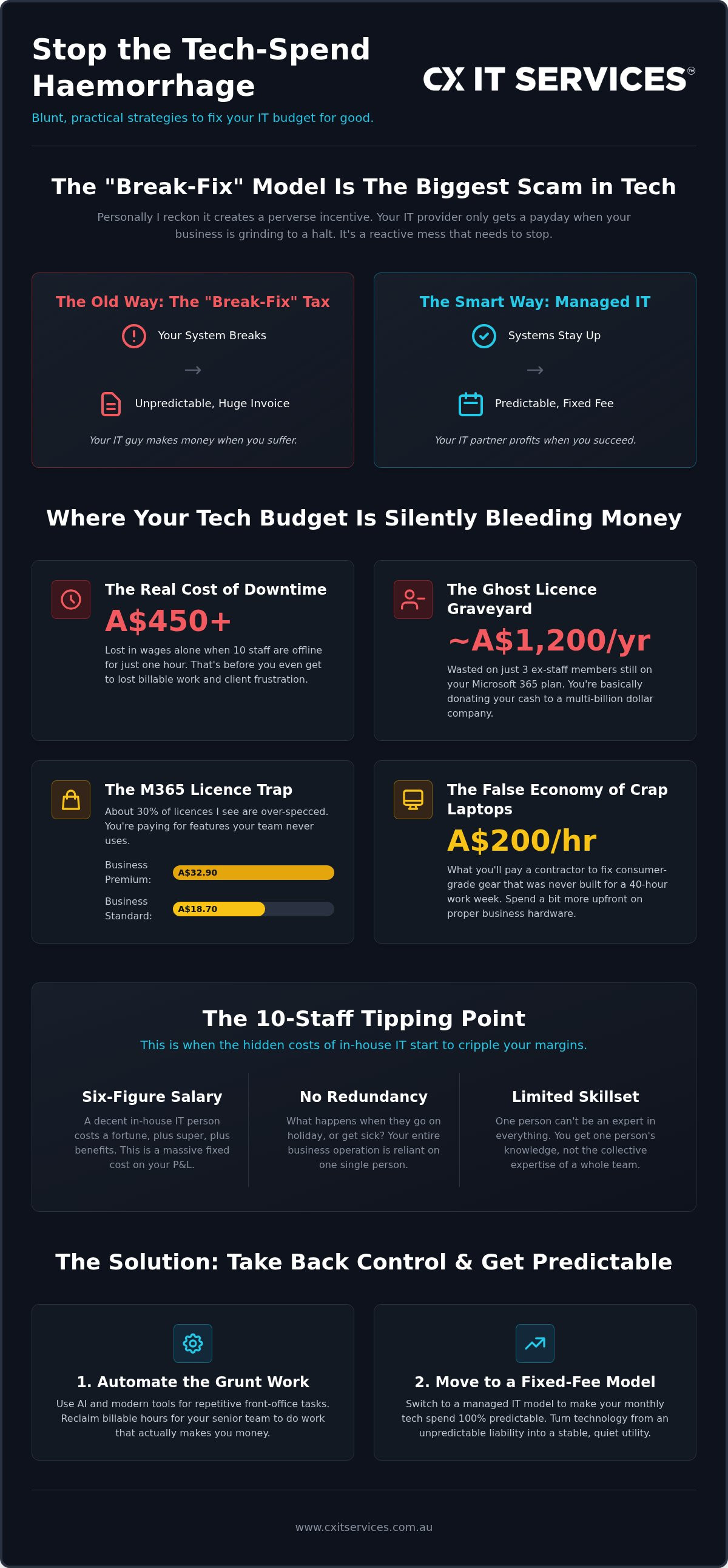
Personally I reckon the "break-fix" model is the biggest scam in tech. It creates a perverse incentive where your IT provider only gets a payday when your business is grinding to a halt. You pay when things break. Your IT guy makes money when you suffer.
This isn't a partnership. It is a reactive mess that keeps your Australian business stuck in the past while your competitors move forward. This dynamic creates what I call a "Break-Fix Tax" on your operations. To be blunt, the Break-Fix Tax is the hidden cost of reactive technology management. It is the silent drain on your bank account that never shows up as a single line item but eats your margin every single month. This is one of the most damaging hidden costs of in-house IT for a growing firm.
The Hidden Cost of Downtime
When your systems go down, the repair invoice is just the tip of the iceberg. You must look at the Total cost of ownership (TCO) of your technology to see the real damage. If ten staff members earning an average of A$45 per hour are offline for sixty minutes, you lose A$450 in pure wages alone.
Factor in lost billable hours and client frustration, and the true cost sky-rockets. Reactive IT is a productivity haemorrhage that costs far more than proactive maintenance. Switching to managed IT support ensures your systems are monitored 24/7. It turns technology from an unpredictable liability into a stable, quiet utility.
Why Cheap Hardware is a False Economy
Buying consumer-grade laptops from a local big-box retailer is a massive mistake. These machines aren't built for the 40-hour work week of a professional services firm. They lack the security features and the longevity required for serious business use.
One of the major hidden costs of in-house IT is the constant tinkering required to keep sub-par gear running. You end up paying an IT contractor A$200 an hour to fix a machine that should never have been on your desk in the first place. Spend a bit more upfront on business-grade hardware. You will save thousands on support costs over the life of the device.
Ultimately, sticking with a reactive model means you are constantly on the defensive. You are waiting for the next disaster instead of building for growth. Breaking this cycle is the first step toward a predictable budget and a more professional office environment. It is time to stop rewarding failure and start investing in stability.
Auditing the Invisible Leaks in Your SaaS and Microsoft 365 Subscriptions
Software bloat is the silent killer of the modern business budget. It is one of those frustrating hidden costs of in-house IT that slowly erodes your profit margins without anyone noticing. When a business lacks a dedicated strategy for its tech stack, subscriptions tend to accumulate like barnacles on a boat. Individually, they look small. Collectively, they can sink your monthly forecast.
I have walked into firms where they were still paying for the "Ghost Licenses" of staff who left months ago. It is a simple administrative failure, but it adds up fast. If you are on a Business Premium plan at A$32.90 per user each month, and you have three inactive accounts, that is nearly A$1,200 a year gone. You are essentially donating money to a multi-billion dollar software company for zero return. Audit your subscriptions every single quarter to keep the ledger clean.
The Microsoft 365 License Trap
Microsoft's pricing is designed to nudge you toward the top tier. But do you actually need it for every single person? Many Australian firms pay for Business Premium when Business Standard at A$18.70 per month would perfectly suffice for most of their staff. Personally, I reckon about 30% of the licenses I see in the wild are over-specced for what the user actually does.
If you have 30 staff and half of them don't need advanced device management or specific security features, you are overpaying by hundreds of dollars every single month. Consolidate your tools. Stop paying for Zoom and Slack subscriptions if your team is already using Teams. Professional Microsoft 365 management is about ensuring every dollar spent on a license is actually doing work for you.
Killing Off Shadow IT
Shadow IT is what happens when your staff buy their own apps because your provided tools are rubbish. They get frustrated with a clunky internal system. They sign up for a "free" trial of a third-party app with their corporate email. Eventually, that trial turns into a paid subscription on the company credit card hidden under miscellaneous expenses.
This creates a mess of overlapping functionality. You end up paying for three different PDF editors and two different project management boards. It is a security nightmare and a financial leak. Standardise your stack. Ask your team what they actually use to get their jobs done. Cut everything else. If you are worried about your current spend, you can book a strategy session to find and plug these leaks before the next quarter.
Standardising your tech stack doesn't just save on subscription fees. It reduces the time spent on training and support. When everyone is on the same page, things just work. That is the goal. Predictable systems and a predictable bottom line.
The 10-Staff Tipping Point: Why In-House IT Is Costing You a Fortune
Personally I reckon every Australian business hits a wall when they reach ten employees. Before that point, you can usually get by with a "DIY" approach or a tech-savvy staff member who fixes things on the side. But at ten staff, the complexity of your network, security, and data management explodes. This is exactly where the hidden costs of in-house IT start to bite your bottom line.
Hiring a full-time IT professional in Australia is a massive financial commitment for a small firm. If you want someone with enough experience to actually protect your data, you are looking at a six-figure salary. You also have to pay for their superannuation, sick leave, and the constant training required to keep their skills current in a fast-moving market. When that person goes on holiday or calls in sick, your entire technical support system vanishes. It is a single point of failure that no professional services firm can afford.
Salary vs. Subscription: The Cold Hard Numbers
Let's look at the actual data for 2026. The median salary for an IT Manager in Australia is A$145,000 per year, according to the Ignite Recruitment Salary Guide. Even an entry-level Support Officer commands a median of A$80,000. Once you add on-costs like payroll tax and office space, that one human is costing you a fortune before they even fix a single laptop.
Compare that against a fixed monthly fee for Managed IT Support. For a fraction of that A$80,000 salary, you get an entire team of specialists. You get 24/7 national support and a redundancy plan that doesn't depend on one person's health or holiday schedule. It turns a massive, variable labour cost into a predictable, manageable subscription.
Access to Strategic Leadership
Most internal hires at the SME level are "doers" rather than "thinkers." They are great at resetting passwords, but they often lack the "big picture" experience to plan your technology roadmap for the next three years. They get bogged down in daily fires and never have the time to look at how your systems could actually drive more billable hours. This lack of foresight is one of the most dangerous hidden costs of in-house IT.
A Virtual CIO provides the strategic leadership you need without the executive price tag. They help you avoid expensive tech mistakes, like buying legacy hardware that will be obsolete in eighteen months. You get senior-level advice on cybersecurity and infrastructure as part of your service. It is about having a safe pair of hands to guide your growth, ensuring your tech spend is an investment rather than just a drain on your cash flow.
Using AI and Automation to Slash Manual Labour Costs
AI is not just for writing funny poems or generating weird pictures. It is for saving real hours and reclaiming your team's sanity. In my experience, one of the most significant hidden costs of in-house IT is the failure to implement automation. If your expensive staff are still manually typing data from one spreadsheet to another, you are burning money.
Aussie firms are already leading the way. According to QuickBooks research from May 2026, 69% of Australian SMBs have adopted AI to stay competitive. These businesses aren't just playing with chatbots. They are using AI and automation to handle the heavy lifting in the back office, allowing their human talent to focus on high-value client work.
Automating the Repetitive Tasks
Look at your front office operations. Identify the tasks your team does every day that a machine could do faster and without making mistakes. Invoice processing and data migration are prime candidates here. Personally I reckon these manual workflows are a quiet tax on your growth that most owners simply accept as "the way things are."
They don't have to be. Implementing AI automation can save up to 10 hours per staff member weekly. That is over 500 hours a year per person. Imagine what your senior accountants or lawyers could do with an extra ten hours of billable time every single week. It is the difference between a firm that is treadling water and one that is scaling rapidly.
Modernising Your Communications
Old-school phone lines are another massive drain on the monthly budget. If you are still paying for traditional lines, you are overpaying for a legacy system that lacks flexibility. Switching to modern business phone systems like VoIP reduces call costs and eliminates the need for expensive hardware maintenance.
Hosted systems allow your team to work from anywhere without missing a beat. It turns a clunky capital expense into a lean, scalable operational cost. This modernisation removes the need for an in-house person to "wiggle the cables" every time a handset stops working. If you want to see exactly where your manual processes are leaking cash, you can book an automation strategy audit to find the gaps in your current setup.
By shifting these manual burdens to automated systems, you aren't just cutting costs. You are building a more resilient business. You are ensuring that your technology is an asset that drives revenue, rather than a legacy burden that requires constant, expensive babysitting.
Moving to a Fixed-Fee Managed IT Model for Predictable Growth
Variable costs are the absolute enemy of a healthy cashflow statement. If you are running a legal firm or an accounting practice, you need to know exactly what is going out of your account every month. The problem with the hidden costs of in-house IT is the sheer volatility they introduce to your ledger. One month everything is fine. The next month, a server decides to give up the ghost or a legacy system fails, and you are hit with a five-figure emergency repair bill.
A fixed monthly fee allows you to budget with 100% certainty. It turns your technology from an unpredictable gamble into a stable utility, much like your electricity or your rent. Personally, I reckon this is the only way to scale a professional services business without losing sleep. You stop worrying about the "what ifs" because the cost of maintenance and support is already baked into your operational expenses.
This model also fundamentally aligns your interests with your IT provider. In the old break-fix world, the provider made more money when things went wrong. In a managed model, we both want your systems to be bulletproof. If your system stays up, we are both winning. If it goes down, it costs us time and resources. That is the kind of partnership that actually drives growth rather than just managing decline.
The Peace of Mind of 24/7 Support
Knowing that help is just a phone call away reduces the baseline stress for your entire team. When a staff member is working late on a big case or a tax deadline and their system hangs, they shouldn't be left to figure it out themselves. Professional on-site support across Australia ensures that no matter where your office is located, you are never left stranded. It removes the "tech anxiety" that often plagues firms that rely on a single in-house person who might be out of range or off the clock.
Cyber Security as Cost Avoidance
I look at cyber security not as an expense, but as the ultimate form of cost avoidance. A data breach is the most expensive "unplanned cost" an Australian business can face in 2026. According to verified data from the ACSC, the average self-reported cost of a single cyber incident for a small business is now between A$46,000 and A$56,600. These are the ultimate hidden costs of in-house IT when security is handled as an afterthought.
Proactive cyber security management is significantly cheaper than paying a ransom or dealing with the fallout of a breach. It is about protecting your bottom line from a catastrophic event. By including advanced security in your fixed-fee model, you are insulating your business from the financial ruin that follows a successful attack. You are choosing the certainty of a monthly fee over the wreckage of a data breach.
Take Back Control of Your Tech Budget
You don't have to accept unpredictable invoices as an unavoidable cost of doing business. By auditing your software bloat and ditching the reactive "break-fix" model, you can finally stop the cash flow haemorrhage. The hidden costs of in-house IT often stem from a lack of strategic oversight, but a fixed-fee approach changes the game entirely.
It is about moving from a defensive posture to a proactive one. We bring over 26 years of Australian IT experience to your firm. Our fixed-fee models are designed specifically to eliminate the "Break-Fix Tax." We provide 24/7 national support for your growing team. We want your systems to work as hard as you do.
Personally, I reckon your time is too valuable to spend it troubleshooting legacy hardware or chasing ghost licenses. It is time to stop fighting your systems. Start focusing on your billable hours. Technology should be the engine of your growth, not the anchor holding you back.
Get a predictable IT budget with CX IT Services.
You've built a great business. Now let's make sure your technology actually supports the next stage of your journey.
Frequently Asked Questions
How much can a business save by outsourcing IT?
Most Australian firms save significantly by switching to a managed model. You eliminate the need for a full-time salary, superannuation, and office space. Personally I reckon the real saving comes from reduced downtime and better security. When your systems stay up, your staff stay billable. You aren't just saving on a paycheck. You are protecting your entire revenue stream from technical failures that usually plague unmanaged environments. It is a smarter way to handle growth.
Is managed IT cheaper than having an internal IT person?
Yes, managed IT is almost always cheaper for businesses with 10 or more staff. A single IT manager in Australia can cost over A$145,000 per year plus super and on-costs. For a fraction of that, you get a whole team of specialists available 24/7. You don't have to worry about sick leave or resignation. It is one of the best ways to avoid the hidden costs of in-house IT while gaining superior expertise.
What are the most common hidden IT costs for Australian SMEs?
The most common leaks are "Ghost Licenses" for staff who have left and "Shadow IT" where team members buy their own apps. You also pay a heavy "Break-Fix Tax" through lost productivity whenever a system fails. These costs are invisible on a standard P&L statement but they eat your margins. Regular audits and a proactive management plan are the only ways to find and plug these financial holes before they become a major issue.
Can I reduce my Microsoft 365 licensing costs?
Absolutely. Most firms are paying for Business Premium when Standard would suffice for many roles. You should also check for inactive accounts every quarter to stop paying for people who no longer work there. Personally I reckon about 30% of businesses are over-licensed. By matching the right plan to the right staff member, you can save hundreds of dollars a month. Consolidating third-party apps into the Microsoft ecosystem also slashes your total software spend.
How does AI automation actually save my business money?
AI automation saves money by reclaiming billable hours from repetitive, low-value tasks. If your team is manually processing invoices or migration data, you are wasting expensive talent. Automating these workflows can save up to 10 hours per person every week. This allows your senior staff to focus on high-value client work that actually grows your firm. It turns a labour-intensive back office into a lean, efficient operation that doesn't need constant manual intervention.
What is the risk of cutting my IT budget too deeply?
Cutting your budget too far creates a massive security liability. Cheap hardware and skipped updates lead to more downtime and higher repair bills later. The biggest risk is a data breach. A single incident costs Australian small businesses an average of A$46,000 to A$56,600. You aren't saving money if one attack can wipe out your annual profit. Smart cost reduction is about efficiency and better management, not just buying the cheapest gear you can find.
How do I know if my business has outgrown its current IT setup?
You have likely outgrown your setup if you are experiencing frequent emergencies or if staff are complaining about slow systems. If your current IT person is constantly underwater and never has time for strategic planning, you have hit the wall. Reaching ten staff is often the tipping point. At this stage, the hidden costs of in-house IT become too high to ignore. You need a more scalable, professional management model to protect your productivity.
Does a fixed monthly fee really cover everything?
A fixed-fee model typically covers all your day-to-day support, monitoring, and maintenance. It eliminates the surprise invoices for routine fixes. However, large-scale projects like a full office relocation or a major infrastructure overhaul are usually quoted separately. The goal is to make your monthly operational spend 100% predictable. It aligns your interests with ours. We both want your systems to stay stable and secure without constant tinkering or unexpected bills arriving in the mail.